Njal’s Saga: an introduction

Njal’s Saga. 13th c. manuscript page. Public domain.

Those who follow this blog have seen messages and photographs from Iceland over the last two weeks.  Mary and I spent a week there with Robert Bella Wilhelm and two other storytellers.  Several decades ago, Robert and his wife, Kelly, created “Storyfest Journeys” to lead small groups of people on “storytelling travel seminars.” http://www.storyfestjourneys.com

We discovered Storyfest Journeys in 1991 and spent a memorable week in west England and Wales on a themed trip, “The Quest for Arthur’s Britain.”  Since then we’ve joined the Wilhelms in Arizona and New Mexico for seminars on the folklore of the southwest and on desert spirituality while their trips to Iceland remained a “someday, maybe” fantasy.  Someday arrived this year.

This was Robert Wilhelm’s  seventh trip to Iceland.  Past seminars have focused on Icelandic and nordic storytelling in general, but Robert had always wanted to lead a seminar on Njal’s Saga.  He knew that such a specialized theme would result in a very small group, which was even smaller, because Kelly, who was teaching, couldn’t come.

Imagine a small group of lovers of myth and folklore, staying in a comfortable guesthouse with great food and lots of coffee, meeting to discuss a unique, 700 year old piece of literature, and then touring places where the events took place.  If that kind of travel appeals, check out the Wilhelm’s website.  In the first half of 2013, they are planning story-related trips to Hawaii, Arizona, the Orkneys, and Iceland again in May.

I tried to show some of the visual richness of Iceland in previous posts.  Now it’s time to focus on the saga.

***

The Icelandic word for saga means both “story” and “history.”  Forty Icelandic sagas are known, and Njal’s is the longest and most popular.  The events took place roughly between 970 and 1020 and were written down in the 13th century.  Njal’s Saga brings The Illiad to mind, but unlike the epic poetry of the ancient world, Icelandic sagas were literary creations from the start.  Single authors gathered the threads of shorter stories and oral histories and wove them into something new.  The sagas were read to an audience from manuscripts that were prize possessions of certain well to do families.  Nineteen early copies of Njal survive.

Several features resulting from the sagas’ origin and intention can surprise a 21st century reader.  Nail biting action adventure scenes are mixed with long genealogies and descriptions of who sat where at a certain banquet.  There are far too many characters and subplots for a contemporary novel.

The 13th century, when the sagas were created, was a period of strife for Iceland, with pitched battles that only ceased when the country submitted to Norwegian rule.  The sagas were written, in part, to affirm the Icelanders’ personal and national identities.  Many living then could trace their origin back to one of the first 400 settlers, so detailed accounts of the doings of their ancestors were always of great interest, in a way that won’t be clear to us at first.

Winter is the traditional time for stories, and in the depth of winter, southern Iceland gets only four hours of daylight.  In the northern part of the country, it’s three.  In the times described in the sagas, families and friends would gather to spend the winter together.  It’s not hard to imagine a dark hall, with people huddled around the charcoal fires, following the reader’s voice into another world, and as the narratives pace became familiar, I found myself settling into the story and understanding why Tolkien borrowed from the sagas in his creation of Middle Earth.

Here is what Robert Cook, translator of the Penguin edition, says in his introduction:

“In Njal’s Saga we read of battles on land and sea, failed marriages, divided allegiances, struggles for power, sexual gibes, malicious backbiting, revenge, counter-revenge, complex legal processes and peace settlements that fail to bring peace, not to mention dreams, portents, prophecies, a witch-ride and valkyries.  Behind all this richness lies a well-crafted story of decent men and women struggling unsuccessfully to control a tragic force propelled by persons of lesser stature but greater ill-will.”

Next: The characters, the structure, and the events of Njal’s Saga

Two hundred years of The Brothers Grimm

Statue of The Brother’s Grimm, Hanau Germany, by Syrius Eberle, 1895-96. CC-by-SA-3.0

In honor of the bicentennial of Children’s Household Tales (1812) by the Brothers Grimm, the University of Florida presents Grimmfest this month and next.  The university is home to the Baldwin Collection of Historical Children’s Literature, which features 2500 digitized children’s texts and a virtual exhibition of 19th century children’s book covers.

The Grimmfest page, http://www.clas.ufl.edu/cclc/fairy-tales.html, has links to other fairytale resources, including related contemporary books and movies.

Grimm’s Fairy Tales, 1865 cover. Public domain.

“Traditional fairy tales have their roots in our oldest stories, in myths and legends, in those primal tales that were formed when human beings first began to speak…However we may wish to define fairy tales, they remain an inescapable part of our psyches and our cultures.  They are why we celebrate the underdog, and secretly acknowledge “The Ugly Duckling” as our own autobiography.  Through their flights of fantasy, fairy tales set us free to seek our happiness, to follow our bliss — if only for the few minutes we are enfolded in a particular tale.”

This is a marvelous resource for anyone wishing to delve into the roots of the stories we love.

The Legacy of Joseph Campbell on billmoyers.com

Twenty-five years ago, Bill Moyers and Joseph Campbell filmed a groundbreaking series that opened the world of myth, story, and folklore to a large audience.   The Power of Myth series was completed in 1987, shortly before Campbell died at the age of 83.  It aired the following year on PBS, and you still sometimes find it replayed during pledge drives.  The companion DVD set and book are still in print.

To commemorate this anniversary, Moyers has loaded podcasts of the first two sessions – “The Hero’s Adventure,” and “The Message of Myth” on his website. http://billmoyers.com/2012/08/10/celebrating-the-legacy-of-joseph-campbell/

If you’ve never seen this series – or even if you have – grab some popcorn and fire it up on your largest monitor.  This wonderful introduction to key stories from around the world was filmed at George Lucas’s Skywalker Ranch.  Lucas was a serious student of Campbell, who structured the first Starwars trilogy around the hero myth.

Almost anything I have to say about myth and folklore is influenced by Campbell.  In these final interviews, he distills a lifetime of study into a clear but powerful series of tales and observations that forever changes one’s view of the great stories of humankind.

Notes on Imagination and James Hillman

Here’s my dilemma:  it’s impossible for me to write about imagination without mentioning James Hillman.  Yet every time I’ve started a post on Hillman, I’ve given it up because the scope of his thought and writing, over almost 50 years, is just too vast.  Hillman died last October at 85 and a two volume work on his life and thought is underway.  Two volumes might not be enough.  So what can a blog post accomplish?  We are about to find out.

James Hillman

Three days after Hillman’s funeral, his friend, Thomas Moore, wrote, “James’s many books and essays, in my view, represent the best and most original thought of our times. I expect that it will take many decades before he is truly discovered and appreciated.  He changed my life by being more than a mentor and a steady, caring friend. If I had to sum up his life, I would say that he lived in the lofty realm of thought and yet also like one of the animals he loved so much. He was always close to his passions and appetites and lived with a fullness of vitality I have never seen elsewhere. To me, he taught more in his lifestyle and in his conversation than in his writing, and yet his books and articles are the most precious objects I have around me.”

Hillman, who served as Director of Studies at the C.G. Jung Institute in Zurich, will be remembered with Freud and Jung as one of the most original psychological thinkers of the 20th century, yet his appeal may be greater outside that discipline than it is with traditionalists in it.  He never pulled his punches.  In 1992 he co-authored, We’ve Had a Hundred Years of Psychotherapy and the World is Getting Worse.  In an interview published a year earlier, he said:

“By removing the soul from the world and not recognizing that the soul is also in the world, psychotherapy can’t do its job anymore. The buildings are sick, the institutions are sick, the banking system’s sick, the schools, the streets – the sickness is out there. … The world has become toxic. … There is a decline in political sense. No sensitivity to the real issues. Why are the intelligent people – at least among the white middle class – so passive now? Why? Because the sensitive, intelligent people are in therapy! …Every time we try to deal with our outrage … by going to therapy with our rage and fear, we’re depriving the political world of something. And therapy, in its crazy way, by emphasizing the inner soul and ignoring the outer soul, supports the decline of the actual world.”

Let me say it again:  those statements were made in 1991.

During the late 80’s, Hillman joined Robert Bly and Michael Meade in presenting a series of conferences exploring the myths and archetypes of the male psyche.  Bly’s, Iron John came out of that work, as did Hillman’s and  Meade’s concern with the genius within, (see my previous post).  This was the subject of Hillman’s, The Soul’s Code, 1997, the first and only one of his books to become a bestseller.  In it, he suggested we come into the world with a calling or destiny, the way an acorn carries the pattern of a mature oak.  Our mission in life is to realize this deeper purpose.

***

An editor once rejected an articles of Hillman’s, saying it would set psychology back three-hundred years.  Hillman said that was exactly what he was trying to do.  Soul and soul-making were his constant concerns, but not as the words are used in modern terms.  He often quoted Keats who said, “Call the world if you please, ‘The vale of Soul-making.’  Then you will find out the use of the world…”  He also repeated a fragment of Heraclitus, “You could not discover the limits of the soul, even if you traveled every road to do so; such is the depth of it’s meaning.”

Hillman did more than offer poetic metaphor; his goal was nothing less than a return to an earlier, three part formulation  of the human person, embraced by the ancients but lost to modernity.  People in earlier times conceived of soul as an intermediate faculty that inhabits an imaginal realm between the physical world of body and the disembodied heights of pure spirit.  Imaginal not imaginary, a disparaging term which suggests that soul, vision, dream, and myth are not real.  In his key work, Revisioning Psychology, 1975, he said:

“First, ‘soul’ refers to the deepening of events into experiences; second, the significance soul makes possible, whether in love or in religious concern, derives from its special relation with death.  And third, by ‘soul’ I mean the imaginative possibility in our natures, the experiencing through reflective speculation, dream, image and fantasy – that mode which recognizes all realities as primarily symbolic or metaphorical.”    

Another key point Hillman makes is the primacy of image in the life of the psyche:  Speaking of Jung he says:

“He considered the fantasy images that run through our daydreams and night dreams, which are present unconsciously in all our consciousness, to be the primary data of the psyche.  Everything we know and feel and every statement we make are all fantasy-based, that is, they derive from psychic images….Every notion in our minds, each perception of the world and sensation in ourselves must go through a psychic organization in order to ‘happen’ at all.  Every single feeling or observation occurs as a psychic event by first forming a fantasy-image.” 

***

At the start of this post, I wondered what I could say in a brief article about a prolific and protean thinker like James Hillman.  Inspire someone to learn more, I hope.  A good place to begin is A Blue Fire, a collection of key writings, edited by his friend, Thomas Moore.

Here are some noteworthy links:

The New York Times obituary:  http://www.nytimes.com/2011/10/28/health/james-hillman-therapist-in-mens-movement-dies-at-85.html?_r=1

“On Soul, Character, and Calling” by Scott Landon, published in The Sun, July, 2012: http://www.scottlondon.com/interviews/hillman.html

A tribute by his friend, Michael Ventura, a journalist, who asks, “What do you say about an intellectual genius who learned to tap dance in his 60s?”   http://www.austinchronicle.com/columns/2012-01-13/letters-at-3am-james-hillman-1926-2011/

A remembrance by Thomas Moore: http://www.huffingtonpost.com/thomas-moore/james-hillman-death_b_1067046.html

I have more to say, but this is enough for now.  I’ll end with a message Hillman sent to his friends during the last few weeks of his life, when he finally became too ill to work:   

“I am dying, yet in fact, I could not be more engaged in living. One thing I’m learning is how impossible it is to lay out a border between so-called ‘living’ and ‘dying’.” 

I think Moore is right – it will take decades to fully appreciate the scope of Hillman’s life and work, but there’s no reason not to begin right now.

Fairytales for Midlife

Joseph Campbell’s groundbreaking series, “The Power of Myth,” broadcast on PBS in 1988, sparked a tremendous interest in myth and folklore.  A number of fine studies followed during the next few years.  One of my favorites was a series of books on fairytales by Allan B. Chinen, a San Francisco psychiatrist.  In his second book, Once Upon a Midlife, 1992, Chinen discusses stories about the problems and tasks that face us in middle age, “when the Prince goes bald and the Princess has a midlife crisis.”

once upon a midlife

Of the 5,000 fairytales from around the world that Chinen reviewed, 90% were “youth tales,” aimed at young people trying to find their place in the world.  The protagonists leave home, struggle to find their courage, fall love, find a treasure, and come into their kingdom or find a job.  Chinen calls the other 10%, “middle tales.”  The focus is middle-aged men and women, “juggling the demands of family and work, grappling with self-doubt and disillusionment, and ultimately finding deep new meaning in life.”

Allan Chinen

The first of the middle tale themes Chinen explores is “the loss of magic,” embodied in the German tale of “The Elves and the Shoemaker.”  Youthful protagonists thrive when they locate a source of magic; they lose it only if they are mean or greedy.  In middle tales, the magic fades in the course of living.  At some point, we realize we’re not going to write the Great American Novel; we don’t have an unlimited number of do-overs left; we don’t have the skill or the energy to realize all of our youthful dreams.  What is left?  If we listen to the stories, Chinen says, we begin to see other roads between the extremes of naiveté and despair, roads that leads toward renewal.

The next theme is “reversals,” often involving men and women dropping traditional gender roles.  The headline in this week’s newspaper Arts & Entertainment section was, “The Era of the Empowered Princess.”  That may be the theme in Hollywood, but not in traditional “youth tales.”  Where the emphasis is socialization, stories all over the world  praise traditional roles.  Things change in middle tales.  Men sometimes say, “To hell with work,” or quit the army, while women grow more assertive and often save the day, as in “The Wife Who Became King,” a story from China.

The third middle tale theme is a new awareness of death and evil.  Youth stories don’t dwell on either one; bad things happen to others, “out there.”  Dragons die, bad sorcerers die, and sometimes evil step-mothers, but never the hero or heroine, and neither of them are evil.  In middle tales mortality gets personal.  Evil gets personal too; no longer does it simply lie “out there.”  The expansiveness of youth gives way to the psyche’s need for wholeness, which means we have to “confront the shadow,” the darkness we carry within.  The best stories, honed by generations of telling, lead us to realizations by the path of wisdom and by the path of humor.  In “The Tell Tale,” a Japanese story, a woodcutter spies his wife in the arms of a pawnbroker.  At first he is seized by a murderous rage.  Rather than kill his wife and her lover, he concocts a ridiculous story and uses it to trick his wife, humiliate the pawnbroker, and makes enough money to live with his wife in comfort – and fidelity – for the rest of their days.  There is far more of the trickster than the knight-in-shining-armor in these stories.

The final middle tale theme in Once Upon a Midlife is renewal, which in these stories, most often involves descent to the underworld.

“Stripped of all their defenses, individuals come face-to-face with the core of their being.  There they find a primordial source of life, beyond conventional notions of good and evil, male and female.  Whether understood as the inner Self, or God, or the life force, this primal source helps men and women reforge their lives…[they] emerge from their suffering with deep healing – and the ability to heal others.”

To anyone interested in the interpretation of folklore, I recommend this page which lists all of Allan Chinen’s books.

Swan Maidens and Fairy Lovers, Part 2

It’s good to know that glasses can help us drink.  The problem is, we don’t know the purpose of thirst. – Antonio Machado

I hope I didn’t create the impression that I have any solid answers to the questions The Bride of Llyn y Fan Fach raises. Just “hints followed by guesses,” to quote T.S. Eliot.

In stories of this type, from all over the world, beautiful Otherworld women enter the lives of mortal men and then leave.  It’s not too great a stretch to imagine they represent the beauty, the love and fulfillment, the joy and intensity we long for in the world, but usually find to be fleeting.  The occasion for the lake woman’s departure is a tap on the shoulder that counts as a “blow.”  In a literal sense, this is absurd.  I take it to mean that the radiance of the Otherworld is like a spectacular sunset:  it illuminates our world but does not endure.  If it hadn’t been a tap, it would have been something else.  Perhaps as T.S. Eliot said, “Human kind cannot bear very much reality.”

Renunciation is not giving up the things of this world, it’s giving up the idea that they last – a Zen master.

Traditional fairytales are not linked to specific dates and places, but this one is.  This indicates a modern sensibility shaping the story pattern, and it seems especially clear in the lake woman’s belief that the world is a veil of tears.  The usual fairytale heroine does not cry at weddings, where people are “entering trouble,” nor does she laugh at funerals where people are “leaving their troubles.”  Her legacy is the gift of healing to help alleviate suffering.

In the lake woman’s view, this world is not our home, but while we are here, compassion is the highest virtue.  This sentiment could have come from Celtic Christianity.  It is also very eastern and reminds me of the theory that the Celts are linked, by diffusion, with the Aryan warriors of India.  Either way, this is a very different world from the Cinderella tales or stories like The Water of Life which suggest you can find your prince or princess and live a happy life together.

And you know the sun’s setting fast, And just like they say, nothing good ever lasts. – Iris DeMent

At the opening of this story, we learn that the young man’s father “died in the wars.”  The dates vary in different texts. One says the end of the 12th century, and others, the 13th century.  The latter date would coincide with the conquest of Wales by Edward Longshanks, the villain in Braveheart.  Edward invited all the bards in Wales to a council and had them killed, understanding that a nation without stories ceases to be a nation.  What Longshanks didn’t understand was that Celtic stories survive wherever there is a pub, a hearth fire, or a quiet country lane, yet I think the sadness of a conquered people infuses the story.

We know there is another world.  The question is, how far is it from midtown and how late is it open? – Woody Allen

Twenty years ago, Mary and I travelled with a small group of storytellers on a tour called, “The Quest for Arthur’s Britain.”  Our guides were a remarkable couple, Robert Bella Wilhelm and his wife, Kelly, who have devoted their lives to storytelling and the sacred.  I’m happy to say they are still at it.  You can check out their website for details on storytelling trips to the Orkney Islands in May, to Iceland in September, and to Hawaii in Jan., 2013:  http://www.storyfestjourneys.com/

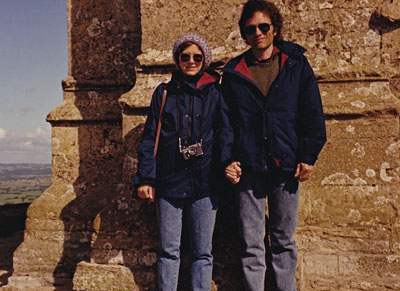
On Glastonbury Tor, Sept., 1991

We spent the last days of this journey at an Elizabethan manor house in the Black Mountain foothills, not too far from Llyn y Fan Fach.  It was one of a very few times in my life that I heard no traffic sound at night and saw no lights of a city.  When the moon was down, it was pitch black.  You could see the shapes of trees against the stars, but little else.

One night I strolled to the end of the yew walk.  The lights from the manor were hidden.  No light, no wind, no sound.  That alone was uncanny, but there was something more.  My Jungian training, which had taught me to understand spirits and fairies as archetypes of the psyche, vanished in a visceral rush of ice down the spine.  Part of me wanted to know what lay beyond, out in the open fields, but I couldn’t bring myself to take another step.  The hair on my neck stood up until I got back to the manor.

Do I believe in other worlds?  I did that night, and I think I do still.  I’m glad I knew the old stories and their lesson:  as human beings, this world is our home, for good or ill.  The peril is very great – too great – for those who venture too close to any other.

Swan Maidens and Fairy Lovers, Part I

When I was an active storyteller, I loved to tell one of the best known legends of Wales.  It’s found in many collections under various names, most often, “The Bride of Llyn y Fan Fach.”  Variations of this story are found all over the world.  A mortal man marries an Otherworld woman who breaks his heart, but sometimes brings marvelous children into the world.

Llyn y Fan Fach and the Bannau Sir Gaer by Rudi Winter. CC by-SA 2.0

I’ve started to write about this legend on other occasions, discarding drafts that rapidly grew beyond the scope of a blog post or two or three.  What prompted me to begin again was a visit to Barnes & Noble.

Barnes & Noble knows what sells.  An entire row is now filled with “Paranormal Romance.”  The covers feature illustrations of winsome teenage girls.  The genre isn’t new; Charles de Lint, a Canadian author, has written stories like this for thirty years.  The popularity is new, and almost all of today’s novels invert the usual folklore setup, in which a mortal man meets a fairy woman.  Not only that, but the odds of a happy ending in these tales are worse than the chance of hitting a single number at roulette.

The Swan Maiden

The Swan Maiden is the most widespread “mixed marriage” type of folktale.  It is also considered the most primitive, since the Otherworld woman’s native form isn’t human.  Usually it’s a bird.  Swan maiden stories are found all over Europe, as well as the middle east, Russia, India, China, and Japan.  There’s a parallel water buffalo woman story in Africa.  According to one researcher, the motif is 30,000 – 40,000 years old, as shown by a bison-woman cave painting.

In swan maiden tales, a man sees a flock of swans glide to earth at night.  Removing their swan robes, they change into beautiful women who bathe or dance together.  Enamored of one in particular, the man takes her robe so she won’t fly away, and eventually persuades her to marry him. Later they have children.  One day the swan-wife hears her children sing of where her husband has hidden the robe, or they tell their mother when they see her in tears.  The swan maiden puts on her robe and flies away forever, leaving the children with their father.

The Welsh Stories

I have a passion for Celtic stories, and those from Wales in particular, but Celtic fairies seldom give a mortal a break.  They put out a Scottish woman’s eye simply because she could see them.  When Thomas the Rhymer succeeded in pleasing the fairy queen for seven years, what did she give him as a reward?  A tongue that could only speak the truth!  Think about how that would serve you at work.  No mystery about why Thomas never married – “Does this make me look fat?”

In Welsh mixed-marriage tales, a mortal man wins the hand of a fairy wife who agrees to stay with him under certain conditions.  They have children, the husband accidentally breaks a condition, usually by touching his wife with iron, and she leaves.  He never sees her again, though she sometimes slips back to visit her children, whose descendants are beautiful and wise.  Here is the best of these stories:

The Bride of Llyn y Fan Fach

At the end of the 12th century, a young man lived with his mother, a war widow, in Carmarthensire in Wales.  Every day he drove their small flock of cattle to the lonely tarn known as Llyn y Fan Fach.  The cows preferred the grass there to any other pasture.

Llyn y Fan Fach, copyright Stuart Wilding, licensed for reuse CC by-SA

One morning, the man (who isn’t named in the tale) beheld a beautiful woman sitting on the water combing her hair.  All he had to offer was a bit of bread, but he walked to the shore and held it out.  She glided over the water and said, “Hard baked is thy bread.  Hard am I to hold.”  Then she dove under the waves.

Unable to think of anything else but her, he brought unbaked dough the next day.  She appeared at noon, glided to the shore, and said, “Unbaked is thy bread.  I will not have thee.”

The lady combs her hair on the water

The third time, the bread was just right.  The lady gave her assent and her father offered a sizable dowry of cattle, goats, and horses, after the young man agreed to one condition – his wife would leave him if he struck her three blows without cause.

Things went well at first, and they had three sons.  Then one day the couple was to attend a christening.  The lady delayed getting ready.  She sent her husband back to the house for her gloves, saying she would saddle the horse.  When she didn’t do so, the young man playfully tapped her on the shoulder with the gloves.  “Not ready yet?”

“Be more careful,” she said.  “For you have just struck the first blow without cause.”  [This incident echoes other stories where the husband touches his fairy wife with an iron bit while bridling a horse, but that detail is missing here.]

A few years later, at a wedding, the wife burst into tears.  The husband tapped her shoulder and asked why she wept.  “I weep for this couple who are now entering trouble,” she said.  “Be careful, my love, for your trouble draws closer.  That was the second blow without cause.”

The man stayed vigilant, and things went well for several more years.  Then one day his wife burst into laughter at a funeral.  He tapped her on the shoulder again and asked why she laughed.  “I laugh because this man has left a world full of trouble,” she said.  “But now your trouble is here.  Farewell, my husband.  You have just struck the third blow without cause.”

Ignoring his protests, she marched to the lake, and all her father’s animals followed.  A pair of oxen dragged a plow six miles to the lake, and the furrows can be seen to this day.  Of the unfortunate husband, we know nothing more.  Longing for their mother, the three sons went to the lake at night and she appeared.  “You are to be of help to the world,” she said.  “I shall instruct you in the arts of medicine.  You and your descendants will be great and skillful physicians.  Whenever you need my advice, I will appear.”

In time, they became the personal physicians of the Prince of South Wales.  The legend of the Bride of Llyn y Fan Fach comes from a book called The Physicians of Myddvai, 1861, by a Welsh printer named Rees.  The Welsh Historical Society has herbal recipes attributed to the lake woman’s descendants, and the last of the line, Dr. C. Rice Williams lived into the 1890’s.

***

What do we make of a story like this?  First, we can recall Marie-Louise Von Franz’s comparison of myth and folklore. The great myths and legends tend to be more polished.  Their plots are coherent enough to satisfy modern demands.  In contrast, folktales are more primal and more opaque.

One unique feature of this tale is the specificity of location and the lake lady’s descendants.  Greek families traced their ancestry to the heroes of Troy, and my mother had a coat of arms dating back to the Normal Conquest.  A similar dynamic is one explanation for the unique segue of this fairy tale into history.

The real mystery for me has always been, why is the husband is doomed from the start?  Who would count a shoulder tap as a “blow?”  Why do mortals never win when they give themselves to Otherworld lovers?

I’ve asked myself why since the day I found a book of local fairytales in a used bookstore in Wales on a visit 20 years ago.  Though I don’t have certain answers, I have some thoughts which I will offer next time.  Meanwhile, does anyone else have any ideas?  Why would the girl’s father set an impossible condition, and why would she actually leave over such a minor slight when the text says she really loves her husband?  I welcome any suggestions you may have.

The Water of Life, Part 2

If you have not already done so, please read the first part of this article in the preceding post.

The Water of Life by Rogasky and Hyman, 1991.

Marie-Louise von Franz, a close colleague of Carl Jung, wrote extensively of fairytales.  She believed that these “simple” stories reveal the core of the psyche better than the great myths and sagas, shaped by poets and spiritual thinkers.  Reading these tales with the same respect the young brother shows the dwarf can reward us with nuggets of wisdom shaped by generations of storytellers sitting beside the hearth fire.

The opening of The Water of Life reminds us that when we don’t know the way, it pays to admit it, at least to ourselves.  We need to pay attention to everything, listen to everything, for we don’t know the shape of the messenger who may show us how to proceed.  Here is the rest of the story:

The dwarf told the third son where to find the castle where The Water of Life flowed.  He gave the prince an iron wand to open the gates, and two loaves of bread to appease the lions who guarded the entrance.

The third son throws the loaves to the lions

In the great hall, he found men turned into stone.  As he left the hall, he spotted a sword and another loaf of bread and picked them up.  Venturing on, he met a beautiful woman who welcomed him.  She said he had set her free. “This realm will be yours and all the enchantments broken if you return in a year to marry me.”

The woman directed him to the Fountain of Life and urged him to leave with the water before the clock struck noon, when the gates would close again. The young man hurried on until he came to a room with a freshly made bed.  Realizing how tired he was, he settled down for a nap.  He woke at quarter to twelve, and just had time to find the fountain, fill a cup with The Water of Life, and race back to the gate.  As it swung closed, it sliced off a piece of his heel.

The dwarf was waiting and told him the sword would defeat any army, and the loaf would feed any multitude and never be diminished.  The young prince then begged the dwarf to free his brothers.  The little man said to forget them, his brothers would only betray him, but he gave in at last to the younger brother’s pleading.

On the way home, the brothers passed through three kingdoms plagued by war and famine, and the youngest used his sword and loaf to save them.  At the same time, he told his older brothers about his success and his betrothal to the Lady of the Fountain.  Before he could give his father the Water of Life, the older brothers swapped it for sea water, which made the king worse.  The older pair then gave the king the true healing draught and claimed the young brother had given him poison.  The king ordered a huntsman to kill his youngest son in the forest, but the huntsman could not bring himself to do it.

The kingdoms the young prince had saved sent riches by way of thanks, and the king began to reconsider.  As the year drew to a close, the Lady of the Water had the road to her castle paved with gold.  She ordered her servants to chase off anyone who walked up the side of the road but welcome the one who strode up the center.  The two older brothers, anxious not to scuff the precious metal, walked beside it and were driven away.  The young prince, able to think of nothing but his love, had no care for gold and walked up the middle of the road.  

The Lady of the Fountain. Detail of an English tapestry

The Lady ran out to meet him.  He became Lord of her realm, freed all the frozen men, and reconciled with his father.  The two older brothers sailed away and were never seen again.

***

If the start of the tale presents a fairly clear dynamic, what follows is more obscure.  The question of how and when to interpret folklore goes far beyond the scope of one or two blog posts.  Folktales may be more primal than myths, as Marie-Louise von Franz suggests, but they leave more open questions.  I tend to follow James Hillman’s advice – “stick with the image.”  When scenes in movies and books, or events in our lives leave us puzzled, we may turn them over in memory and imagination for years without rushing to ask what they “mean.”  In doing so, we let them nourish us without draining their power by settling for simple answers.

For instance, the Lady of the Water of Life gives the youngest son clear instructions to find what he came for and get back through the gates before noon.  So what does he do?  Hits the sack when he spots a bed.  Strange behavior for a lad who has gotten as far as he has through doing what he’s been told.

I’ve come to believe the bed is another trial on the way to the Water of Life.  It took warrior courage and dwarf tricks to get by the lions guarding the gates.  Here the trial is staying awake – not always easy in life.  At the wrong time, if you “look neither right nor left,” you miss the chance of renewal.  At the right time, it’s essential.  If the prince hadn’t made it out by noon, I believe he would have turned to stone like the others in the courtyard.  There is nothing in this text to support this a view; my opinions are based on other stories.  One is a fuller account of stone people in a tale from The Arabian Nights.  The other is a trial-by-bed that Sir Gawain undergoes on a mysterious “Isle of Women.”  When he succeeds, he too becomes the champion of the Otherworld queen.

Such hunches are tentative and subject to change.  It isn’t answers but wrestling with the questions that draws my imagination again and again to this kind of story.

*** 

Two decades have passed since I found The Water of Life, and since then, “Look for the dwarf by the side of the road,” has become something I tell myself every time I’m stuck.  Such renewal is open to everyone – it’s our birthright, though certain attitudes, embodied in the older brothers, will chase inspiration away.  Older brothers pretty much run the world:  they are the movers and shakers, the ones who get things done, which means they keep going even as the walls close in.

That’s one reason I love blogging.  It’s an excuse to discover and celebrate people who talk with dwarves:  those who build little libraries.  Those who buck the trend and open small bookstores.  Those who publish their own books, in the grand tradition of Walt Whitman, who initially sold his poems door-to-door.  People, in other words, who try to occupy their own lives, which is what this story is really about.

A world where the Water of Life flows is filled with individual acts of courage.  A world where the waters are choked off looks very different, for as Michael Meade observes:

“There is something incurable in this world that makes the soul long for the healing and beauty of the otherworld.  Each visit to the other realm requires stopping the business and busy-ness of the daily world in order to listen to the questions being asked from the inner-under-other sides of life…Unless the inner voice and the little people are heard from again, the world will continue to drain of meaning and will keep turning a cold heart to the immensity of human suffering.”