Structure in Folktales, continued

Red Riding Hood, by Gustave Dore

In my last post, I said I was going to review some folktales to see if any conventions of the “three act structure,” used in contemporary fiction and cinema, apply.  Lest I be accused of hubris, I did not say I was going to be systematic about this.  My qualifications are simply a lifetime of love for this stuff.  Here are a few random observations.

The first thing I noticed – and I should have expected this – was the apples and oranges nature of my comparison between long fiction and short, between modern novels and screenplays and the kinds of tales you find in Grimm and other folklore collections.

Some longer epics do mesh with the three act structure.  In Homer’s Iliad, plot point #1 is Paris taking Helen to Troy, and plot point #2 is the Trojans wheeling the horse into the city – this is how the 2004 movie, Troy, is structured too.  It seems the three act structure only really fits longer fiction.  This leads to the question of whether the concepts apply to short fiction at all and to folktales in particular.

Every one of the folktales I reviewed has what Syd Fields called, an “inciting incident,” an event or situation that sets the action in motion.  The king is sick, the princess is missing, a dragon is loose on the land.  Often this is right where the tale begins, without any other preamble.

In terms of the major plot points, most of the folktales I looked at only have one.  Some have two and a few do not have any.  Are there any plot points, in the sense of a major crossroad, in the tale of Red Riding Hood?  Not really.  The unfortunate girl obeys her mother – “Take this basket to grandmother” – and events roll on to their unfortunate conclusion.

Cinderella has a single plot point.  The fairy godmother asks, “Do you want to go to the ball?”  When Cinderella says yes, her happy fate unrolls like destiny.

Cinderella by Edmund Dulac

Another common folktale set up has just one decision point:  three brothers or three sisters set off on quest.  Each of them meets an “insignificant” or repellant creature as they set out.  The older siblings are arrogant and come to an unfortunate end.  The younger sibling behaves with respect, and the creature’s advice and boons are key to fulfilling the quest and often finding love and riches as well.

A Grimm’s fairytale, “The Water of Life,” is a good example.  The king is sick and only the water of life will heal him.  Two brothers set out, but disparage an “ugly little dwarf” who offers advice.  They wind up stuck – literally – in a mountain pass.  The youngest brother, who is open to help, receives it in abundance, both for the immediate quest and in overcoming the treachery of his brothers later on.  Although the action is rather complex, the only real decision the brothers face is whether or not to befriend the little man at the side of the road.  That choice determines their fate.

Beauty and the Beast by Warwick Goble

Some stories with two plot points echo the three act structure.  An example is, “The Pedlar of Swaffham,” which I discussed here a year ago:  http://wp.me/pYql4-85.  A poor pedlar in the English village of Swaffham dreams he will find gold if he travels to London Bridge.  Unlike most people who do not act on their dreams, he decides to go (plot point #1).  He spends three days waiting fruitlessly.  His decision to stick it out, to believe in his dream, is the second key plot point and is rewarded when a shopkeeper asks what he’s doing.  When the pedlar tells him, the shopkeeper says dreams are a lot of foolishness:  “Why just last night I dreamed of a bag of gold under the peddlar’s oak in the village of Swaffham, wherever that is, but you don’t see me running all over the countryside, do you?” 

A story like this seems so modern in it’s emphasis on trusting oneself and following dreams, it may be surprising to know that Rumi recorded the first version 900 years ago.  In other variations, the poor man travels to Baghdad, Jerusalem, or Krakow.  Still, in conforming (sort of) to the three act structure, “The Pedlar of Swaffham” is the exception and not the rule.

*** 

Every story has a beginning, middle, and end.  How long the sections are and how we move between them is the province of structure.  If you’ve ever heard a good storyteller, you’ve seen them adjust the pacing to match the mood of the audience.  You’ve seen gesture, expression, and silence used to enhance the tale in ways a written transcription can never capture.

It’s easier to gain an intuitive sense of how to tell a story aloud than to write one, and easier to structure a short story than a novel or screenplay.  Some people may gain a sense of how to structure a novel by reading them, but for the rest of us, constructions like the three act structure form a useful skeleton to build a story.  It isn’t the secret of what makes a novel or movie compelling, but I find it a useful bridge to that destination.

In a similar way, structure alone does not explain the magic in my favorite folktales.  For that I will have to slow down and consider each one more closely.  And there is a topic for more than one future post!

Puss In Boots by Gustave Dore

The Story of Shambhala

"Song of Shambhala" by Nicholas Roerich, 1943

The fictional earthly paradise of Shangri-La, discussed in my previous post, derives from early Buddhist teachings about Shambhala, a remote realm of advanced spiritual practitioners.  Shambhala is discussed in the Kalachakra Tantra, which Shakyamuni Buddha is said to have taught the Shambhala King, Dawa Sangpo, and 96 lesser rulers, over 2500 years ago.  The King taught all the citizens, since this practice leads to rapid enlightenment, which he hoped would enable them to withstand a threatened invasion.

This is the same “Kalachakra for World Peace,” that the Dalai Lama conferred last July in Washington, DC.  “World Peace,” does not mean it makes one a blessed-out pacifist.  Kalachakra means, “Wheel of Time,” and explores the cycles that affect individuals and the world at large.  It teaches that barbarian hordes periodically invade the civilized world and attempt to eliminate spiritual practice.  Such an invasion, leading to world war, is predicted for the year 2424, at which time, the Kingdom of Shambhala will again manifest in this world to turn the tide.

Kalachraka Mandala

Proponents say that those who take the Kalachakra initiation will be reborn on the victorious side, and the end of this conflict will usher in a new golden age.  (from, Alexander Berzin, Introduction to the Kalachakra Initiation, Snow Lion Publictions, 2010).

In common with the older Hindu epic, The Mahabharata, the warfare described in this teaching has inner and outer dimensions.  To the authors of Kalachakra, “barbarians” were non-Sanskrit speaking people who ate beef, and like Alexander the Great, periodically launched literal invasions.  The authors also understood “barbarians” to mean our own treacherous impulses like greed, hatred, and jealousy, which keep us bound to the wheel of suffering.  This inner war is part of every individual’s spiritual path.

Scholars have located Shambhala near Mount Kailash in the Himalayas, a place sacred to Hindus, Buddhists, and Jains.  They caution that only part of the journey is physical; arrival depends on knowing certain mantras and other spiritual techniques.

Shambhala is said to be near the 22,000' Mt. Kailash

A Western analogy that comes to mind is the Avalon of Marion Zimmer Bradley’s, Mists of Avalon.  When the priestess, Morgaine, falls out of inner harmony, she cannot reach the sanctuary.  In a similar way, some legends say King Arthur is not really dead.  The story says he will rise again at the time of Britain’s greatest need, and numbers of people reported visions of mounted knights during the second world war.

Paramahansa Yogananda (1883 – 1952), born in India, came to this country in 1920.  He was probably the most influential teacher of meditation and Eastern philosophy in America in the first half of the 20th century.  Yogananda predicted a similar time of turmoil, followed by a higher age of spiritual and creative growth.

Eastern concepts of time are cyclical rather than linear.  Yogananda outlined a 24,000 year cycle of four ascending and descending ages, analogous to what the Greeks called, gold, silver, bronze, and iron.  Yogananda’s predictions are eerily similar to what the world is experiencing now:  economic, climactic, and social disruptions.  The good news is that in this view, like that of Kalachakra, we are on the cusp of a higher age.  The bad news is, it’s not going to happen right away – as in, not in our grandchildren’s lifetime.

Still, a well known Tibetan teacher, speaking of our “degenerate” times, reminded his audience of how fortunate we are to live when profound spiritual teachings are available.  If we don’t get to chose all our external circumstances, according to Kalachakra and the teachings of Yogananda, we do get chose how to shape our response and our inner condition.

As Gandalf told Frodo, “All we have to decide is what to do with the time that is given to us.”

The Government and the Marx Brothers

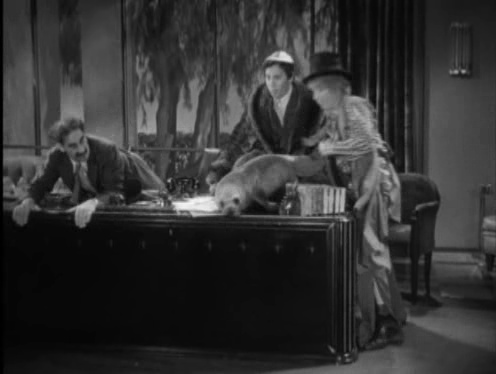
Where's the Seal?

Back in college, one of my professors gave me an idea I’ve never forgotten.  He spoke of myths that shape and inspire our national consciousness, and how they always relate to a past that is not only gone but may not even have happened.  It must have been back in the 70’s, because he referenced the gun-in-the-rack, survivalist twist on the rugged individualism that Bonanza brought into our living rooms once a week.

The Cartwright boys get the job done

I’ve been thinking of myths of politics lately for one simple reason.  In following the current debate in Washington on the debt ceiling, I’ve come to a conclusion I have never reached before, through good times or bad – until now.  Quite simply, I think we are fucked.

Perhaps not over this particular crisis, for I don’t think any politician who wants to get re-elected – all of them, in other words – wants to get stuck with the blame for a national default.  But I think this “debate” reveals how utterly disfunctional our system has become.  Handwringing over the gummint has probably always been a national pastime – I finally believe it is justified.  Still, I prefer laughter and even creative thinking to handwringing, so I have been mulling over what myths I believed about about our leaders in the past, and what might be a better fit now.

Back in the days when my favorite TV show was “Leave it to Beaver,” I watched  Mr. Smith Goes to Washington with my parents: a rugged individualist from Montana takes on the system, and proves that right and integrity still can prevail.

Jimmie Stewart fights the good fight

Soon after I saw Mr. Smith, for a few brief years, we had Kennedy’s Camelot:  “Ask not what your country can do for you; ask what you can do for your country.”   Fast forward six years and there was Kent State and with Crosby, Stills, and Nash singing, “Soldiers are gunning us down.”  It’s been a roller coaster ride since then with ups and downs, times of malaise and times of letting the good times roll, but all along, at least for me, there was the faith that we can make things better.  Our system may be flawed but it works.  There was always someone to believe in, someone like Senator Robert Byrd, a real-life Jimmie Stewart who carried a copy of the Constitution in his pocket.

Sen. Robert Byrd, one of my heroes

Senator Byrd is gone now, and so is my faith that we can right ourselves in time to avoid driving off a cliff.  What kind of myth fits that?  I’ve been mulling it over for several weeks, and it came to me yesterday, thanks to Turner Classic Movies.  They aired my favorite Marx Brothers film, Horse Feathers, and there it was:  my latest take on the current state of our government:

Do you think there’s a kinder way to depict our current crop of elected “servants?”  If so, please let me know!

Marginal People, People of the Margins

Given the doings and structure of the psyche, there is no such thing as being alone.  If you are the only one in the room, it is still a crowded room. – Michael Ventura

While reading and enjoying the interviews in Bill Moyers Journal (which I discussed here, https://thefirstgates.com/2011/05/24/bill-moyers-journal-the-conversation-continues/), I came upon a phrase that evoked a cluster of other ideas.

Moyers interviewed author, Louise Erdrich, concerning her novel, Shadow Tag, which he considers exceptional.  During the interview, Erdrich, who is the daughter an Ojibwe mother and a German American father, said “I live on the margin of just about everything, Bill.  I’m a marginal person, and I think that is where I’ve become comfortable.”   I recommend the interview as a whole, as I do the others in Moyers’ book, but right now I want to focus on the phrase Erdrich used – “marginal person.”

Louise Erdrich

In context, she was talking about the split between people’s waking selves and their dream selves, which is one of the subjects of Shadow Tag.  She was also talking about the tensions between her Catholic upbringing and the Ojibwe culture, as well as the tensions between her various roles, such as mother and writer, which don’t always fit well together.

In short, I take the phrase, “living on the margin,” and being a “marginal person,” to mean”outsider,” one who stands at the edges watching, related but not quite part of.  I am going to take this notion a step further, because it accords with recent thought in depth psychology as well as conditions in our culture.

James Hillman, a prominent post-Jungian thinker, has written eloquently of our “polytheistic” psyches, formed of a number of archetypal forces that often compete with each other.  This is in distinction to Jung’s “monotheistic” psychology, which posits a central “Self” which is alpha and omega of the psyche.

James Hillman

Here is what Michael Ventura, a journalist, screenwriter, and friend of Hillman’s has to say:  There may be no more important project in our time than displacing the…notion that each person has a central and unified “I” which determines his or her acts.  “I” have been writing this to say that I don’t think people experience life that way.  I do think they experience language that way, and hence are doomed to speak about life in structures contrary to their experience.  Ventura adds, The central “I” is not a fact, it’s a longing – the longing of all the selves within the psyche that are starving because they are not recognized” (Michael Ventura.  From “A Dance For Your Life in the Marriage Zone,” in Shadow Dancing in the USA, 1985, out of print).

Ventura’s essay on marriage names a few of these “selves:”  My tough street kid is romancing your honky-tonk angel.  I am your homeless waif and you are my loving mother.  I am your lost father and you are my doting daughter.  I am your worshipper and you are my goddess.  I am your god and you are my priestess.  I am you client and you are my analyst.  I am your intensity and you are my ground.  These are some of the more garish of the patterns. 

You get the idea, and though you may find it mildly interesting, perhaps you wonder, what is the point, and what does it have to do with margins?

Plenty, I think, and it’s all wrapped up in a word in a word related to margins.  The word is liminality, from the Latin word, limen, which means, “threshold.”  People and cultures in liminal states are “betwixt and between.”  The definition given in Wikepedia is:  a psychological, neurological, or metaphysical subjective state, conscious or unconscious, of being on the “threshold” of or between two different existential planes.  Though the word was initially used by anthropologists to anaylze the middle stage of ritual practice, it has passed into broader usage, with this important meaning: [liminality is] now considered by some to be a master concept in the social and political sciences writ large…very useful when studying events or situations that involve the dissolution of order, but which are also formative of institutions and structures.

Hermes, the Greek messenger god, is the archetypal figure of liminal states, for he can easily pass between the worlds and speak to gods and mortals.  His Roman name, Mercury, is synonymous with quicksilver, that flashing liquid metal that is not quite one thing or another and cannot be contained.  My suggestion is that marginal people, people who are at home in the margins, people whose psyches welcome Hermes, are fortunate in this liminal state of our culture and world, as it becomes increasingly hard to bury our heads in the sand and fail to note “the dissolution of order…which [is] also formative of institutions and structures.”

Hermes, Messenger of the Gods

My previous post on nonfiction writing spoke of the “dissolution of order” in publishing and the nimbleness that is likely to characterize and benefit those writers who can adapt and even help create the new structures that are going to emerge.

The landscape of work is another example that touches everyone.  My father worked forty years for the same company, doing the same sort of job, before retiring with a pension.  Showing up as the same person every day served him well.  I had three distinct careers in six different organizations; that is the current statistical norm, and I bet it will seem tame to the generation now coming of age.  Access to a variety of “selves” was an asset in sailing those waters.

Rigid and hierarchical structures are not faring well this year, be they Arab governments, the government of California, the management of Borders, or people in almost any endeavor who cling to business as usual.

If you recognize yourself as a marginal person, a child of Hermes, one who has never been quite “this” or “that,” but both and neither, relax.  These may be the very times when you shine, when your gifts are needed, and when the ways will open as you come into your own.

A Childhood Story I Have Never Forgotten: The Death of Balder

Like many children, I read to be scared witless, to be less lonely, to believe in other possibilities.” – Amy Tan

When I was young, I spent hours devouring a ten volume set of stories and poems called, Journeys Through Bookland:  A New and Original Plan for Reading Applied to the World’s Best Literature for Children , 1939.  

The illustrations alone could transport you to other worlds, and the world I most liked to visit was that of the Norse gods.  Interesting choice for a kid, since this was a world that was destined to end badly.  At Rangarok, the last battle, the forces of chaos and darkness would win the day.  No doubt this mythic cycle influenced Tolkien’s Silmarillion, and just like our mortal lives or a fleeting sunset, the certainty of an ending lends these northern stories a haunting beauty.  Within that canon, there is one story that fascinated me more than others and pops into mind whenever I think of the root stories of my life.

The Death of Balder:

Balder, the god of light and summer, was the second son of Odin and Frigg and beloved of mortals and gods alike.  Because he was associated with truth, his mother worried when he was plagued with nightmares of his own death.  Frigg travelled the nine worlds, extracting vows from humans, immortals, plants, and metals not to hurt her son.  Because Balder was popular, every creature agreed – except the mistletoe, which Frigg considered too insignificant to ask. ( Oops!!!!! )

Now Loki was the trickster and the most fascinating and multi-faceted character of the lot.  He wasn’t one of the ruling family of gods, though sometimes humans prayed to him and he helped.  As a sower of chaos, he kept things in motion.  Coyote did the same for Native Americans, but Loki was much darker and proved deadly to Balder.

Loki and Rhinemaidens, by Arthur Rackham, 1910

Balder was asking for trouble the day he stood before the gods and challenged them to throw their spears and weapons at him.  “Gimme your best shot!”  In a color plate in Journey’s Through Bookland, there he was, the curly-haired golden boy, strutting his stuff like a star quarter back.  Ten years later, reading the Illiad in college, I would learn the word, hubris, but even without the vocabulary, I knew he was asking for trouble.  I knew I was supposed to like him, but I honestly thought him a moron.  You wanted to slap Balder – and Loki did worse that that.

Balder’s blind brother, Hodr wanted to join the fun, so Loki, in the shape of Thokk, a giantess, offered to help.  Did I mention Loki was a shapeshifter?  Loki/Thokk handed Hodr a dart made of mistletoe and guided his throw so it pierced Balder’s heart.  Thokk also refused to weep at Balder’s funeral, thus preventing him from returning from Hel.

The gods caught Loki and his punishment was terrible:  he was chained beneath the earth with a serpent above him dripping searing venom on his face and there he will stay until the bones of the earth are shattered at Ragnarok.  Sometimes the pain is so fierce, Loki writhes in agony and the earth shakes.  Without the god of light, the final battle draws near, and Fenris the Wolf, strains against the chains he will break at the start of Ragnarok.

Odin battles Fenris at Ragnarok

So why did the story fascinate me so?  When I was younger and imagined myself to be wiser, I might have tried to concoct some plausible explanation, but now I agree with Heraclitus (as quoted by James Hillman) who observed that one can never plumb the depths of the soul or be certain of its shifting landscapes and cast of characters.  But I am certain that one thing that keeps this story alive for me in imagination is mystery:  all the questions I cannot answer.

  • Why was Balder such a jerk?  Well over the years I sort of got a handle on this with the understanding that mythological gods are do not have well-rounded personalities.  It is a function of the god of summer to die – though most often in annual cycles.
  • Why, in spite of my best efforts, did I secretly identify with Loki even as I feared and loathed him?  I have no clear idea, except now I suspect that is a common reaction.  Somehow it is necessary, and we know it in our bones.
  • Why such a cruel and unusual punishment for Loki?  Isn’t it out of proportion to the crime?  I remember I thought so as a kid.
  • Why did I enjoy a story and illustrations that frightened me out of my wits?  That too, I think, is necessary.  That’s why we like Stephen King and Mary Shelley and why I’m betting Bram Stoker will outlive Twilight.  I believe well meaning people who would clean up fairy tales for children have it all wrong – life itself will sometimes be more scary than any story, and the old tales are like inoculations.
Ultimately, “The Death of Balder” just leaves me wondering – wondering about all kinds of things.  About the kind of people who would tell such a story.  About how they found their courage in a cosmology in which their gods were doomed to go down in defeat in the end.  Wondering if they really believed that or if, like the classical Greeks, they told these as beautiful wisdom tales without thinking they were literally true?

My wondering about a story like this could go on forever, which is probably why it still lives and breathes for me all these decades later.

NEXT:  Two ballads that keep me wondering.

On Fairy-Stories by J.R.R Tolkien

Once in a while, I worry that I have said everything I have to say, that I have nothing left to blog about.  The mood hit yesterday, after I hit the “Publish” button, and it lasted a good 20 minutes.

Then I remembered that for the last three years or so, my battered and yellowing copy of The Tolkien Reader has been stashed in the software cabinet, along with CD’s for Office, Photo-Shop, and Quicken.  I have no idea why I put it there, but that’s where it stayed because I knew where it is was and it seemed as good a place as any.

When I say yellowing, I mean the pages of this book are really yellow:  it must be at least twenty-five years since I opened it, but I remembered Tolkien’s essay, “On Fairy-Stories” and had a look.

It was downright eerie to see how certain passages I had underlined decades ago are relevant to my present writing interests and concerns.  For instance, those who followed this blog in February will remember a three-part series I wrote on shape-shifters.  “The trouble with the real folk of Faerie is that they do not always look like what they are,” says Tolkien.

Tolkien asks what a fairy story really is and notes that it is not just a story about fairies.  It is also not a story for children, a connection he dismisses as a cultural quirk.  Fairy stories are, he says, “stories about…Faerie, the realm or state in which fairies have their being.”

Faerie lies beyond this world, in an intermediate realm, between the extremes of heaven and hell.  Tolkien quotes the ballad of “Thomas the Rhymer (Child #37) where the Fairy Queen shows Thomas three paths.  They will take the third, which winds into the unknown hills:

O see ye not yon narrow road,
So thick beset wi’ thorns and briers?
That is the Path of Righteousness,
Though after it but few inquires.

‘And see ye not yon braid, braid road,
That lies across the lily leven?
That is the Path of Wickedness,
Though some call it the Road to Heaven.

‘And see ye not yon bonny road
That winds about the fernie brae?
That is the Road to fair Elfland,
Where thou and I this night maun gae.

Analogies jump to mind:  the imaginal realm of Archetypal Psychology, the place of soul, between the physical world and the formless world of transcendent spirit.  The astral world of Hindu cosmology, described in detail in Paramahansa Yogananda’s Autobiography of a Yogi, which is far more subtle than physical reality, and far more dense than the realm of spirit.  I am not just being scholarly here, but trying to point to a key fact:  Faerie is analogous to the place of dreams and nightmares, of angels and demons, in old and new traditions around the world.  I could cite a lot more examples.

According to Tolkien, some our most primal desires lie in our fascination with tales of Faerie:  the desire for “the realization, independent of the conceiving mind, of imagined wonder.”  Another is “the desire of men to hold communion with other living things.”  And finally, we look to “the land of the ever young” in our longing to escape death.  And though we can’t pull that off in physical reality, Tolkien says that “fully realized” or “complete” fairy tales end with “imaginative satisfaction” of some of our deep desires.  They give us “a fleeting glimpse of Joy, Joy beyond the walls of the world, poignant as grief.”

I’d recommend this essay, written in 1939, especially to writers of fantasy literature, but to writers in general, for Tolkien has much to say about another primal desire, the desire to be a creator of worlds – “sub-creator” is the phrase he uses.

***

And finally I will end with some unexpected good news for Tolkien fans.  Today’s Sacramento Bee reported that filming of The Hobbit has started after numerous delays.  This will be a two year, two film project, directed by Peter Jackson, staring Martin Freeman as Bilbo, and also featuring Elijah Wood, Ian McKellan, Cate Blanchett, and Orlando Bloom.   Release of film number one is expected in late 2012.  Something else to look forward to for those who love to explore the world that Tolkien created.

Shapeshifting in Faerie: The Ballad of Tam Lin

One fall day, when I was a college sophomore, I was boiling water for coffee in my off-campus apartment, getting ready to leave for a 9:00am class.  A clock radio on the counter was tuned to the local progressive rock station, but I wasn’t really listening, until a driving tempo opened a song with a strong, urgent, woman’s voice singing what was clearly a piece of folklore:

I forbid you maidens all,
that wear gold in your hair,
to travel to Carterhaugh,
for young Tam Lin is there.

I turned up the volume…

Them that go to Carterhaugh,
but they leave him a pledge,
either their mantles of green,
or else their maidenhead.

I was hooked by then, all my attention on this music.

Janet tied her kirtle green,
a bit above her knee,
and she’s gone to Carterhaugh,
as fast as go can she.

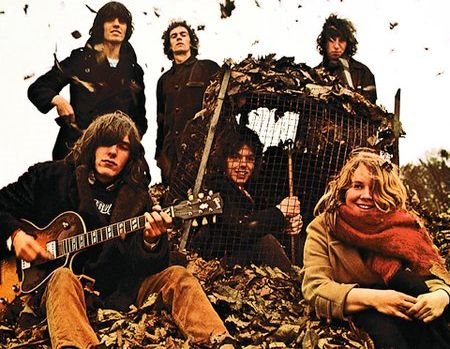
The group was Fairport Convention, the vocalist, an amazing singer named Sandy Denny who died in a tragic accident a few years later.  The song was, Tam Lin.

Fairport Convention

At the end of the day, I came home with the album, Liege and Lief tucked under my arm, and a backpack full of books like Folklore in the English and Scottish Ballads. You could say the passion that music ignited is with me to the present day:  it launched me into fantasy literature, shaped twenty years of storytelling, and this particular ballad is an important source for the fictional world I am building now for a heroine who wrestles with her fairy/mortal ancestry.

The ballad

Tam Lin comes from the Scottish border country and was first transcribed in 1549.  Francis James Child published 14 variants in his collection of English and Scottish ballads.  A mortal woman falls in love and conceives a child by a man who had been a mortal knight, until he was captured and somehow enchanted by the fairy queen.  In the Fairport lyrics:

Tell to me, Tam Lin, she said,
why came you here to dwell,
The queen of fairies caught me,
when from my horse I fell.

At the end of seven years,
she pays a tithe to hell,
I so fair and full of flesh,
am feared it be myself.

To disenchant her lover, Janet must hide at midnight on Halloween, at Miles Crossing, pull Tam from his horse, and hold on for dear life as the queen transforms him into a series of hideous and frightening shapes (I said this involved shapeshifting).  The queen turns Tam Lin into a snake, a newt, a bear, a lion, red-hot iron, and finally burning lead, at which point Janet does as instructed and throws him into a well, from which he emerges in his human form.  The queen is furious, and says if she had known of Janet’s loyalty, she’d have plucked out her eyes.  The real fairies of folklore are not nice people and are known to blind mortals who can see them.

Carterhaugh in 2005. You can still visit Tam Lin's well

Such renowned fantasy authors as Susan Cooper, Pamela Dean, Diana Wynn Jones, and Patricia McKillip have written novels based on Tam Lin’s story.  In 1970, Roddy McDowall directed a movie version staring Ava Gardner.  Countless individuals and groups have covered the ballad and there is at least one website devoted to nothing but exploration and creative elaboration of this song.  (see all these links here:  http://en.wikipedia.org/wiki/Tam_Lin)

What about the Shapeshifting?

Though Tam Lin is local to Scotland, the motif of disenchanting someone by holding on through countless frightening transformations is common to folklore throughout Europe.  This tale of shapeshifting is really quite different from Barth’s Menelaiad, discussed in the previous post.

There is a youthful, hopeful quality in this story of a heroic young woman who knows what she wants with such a fierce determination that nothing can thwart her, not even all the illusions and false paths that waylay most people’s dreams.

There is a quality of angst in Barth’s story question:  how can we ever sort out what is true from what is illusion?  I recall that after his campus visit, several sophomores proclaimed the death of literature as we know it.  Janet and Tam have no time for that – if this be illusion, play on, they would say (to badly misquote the bard).

Tam Lin explores the illusions of young lovers, while the Menelaiad does the same for a middle-aged and war-weary king.

Our final story of shapeshifting comes from India, and is several millenia old.  It sits somehwhere between the optimism and pessimism of the first two tales.  Yes, it affirms, life is a series of dreams, where dreams of joy transform into nightmares and back again endlessly – but imagine the joy of waking up.  That awakening, according to this tale, is nearer than we think.

Meanwhile here – as timeless as any fairy artifact – is Fairport Convention’s version of the Ballad of Tam Lin:

http://www.youtube.com/watch?v=jy3ihk205ew

On Shapechangers: Proteus in John Barth’s, The Menelaiad

I’ve been thinking a lot about shapechangers over the last few months.  I’m trying to refine the villain in my current novel, and I really want to give him shapechanging powers, but he needs some restrictions.  Presumably, a villain with an unlimited ability to change his form instantly and at will could never be caught.  That would be a different story than the one I am writing.

The figure of  “The Shapechanger” has fascinated me since I heard John Barth read his story, “The Menelaiad” four decades ago.  I have never forgotten that tale or several related stories which I will discuss in future posts.  “The Menelaiad,” was published in Barth’s collection of short fiction, Lost in the Funhouse, in 1968. English majors love it as “metafiction,” writing about writing, but what really caught me is the “simple” image of a man who wrestles a shapechanger and can never again be certain if his life is really unfolding as it appears, or if he is still engaged in the wrestling match.

Barth was fascinated with “frame tales,” stories within stories.  A classic example is The Arabian Nights.  Scheherazade  tells stories with multiple characters who each tell their own stories, often with people within those stories telling stories.  Barth claimed that in his search of world literature, he never found a story that went deeper than five levels, so he decided to write one with seven.  He began with an episode from the Odyssey, which has plenty of shapechanging and frame tales as it is.

Barth chose the episode where Menelaus, husband of Helen (who launched a thousand ships) relates how he was blown off course, to the Nile delta, after the fall of Troy.  (He tells the tale to Telemachus, son of Odysseus, who was urged by the goddess Athena in the shape of Mentor, an elderly advisor, to seek for news of his missing father – clear enough?)

Luckily for Menelaus, Eidothea, the daughter of Proteus, the Old Man of the Sea, falls in love with him, and relates how he may win sure and certain advice from her father who does not like to dispense such information.

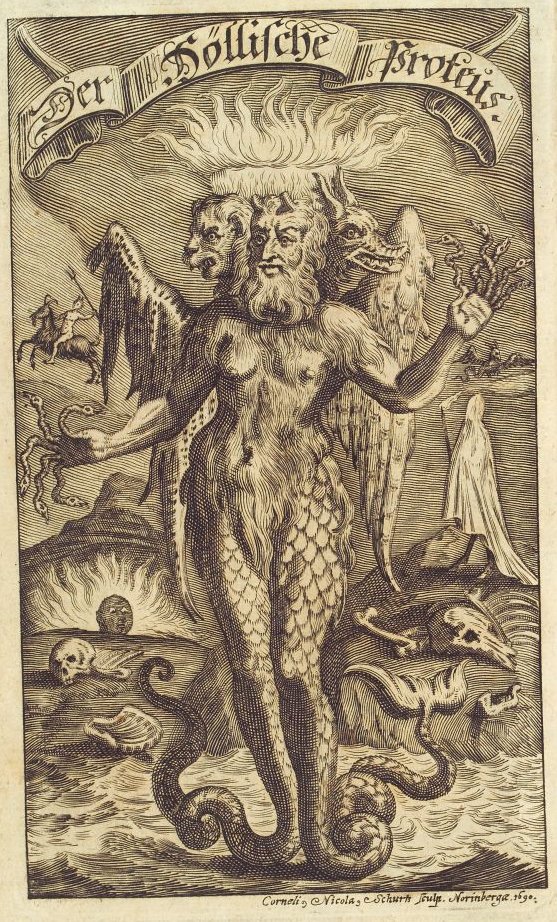
Proteus is herdsman of Poseidon’s seals, so Menelaus must hide himself in a smelly sealskin, jump Proteus when he comes into his cave at noon, and hang on for dear life, for Proteus:  “can foretell the future, but, in a mytheme familiar from several cultures, will change his shape to avoid having to; he will answer only to someone who is capable of capturing him. From this feature of Proteus comes the adjective protean, with the general meaning of “versatile”, “mutable”, “capable of assuming many forms”.  http://en.wikipedia.org/wiki/Proteus

Proteus, The Old Man of the Sea

Barth has a field day letting Menelaus tell the tale of conversations with different people at different times – when someone related what someone else related about what someone else related, he relates.

And yet, for all the tour de force writing, the central image of the tale is like a koan that stays with you.  While holding on to Proteus, Menelaus realizes he can never again be sure that Proteus has not changed into Menelaus holding Proteus, and if so, what or who is he?  All he can know for sure is that he is a voice asking who or what he is.

***

There is a classic Zen story of a man who dreams he is a butterfly.  When he wakes, he wonders if he is a man who dreamed he was a butterfly, or a butterfly dreaming he is a man.

It’s easy to flip the page and forget about that particular story.  It is harder or even impossible to forget Barth’s “Menelaiad,” once you make the effort to wade through some of his bizarre invented ways to use quotes in ways they were never designed to be used.  “”””This is frustrating!”””” he said, she recounted, he told me, I say.

I’ve always suspected that Proteus predates the Olympian pantheon of classical Greece, for what could be more antithetical to the ideals of clarity, order, and rational philosophy than a shapechanger?  There really is no character in mythology more dangerous to any kind of fixed worldview than one who can plant the seed of doubt at the core of awareness.  “Is this really true?”  “Are things really as they appear to be?”  The moment consciousness really and truly begins to entertain questions like these, the wrestling match has begun.

NEXT:  A ShapeChanger in Faerie.