Doh! Now we (guys) are in for it!

NPR reports that in response to you know what, Democratic women legislators in six states have proposed new limits to male access to reproductive health care. http://www.npr.org/blogs/health/2012/03/15/148695307/in-protest-democrats-zero-in-on-mens-reproductive-health.   Consider:

House Bill 116 in Georgia states that:  “Thousands of children are deprived of birth in this state every year because of the lack of state regulation over vasectomies.”

An Oklahoma state senator proposed new legislation to regulate sexual acts:  “Any action in which a man ejaculates or otherwise deposits semen anywhere but in a woman’s vagina shall be interpreted and construed as an action against an unborn child.”

In Ohio, a female state senator sponsored a bill requiring men seeking drugs like viagra to:

  1. Have a cardiac stress test to ensure they are ready for sexual activity.
  2. Obtain written certification from a recent sexual partner that they are indeed experiencing erectile dysfunction.
  3. See a sexual therapist who would explain certain nonprescription lifestyle choices, such as celibacy, as alternate treatments for the problem.

***

It’s the very passion that people bring to these issues make them such effective smokescreens.  If “they” can get us asking the wrong questions…

We slide toward a third war in a decade with no hint of a national debate.  Recent news on Citigroup and Goldman Sachs reveal that the players who brought us the last financial meltdown are on track to do it again.  People know about Rush Limbaugh.  How many have heard of Greg Smith?

It used to be that “Nero fiddling while Rome burned” was the ultimate paradigm of irresponsible leadership.  Now it’s the 2012 presidential election.

And We Have A Winner!

That’s right, a winner in the: Caption the Condom Cartoon Contest  (announced here last week http://wp.me/pYql4-1MT).

There were at least a few positive outcomes after Rush Limbaugh’s slur of law student, Sandra Fluke, which inspired the contest.

1) One positive result:  I got to use some great alliteration in the contest name. 

2) Another bit of good news:  eleven sponsors bailed on Rush after his outburst.  Unfortunately, a Republican Super-Pac stepped in with bailout money.  Apparently some consider Limbaugh’s mouth too big to fail.

3) And best of all, at least for this blog, Camille w1ns a $10 Amazon gift card with her caption:

If only Rush’s parents had known how to use me properly… 

Please stop by Camilles blog and see what other clever things she is up to: http://poppycockandsomesuchnonsense.wordpress.com/

And thank you all for your entries and for stopping by to share a laugh!

My First Ever, Caption the Cartoon Contest!

My recent resolution to stay more positive on this blog is challenged almost every time I pick up a newspaper or turn on the evening news.  Believing that laughter is better than tears, and in keeping with this week’s headlines, I’m announcing a little contest:

Thanks to istockphoto.com for this royalty-free cartoon

I’m guessing that everyone who isn’t living with wolves knows why poor little Mr. Happy is sad. I will award a $10 Amazon gift card to the best caption for this cartoon, submitted as a comment to this post by midnight PST, Saturday, March 10.  Multiple entries are encouraged.

***

If you have been on vacation, or on a media fast, or if you live in a country that still has real political debate, you may not have heard of the controversy over rules that require health-care providers to cover contraception even if it violates the conscience of certain faith-based employers.  Throwing gasoline on the fire, conservative talk show host, Rush Limbaugh, called Sandra Fluke, a third-year law student, a “slut” and “a prostitute” after she testified in favor of insurance coverage of birth control. http://www.sacbee.com/2012/03/03/4307985/contraception-fight-intensifies.html

So now that you know the story, what are you waiting for? Get busy writing your captions!

Life: The Movie by Neal Gabler – A Book Review

In his final movie, Being There, 1979, Peter Sellers plays Chance, a gardener with a low IQ, who becomes an advisor to the president and business tycoons. In one iconic scene, Chance is accosted by a knife wielding youth in Washington, DC.  He pulls out his TV remote control and clicks it to change the channel.  He is puzzled when the assailant doesn’t vanish.

Peter Sellers as Chance in “Being There”

This might be the perfect illustration for Neal Gabler’s, Life, The Movie:  How Entertainment Conquered Reality, (2000).  Gabler quotes historian, Daniel Boorstin, who wrote in the early 60’s that, “We risk being the first people in history to have been able to make their illusions so vivid, so persuasive, so ‘realistic’ that they can live in them.”  Done deal, according to Gabler, who calls us, not just a “post-modern culture,” but a “post-reality culture.”

At times I had to keep my own assumptions in check:  subjects like reality and imagination open onto psychological and spiritual vistas beyond the scope of this or any other single book.  But when Gabler cited concrete examples, I found myself nodding my head on almost every page.

“You know how to brood because you have seen Rebel Without a Cause,” Gabler says, quoting cultural analyst, Louis Menand.  “What better model does the world offer?”

Gabler charts the ascendency of entertainment in America from the early 19th century, where the split between high and low culture was fueled by our democratic suspicion of all elites.  Calling someone “aristocratic” was a serious insult.  During the 1840 presidential campaign, when a man called Daniel Webster an aristocrat, he thundered back that he’d grown up in a log cabin, and anyone calling him an aristocrat was “a coward and a liar.”  ( Sound familiar? )

Nathaniel Hawthorn despaired of the fate of serious writers amid the flood of “trash” being published.  One publisher sold four million dime novels in five years, at a time when the US population was only 25 million.

In 1850, 1% of the population owned 50% of the nation’s wealth and held almost all public offices.  Upward mobility was a myth, since 98% of that wealth had been inherited.  While the one-percent held the power, then as now, culture wars raged, sometimes with a violence that we (thankfully) haven’t seen yet.  One night in New York, rival Shakespearean actors, one British and one American, were both scheduled to perform, the former in an uptown theater, the latter downtown.  Police ejected the rabble who had bought tickets solely to heckle the British actor.  A much larger crowd gathered across the street to throw rocks as the “aristocratic” crowd tried to leave.  The militia was called, a riot ensued, and before the night was over, 22 lay dead and more than a hundred wounded.

In the end, it was movies that won the day for popular culture.  The 1% stayed away from the early nickelodeons, which tended to be crowded and crass.  Later, with middle-class patronage, refined behavior became the norm, but the elite have never fared well in the movies, from the Marx Brothers  Night at the Opera, to the present, where a too-expensive suit is always the mark of a villain.
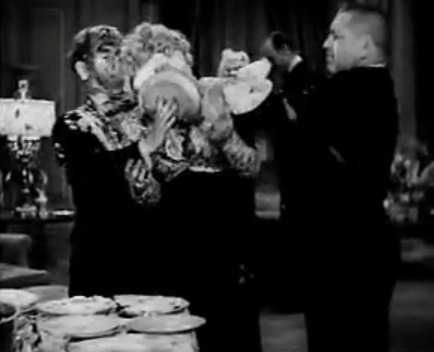
Three Stooges + high society + pies = disaster

As he charts the history of high vs. popular culture, Gabler makes a telling point.  It isn’t just about high brow and low brow – it’s about the ascendency of entertainment.  Being entertained is easy, and the corollary is that when the goal is entertainment, grabbing and holding audience attention is the supreme value, and “things that do not conform – for example, serious literature, serious political debate, serious ideas, serious anything – are more likely to be compromised or marginalized than ever before.”

Life: the Movie is a complex and disturbing book.  Gabler says in the introduction, it is diagnostic and not prescriptive.  To offer easy answers, he says, would be like the movie illusion where we meet the monster in act one and see it vanquished in act three.  Writing 12 years ago, Gabler said:

“One is almost compelled to admit that turning life into escapist entertainment is a perversely ingenious adaptation to the turbulence and tumult of modern existence.  Why worry about the seemingly intractable problems of society when you can simply declare ‘It’s morning in America,” as President Reagan did in his 1984 reelection campaign, and have yourself a long-running Frank Capra movie right down to the aw-shucks hero?”

I read this book after watching Neal Gabler speak on the fictions that lace the current election campaign on Moyers & Company, as I described in the preceding post. Because of it’s scope, I would recommend Life: the Movie only to those who want to delve into this issue in some depth.

But  I would recommend that everyone watch the ongoing conversation this year between Gabler and Moyers.  The confusions and illusions surrounding the political process are more convoluted than when the book was written, but Neal Gabler remains a reliable guide to pulling back the curtains and helping us draw closer to the truth.


An Excellent Article on the Occupy Movement

“It is no longer sufficient to appeal to government to put things right; a corrupted system will not reform itself. We must create new systems, new modes of decision-making and interaction, and new forms of economic behavior to replace the old.”  

These words of Carne Ross, a former British diplomat come from an article in the Feb. 27, 2012 edition of The Nation, “Occupy Wall Street and a New Politics for a Disorderly World.” http://www.thenation.com/article/166122/occupy-wall-street-and-new-politics-disorderly-world

Thanks to blogger, Henry David Thorough for the link: http://deliberateobserver.wordpress.com/

Stephen Colbert’s Super PAC is Worth a Million Dollars

Americans for a Better Tomorrow, Tomorrow, the Super PAC started by Comedy Central’s Stephen Colbert, filed papers with the Federal Election Commission yesterday stating that it has raised $1,023,121. “How you like me now, F.E.C? I’m rolling seven digits deep!” Colbert wrote in an addendum. http://money.cnn.com/2012/01/31/news/economy/colbert_super_PAC_filing/index.htm

Colbert, who has been using his show to explore the murky world of campaign finance added, “It’s the way our founding fathers would have wanted it, if they had founded corporations instead of just a country.”

Documents filed by Colbert showed that most contributions were less than $250, but listed some interesting exceptions.  Gavin Newsom, the Lieutenant Governor of California, gave $500.  Newsom said, “I applaud Stephen Colbert exposing the absurdity of our current political financing system. I’m proud to support Colbert’s message with a donation. And I like his haircut.”

It can hardly be an accident that Colbert filed his report on the same day that Mitt Romney completed his purchase of the 50 Florida delegates using Super PAC funds.

I spotted an interesting article in the morning paper, drawn from the Washington Post:  “GOP super PACs may give Obama a run for his money.”  Unusual so early in an election year – no high-sounding phrases about the will of the people or selecting the best candidate.  Just a bare statement of fact that the winner will be the one who buy the most airtime on TV.

On the January 20, Bill Moyers interviewed David Stockman, former budget director for Ronald Reagan, who shared his disillusionment:

“we also have to recognize the pessimism that the public reflects in the surveys and polls is warranted…The Congress is owned lock, stock and barrel by one after another, after another special interest…So how do we turn that around? I think it’s going to take, unfortunately a real crisis before maybe the decks can be cleared.” http://billmoyers.com/

On the same program, Moyers interviewed Gretchen Morgenson, a Pulitzer Prize winning journalist for The New York Times and author of the 2011 book, Reckless Endangerment: How Outsized Ambition, Greed, and Corruption Led to Economic Armageddon.

Morgenson agrees that another crisis, worse than 2008 is inevitable, because nothing has changed, and expects it to happen within the next 10 years.  After listening to her sadness and anger, Moyers asked Morgenson if there was anything that gave her hope, and she said yes:

“What makes me optimistic is that people are understanding this now, that Main Street gets it, you know, the thing that I found compelling about the Occupy Wall Street movement was that it seemed to be tapping into this anger. Previous to that there was just this kind of silence, you know, people were maybe too flabbergasted by what had gone on.
…………………………………..
But we still don’t know it all and until we do we can’t really protect ourselves going forward. But I do get a sense that there is anger, that there is rage and that maybe, maybe, just maybe somebody in Washington might pay attention to that.”

The California Wolf

On December 28, a 2 1/2 year old male wolf crossed the border into California after a 1,000 mile journey south through Oregon.  Wolf OR7, as he is called by Fish and Game, is the first wild wolf in the state in almost 100 years.  A young wolf will leave his pack to search for a mate to start a new one in situations like too many wolves competing for game in a certain region.

Wolf OR7

The new California wolf is a descendant of the 66 Canadian wolves who were relocated to Yellowstone in the mid 90’s.  He is one of an estimated 1600 wolves who now roam free in the Rocky Mountain states, in the southwest, and in Oregon.

According Tim Holt, a freelance writer in Dunsmuir, CA, “local ranchers and a few pandering elected officials have him in their cross hairs, saying he ought to be shot on sight.”   At the same time, “there are wolf advocates who practically worship this predator, seeing the wolf as symbol and martyr of a vanishing wilderness.”

Holt sees another possibility:

The removal of wolves, or their reintroduction, reverberates up and down the food chain. By culling deer and elk, new wolf populations help restore vegetation along streambeds, improving habitat for songbirds, beavers and river otters. And by going after weak and old members of deer and elk populations, they help strengthen their stock. Wolves, in other words, are instinctive wilderness restoration specialists.

So the wolves’ return to this state offers a litmus test of our commitment to the health of our remaining wildlands. But it goes beyond that. Allowing them to reintroduce themselves would be one more sign that we’re moving away from a human-centered view of nature, based on narrow economic interests, and have begun to see ourselves as a part of what might be called the broader economy of nature. http://www.sacbee.com/2012/01/29/4221053/wolf-can-help-us-balance-our-approach.html#storylink=cpy

Somewhere deep within us as well, is a fear of wolves that makes generations of children shiver at Little Red Riding Hood.  That thrilled me when I read Jack London’s stores of wolves battling men.  I didn’t know at the time that London’s stories were pure fiction.  No such incidents ever happened.  During the ’90’s, I volunteered at the Folsom City Zoo because I wanted to interact with the wild canines – the wolves and foxes and coyotes.

Helping to socialize Redbud, a wolf pup, ca 1995

During the 90’s, all the texts on wolves agreed there were no confirmed cases of a non-rabid wolf attacking a human in North America.  I don’t think that has changed.  A classic account is 50 years old.  Farley Mowat, a Canadian author and conservationist, spent a summer living by himself among wolves.  In his 1963 book, Never Cry Wolf, he wrote:  “We have doomed the wolf not for what it is, but for what we deliberately and mistakenly perceive it to be — the mythological epitome of a savage, ruthless killer — which is, in reality, no more than the reflected image of ourself.”

Never Cry Wolf by Farley Mowat, 1963

The book, and the movie made of it in 1983, deserve much of the credit for reversing public attitudes toward the wolf, and allowing reintroduction to happen at all.

Never Cry Wolf movie, 1983

Gandhi said the character of a nation is revealed in the way it treats its animals.  Let’s hope the way we treat OR7 reveals something compassionate, wise, and generous in us.

Sage, at the Folsom City Zoo, ca. 1995

Bill Moyers is Back!!!!

On Sunday evening, I was delighted to catch the first episode of the new PBS series, Moyers & Company.  You can view it, and a lot more, on the new website, http://billmoyers.com/.

Moyers interviewed political scientists, Jacob Hacker and Paul Pierson, authors of, Winner-Take-All Politics:  How Washington Made the Rich Richer–and Turned Its Back on the Middle Class.

The conversation startled me, as Hacker and Pierson said they were startled during their research.  They found that the current income gap in this country – greater than in some third world countries like Egypt – was not an inevitable consequence of free market dynamics or trends like globalization.  It was politically engineered over the last 30 years.  Hacker and Pierson argue that the current American leadership more closely resembles a third world oligarchy than the democracy our parents knew.

“Who’s the culprit? “American politics did it– far more than we would have believed when we started this research,” Hacker explains. “What government has done and not done, and the politics that produced it, is really at the heart of the rise of an economy that has showered huge riches on the very, very, very well off.”

Bill considers their book the best he’s seen detailing “how politicians rewrote the rules to create a winner-take-all economy that favors the 1% over everyone else, putting our once and future middle class in peril.” – (from billmoyers.com)

Jacob Hacker and Paul Pierson on Moyers & Company

Winner Take All Politics is going into my already overcrowded book-queue, since it appears to be of critical importance.  The first step in correcting a problem is gaining an accurate understanding of its nature.  The fact that the assault on the middle class was created and not fated is good news, according to Hacker and Pierson.  Something done can be undone.  Along with Moyers, they agree that our current national sense of outrage is a positive sign.

Moyers’ work and website are important to bring up today.  On the website you can find an April, 2010 interview with two African American lawyers, discussing what Dr. King would have made of America today. Lawyer Bryan Stevenson said:

“I think in America, the opposite of poverty is justice. I think there are structures and systems that have created poverty, and have made that poverty so permanent, that until we think in a more just way about how to deal with poverty in this country, we’re never gonna make the progress that Dr. King envisioned.”  http://billmoyers.com/content/bryan-stevenson-and-michelle-alexander/

These are important things to consider, especially today.