Books for Brainiacs (literally)

I was browsing the NPR list of recommended Sci-Fi titles today, and could barely manage a ho-hum.  I’ve slipped into one of my periodic non-fiction moods, and I’ve learned to follow such whims to see where they take me.  I fear that my book queue may get even more unmanageable after stumbling upon these NPR recommendations:  Insane Science:  Five New Books that Explain the Brain.  http://www.npr.org/2011/06/08/136896426/insane-science-5-new-books-that-explain-the-brain  Here is a quick summary of the article:

The Compass Of Pleasure: How Our Brains Make Fatty Foods, Orgasm, Exercise, Marijuana, Generosity, Vodka, Learning, And Gambling Feel So Good  by David J. Linden.  Everyone probably guessed Fatty Foods, Orgasm, Vodka, and perhaps Generosity, but the author claims that Paying your taxes belongs in that category too.

The Believing Brain: From Ghosts To Gods To Politics And Conspiracies — How We Construct Beliefs And Reinforce Them As Truths by Michael Shermer.  Shermer, a former Evangelical Christian who became an agnostic in college claims that belief precedes the explanations we invent for them.  However, Shermer acknowledges that, “we could be wrong.”

The Psychopath Test: A Journey Through The Madness Industry by Jon Ronson.  The bad news:  an estimated 1% of the population is psychopathic.  The good news:  if you wonder if you are, you almost certainly are not.

The Optimism Bias: A Tour Of The Irrationally Positive Brain by Tali Sharot.  Even if you are a cynic, your brain is probably hardwired for optimism.  “Most people are programmed to predict happy endings in all facets of our lives.”  As you might have guessed, there is measurable survival value in thes.

A Billion Wicked Thoughts: What The Worlds Largest Experiment Reveals About Human Desire by Ogi Ogas and Sai Gaddam.  If you want to know what people really think about sex, look online, claim the authors, and that is what they did.  Their conclusion, after sifting through “reams” of data?  Men’s sexual brains “are more like Elmer Fudd,” and women’s, “like Miss Marple.”  That hook I think, is enough to get me to download this one.  Not that I would be crass enough to ever make a joke about Elmer Fudd and Congressman Wiener – nope, no way.

Happy reading, everyone, and I categorically deny all rumors that I have too much time on my hands!

Spiritual Bypassing: An Interview with John Welwood

John Welwood has studied, taught, and written about the relationship of psychotherapy and spiritual practice for thirty years.  He is currently the editor of the Journal of Transpersonal Psychology and author of Journey of the Heart.

In an interview in the Spring issue of Tricycle, Welwood discusses the concept of “spiritual bypassing” which he presented three decades ago:  http://www.tricycle.com/interview/human-nature-buddha-nature.  According to Welwood, spiritual bypassing is the “tendency to use spiritual ideas and practices to sidestep or avoid facing unresolved emotional issues, psychological wounds, and unfinished developmental tasks.”

Both eastern and western world views implicitly or explicitly elevate spirit over flesh, absolute truth over relative truth, and the impersonal over the personal.  Welwood says such an attitude is fraught with danger:  “One might, for example, try to practice nonattachment by dismissing one’s need for love, but this only drives the need underground, where it is likely to become acted out in covert, unconscious, and possibly harmful ways.”

We’ve all seen that dynamic play out in headlines of scandals involving both eastern gurus and western clergy.  Other consequences of an exclusive focus on the transcendent are less dramatic but far more pervasive.  I once attended a talk presented by a large organization that teaches eastern spiritual practice.  The group is well regarded – never a hint of scandal.  During the Q&A following the talk, one young woman said, “I cried when cat died recently.  Was that okay?”  Everyone breathed a collective sigh of relief when the speaker said yes.

Is it all right to be myself?  Is it all right to think what I think and feel what I feel?  Not if the focus of practice is transcendence of all that is messy in the human condition.  Welwood has seen a lot of this in his therapeutic practice and says:

One Indian teacher, Swami Prajnanpad, whose work I admire, said that “idealism is an act of violence.” Trying to live up to an ideal instead of being authentically where you are can become a form of inner violence if it splits you in two and pits one side against the other.

For anyone interested in or engaged in spiritual practice, this is a worthwhile article to consider, as John Welwood tries to articulate the vision of a spiritual discipline that aims to fully develop both “poles” of our nature, the human and the divine.

Says Who?

This post is about judging ourselves negatively based on unexamined or under-examined beliefs.  What got me thinking in this direction was the recent exploration I did on ebook publishing.  I’m guessing that most unpublished writers long for the validation that acceptance for traditional publication confers:  “Now I am somebody!”  In fact, those ebook authors who have launched their careers by non-traditonal means have also done an end-run around our customary who’s-who assumptions.  New game, new rules.

I want to consider some of the ideas we use to bludgeon ourselves.  I’m not talking about (relatively) small issues:  I wish I had a nicer lawn. Nor am I considering such serious and potentially clinical issues as a pervasive, non-specific, feeling that I am just no good: I am not up to taking on original sin, in any of its many variations.

I’m talking about the dozens of ideas we or our friends have used to put ourselves down.  Reasons I am a loser:

  • Because I didn’t make the little league team.
  • Because I am dumb in math
  • Because girls think guys in the math club are nerds.
  • Because I’m not as pretty as my sister.
  • Because I didn’t get into my first choice college.
  • Because I don’t like my job.
  • Because I am not married.
  • Because my marriage is on the skids.
  • Because I don’t have any children.
  • Because the kids are out of control, which means I’m a terrible parent.
  • Because I got skipped over for a promotion.
  • Because I can’t handle my new job.
  • Because I got laid off.
  • Because I hate this town and want to live in (fill in the blank).
  • Because I can’t get get my book published
  • Because I want to be somebody.

Something in that list may bring to mind some past or present hot button issues.  Ideas like this can be incredibly painful, but interestingly, the moment our minds change, the issues and pain disappear.  We can see this by considering past ideas, the ones we no longer believe.  One day in grade school, I had a revelation:  I don’t really care about little league – I was just trying out because everyone else was. Instantly, all the inferiority vanished.  I was no longer a loser just because I wasn’t good at baseball.  Soon enough, however, new limiting ideas filled the void and I was a loser again.

That dynamic should make us very suspicious!

It made Cheri Huber suspicious.  Huber, a Zen teacher who is also versed in modern psychology, has made it one of her special missions to take on the voices of self-hate she finds so rampant in our culture.  Huber travels and teaches internationally, is a prolific author, has a regular radio talk show, and hosts workshops both online and at “The Zen Monastery Peace Center,” in Murphys, CA.  http://www.cherihuber.com/index.html

Huber is the author of twenty books, most of them published by “Keep It Simple,” an independent press she and her sangha founded back in the ’80’s.  Perhaps her most pervasive theme is contained in title of one of her most popular books:  There Is Nothing Wrong With You:  Going Beyond Self-Hate.  In the introduction, she writes:

Every spiritual path tells us that what we are seeking is inside us.  Society, the world, others, conditioning, teaches us as children to stop looking to ourselves in order to know what is so for us, and to begin to look to others in order to know what is right.  We first learn to look to parents, then teachers, then friends, lovers, husband or wife, children, Jesus or the Buddha or God – all “out there.”  The love, the acceptance, the approval is out there (emphasis added).

Huber sometimes uses the model of “sub-personalities,” to illustrate the origin of the self-hating voices.  Simplistically, sub-personalities are a series of “mini-me’s” living inside my psyche, with the power to take possession of my awareness from time to time.  Some of them hate me.  Some of them do nothing but whisper poisonous thoughts, and of these, Huber says:

You can listen to the voices that say there is something wrong with you.  It’s actually very helpful to be aware of them.  Just don’t believe them.  Most of what we have been taught to believe we had to be taught to believe because it isn’t true.  This is why children have to be conditioned so heavily!  We would never have reached these conclusions on our own!

I sat in a one day retreat with Cheri Huber in the summer of 2005, and got a sense of her deep commitment to this particular work.  It was clear from her comments that she had come from a starting place of crippling inferiority and lack of self worth.  She now seems like a joyous person, and one who believes her process is open to everyone, and judging by the numbers of people who threw themselves into the work that day, quite a few others have found it true for them.

As you learn to sit down, sit still and pay attention, you begin to glimpse that which sees through the illusion, beyond the voices of society’s conditioning, back to the original being.  And slowly that perceiving becomes more real than all you’ve been taught to believe…you begin to see with a much broader view…you begin to be the love, acceptance, and compassion you have always sought – Cheri Huber.


Of Hamsters, Wisdom, and Persephone

Persephone the Innocent

The protagonist of Karyn’s Magic, the young adult novel I’m writing, is a teenager who lets something evil into the world.  Not only must she scramble for damage control, but she is forced to see the same evil as a potential within herself.  I usually think of “loss of naiveté” as theme of adolescence, but remembering hamsters brought to mind a personal experience that happened earlier than that.

My fifth grade teacher had a pair of hamsters, favorite classroom pets.  At one point she could no longer keep them, and asked if anyone could provide them a good home.  I spend my Saturdays at a small museum in Alum Rock Park, in San Jose, that had a small zoo and classes and field trips for young people.  We had day trips to ocean tide pools, a weekend camping trip to the Mojave, plus at the museum we got to play with some of the critters.  One of my favorite stunts was to wrap a boa constrictor around my neck and explain to startled visitors that these snakes never squeezed anything they didn’t regard as food.

I told the teacher I had a home for her hamsters and took them to the museum.  “Great, we can use these,” the director said.  At the end of the day, after the museum closed to visitors, I learned what he had in mind.  Before I quite realized what was happening, he dropped one of the hamsters into a glass case with a huge rattlesnake.

The ensuing drama seemed to go on forever:  the hamster sniffing, scooting around, knowing something was wrong but not quite knowing what.  I wanted to look away but couldn’t.  The snake coiled in slow motion, almost lazily, with hard, unblinking eyes.  It’s strike was a blur, you couldn’t see it;  you could only hear, not see, the hamster slammed into the top of the cage by the force.  It was over in less than a second.  The animal did not even twitch.

I asked about the other hamster and learned that a snake that big cost several hundred 1960’s dollars, and live food was expensive.  I didn’t demand the other hamster back.  There were older kids there, some in jr. high, and I wasn’t about to wimp out. And scientists sometimes have to suck it up, right?

On Monday, the teacher asked how the hamsters were doing.  I told her and the class that they were fine.  I never put another boa constrictor around my neck.  I was at the edge of adolescence, and the world was poised at the edge of “the sixties;” there would be more and bigger occasions for guilt soon enough, but most of those are long forgotten.  This is the event I come back to when I think or write about the loss of innocence.

***

What does she hear on the wind?

James Hillman, the prolific author who coined the phrase, “archetypal psychology,” for his own brand of post-Jungian thought, borrows a phrase from Keats and calls our world, “the vale of soul-making.”  For Hillman, the natural movement of soul is down, into the depths, where a darker kind of wisdom lies.

(to understand Hillman it is critical to know that he uses the world “soul” as the ancients did:  not as the “eternal soul” of western religion, but more as we use the phrase, “psyche.”  He places “soul,” the source of imagination and fantasy, between the “eternal spirit,” and the body – a three-part image of personality you seem to see in biblical references, as well as in eastern religion even now).

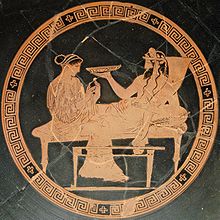
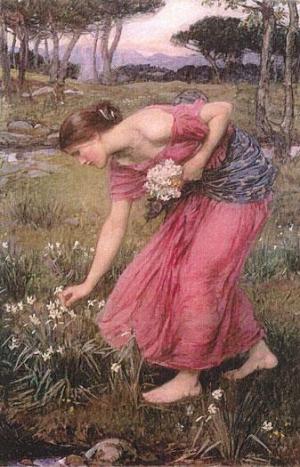
The story that illustrates Hillman’s perspective on “innocence,” is the myth of Persephone.  As a beautiful young girl, she is playing one afternoon with her friends, when she bends to pluck a narcissus flower.  The ground opens up, and Hades, the Lord of the Underworld, scoops her into his chariot and carries her into the depths.  Hillman writes:

“Each of us enacts Persephone in soul, a maiden in a field of narcissi or poppies, lulled drowsy with innocence and pretty comforts until we are dragged off and pulled down by Hades, our intact natural consciousness violated and opened to the perspective of death.”  Revisioning Psychology

By the time the Olympian gods put enough pressure on Hades to cause him to relent, Hermes, messenger of the gods is stunned to see Persephone transformed. No longer the naive maiden, she is the darkly radiant Queen of the Underworld. She has eaten the food of the underworld – six pomegranate seeds, and must spend that six months of every year under the earth.

Supposedly that explains why there is winter, but in a far more interesting sense, it gives us an image of why, despite our wishes, wisdom doesn’t lie in the sunny, flower dotted fields of youth, but in the depths of a soul that knows both light and darkness.

Persephone and Hades

New help for coulrophobics

According to an NPR report, coulrophobia, the fear of clowns, is the third most common phobia in Britain, right behind the fear of spiders and needles. Our cousins across the water fear clowns more than they do flying in airplanes. Coulrophobia on NPR

Now there is new hope for sufferers thanks to the dedicated clownselors of the John Lawson circus, who offer pre-show therapy. Paul Carpenter, aka, Popol the Clown, explains how clown therapy works:

...we invite them to the big top during the day when it’s quiet and they meet me and our other clown, but they meet us in our normal, everyday guises, not in makeup or anything. And then we take them into the circus ring, and they watch us as we slowly transform ourselves into our clown personalities.

Popul (Paul Carpenter), right, and his friend, Kakehole

We put on our makeup very slowly, and then we put on our costumes. And if that goes well and they haven’t run for the door, we then try and get them interacting with us in the circus ring. We go through a few clown routines, getting them involved. And if that goes well, our ultimate aim is to get the person themselves dressed up in costume and makeup, and then we help them find their own inner clown..they come into the circus being scared, and then they end up leaving as a clown themselves.

Hmm…I’m not sure ’bout that. Finding my inner clown sounds pretty good, but why do I keep thinking of Stephen King and Chuckie?

I knew a real clown who was truly funny. I met Amelia Mullen, aka, Pansy Potts the Clown, at the Sacramento Storyteller’s Guild. There seem to be two general ways of telling a story to a crowd, either in “quiet” way of a storyteller around the campfire, or in the dynamic way of an actor on a stage, the way vaudeville must have been. My way is very much the former, while Amelia worked the crowd, strutting across the stage with gestures and wild voices. No one fell asleep when she was telling a story.

I later realized she developed this style of storytelling as a way of keeping the attention of rowdy four year olds while entertaining at birthday parties – now there is something to give you a phobia!