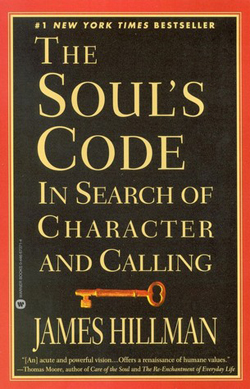
James Hillman (1926-2011), a prolific post-Jungian psychologist, thinker, and cultural critic, wrote more than 20 books, but The Soul’s Code: In Search of Character and Calling (1997) is probably his best known work.
In a head-on attack upon the reductionist nature of both the nature and nurture camps of western developmental psychology, Hillman proposes a view of individual destiny based on Plato’s Myth of Er. Are we nothing but helpless products of our mothers in the first year of life or our luck-of-the-draw genetics? Or is there a deeper meaning to how we grow and unfold?
Hillman proposes an “acorn theory,” arguing that each acorn holds the pattern of the oak it may become, just as each soul that enters the world may bear a destiny shaped by intelligence rather than random chance: “what is lost in so many lives and what must be recovered [is] a sense of personal calling, that there is a reason I am alive.”
Hillman expounds his theory in a number of biographical sketches. He writes of Manolete, the most famous bullfighter of 20th century Spain. As a child, he was sickly and frail. “He stayed so much indoors and clung so tightly to his mother’s apron strings that his sisters and other children used to tease him.” Then, at the age of 11, he became fascinated with bulls.
Current psychology theory would hold that Manolete chose a macho vocation to compensate for his mama’s-boy childhood. Hillman wonders if somewhere deep inside, was “the acorn” that realized his destiny was to face down charging, thousand pound bulls, including the one that gored him to death at age 30. Of course that was too frightening a vision for a boy of 8 or 9 to hold! Of course he held tight to his mother!
Hillman also discusses the childhood of Eleanor Roosevelt, one of the 20th century’s most influential women. As a child, Eleanor was “funny,” as well as “sullen, stubborn, spiteful, [and] sour…She lied; she stole, she threw antisocial tantrums in company.”
She lost her mother, a brother, and her “playboy father” before she was nine, but all the while carried on a vivid fantasy, “the realest thing in my life,” in which she lived with her father in a large household and traveled the world with him.
Psychotherapy would have regarded her fantasies as delusions and prescribed psychotropic medications to try to return her to normal. But what of the possibility that her visions meant something? What if her fantasies were “invented by her calling,” Hillman asks, and “were indeed more realistic in their orientation than her daily reality.”
“Imagination acted as a teacher, giving instruction for the large ministering tasks of caring for the welfare of a complex family, of a crippled husband, of the state of New York as the governor’s wife, the United States as its first lady, and even of the United Nations. Her fantasies of attending to “Father” were a preliminary praxis into which she could put her call, her huge devotion to the welfare of others.”
Hillman is always provocative, inviting us to look deeper into, or “see through” the ideas that limit soul and it’s individual expression. Psychological literalism is often in his crosshairs, as when he says, “Our lives may be determined less by our childhood than by the way we have learned to imagine our childhoods.”
James Hillman, 1926-2011
The Soul’s Code is a challenging book, but valuable as it sheds new light on many unquestioned assumptions about development, the individual, and destiny that need to be questioned.
“Affirmations are simply the practice of repeating to yourself what you want to achieve while imagining the outcome you want.” – Scott Adams
For a long time, the word “affirmation” brought to mind, “Every day in every way, I am getting better and better.” When you see it in print like that, it’s hard to believe and easy to dismiss. The phrase was created by Emile Coué (1857-1926), a French psychologist and pharmacist who developed a method of psychotherapy based on autosuggestion.
Later, when I studied the teachings of Paramahansa Yogananda, I found a broader concept of affirmations and why certain types of suggestions work for certain types of people. In Scientific Healing Affirmations, (1925), Yogananda wrote:
“Imagination, reason, faith, emotion, will, or exertion may be used according to the specific nature of he individual – whether imaginative, intellectual, aspiring, emotional, volitional, or striving. Few people know this. Coué stressed the value of autosuggestion, but an intellectual type of person is not susceptible to suggestion, and is influenced only by a metaphysical discussion of the power of consciousness over the body. He needs to understand the whys and wherefores of mental powers. If he can realize, for instance, that blisters may be produced by hypnosis…he can understand the power of the mind to cure disease. If the mind can produce ill health, it can also produce good health.”
Recently, I found an even simpler testimonial to the power of affirmations in Scott Adam’s book, How to Fail at Almost Everything and Still Win Big. Discussing affirmations in an earlier book, Adams drew negative email from people who claimed he believed in magic. In two chapters of his latest work, Adams lays out the principles of affirmations without venturing any guesses on why they have worked for him, with the exception of one simple principle:
“The pattern I have noticed is that the affirmations only worked when I had a 100 percent unambiguous desire for success.”
He then summarizes his experience with affirmations, leading up to the big one in his life: “I, Scott Adams, will be a famous cartoonist.” As the book makes clear, he was already working in the field and committed when he practiced this suggestion.
I recommended How to Fail when I reviewed it, and the chapters on affirmation alone are worthy of another recommendation.
Last Friday, August 15, the theme of National Public Radio’s “TED Radio Hour” was “Simply Happy,” and carried the message that “finding happiness may be simpler than you think.” Narrator Guy Raz reviewed the ideas of five speakers whose TED presentations focused on happiness as something that can be cultivated.
Matt Killingsworth, a researcher at UC San Francisco, gathered real-time input from 35,000 people via a simple smart phone app one can register for at trackyourhappiness.org. Several times during the day, volunteers receive three questions on their phones:
1) How do you feel right now? (on a scale from very good to very bad).
2) What are you doing? (check one of 22 choices).
3) Are you thinking about what you are doing? (as opposed to “mind wandering”).
Killingsworth discovered that 47% of the time, people are thinking of something other than what they are doing (ranging from a high of 65% when taking a shower, to an interesting 10% whose minds wander while having sex). His finding, across all activities is that “people are substantially less happy when their minds are wandering.” This includes even unpopular tasks like commuting to work. He concludes that “mind wandering is a cause rather than a consequence of unhappiness.”
Though he doesn’t cite the growing interest in mindfulness meditation practice, it’s significant that recent articles in Scientific American have mentioned studies of this practice, including Is Mindfulness Good Medicine, which appeared on the Scientific American blog the day before NPR posted Killingsworth’s findings.
Carl Honore is a journalist and the author of In Praise of Slowness: Challenging the Cult of Speed (2005). He claims our world is “addicted to speed” and living “the fast life rather than the good life.” He says his wakeup moment came when he realized he was speed-reading bedtime stories to his young son, compulsively rushing through one of the richest times of his day.
Honore says we are “so marinated in the culture of speed that we almost fail to notice the toll it takes on every aspect of our lives – on our health, our work, our relationships and our community.” For one thing, speed and adrenaline can be exciting. For another there is a strong cultural bias that equates slowing down with being a slacker. One common meaning of “slow” is “not very bright.”
Honore says he still enjoys the fast pace of life as a journalist in London, but he is now “in touch with his inner tortoise,” and doesn’t unconsciously overload himself. “I feel like I’m living my life rather than actually just racing through it. So is it possible? That’s really the main question before us today. Is it possible to slow down? And I’m happy to be able to say to you that the answer is a resounding yes.”
Graham Hill was an early ’90’s internet millionaire by the age of 30. He sold the company he had built with friends, and then filled “the void” he felt inside with stuff: “I bought a 3,600 square foot home, Volvo sedan, tons of furniture, gizmos, technology, stereos, probably had one of the first MP3 players. You can’t believe how much stuff.”
Unlike most of his wealthy peers, Hill realized his stuff wasn’t making him happy so he got rid of most of it. He now lives in a custom designed, 420 square foot New York City apartment that is wonder of space efficiency:
Hill notes that Americans use three times as much space as we did 50 years ago, yet we have still spawned a $22 billion dollar, 2.2 billion square foot self-storage industry. Other consequences include, “Lots of credit card debt, huge environmental footprints, and perhaps not coincidentally, our happiness levels flatlined over the same 50 years. Well, I’m here to suggest there’s a better way – that less might actually equal more.”
Dan Gilbert, Harvard Psychologist and author of Stumbling on Happiness (2007), spoke in his talk of the many ways in which our happiness does not depend on circumstances or getting what we want. Humans are resilient enough, he says, to recover from serious trauma, though imagination generally tells us otherwise. Gilbert cited three cases, drawn from a single edition of the New York Times.
Jim Wright, Speaker of the House of Representatives before Newt Gingrich, resigned in disgrace after a scandal involving “a shady book deal.” He lost his position, reputation, and money, but now says, “I am so much better off physically, financially, mentally and almost every other way.”
Pete Best, The Beatles’ first drummer, was replaced by Ringo Starr just before the band became world famous. Still a drummer and studio musician, Best says, “I’m happier than I would’ve been with The Beatles.”
And most dramatic to me was Moreese Bickham, 78, released from prison because of DNA evidence after serving 37 years for a crime he did not commit. Upon release, Bickham said, “I don’t have one minute’s regret. It was a glorious experience.”
Baring “extraordinary” people like Gandhi or Nelson Mandela, we can hardly imagine prison as being worthwhile, let alone “glorious,” but Gilbert uses these and other examples to underline the power that “reframing” events has on our outlook. The stories we tell and the meaning we find in experience are critical. “It is wrong to say that we have no control over our happiness. It is wrong to say that we have complete control over our happiness. We have some input into how happy we will be…We can learn to see events in a constructive and positive way.”
Brother David Steindl-Rast, a Benedictine monk, has devoted himself to interfaith dialog and the interaction of religion and science. His TED topic was gratitude, as one might expect of a man whose home page is gratefullness.org. He says most people think we are grateful when we are happy, but the opposite is true: gratitude leads to happiness.
He outlines a simple way to cultivate gratitude, beginning with stopping our minds and our busyness to reflect that “You have no way of assuring that there will be another moment given to you. And yet, that’s the most valuable thing that can ever be given to us. We say opportunity knocks only once. Well, think again – every moment is a new gift, over and over again, and if you miss the opportunity of this moment, another moment is given to us, and another moment. We can avail ourselves of this opportunity or we can miss it. And if we avail ourselves of the opportunity, it is the key to happiness.”
Such a simple step, repeated, carries great weight, for Steindl-Rast reflects that grateful people are not fearful, and if we are not fearful, we will not be violent. “If you’re grateful, you act out of a sense of enough and not from a sense of scarcity, and you’re willing to share.If you’re grateful, you’re enjoying the differences between people and you’re respectful to everybody, and that changes this power pyramid on which we live. And it doesn’t make for equality, but it makes for equal respect, and that is the important thing. A grateful world is a world of joyful people, grateful people are joyful people. And that is what I hope for us.”
***
The question of attitudes and habits that lead to wellbeing has emerged as the key theme of theFirstGates this year. I’ve posted ideas from Carl Jung, the Dalai Lama, and Scott Adams, creator of Dilbert. Here are five more voices (and more to come) saying that happiness is not an accident, not given to a few select or fortunate people. It is a choice we can all make, a direction we can aim for at any given moment
Sometime during the first semester of graduate work in psychology, our clinical practice professor made an interesting observation. “The funniest people I know,” she said, “have all deeply experienced sorrow.” Her words came back when I heard we had lost Robin Williams.
They say he suffered from alcoholism and depression, both progressive, fatal diseases that can be arrested. Interestingly, the media has done much to remove the stigma from both conditions. Ted Danson, as bartender, Sam Malone on Cheers, helped normalize an alcoholic abstaining and going to meetings. And the constant din of TV antidepressant commercials has probably primed millions to “Ask their doctor” about this oh so modern affliction.
Untreated depression, like untreated alcoholism, puts a person at risk for suicide, accidents, and poor health choices that end too many lives far too early. It’s futile to speculate on why some people reach out for help and others do not, but no individual, not you nor I, is a statistic. We are not bound by any kind of odds.
In this world where information is so easy to come by, it is my hope than anyone who sees in themselves the conditions that took Robin Williams from us may hit google and check out the mountains of information on what they may have and what can be done about it.
Subtle body from 1899 yoga manuscript. Public domain.
One of the key themes emerging for me this year, both in living and blogging, involves mental hygiene, in particular, watching what ideas and thoughts I dwell on. I tried to express it in posts like Guarding the Mind and The Wishing Tree Revisited. Cheri Huber a Zen teacher, sums it up like this: “The quality of your life depends on the focus of your attention.”
As I check out things online, I bookmark articles that look like they might lead to interesting posts. Several recent posts center on a parallel theme, the intimate connection of mind and body.
The first comes from Julieanne Victoria’s blog, Through the Peacock’s Eyes. In a post called, Effect of Thought on Health and the Body, she describes a small book by James Allen, amazing because of its visionary nature – it was written in 1902 and published in 1920.
Nowadays we’re used to seeing people practice Tai Chi in parks. We find yoga classes at local gyms and hear of corporate executives learning mindfulness meditation. A discussion of the ends and means for lifting such practices out of traditional contexts is a topic for another time. The point is, general awareness of the mind-body connection snowballed in the west in the latter half of the 20th century. I think it’s just beginning, which makes James Allen’s conclusions, penned 112 years ago, all the more unique. Check out Julieanne Victoria’s post. It is inspiring to read these words of a man who understood these truths before almost anyone else in our culture.
One manifestation of the mind-body connection that everyone knows about involves stress. Stress is bad and A-Types have it worst, right? What if you learned, as I did in a recent NPR article, that almost all of the studies that created “stress” and “A-Type” as modern words and concepts were funded by big tobacco companies, seeking to prove that stress and not cigarettes, cause heart problems and cancer? This article is an eye opener, and not because of this single topic. It’s illuminating to see how far money can go in creating the “truths” we try to live by.
The final post that caught my attention comes from the Scientific AmericanBlog, What does Mindfulness Meditation do for your brain. Leaving aside all questions of what might be lost in separating mindfulness practice from it’s Buddhist context, the benefits appear to be compelling:
“It’s been accepted as a useful therapy for anxiety and depression for around a decade…It’s being explored by schools, pro sports teams and military units to enhance performance, and is showing promise as a way of helping sufferers of chronic pain, addiction and tinnitus, too. There is even some evidence that mindfulness can help with the symptoms of certain physical conditions, such as irritable bowel syndrome, cancer, and HIV.”
Beyond these experiential findings, the Scientific American post presents a powerful physiological finding. MRI scans of people after an eight week mindfulness meditation course show the amygdala shrinking. This is the brain’s fight or flight center, associated with emotion and fear. At the same time, the pre-frontal cortex, “associated with higher order brain functions such as awareness, concentration and decision-making,” becomes thicker. In addition, brain links are altered: “The connection between the amygdala and the rest of the brain gets weaker, while the connections between areas associated with attention and concentration get stronger.”
These few posts are just the barest notes on a huge topic, but one I find fascinating. I’ll be posting more as I see more interesting stories along these lines.
I find the tinfoil helmet image is always good for a laugh – don’t want those pesky aliens messing with our thought patterns! At the same time, we all know aliens aren’t the problem. I recently read a statistic that in the US, we see as many advertisements in a year as people 50 years ago did in their lifetimes. Advertisers explicitly set out to mess with our thought patterns. Now an NPR post reveals that “Facebook scientists” have messed with our thoughts as well.
The Bride of Frankenstein, 1935
Here’s the gist of their experiment:
“For one week back in 2012, Facebook scientists altered what appeared on the News Feed of more than 600,000 users. One group got mostly positive items; the other got mostly negative items.
Scientists then monitored the posts of those people and found that they were more negative if they received the negative News Feed and more positive if they received positive items.”
Experimental methods rapidly followed the birth of psychology in the last century as social scientists sought acceptance into the real community of science. Freud, after all, won his Nobel Prize in literature, not science.
Back in the day, psych experiments were conducted on helpless animals and hapless college students who needed to make a buck. Now, Facebook Scientists (don’t you wish you could see their credentials?) can run such tests on all of us for free, because no human being now living has ever read the Terms of Service for anything online that they wish to join.
I actually find it interesting that this particular test confirmed a hunch I’ve been working out on this blog over the last few months: Reading negative news makes me crabby, while reading positive news improves my disposition. Only took me four years of blogging to work that out, a truth that could also be summarized by these wise words of British author, Kingsley Amis: “Nice things are nicer than nasty ones.”
Oh yes, and I was being precise when I said four years – I launched this blog four years ago on June 28. They say most blogs don’t last that long, and I know I’m posting less often lately – it seems like I always get lazy in summer, especially in June. But all of you readers keep me hunting for interesting things, or weird things (like Facebook scientists) to share. So thanks, I appreciate it, and please stay tuned!
“Growing up meant you were competent and stayed out of trouble…When you hit the wall, who or what would see you through?”
Traditional Zen practice is both very simple and very formal. Think of classic Japanese brush painting. In Zen, there are prescribed ways of bowing, walking, holding the hands in meditation, and so on.
At the end of byall means A ZEN CAUTIONARY TALE, Zen abbot, Edward Espe Brown, includes a photograph of himself, in full Zen regalia, with a stern expression on his face, and a pig puppet on a cushion beside him. Traditional Zen masters don’t give dharma talks with pig puppets any more than traditional authors use upper and lower case in their titles like Brown does here. by all means lies outside traditional book categories, which ironically, makes it very Zen.
When Edward, as an adult, rescues Ponce (two syllables) the Pig puppet from a cat named Turtle (not a puppet), his affection for Ponce allows him to explore many issues, especially those of abandonment: how others abandon us, how we abandon them and ourselves, and all the things we do to try to compensate:
“A lot of things that Edward did were very important because it was important to him to be doing important things and not just wasting his time. Otherwise how could he have any respect for himself? And wasn’t it important to be self-respecting? Because if you left it to the others, there didn’t seem to be a lot of respect going around, and you weren’t likely to get much.”
We learn how Edward lived in an orphanage after his mother died when he was three. We learn how he turned his anger on the stuffed animals he had as a kid after he got out. We see how childhood issues live on inside the adult and how Ponce the Pig reacts at a critical moment, when Edward abandons him. At first Ponce weeps, but then he closes his eyes to meditate (the pig is a dedicated Dharma practitioner):
“He found his heart swelling even though nothing changed outwardly. The space within was like that: vast and expansive, warm and tender without dimensions. All of his friends were gathering just as fast as he could think of them. A burst of astonishment flashed through Ponce. Left without any capacity for thinking about what was happening, he was one with everything, and everything was a part of him. No separation could be found. Dazzling! What was there to think about? Nothing needed figuring out…” Edward learns his lesson and reconciles with Ponce in the end because it’s that kind of a book.
I enjoyed by all means, but it’s not for every reader. It is not an instruction manual in Zen or a book of eastern philosophy. If you have no interest in Zen or have not spent time talking to puppets as I have, the book might not appeal.
If you are in doubt, I suggest you check out some of the Dharma talks Edward has made available on his website. If you like them, you’ll probably like the book. The talks, like this book, are simply another way that Edward, with abundant humor and compassion, tells his truths, using all means.
See no evil, hear no evil, speak no evil, by John Snape, CC-BY-SA-3.0
This morning I showed my wife a newspaper photo depicting a politician who closely resembles a recent movie villain. “No one will vote for him,” I said.
She laughed and agreed, but a little while later said, “Wow, that made it hard. I’m trying to give up criticism for Lent.”
I apologized, for I know how hard real spiritual discipline can be. Then I reflected that her resolution echoes a thought I’ve had on and off for some time – cutting, or at least reducing, the negative topics and posts in this blog. The period of Lent, about seven more weeks, seems like a good trial period, so I’m going to try this experiment and figure it out as I go along.
When considering this move in the past, I’ve had fears along the lines of becoming Pollyanna or having nothing to write about if I close my eyes to the world’s crap. I am confident, however, that tens of thousands of writers can take up the slack if I take a break.
There are many reasons to do so. First and foremost for me is this simple truth from Zen teacher, Cheri Huber, so simple and yet so easy to forget: “The quality of your life is determined by the focus of your attention.”
The same truth is expressed in completely different terms in Scott Adams’s new book, How to Fail at Almost Everything and Still Win Big. This cartoon genius who gave us Dilbert says: “Reality is overrated and impossible to understand with any degree of certainty. What you do know for sure is that some ways of looking at the world work better than others.” (I plan to review this book here soon).
A final, obvious example, given his recent visit to this country, is the Dalai Lama. Beyond doubt, he’s the most joyous person who lives in the public spotlight. I’ve never been in his physical presence, but I have met a few spiritual masters, men and women of several traditions, and for me, they all had one thing in common: when you get near them, you pick up their joy. And I mean a profound joy, the kind that sometimes has left my jaw aching from smiling so much more than I am used to. I’m sure the Dalai Lama is like that.
Dalai Lama with Christ University Choir, Bangalore, India
One of the many things he has said that always struck me concerns a difficulty he had when he first came to the west: he could not at first believe the degree of shame and self-hatred that are native to our culture. It was completely new and shocking to him to hear such a thing, for there was nothing like it at all in Tibet. I believe it’s no coincidence that you never hear the Dalai Lama say critical things about anyone else. He doesn’t even criticize the Chinese, saying only, “They helped me cultivate patience.”
As I end this post, I realize some readers outside the U.S. might not be familiar with its title, which comes from an old western song, “Home on the Range:”
Home, home on the range, Where the deer and the antelope play, Where seldom is heard a discouraging word, And the skies are not cloudy all day.
“Home on the Range” is the state song of Kansas, and like “Somewhere Over the Rainbow,” that other great song that reminds us of Kansas, it seems to ask the question, “Why not I?” Or, “Why not us?”
Asking “why not” is itself a classic spiritual discipline. What factors hold me back from the kind of life I want to live. In my own case, criticism of self and others is part of that mix. Let’s see what happens here over the next seven weeks…








 The First Gates