An unplanned television fast

CC BY-NC-ND 2.0

CC BY-NC-ND 2.0

We are a week into a major home reconstruction project that has about 2/3 of our living space sealed off against dust.  Bedroom, study, kitchen, and bath are available.  Internet too, since I carried the modem down to this end of the house.  A little cramped at times, but overall, just fine for a short period of time.

What surprises me is how little I miss TV.  More than that, it’s refreshing in many ways not to have it.  The sound was on at one of the TV’s at the gym and I found it so irritating I moved away.

It hasn’t been a completely video-less week.  One day we ventured out to the cineplex to watch Frozen.  Another evening we viewed an Agatha Christie mystery on youTube (the 13″ screen of my mac was ample).  On Friday, I watched a 20 minute Newshour segment on pbs.org.  And last night, we clambered through the dust curtains, out to the living room where the furniture is clumped, to watch the finale of Downton Abbey.

I’m not going to waste any time with polemics against television.  I enjoy several shows and of course, Turner Classic Movies.  I expect to watch those when the house is back to normal.  But a cautionary story came to mind as I looked for images for this post.

It’s possible some readers may not remember analog TV and the pre-404 no-signal pattern called “snow.”
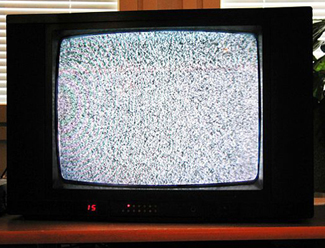
Snow.  CC BY-NC-ND 2.0

Snow. CC BY-NC-ND 2.0

This always reminds me of Neal Stephenson’s visionary novel, Snow Crash.  Published in 1992, Stephenson envisioned a post-nation state world in which people lived as citizens of corporate territories.  The former United States still excelled at two things, computer micro-code and high speed pizza delivery, the latter because the mafia had taken over the business.

In 1992, the year I first got a windows computer, an 8K modem, and an AOL membership, Stephenson imagined virtual worlds where people created avatars to jack in and interact.  Then someone launched a virus that messed with people’s brains.  Anyone who opened this malware saw a pattern based on ancient glyphs that led to the Tower of Babel.  Viewing these symbols scrambled their neurons, in essence, turning their minds to snow.

What struck me this past week were the parallels to our current media world.  I can’t help thinking of all the ways that commercials, local news, political debates, and most of what passes for entertainment scramble our neurons, though much more slowly and in ways that leave us perfectly able to buy stuff.

I could say more, but this is enough – something to think about.

Posts I haven’t yet written

Quite a few of my posts begin with ideas that rattle around until research or mulling them over generates enough interest to get me writing.  Time for contemplation and research have been in short supply recently and are likely to be for the next week, so grabbing this moment, I decided to mention a few things I am working on that may or may not get posts of their own in the future.

Water

With the drought on everyone’s mind, I was tempted to write a piece on the symbolism of water.  The problem is, (1) the subject is huge, (2) it’s already been done, and (3) a Star Trek episode keeps me from starting.  Every time I remember the silicon creatures who called humans, “ugly bags of mostly water,” all my attempts to stay focused and serious fail.  According to Mr. Data, it’s an accurate description of our species.  Thanks, dude.

http://www.youtube.com/watch?v=paH97dYR6Lg

There’s another approach to discussing water in California that centers on economics and politics.  I could discuss the millions of gallons we pour into fracking wells.  Or I could mention the president’s three hour visit to Fresno, complete with a photo-op in a dry field before jetting off to Rancho Mirage, but I don’t think I will.  If I want to get depressed over water, it’s easier just to rent Chinatown.

I’m writing a letter

Not just any letter.  I’m writing a letter of condolence to someone whose dog recently died.  It’s one paragraph forward and two back.  Those who have lost a beloved pet will understand how this letter is siphoning off most of the emotional energy I’m willing to invest in writing at this time.

Too many choices

A chain of associations based on some of my own experiences led to a fascinating but huge subject, the difficulty of having too many choices.

photo by Alexander Acker, 2010, CC BY-ND-2.0

photo by Alexander Acker, 2010, CC BY-ND-2.0

In his 2004 book, The Paradox of Choice – Why More is Less, psychologist Barry Schwartz writes that seeking the “perfect” choice is “a recipe for misery.”  Other researchers say, “The current abundance of choice often leads to depression and feelings of loneliness,” and “Americans are paying for increased affluence and freedom with a substantial decrease in the quality and quantity of community.”

This kind of subject deserves elaboration, but if you don’t want to wait for me to get around to it, just Google on “too many choices” and see what you find.

I’m learning Spanish

Yup, I started last summer on Rosetta stone, for a variety of reasons, including (but not limited to, or necessarily in order of importance):

  1. It seemed like a good idea at the time.
  2. Languages are supposed to be good for the brain.
  3. One night, flipping through the TV listing, it seemed like it would be fun to watch El Codico DaVinci on the Spanish station.

One of my Facebook friends who knew me back when, reminded me that in 7th grade Spanish, I was a class clown.  The reason was simple.  I believed I was “no good at languages,” and it became a self-fulfilling prophecy.  There’s a lot of satisfaction in erasing that misperception.  I came upon the Spanish version of book I have in English yesterday and flipped through it before deciding I’d better start in the children’s section.  I wonder if they have cartoons on Saturday morning on the Spanish channels?

Meanwhile, I don’t know why mid-February should be so busy, but it is, and I have to move on to the next thing, so let me summarize this post.

  1. Water is good, though flooding is bad.
  2. Few things are harder than losing a dog.
  3. Choosing things can be iffy.
  4. Learning a language sometimes carries the kind of excitement that learning to read must have done when we were kids.

Feel free to quote me.  Until next time, when maybe I’ll manage to write a real post…

Longmire

Wallpaper_Longmire_S02a

Thanks to a tip from our niece, Theresa, we’ve discovered a promising mystery show on A&E.  Longmire, based on a series of award winning novels by Chris Johnson, premiered in June, 2012.  Now in its second season, the first years’ shows are available on Netflix.

In the pilot, we find Walt Longmire (played by Australian actor, Robert Taylor), sherif of the fictional Absaroka County, Wyoming, returning to work a year after his wife’s death.  He gets a call from his deputy, Vic (aka Victoria, played by Katee Sackhoff), formerly a Philadelphia homicide detective.  Joining her on a remote ridge, they discover a dead sheep and a dead man, both killed by bullets from an antique Sharps rifle.

The victim is a teacher whose wife thought he was in Laramie.  With more digging and the help of his Cheyenne Indian friend, Henry Standing Bear (Lou Diamond Phillips), Longmire discovers the dead man was the father of a 16 year old girl whose Cheyenne mother reported her missing three months earlier.  That could present new problems; Longmire isn’t popular on “the Res,” having jailed the tribe’s chief for extortion.  A gun expert warns Longmire that the Sharps rifle can kill a horse at 500 yards.  Such an antique sniper’s weapon would only be used “by a coward or a professional, and both can be very dangerous.”

Longmire echoes the square-jawed defenders of justice from earlier era westerns – he reminds me of the McLoud mysteries that starred Dennis Weaver from 1970-77. This show, like our times, is darker and more full of angst than the earlier series. Look for the show on Monday’s on A&E, or on Netflix.  I plan to.

Homer in Iceland

Saga_of_Carl_Carlson_promo_4

Readers of this blog know I am a fan of things Icelandic and a fan of The Simpsons.  I was delighted last night to discover a little known saga on the final show of season 24 of our longest running television show.

If I’d only been more active last week on Facebook, where I follow The Simpsons, I would have been able to pass along advanced notice, but sooner or later, “The Saga of Carl Carlson” will show up on Hulu, so here is a brief description to whet your appetite.

When the gang at Moe’s tavern wins the lottery, Carl mysteriously disappears with the loot.  Lenny, Moe and Homer track him to Iceland, his native country since he was adopted by the Carlson clan as a child.  His pursuers learn that his goal is to clear the family name from a stain in a thousand year old saga.

Greed hangs in the balance with male bonding, but at last Homer speaks up in defense of Carl.  There are some great scenes of volcanoes, tiny horses, and northern lights, as well as appearances by Sigur Ros, the internationally known Icelandic band.  They provide the soundtrack as well, and their own take on the theme song.

http://www.youtube.com/watch?v=_0HJLafkKK8

Reunited at last back at Moe’s, Homer reflects on the strength of male friendship: “We don’t get together to share our feelings, we come here to escape them!”

“The Saga of Carl Carlson.”  Remember that if you are a Simpson’s fan and missed the show.  Check back on Hulu.  This episode is a lot of fun.

Remembering Max Headroom, a visionary TV show

max headroom newsweek

In 1984 I joined Intel as their graphic workstations  were shrinking from video arcade sized units to large desktop computers. In my spare time, I sometimes played with a Commodore64 and saved quarters for Space Invaders. The first IBM personal computer did not roll out until the following year.

That was the state of technology when Max Headroom was born.  The creation of a British trio, George Stone, Annabel Jankel, and Rocky Morton, Max was an artificially intelligent, disembodied personality who lived in cyberspace before the term was coined.  Computer animation wasn’t advanced enough to portray the computerized look the group was after, so filming Max required a four hour makeup session that actor Matt Frewer described as “a very painful, torturous and disgusting enterprise.”

Rocky Morton described Max as a “very sterile, arrogant, Western personification of the middle-class, male TV host,” but he was also “media-wise and gleefully disrespectful,” which endeared him to younger viewers.

Max appeared on American TV in 1987, as a talking head – literally – in a TV newsroom in a dystopian near-future dominated by large corporations and television.  Although he became a spokesman for “The New Coke,” and appeared on Sesame Street, only 13 shows aired.

Part of the problem was that Max was down right irritating, with his visual and vocal stutter and an op-art background that was the best computer animation could do at the time.  Here is a 3o second sample from his Coke commercial:

The fact remains that Max Headroom was decades ahead of his time. In one episode, for instance, terrorists blow up all TV towers in the city, pushing the population to riot when they find they have nothing to watch. In the nick of time, city officials pacify everyone by distributing hand-held video viewers loaded with old reruns.

Remember, this was 1987, when the best technology Hollywood had to offer wasn’t enough to capture the vision of Max’s creators.

So what brought Max Headroom to mind right now?  Beyond Max’s “dystopian future dominated by large corporation and television” that is.  Why today, December 3, 2012?

Yesterday, after  a series of storms, I ventured out to the supermarket and walked in just as they played the Christmas carol holiday song I hate most, “Little Saint Nick,” by the Beach Boys.  I had to compliment the store, however – the sound was just barely audible.  Not loud enough to cause real annoyance, I thought, but enough to keep silence at bay, which might cause people to riot.

That brought Max to mind.  “Ha-ha-ha-happy Ho-ho-holidays, everyone.”