
Thanks to a recent comment by Sara Lier, I have the correct attribution for one of my favorite quotes. It was Muriel Rukeyser, the American poet and activist, who said, “The universe is made of stories, not atoms.”
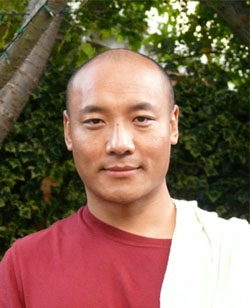
I think Anam Thubten Rinpoche would agree. In his latest book, The Magic of Awareness 2012, he says enlightened consciousness is available any time we can let go of our story lines. He talks a lot about meditation as resting, as a cessation of effort including all efforts to meditate, to get enlightened, or collect any other spiritual goodies:
“Deeply resting is the point where we are no longer looking for anything else. As long as there is an act of searching for God or truth or eternal self, it is not only that we haven’t found it; we are actually moving away from it with great speed.”

We can all remember moments when we were “no longer looking for anything else.” They are often our most joyous moments. Anam Thubten’s teaching centers on this experience, on the deep truth and joy it contains.
The illusion of separation of self and other, self and the world, lies at the heart of all our troubles according to Buddha’s teaching, which Anam Thubten restates for the 21st century. Good or bad, any concept of “I” leads to a friend-or-foe, fight-or-flight relationship with the world. Yet “this ‘I’ is a fictitious entity that is always ready to whither away the moment we stop sustaining it…All we have to do is simply sit and pay attention to our breath, allowing ourselves to let go of all of our fantasies and mental images.” (from No Self, No Problem, 2009).
There’s nothing dumb about statements like that, since the teachers who make them never confuse the relative and ultimate levels of truth. This is my car and that one is yours, and things work out better between us if we remember which is which. The problem comes if I decide your car is better than mine. If I conclude I’m the kind of person who never gets what he wants. Maybe I’m undeserving…
The ego, the sense of a separate self, can spin such stories forever. Fortunately, it doesn’t take much to glimpse the alternative vision. “Try this,” says Anam Thubten. “Pay attention to your breath in silence. Look at your mind. Immediately we see that thoughts are popping up. Don’t react to them. Just keep watching your mind. Notice that there is a gap between each thought. Notice that there is a space between where the last thought came to an end and the next one hasn’t arrived yet. In this space there is no “I” or “me.” That’s it.” That, he says, is our ultimate and eternal nature.
Ideas like this do not demand belief, just consideration and perhaps later exploration. The books listed here are a good place to start, as well as the website for Anam Thubten’s Dharmata Foundation, located in Point Richmond, California.
Einstein once said the only important question is whether or not the universe is a friendly place. It is, according to Anam Thubten, as soon as we let go of our conditioned ideas that it is something else. That realization, or at least a glimpse of it, is always closer than we think, no matter who we are and what we are doing.



 The First Gates