80th Annual Writer’s Digest Competition

This contest has been around longer than most of us have been alive (which is no guarantee of anything, but still…).  It offers six cash awards in each of ten categories, and one grand prize of $3000.  Deadline is May 2, but the rules indicate a “late entry date” of May 20 that will cost a $5 fee added to the $25 entry cost.  Enter online or by snail mail.  Categories are:

  • Inspirational Writing (spiritual/religious)
  • Memoir/Personal Essay
  • Magazine Feature Article
  • Genre Short Story (Mystery, Romance, etc.)
  • Mainstream/Literary Short Story
  • Rhyming Poetry
  • Non-rhyming Poetry
  • Stage Play
  • Television/Movie Script
  • Children’s/Young Adult Fiction

In addition to cash prizes in each category, there are other nice perks.  Subscriptions to writer’s digest and discounts for online seminars.  A local friend got one of the certificates given to the 11th – 100th place winners in each group, and it was a truly nice recognition that his submission had merit and an encouragement to keep at it.

So, nothing ventured…

http://writersdigest.com/annual?et_mid=122023&rid=3017168

The King’s Speech

I confess that despite the academy award nominations and four-star reviews, I wasn’t really looking forward to The King’s Speech.  In the back of my mind was the thought – “Come on – a full length movie about stuttering?”  The first two minutes of the film changed all that as the genius of Colin Firth and Helena Bonham-Carter pulled me into the pain this affliction brings to sufferers.  There are certain expressions you never forget in the movies, but I cannot recall such expressiveness, such anguish conveyed with so much restraint.  For an actor of the calibre of Firth, a glance or a momentary twist of the mouth can speak volumes.

Firth plays Prince Albert, the Duke of York, second son of King George V, and father of the current Queen Elizabeth.  As the film unfolds we glimpse the life-long pain “Bertie” has experienced – the badgering of his father and brother, and the failure he experiences at every “minor” address he cannot avoid.

Out of sheer desperation, Bertie seeks the help of Australian speech therapist, Lionel Logue (Geoffrey Rush) – and none too soon, for history is about to raise the stakes to a higher level than most of us ever have to experience.  His father’s death and his brother’s abdication leave Albert no choice but to ascend to the throne as King George IV.

“I am not a king, I am not a king,” Bertie cries again and again in the most moving scene of the film.  “I’m just a naval officer!”  But a king he must become in a hurry.  In the climactic scene of the film, he has to address his subjects all over the world when war breaks out with Germany.

Bertie and Logue on their long walk to the radio room made me think of Frodo and Sam on their final ascent to Mt. Doom, and why not?  Both are stories of people who feel completely inadequate to the demands of their fate, but who find the strength to act for their own salvation and that of their nation.  The difference, of course, is that these events really happened.

Young Adult vs. Middle Grade Fantasy

I know a sure-fire way to depress myself – visit the young adult section of the local Barnes & Noble.  I should explain.  None of my favorite authors or books like the ones I want to write are out on the shelves; everything is far too market researched, too hip, slick, and cool for the likes of moi.

I made my semi-annual visit recently, and went through my usual chain of thoughts.  Should I take a pseudonym and try my hand at vampire romance?  Should I do like Marcel Duchamp and spend the rest of my life playing chess?

Sooner or later – in this case, the same day – I come to a solution that works.  I stopped by the local library and went to the “middle-grade” stacks.  For readers in this range, roughly older grade school through middle school, fantasy never goes out of style.  Reading these books is like dipping into the fiction that really made me love fiction.

The YA/middle grade distinction is anything but exact.  Harry Potter is usually found in the middle grade section, and in thinking about that, a few differences became clear.  There is less introspection and more action, of course, but there is also a different quality to the characters’ introspection.

A middle grade hero like Harry worries that he is not adequate to take on Voldemort.  A young adult hero worries that he is not adequate.  They are just on different spots of the whole arc of coming of age, which I don’t think anyone ever fully outgrows.  I’m sure that is one reason why people of all ages love Harry.

Here is a brief synopsis of three middle grade fantasies I have thoroughly enjoyed, and which you may as well.

The Sisters Grimm: The Fairy-Tale Detectives by Michael Buckley

Two years ago I drove to a nearby Borders to hear Michael Buckley discuss his popular middle grade fantasy series, The Sisters Grimm. Buckley was snowed in on the east coast and forced to cancel, but interestingly, there were five adults and two seventh grade girls waiting when the news came.  The girls told us how disappointed they were, and gave a synopsis of the series.  Both said they liked these books better than Harry Potter.  When articulate young readers tell me they like something better than Harry Potter, I pay attention; I brought home the first three books of what has grown to an eight book series.

In book one, after their parents mysteriously disappear, Sabrina and Daphne Grimm are sent to live with their Granny Relda in the Hudson River town of Ferryport Landing.  Suspicious Sabrina has no patience with the tall tale this “grandmother” spins – that the sisters are descendants of the famous Brothers Grimm, whose fairytales were actually case files of the activities of “The Everafters.”  These strange and sometimes dangerous creatures of story actually exist in Ferryport Landing, where they were brought and contained by Wilhelm Grimm to ensure their survival.  When Sabrina sees Granny Relda taken by a giant who almost catches her and Daphne, she can no longer doubt.  The sisters must team up with Puck and Jack the Giant Killer to dodge the town police (the three little pigs), rescue Granny Relda, and get to the bottom of a shady real estate deal engineered by the foppish Prince Charming, the mayor of Ferryport landing.


Inkheart by Cornelia Funke

When she is twelve, Meggie Folchart discovers that her father, Mo, is a “Silver Tongue,” a person with a dangerous gift.  When he reads a tale aloud, characters from the book are drawn into our world, while people from our world disappear into the the story.  Meggie learns that her mother, Resa, vanished when Mo read from a rare book, Inkheart, while the evil Capricorn came here from the story.  He has since found his own Silver Tongue to read his henchman into this world, even as he seeks to destroy all other editions of the book, so that Mo cannot send them back.

Mo, desperate to rescue Resa, seeks out the author of Inkheart who still has one copy of the manuscript.  Mo, Maggie, and the author, are captured by Capricorn, whose personal Silver Tongue is of the poorest quality.  When Meggie proves to have the gift, Capricorn threatens to kill her mother unless she reads “The Shadow,” the ultimate evil, into this world.

Inkheart was made into a fun movie in 2009, starring Brendan Frazer, Helen Mirren, and Eliza Bennet as Meggie.  There are two additional titles in this series.  I have not read them, but a friend says each book is better than its predecessor.

The Spiderwick Chronicles by Tony DiTerlizzi and Holly Black
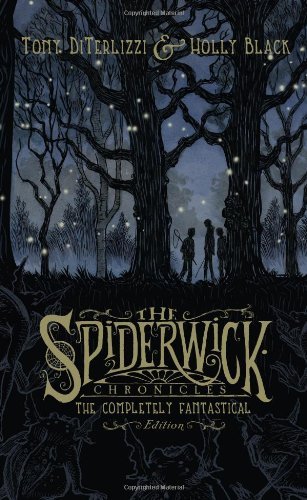
After his parents split up, Jared Grace, his mother, his twin brother Simon, and his older sister Mallory, find themselves in the broken down Spiderwick Estate.  It’s a dump, and even worse, right on the edge of Faerie.  When the Grace siblings find a mysterious Field-Guide to the nice and not so nice denizens of this other world, some very unsavory creatures are determined to get it back.  At first, poor Jared, with a history of anger issues after the divorce, is blamed for the mischief.  Later  the whole family joins together in a fight for survival.

The Spiderwick Chronicles consist of five thin books.  The edition pictured above contains all of them, because you won’t be able to read just one.  I started the books after seeing an enjoyable movie version in 2008.

What I am reading Next:

I love libraries, where I am free to choose a book by its cover, or in this case, by its title.  Next in my middle-grade book queue is The Faceless Fiend:  Being the Tale of a Criminal Mastermind, His Masked Minions, and a Princess with a Butter Knife, Involving Explosives and a Certain Amount of Pushing and Shoving, by Howard Whitehouse.  I’ll let you know how I like it.

Missy’s Homecoming Day, aka, Valentine’s Day

I’ve always been something of a Valentine’s Day Scrooge – “Humbug!”  Always, even in fifth grade, while trying to decipher the nuances of the text on candy kisses enclosed in the envelopes during the school Valentine swap.

I’m not doctrinaire about it.  I always bring Mary a card and some little treat.  And it is marvelous to stop to be mindful of the love and friendships we enjoy.  I’m just not a fan of Hallmark holidays.  It’s hard not to be a bit cynical when the hearts come out the last week of December, during the Christmas closeout sales.

Much of that cynicism ended two years ago, on Saturday, February 14, 2009, at noon.  Mary had spent the morning at Saint Francis Episcopal church.  Like their namesake, the good people there have a serious ministry with animals.  They rescue dogs and train them as companion and service animals for vets coming home from our wars.

Mary called to tell me an eight month old papillon had washed out of the program.  The little thing been mistreated or neglected, for she was much too hyper and skittish to make any kind of service training feasible.  “She is really sweet,” Mary said.  My wife later confessed that she was counting on me to be the voice of reason, and tell her to get real.  Didn’t happen!

Instead, I leashed up our other two dogs and took them over to meet Missy.  It was instant bonding, all around.  Humans and canines instantly warmed up to the little one, and she to us.  Thankfully, neither Mary nor I had any clue how much harder three dogs are to care for than two!  Missy was part of the family and we took her home within the hour.

Now Valentine’s day will forever have a face, one far more appealing than any stupid, rosy-cheeked cupid.  The hearts of people and animals do not seem to have any limits for how much love they can hold.  At this very moment I’m gazing at Missy curled up at my feet – one of the biggest hearts in one of the smallest beings I have ever had the joy of including in my life.

Missy

The World as Shapeshifter: A Hindu Parable

Generalizations are dangerous, and here comes a big one:  western cosmologies posit a substantial world because God made it.  Eastern traditions declare the world to be illusory because God dreams it.  This naturally shapes traditional tales of the east, where the emphasis is not on sorting out truth and illusion, but waking up altogether.  As one online Zen teacher quipped, “Strictly speaking, the phrase, ‘true thought,’ is an oxymoron.”

Vishnu Dreams the Universe

Quips aside, the Hindu tradition asserts that nothing is more difficult or more important than waking up to the illusory nature of ordinary appearances, which makes true seem false and false seem true. The name for this cosmic illusion is Maya, beautifully illustrated in the following story, in which Krishna, an incarnation of God, gives his disciple, Narada, an experience of Maya.  The one thing worth noting at the outset is that Narada was already a fully enlightened being; the webs of illusion can even snare a sage.

***

One day as they were out walking, Narada asked Krishna to explain the nature of Maya.  Krisha replied, “Narada, Maya cannot be explained, it can only be experienced.  Come with me.”

Krishna led them to a desert.  Narada asked what a desert had to do with anything, and Krishna said, “Just wait.”

They walked on until Krishna collapsed and said, “Narada, my friend, I can’t go any farther.  Will you get me some water?”

Narada walked on until he came to a village.  At the well, a beautiful young woman drew him some water.  Narada was so taken with her, he followed her home, and was welcomed by her father, the headman of the village.  Before long, Narada asked for her hand in marriage.  Her father agreed, on the condition that Narada stay in the village and live in the family home.

Shortly after the wedding, the girl’s father died, and Narada became headman of the village.  He prospered, and in time, four children were born, but just at the height of his success, a devastating cyclone blew through the land.  Narada put his family in a boat but it capsized in the flood, and his wife and children were lost.

The poor man crawled onto shore and collapsed in the mud, lamenting.  “My wife is gone, my children are dead!  How can I live without them?”

Just then he found himself at the feet of Krishna who said, “Narada, did you remember my water.”

***

It just seems wrong to add anything to a story like this, so I won’t.

Shapeshifting in Faerie: The Ballad of Tam Lin

One fall day, when I was a college sophomore, I was boiling water for coffee in my off-campus apartment, getting ready to leave for a 9:00am class.  A clock radio on the counter was tuned to the local progressive rock station, but I wasn’t really listening, until a driving tempo opened a song with a strong, urgent, woman’s voice singing what was clearly a piece of folklore:

I forbid you maidens all,
that wear gold in your hair,
to travel to Carterhaugh,
for young Tam Lin is there.

I turned up the volume…

Them that go to Carterhaugh,
but they leave him a pledge,
either their mantles of green,
or else their maidenhead.

I was hooked by then, all my attention on this music.

Janet tied her kirtle green,
a bit above her knee,
and she’s gone to Carterhaugh,
as fast as go can she.

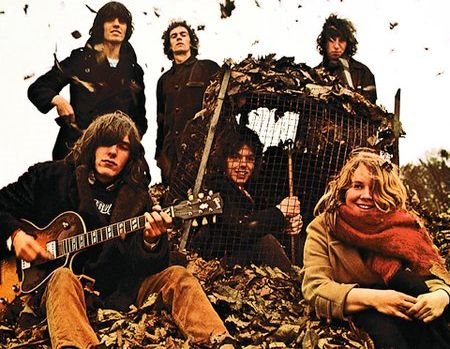
The group was Fairport Convention, the vocalist, an amazing singer named Sandy Denny who died in a tragic accident a few years later.  The song was, Tam Lin.

Fairport Convention

At the end of the day, I came home with the album, Liege and Lief tucked under my arm, and a backpack full of books like Folklore in the English and Scottish Ballads. You could say the passion that music ignited is with me to the present day:  it launched me into fantasy literature, shaped twenty years of storytelling, and this particular ballad is an important source for the fictional world I am building now for a heroine who wrestles with her fairy/mortal ancestry.

The ballad

Tam Lin comes from the Scottish border country and was first transcribed in 1549.  Francis James Child published 14 variants in his collection of English and Scottish ballads.  A mortal woman falls in love and conceives a child by a man who had been a mortal knight, until he was captured and somehow enchanted by the fairy queen.  In the Fairport lyrics:

Tell to me, Tam Lin, she said,
why came you here to dwell,
The queen of fairies caught me,
when from my horse I fell.

At the end of seven years,
she pays a tithe to hell,
I so fair and full of flesh,
am feared it be myself.

To disenchant her lover, Janet must hide at midnight on Halloween, at Miles Crossing, pull Tam from his horse, and hold on for dear life as the queen transforms him into a series of hideous and frightening shapes (I said this involved shapeshifting).  The queen turns Tam Lin into a snake, a newt, a bear, a lion, red-hot iron, and finally burning lead, at which point Janet does as instructed and throws him into a well, from which he emerges in his human form.  The queen is furious, and says if she had known of Janet’s loyalty, she’d have plucked out her eyes.  The real fairies of folklore are not nice people and are known to blind mortals who can see them.

Carterhaugh in 2005. You can still visit Tam Lin's well

Such renowned fantasy authors as Susan Cooper, Pamela Dean, Diana Wynn Jones, and Patricia McKillip have written novels based on Tam Lin’s story.  In 1970, Roddy McDowall directed a movie version staring Ava Gardner.  Countless individuals and groups have covered the ballad and there is at least one website devoted to nothing but exploration and creative elaboration of this song.  (see all these links here:  http://en.wikipedia.org/wiki/Tam_Lin)

What about the Shapeshifting?

Though Tam Lin is local to Scotland, the motif of disenchanting someone by holding on through countless frightening transformations is common to folklore throughout Europe.  This tale of shapeshifting is really quite different from Barth’s Menelaiad, discussed in the previous post.

There is a youthful, hopeful quality in this story of a heroic young woman who knows what she wants with such a fierce determination that nothing can thwart her, not even all the illusions and false paths that waylay most people’s dreams.

There is a quality of angst in Barth’s story question:  how can we ever sort out what is true from what is illusion?  I recall that after his campus visit, several sophomores proclaimed the death of literature as we know it.  Janet and Tam have no time for that – if this be illusion, play on, they would say (to badly misquote the bard).

Tam Lin explores the illusions of young lovers, while the Menelaiad does the same for a middle-aged and war-weary king.

Our final story of shapeshifting comes from India, and is several millenia old.  It sits somehwhere between the optimism and pessimism of the first two tales.  Yes, it affirms, life is a series of dreams, where dreams of joy transform into nightmares and back again endlessly – but imagine the joy of waking up.  That awakening, according to this tale, is nearer than we think.

Meanwhile here – as timeless as any fairy artifact – is Fairport Convention’s version of the Ballad of Tam Lin:

http://www.youtube.com/watch?v=jy3ihk205ew

On Shapechangers: Proteus in John Barth’s, The Menelaiad

I’ve been thinking a lot about shapechangers over the last few months.  I’m trying to refine the villain in my current novel, and I really want to give him shapechanging powers, but he needs some restrictions.  Presumably, a villain with an unlimited ability to change his form instantly and at will could never be caught.  That would be a different story than the one I am writing.

The figure of  “The Shapechanger” has fascinated me since I heard John Barth read his story, “The Menelaiad” four decades ago.  I have never forgotten that tale or several related stories which I will discuss in future posts.  “The Menelaiad,” was published in Barth’s collection of short fiction, Lost in the Funhouse, in 1968. English majors love it as “metafiction,” writing about writing, but what really caught me is the “simple” image of a man who wrestles a shapechanger and can never again be certain if his life is really unfolding as it appears, or if he is still engaged in the wrestling match.

Barth was fascinated with “frame tales,” stories within stories.  A classic example is The Arabian Nights.  Scheherazade  tells stories with multiple characters who each tell their own stories, often with people within those stories telling stories.  Barth claimed that in his search of world literature, he never found a story that went deeper than five levels, so he decided to write one with seven.  He began with an episode from the Odyssey, which has plenty of shapechanging and frame tales as it is.

Barth chose the episode where Menelaus, husband of Helen (who launched a thousand ships) relates how he was blown off course, to the Nile delta, after the fall of Troy.  (He tells the tale to Telemachus, son of Odysseus, who was urged by the goddess Athena in the shape of Mentor, an elderly advisor, to seek for news of his missing father – clear enough?)

Luckily for Menelaus, Eidothea, the daughter of Proteus, the Old Man of the Sea, falls in love with him, and relates how he may win sure and certain advice from her father who does not like to dispense such information.

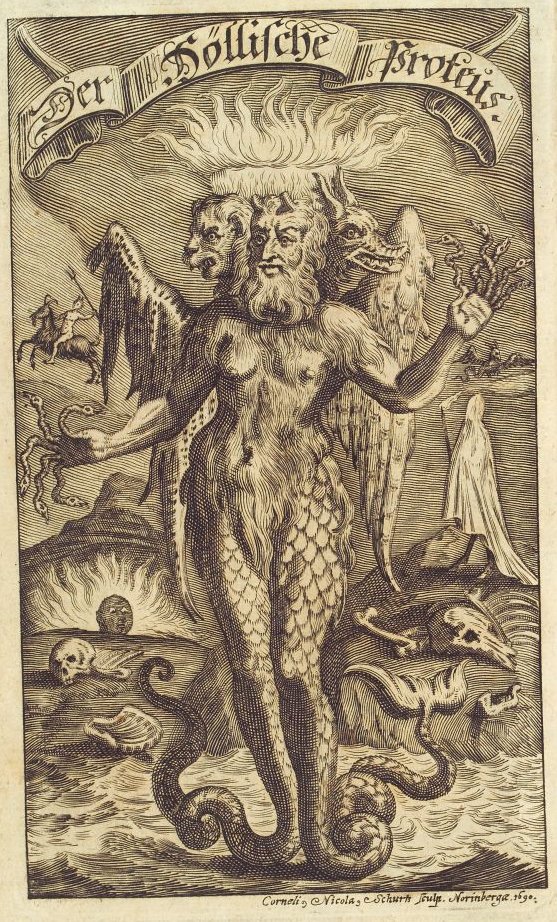
Proteus is herdsman of Poseidon’s seals, so Menelaus must hide himself in a smelly sealskin, jump Proteus when he comes into his cave at noon, and hang on for dear life, for Proteus:  “can foretell the future, but, in a mytheme familiar from several cultures, will change his shape to avoid having to; he will answer only to someone who is capable of capturing him. From this feature of Proteus comes the adjective protean, with the general meaning of “versatile”, “mutable”, “capable of assuming many forms”.  http://en.wikipedia.org/wiki/Proteus

Proteus, The Old Man of the Sea

Barth has a field day letting Menelaus tell the tale of conversations with different people at different times – when someone related what someone else related about what someone else related, he relates.

And yet, for all the tour de force writing, the central image of the tale is like a koan that stays with you.  While holding on to Proteus, Menelaus realizes he can never again be sure that Proteus has not changed into Menelaus holding Proteus, and if so, what or who is he?  All he can know for sure is that he is a voice asking who or what he is.

***

There is a classic Zen story of a man who dreams he is a butterfly.  When he wakes, he wonders if he is a man who dreamed he was a butterfly, or a butterfly dreaming he is a man.

It’s easy to flip the page and forget about that particular story.  It is harder or even impossible to forget Barth’s “Menelaiad,” once you make the effort to wade through some of his bizarre invented ways to use quotes in ways they were never designed to be used.  “”””This is frustrating!”””” he said, she recounted, he told me, I say.

I’ve always suspected that Proteus predates the Olympian pantheon of classical Greece, for what could be more antithetical to the ideals of clarity, order, and rational philosophy than a shapechanger?  There really is no character in mythology more dangerous to any kind of fixed worldview than one who can plant the seed of doubt at the core of awareness.  “Is this really true?”  “Are things really as they appear to be?”  The moment consciousness really and truly begins to entertain questions like these, the wrestling match has begun.

NEXT:  A ShapeChanger in Faerie.

Stylish Blogger – Moi?

Show of hands, how many liked gold stars in grade school?  Me too.

My friend, Rosi Hollinbeck, who blogs at The Write Stuff  http://rosihollinbeckthewritestuff.blogspot.com/, honored me with a Stylish Blogger Award, which is a kind of updated gold star for the information age.

What I have to do now is tell you seven things you did not know about me and then pass on the award to other bloggers I enjoy. So…

Seven Things You Did Not Know About Me

1)  I was born in Poughkeepsie, NY, home town of at least one celebrity, Ed Wood, the cross-dressing director of Plan Nine From Outer Space who was played by Johnny Depp in the 1994 movie.

2)  My first ambition in life, formed in early grade school, was to be a Paleontologist.  I’d read a biography of Roy Chapman Andrews, who made important discoveries in the Gobi Desert, and I had visited the New York Museum of Natural History.  Camp out in the desert, not wear a tie, dig up dinosaur bones – even today, that sounds like a pretty good job description!

3) When I was 15, my father’s work took the family to France for two years.  Not only did I get to soak in the atmosphere and art of Europe at a very impressionable age, but I also absorbed a huge dose of cultural relativism.  Since that time, I tend to experience every environment as an outsider – uncomfortable sometimes, especially when I was younger, but as a contemplative and a writer, seeing the ordinary as strange, and the strange as not so unusual has come to seem like a normal point of view.

4) I started writing stories about animals in the fourth grade.  In the fifth grade, I wrote a sequel to Wind in the Willows.  In high school I edited literary magazines.  When I went to college, I majored in English – a bad move, I am convinced, for someone who wants to be a writer.  English was so dry and the visual arts so compelling at that time, I transferred schools and majors in my junior year.  This was either (1) an unfortunate detour that took me away from writing for several decades, or (2) a necessary path of self-discovery, depending on how I look at it.  Most of the time, I see it as #2.

5) I taught drawing and photography at Butte College from 1980-1983, but after severe budget cuts, I went into computer graphics – not the whizzy, Pixar stuff, but engineering graphics, which proved to be a fortunate choice and a good way to make a living over the last quarter century.

6) A mutual friend had been trying to introduce Mary and me for some time, but she did not want to meet me.  Only John’s threat of cutting her off from his excellent Sunday brunches persuaded her to come.  Luckily for the both of us!  If all goes well, we will celebrate our 35th anniversary in June.

7) At the end of December, I retired.  A long chain of fortunate events and good karma allowed me to leave my day-job to work on pursuits like this that are closer to my heart.  I have not written about it before this because I’m still not used to it.  On Sunday afternoons, I still find myself thinking, “Oh crap, I haven’t done half of what I wanted to this weekend!”  Only later do I realize that Mondays are not as tough as they used to be.

Some Favorite Blogs

1)  Fiction after fifty:  Interesting ideas, trends, hints aimed at writers starting out later in life.  http://fictionafter50.com/

2) “I’ve noticed that blogs are mostly about the news, but I am going to go with The Olds.  Like my erstwhile Concord neighbor Thoreau, I prefer to reflect upon the timeless.” So begins the brief introduction to the blog of Lama Surya Das, who reflects on these timeless concerns from a unique point of view, informed by Tibetan Buddhism, but accessible to anyone:  http://surya.org/wp/

3)  Dr. Amy Rogers, a fellow member of the local chapter of the California Writer’s Club, writes and reviews medical and science thrillers, everything from The Andromeda Strain to Hound of the Baskervilles on sciencethrillers.com: http://www.sciencethrillers.com/about/

4)  At Tracking The Words, you can check the daily progress of a writer who has decided to self-publish this year.  You can find numerous links to the rapidly changing technology and attitudes toward ebooks and other non-traditional methods of getting your story into the hands of interested readers.  http://writingcycle.wordpress.com/

5) The Writer Unboxed:  A very active site with a rich store of interviews with authors and people involved in publishing.  I got some of the information for my post on Donald Maass from pieces on this site:  http://writerunboxed.com/

There are far more interesting blogs than hours in the day to discover them, so I will continue this later.