Dwight Swain’s Motivation-Reaction Units

A recent discussion in one of my critique groups sent me back to my reference-of-choice for writing fiction, the book I would probably pick if I could have only one book on writing.  This is the writing book I’ve read cover to cover twice and dipped into many other times.  It was written in 1965 and updated in 1982 by Dwight Swain, a long-time professor at the University of Oklahoma, who gave it the slightly embarrassing title, Techniques of the Selling Writer.  I’m sure he did it on purpose.  There’s a no-nonsense, let’s-get-real quality to the book; show me a writer who wouldn’t like to get paid for prose.

I went back to the text to look up one of Swain’s most valuable concepts, and hands down, the one with the silliest name: the Motivation-Reaction Unit, aka, (you guessed it) the MRU.  I think this name is deliberate too; once you get it, you never forget it.  You can look up another take on MRU’s on Randy Intermanson’s AdvancedFictionWriting.com, the site where I first heard of Dwight Swain: http://www.advancedfictionwriting.com/art/scene.php

***

Motivation-Reaction Unit is the fundamental building block of an action sequence (it’s important to stress that it does not apply do description, exposition, or reverie).  It’s pretty simple:  something happens, the hero reacts to it, the situation changes, and something else happens.  How characters react to events will largely determine their plausibility and how closely we bond with them.

There’s a lot more to it than that, of course, but this is an introduction.

The Motivation part is the easiest:  something external happens, something apprehended by the senses.  The house catches fire, a car almost hits me, the boss says, “You’re fired,” I pass a bakery and smell bread like my grandmother used to bake.  The key point here is to chose events that are meaningful to the character or the story:  a flight of Canadian geese overhead might change the life of a man in a dead-end job and a loveless marriage, who has always equated birds with freedom, but if the same man only worries about getting pooped on, why include it at all?

The Reaction component is harder:  it includes three events that Swain calls Feeling, Action, and Speech.  Ingermanson calls them Feeling, Reflex, and Speech.  I call them “Involuntary Response, Reflex, and Speech/Decision.  In real life they can be virtually simultaneous, but in fiction we need to write them sequentially.

Feeling, as Swain uses it, refers to an immediate, involuntary response –  what do you do when a horn blares behind you?  That is why I prefer “involuntary response.”  It may be physiological – you jump out of your skin at the horn, but depending on the stimulus, it could be a memory – what does the smell of the bread bring up?

Reflex or Action is a response I have some control over, and as such, will reveal more of my character than being startled by a loud noise.  I may spin in the direction of the horn with clenched fists.  Or grasp a parking meter to steady myself.  Or count to ten.  Or pull the gun from my shoulder holster.

Speech/Decision is where response is most rational.  It’s going to involve rational thought/feeling, expressed as speech or as inner dialog, and maybe a decision.  Maybe the horn-blower is Eddie Haskel, an old high school adversary.  Maybe I say, “Jeeper’s Eddie, I’ve asked you before to quit doing that,” then I slink away with bent shoulders, berating myself once again for not standing up to him.  Maybe I aim my 38 at his head and say, “This time you’ve gone too far, dirt bag!”  Maybe, if I’ve smelled grandmother’s bread, I think “There’s a poker game tonight.  If I’m lucky, I could win bus fare to get back home.”

The key point Swain makes is that we don’t need all three responses to every stimulus; two or even one will do, but, the responses must come in this order, from least-to-most “rational” to avoid confusion.  It makes no sense to say, “When I spotted Eddie Haskell, I drew my 38 and aimed at his head.  I nearly jumped out of my skin when he blared the horn.”  You get the idea.

SO WHAT???

We want readers to feel what we want them to feel, and our greatest chance is usually through the protagonist.  If the audience bond’s with our lead character, and the character’s responses to events are plausible, the audience will deeply experience what they experience.  Huck Finn, Ebenezer Scrooge, Frodo Baggins.  Swain has presented a template.  Constraining?   Yes, but like the constraints of a three act structure, or pigment on a rectangular canvas, I think there’s a lot of room for creativity within the MRU structure.

I caught myself not long ago, relying too heavily on just the immediate and largely inarticulate visceral responses of my character to convey emotional states; it wasn’t working.  When I came back to Swain I realized I had a pattern.  I realized my approach wasn’t wrong, so much as it was insufficient.  I had more work to do.  We always have more work to do – it helps when we know what it is.

Indian Grinding Rocks State Park

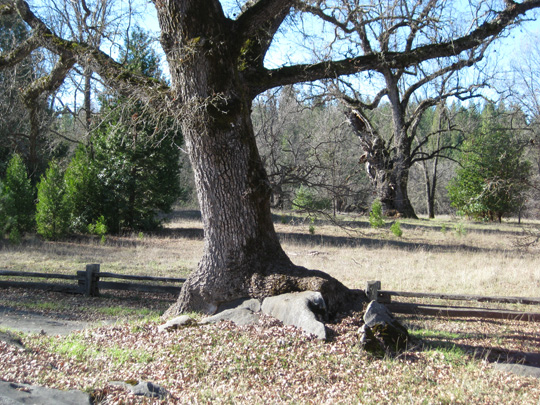
Every year about this time, when the days are mostly rainy or foggy, I find myself drawn to Indian Grinding Rocks Park, a gem of a state historical park in the foothills, east of Sacramento, and about eight miles east of Jackson.  At 2400′,  the skies are often blue in January, and green shoots poking up through the brown grasses hint at spring.

Grinding Rock Mortar Holes

The Miwok people called the place Chaw’se, meaning “grinding rock,” and camped here in the fall to gather and process acorns.  There are 1185 mortar holes on soft slabs of limestone where year after year the women pounded acorns into flour and meal while the men hunted, to lay in supplies for winter.  Petroglyphs are carved on the mortar slab, though some of them, estimated at 2000-3000 years old, are becoming faint.

An excellent museum displays arts, crafts, tools, and California tribal history.  Native American teachers demonstrate crafts like basket weaving and flint knapping on the second saturday of most months.  Native people use the reconstructed roundhouse for ceremonies at various times of the year, with the largest, the Big Time, at the end of September.  For several days, acorn harvest time is celebrated with native food, crafts, storytelling, and public dances during the day.  Tribal members hold privae ceremonies at night.

Chaw’se Roundhouse Entrance

Going in January is a great way to shake off cabin fever and simply enjoy the little valley, although it’s too early to get the full benefit of one of my favorite parts of the park, a self-guided trail along the creek and up a hillside, with markers for 18 plants the Miwok used for medicinal and other purposes.  Nothing is in yet in bloom, so aside from tree-based medicines like willow bark, there is no chance for real recognition.

The park service has reconstructed the temporary bark structures the Miwok used during the acorn harvest.  A friend camped in one in the fall with a group of boy scouts and said the nights were really cold!

The elephant in the living room for all  California parks at this time is the impact of budget cuts in the wake of our fiscal crisis.  Hopefully Grinding Rocks, a living monument, will be spared from a dire  reduction of services, but anyone planning a visit, especially from far away, should call or check the website:   http://www.parks.ca.gov/default.asp?page_id=553

There are nice picnic facilities, but no concessions so you need to bring snacks at a minimum; the nearest town is three windy miles away.  A “primitive” campsite with 27 spaces overlooks the park; I’ve had friends drive up at the start of holiday weekends with no reservations and find room.

***

I have always found something compelling about winter in the California foothills, something plain or basic about the simplicity of sky, tree, and grass.  The abundance of foliage, humming insects – and crowds at a place like Chaw’se – will come later.  Now there is just the growing warmth of the winter sun, the voice of the wind, and a feeling of home that people have shared in this spot for thousands of years.

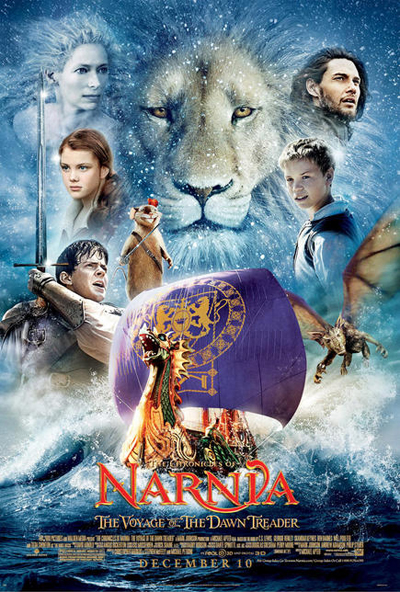
The Chronicles of Narnia: The Voyage of the Dawn Treader

Okay, once again I waited until nearly the end of a theatrical run to see a popular movie. I don’t know if there is a name for my condition: an almost pathological fear of seeing new releases in crowded theaters that harks back to the trauma we suffered when first attempting to see Star Wars. The theater sold overbooked tickets, just like an airline, and we had to leave just as Darth Vader appeared.

Voyage of the Dawn Treader is the third book of C.S. Lewis’s Chronicles of Narnia, and this movie is the first produced by Fox after Disney let go of the franchise when Prince Caspian, the second film, posted disappointing returns.

I can understand that to a degree. I’ve read the first Narnian chronicle, The Lion, The Witch, and the Wardrobe, many times; not so the others. The first book has things guaranteed to enchant the dreamer in all of us: a magical world in a clothes closet, filled with talking animals, where children become kings and queens, and defeat a great evil with the help of a lion who is a thinly disguised Christ figure.

I do not propose to outline the series for those who are not familiar with it, but pose a question the movie raised. What do we make of a film that is more compelling than the book because of the director and screenwriter have added elements the author did not?

Blasphemous as this may sound, I found Peter Jackson’s film treatment of Tolkien’s Lord of the Rings more compelling than the book, but those movies remained scrupulously faithful to the text.

In Dawn Treader, the two youngest Pevensie children, Lucy and Edmond, and their obnoxious cousin Eustace, are transported to Narnia to help King Caspian on his voyage to the east to find seven missing lords of Narnia.  I remember the book as a series of episodes that were not connected thematically except through the characters’ battles with temptation:  Lucy’s desire for Beauty, Edmond’s desire for Power, and Eustace’s Greed which causes his temporary transformation into a dragon.

Let’s just say that when the first of this series of movies came out in 2006, I set out to reread the seven books, and gave up in the middle of this one.

In Dawn Treader, the final test that is overcome is a dark island where dreams come true.  Lewis alludes to, but doesn’t dwell on the possibilities of a world where truth and illusion are indistinguishable; with Aslan’s help, the crew rescues the final lord and makes their escape.

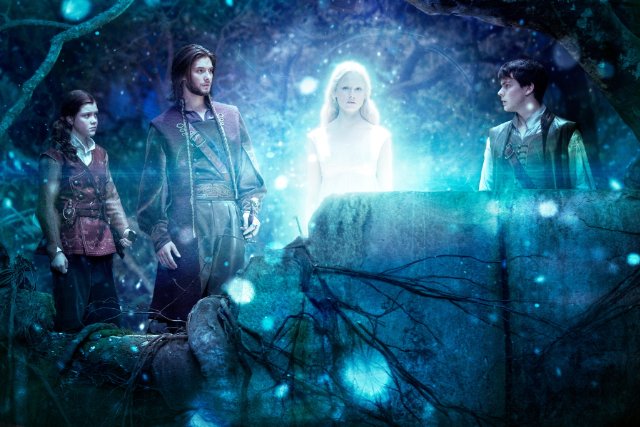
Director Michael Apted makes this dark island central to the story:  the crew and all of Narnia are threatened by a great evil that can take any shape – it mirrors each individual’s hopes and fears.  This is a very personal darkness, a tailor-made evil, a Satanic force that Christian theology imagines, but which Lewis did not in the third book of his series.

This force is also Mara, the demon lord of Buddhist theology who evoked the most piercing desires and fears in an effort to overcome Prince Siddartha on the night of his enlightenment.

“Value added,” is a business term I first heard in the 90’s applied to Intel, which takes silicon, one of the most common elements on earth, and transforms it into microprocessors.

“Value added” is also what Michael Apted did in fleshing out the unrealized potential of C.S. Lewis’s book, to portray each individual’s unique path of heroism.  In the words of the magician, Coriakin, “You cannot hope to overcome the darkness without until you subdue the darkness within.”

Another Short Short Story Competition

Here is another short-short story contest, this one with no restrictions other than word count.  It is sponsored by the Sacramento Branch of the California Writer’s club, but listed as open to all writers.

750 word maximum,

March 31 deadline.

$10 entry fee.

Prizes of $100, $50, and $25.  Winners will be announced in the June Sacramento Branch newsletter and subsequently published there.    Here are the details:

http://www.cwcsacramentowriters.org/special-events/contests/2011-short-short-story-contest/

Welcome to the New World Order

The title of this post is actually a lyric from one of the Springsteen songs I posted, but also fits what I want to talk about today.

One afternoon twenty years ago, as I sat in my cubicle watching the clock inch toward 5:00, two friends from the IT department came over and asked if they could install something interesting called, “Mosaic” on my computer.  Ready for any diversion, I said, “Sure.

For those who do not remember, Mosaic was the first publically available internet browser. I spent the next three hours transfixed, only logging off when hunger drove me from the building. I didn’t realize I had witnessed something as significant as the steam engine – the world had started to change.

The other half of this equation manifested within the year – NAFTA – although us techies were slow to see what was happening as we continued to rake in the bonuses, at least for a while, for enabling the change.

It’s old news now:  the twin engines of the internet and globalization have changed the landscape of work forever, for everyone.  According to two significant articles I came upon recently, too few of our leaders are acknowledging what everyone in the trenches knows.

I glossed over the articles in my Springsteen post, which does not do them justice; both are worth reading.  The gist is that no amount of stimulus money, or politicians “plans,” or “business friendly environments” are going to bring back many jobs that a changing world has made obsolete.  In this country, economic recovery will not restore opportunities for elevator operators, gas station attendants, most travel agents, most manufacturing workers, or the tens of thousands of software engineers whose work is now done overseas.  New “efficiencies” have allowed occupations in all industries to be “right-sized.”

Here are the articles:

“Where the Jobs Aren’t:  Grappling With Structural Unemployment,” by Zachary Karabell, Time, January 17, 1011.
http://www.time.com/time/business/article/0,8599,2040966,00.html/

“Many Jobs Gone Forever Despite Onset of Recovery,” by Darry Sragow, The Sacramento Bee, Jan. 8, 2011,
http://www.sacbee.com/2011/01/08/3308378/many-jobs-gone-forever-despite.html/


In my opinion, all this was well underway ten years ago, but masked by a decade-long economic sugar-rush comprised of a housing bubble and military spending.  Quite a few people saw it for what it was.  In 2005, someone on a financial bulletin board quipped that soon Americans would earn their living selling each other beanie babies on eBay.

The grand irony as a tech worker over the last decade has been seeing so many positions eliminated as a direct result of our success.  Young yang always becomes old yang, according to the I Ching.

***

I have been thinking about how this affects writers.   On one hand, as Dylan said, “When you got nothin’ you got nothin’ to loose.”  I know published authors, but none who make their living solely from writing.   A while ago, someone asked Gary Snyder what he would do if he was just starting out as a poet.  Snyder, who has written poems about fixing old pickups, said he’d probably get a day-job as an auto mechanic.  For most of us, with vocations different from our avocation, not too much has changed.

This may be Pollyanna-ish, but I tend to think the internet represents mostly upside for us.  I do not mean just opportunities for exposure, though these are important, and I am certain new avenues will continue to emerge.

I am talking of information or services that one may fairly ask and receive payment for.  One example is Randy Ingermanson, whose AdvancedFictionWriting.com is listed on my Blogroll.  He charges a nominal fee for some of his online classes, and if they are as worthwhile as his free discussion of the “Snowflake Method” (for working out plot and structure), they are probably worth the cost.

The internet holds more information and services than any of us could use in ten lifteimes.  How does any one site rise above the crowd?  By specializing, somehow aligning with personal passion, I suspect.  Beyond Google I probably visit no more than a dozen sites on a regular basis, all of them very focused on topics of interest to me.

Sometimes over coffee I fantasize different internet ventures the way I fantasize story plots.  It recently struck me that it’s probably harder to write even a bad novel than to dream up an online venture that could generate income, if one was so moved and motivated.

What does it take after all, at a minimum, to write a novel?

  • A high degree of desire and determination.
  • In depth knowlege of fiction in general and one’s genre in particular.
  • Imagination to dream up story ideas, pick one, and continuously refine it.
  • The company of like minded people for advice and support.
  • Several years worth of evenings and weekends.

Isn’t it likely that if someone focused this kind of effort on an online endeavor, something worthwhile would come of it?  And if it happened to mesh with one’s passion…well, that is worth pondering over a cup of coffee.   Hmmm, now what features would you want in a beanie baby exchange?

750 Word Short Short Story Contest

Could you write a 750 word story with bars and restaurants as the theme?  How about for $1000 and the chance to have your story broadcast on the Selected Shorts public radio series?   Those are the prizes in the 2011 Stella Kupferberg Memorial Short Story Contest.

The entry fee is $25, the deadline March 1, and this year’s judge will be Jennifer Egan:  “a National Book Award finalist and the author of The Invisible Circus, Look at MeThe Keep, as well as a short story collection, Emerald City. Her new book, A Visit from the Goon Squad, was published in June and her short story Safari was selected by Richard Russo for Best American Short Stories 2010″

The following link has all the details and a FAQ that explains a bit about the contest and the Selected Shorts organization:

http://www.writingclasses.com/ContestPages/Kupferberg.php?utm_content=13221253?utm_campaign=New%20Writing%20Contest%20-%20New%20Workshops%20-%20Advice%20from%20Janet%20Evanovich?utm_source=streamsend?utm_medium=email

Let’s see:

It was a dark and stormy night.  “Of all the gin-joints in all the world,” he muttered…

Only 733 words to go!

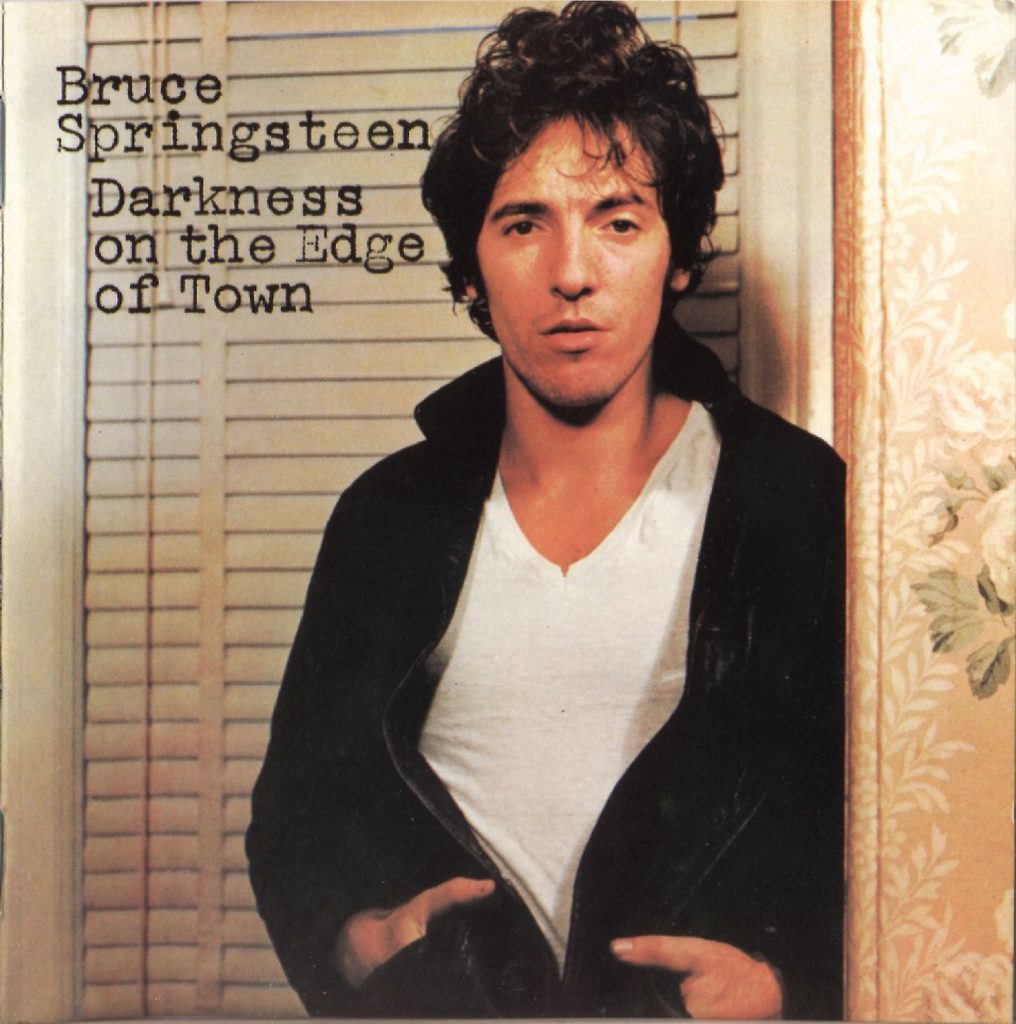
Darkness on the Edge of Town: Homage to The Boss


This post started as something completely different, but it swung like a compass needle toward something I truly love – the music of Bruce Springsteen.

I blog about all sorts of things that interest me, that I enjoy, that make me laugh. I sometimes write about ambitions and guiding philosophies, which are very important, but strangely, I have neglected how much music means to me.

I’ve been a huge Springsteen fan since I first picked up Greetings From Asbury Park in 1973. The man should be Poet Laureate of America, for as someone observed, who else can make you feel nostalgia for New Jersey?

***

I started the morning intending to post on two very significant articles I read in the last two days on structural, rather than cyclical, unemployment in this country.  This is something I think about often because my career in technology spanned the revolution that made it so easy to “offshore” and eliminate so many vocations.  Show of hands, how many are reading this on a computer that was assembled in the US?  As I thought, not a one.

The following are very good articles, that point out that we have a real problem that cannot even be addressed until it is acknowledged, which politicians have yet to do:

“Where the Jobs Aren’t:  Grappling With Structural Unemployment,” by Zachary Karabell, Time, January 17, 1011.
http://www.time.com/time/business/article/0,8599,2040966,00.html/

“Many Jobs Gone Forever Despite Onset of Recovery,” by Darry Sragow, The Sacramento Bee, Jan. 8, 2011,
http://www.sacbee.com/2011/01/08/3308378/many-jobs-gone-forever-despite.html/

As usual, however, poets see things before others, and Springsteen has been telling us since 1978 that we have a darkness at the edge of town.

***

What follows is a blatant excuse to upload some really good music – kind of like a Blues Brothers movie, where anything resembling a plot is secondary.

Here is an anthem everyone loves, perhaps because so few of us live in the place where we grew up.  Yet “My Hometown,” 1984, explicitly laid out the issue of “structural unemployment” a quarter of a century ago:

Now Main Street’s whitewashed windows and vacant stores
Seems like there ain’t nobody wants to come down here no more
They’re closing down the textile mill across the railroad tracks
Foreman says these jobs are going boys and they ain’t coming back


A poet will also recognize how work is much more than balance sheets and GDP; it touches every aspect of individual and family life.  From “The River,” 1980, live at Glastonbury:

I remember us riding in my brother’s car
Her body tan and wet down at the reservoir
At night on them banks I’d lie awake
And pull her close just to feel each breath she’d take
Now those memories come back to haunt me
they haunt me like a curse
Is a dream a lie if it don’t come true
Or is it something worse…


And finally, two more recent favorites, from the 1995 album, “The Ghost of Tom Joad.  They are self-explanatory.

Hot soup on a campfire under the bridge
Shelter line stretchin’ round the corner
Welcome to the new world order
Families sleepin’ in their cars in the southwest
No home no job no peace no rest

The highway is alive tonight
But nobody’s kiddin’ nobody about where it goes
I’m sittin’ down here in the campfire light
Searchin’ for the ghost of Tom Joad


And from the same album, “Youngstown,” performed in Youngstown, Ohio:

From the Monongaleh valley
To the Mesabi iron range
To the coal mines of Appalacchia
The story’s always the same
Seven-hundred tons of metal a day
Now sir you tell me the world’s changed
Once I made you rich enough
Rich enough to forget my name

And finally, to end on an upbeat note, a favorite recent Springsteen cut, performed live in London, 2007 I believe.  This is “The Sessions Band,” assembled for “The Seeger Sessions,” a CD tribute to the music of Pete Seeger on the occasion of his 90th birthday.  That recording, and “Live in Dublin,” are a can’t-sit-still mix of folk, rock, gospel, and jazz music.

God gave Noah the rainbow sign
“No more water but fire next time”
Pharaoh’s army got drownded
O Mary don’t you weep


If this appeals, be sure to check out The Boss’s web page: http://www.brucespringsteen.net/news/index.html
http://www.brucespringsteen.net/news/index.html

Workshop with Donald Maass, Feb. 21, in San Francisco

In response to my post yesterday about the agent workshop in Sacramento, I got a very nice email from Margie Yee Webb, President of the Sacramento Branch of the California Writer’s club, and author of Cat Mulan’s Mindful Musings: Insight and Inspiration for a Wonderful Life which is scheduled for publication in February, 2011. Congratulations Margie!!!

Ms. Yee informed me that Donald Maass, whose, Writing the Breakout Novel, I reviewed here (see the December archive), is giving a half-day seminar called “Micro-Tension: The Secret of the Best-Sellers.”  This will be a post-conference session in connection with the San Francisco Writer’s Conference:

This workshop has been given to rave reviews throughout North America by the man who wrote the book (and workbook) on writing the novel that will break you out of the pack. In the course of two decades Mr. Maass has arrived at a number of definite and highly perceptive conclusions on just what the differences are between an ordinary, pedestrian but enjoyable novel and an ostensibly similar work that catapults the book and its author into an entirely new plane of literary success.

Details on the San Francisco conference and this workshop can be found in the comment Ms. Yee was kind enough to post here:

https://thefirstgates.com/2010/12/07/donald-maass-and-the-breakout-novel/#comments