Joseph Cornell’s Dreamtime

Looking at Malcolm Forbes’ toys in the previous posts reminded me of one of my favorite American artists, Joseph Cornell (1903-1972), who built windows into our dreams, into other times, and other worlds.

Untitled (Hotel Eden) ca. 1945

Cornell, who was wary of strangers and self-taught as an artist, led a reclusive life, most of it in a wood-frame house in a working class neighborhood in Queens. Though he had galleries and collectors from an early age, I have never seen him listed among the “major” American artists of the 20th century. One of my college art history professors suggested he was “ahead of his time,” in the missed-the-boat sense, noting that in the 60’s, Robert Raushenberg gained art world super-star status with constructions and collages similar to those Cornell had begun in the 30’s.
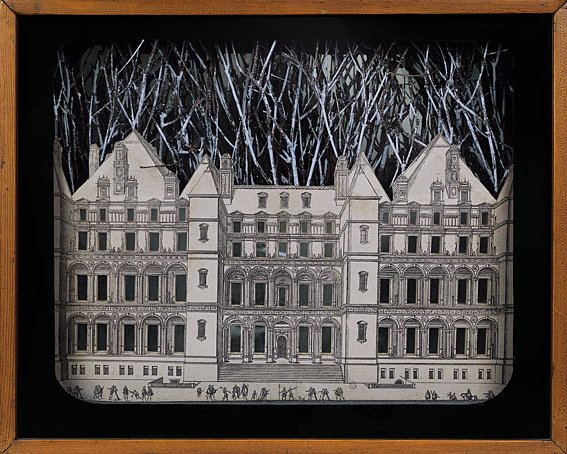
Setting For a Fairytale

I think there was much more to it than that; I find it significant that Cornell, described as “frighteningly well read,” had a special affection for the poetry of Emily Dickinson, another reclusive soul, and Arthur Rimbaud, who firmly rejected the literary and artistic “establishment” of his time.

Cornell said what he wanted in his art was “white magic.” It’s hard to imagine such a subtle ambition surviving the grand gestures and conscious self-promotion of the artists of Warhol’s generation. Cornell’s distance from that mileau seems to have been deliberate.
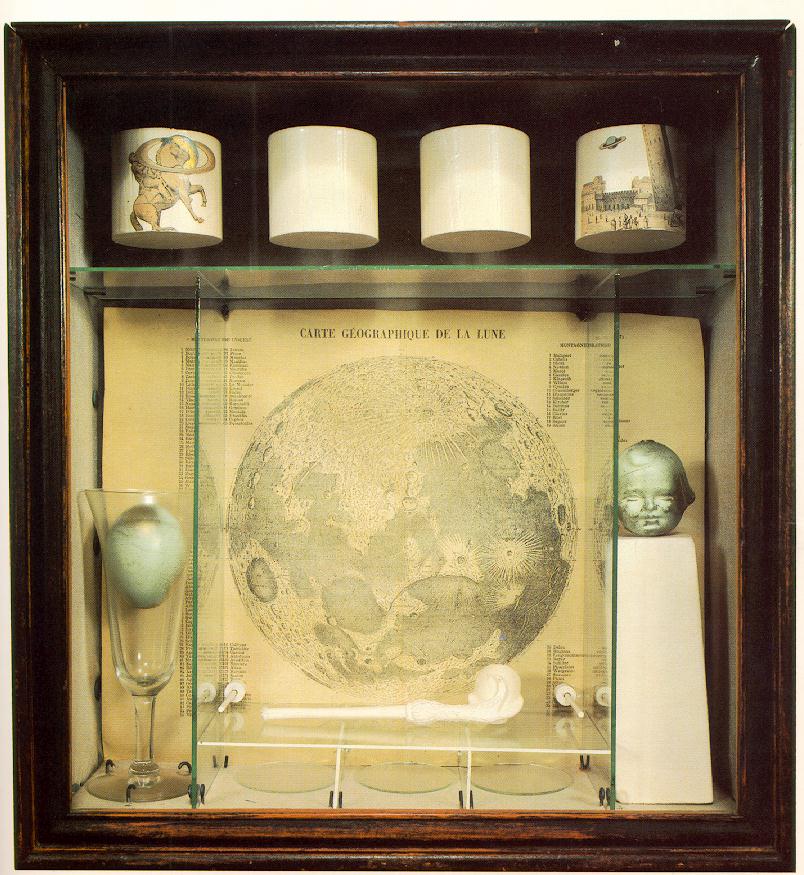
Untitled (Soap Bubble Set) 1936

In a wonderful article on Joseph Cornell in 2003, the centennial of his birth, Adam Gopnik says:

What’s nostalgic in Cornell’s art is not that it’s made of old things…What’s nostalgic is that, behind glass, fixed in place, the new things become old even as we look at them: it is the fate of everything, each box proposes, to become part of a vivid and longed-for past…a bottomless melancholy in the simple desolation of life by time. The false kind of nostalgia promotes the superiority of life past; the true kind captures the sadness of life passing.

http://www.newyorker.com/archive/2003/02/17/030217crat_atlarge?currentPage=1
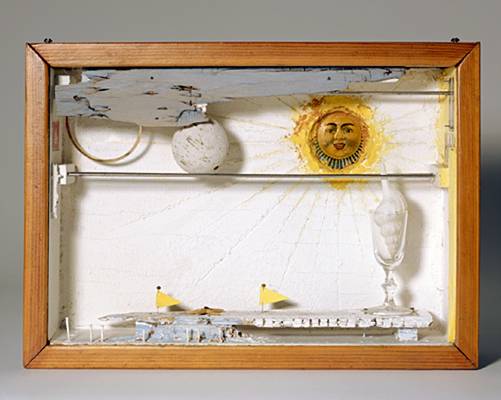
Gopnik says Cornell’s much-storied isloation was central to his way of working.

He had discovered the joys of solitary wandering. Beginning in the early nineteen-forties, his life was structured by a simple rhythm: from Queens via the subway to Manhattan, where he walked and ate and watched and collected, and then back home to the basement and back yard in Queens, where he built his boxes, talked to his mother, and cared for his brother (who had severe cerebral palsy).

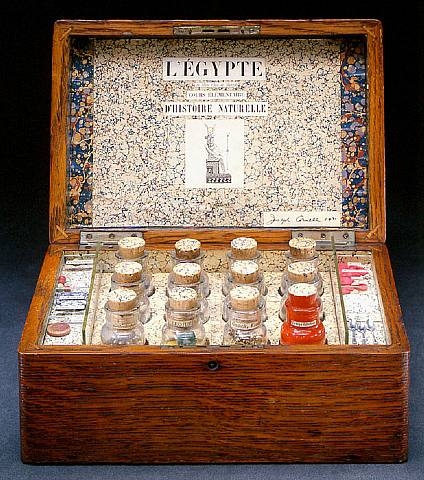
Certain themes recur in the work of Joseph Cornell:  birds, ships, the requisite surrealist clocks, and bottles which hint at potions or hidden alchemical mixtures.
Another recurring theme is idealized images of women.
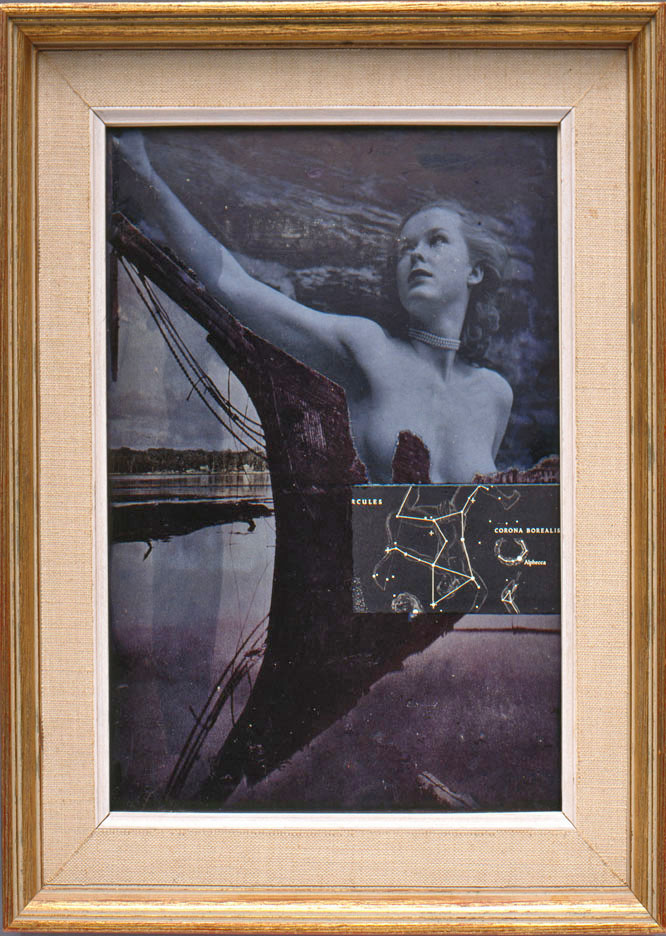
Ship With Nude

Although he professed devotion to unattainable women like Lauren Bacall and Marylin Monroe, his reserve kept him out of romantic relationships as far as anyone knows.   At the same time he was friends with numerous ballerinas, including Tamara Toumanova, a “superstar” in the world of ballet at a time when Cornell had gained some prominence in the world of art.  Several of his pieces are homages to Tourmanova.

The final exhibition Cornell worked on during 1972, the last year of his life, was for “children only.”  Everything was placed at their eye level, about three feet above the floor.  Denise Hare writes:  “Joseph Cornell often said children were his most receptive and enthusiastic audience.  They were filled with innocence and needed to see.”  Brownies and cherry coke were served as refreshments.

Cornell at an exhibition of his work for children at Cooper Union, 1972

In his 2003 article, Adam Gopnik says:

He is an artist of longings, but his longings are for things known and seen and hard to keep. He didn’t long to go to France; he longed to build memorials to the feeling of wanting to go to France while riding the Third Avenue El. He preferred the ticket to the trip, the postcard to the place, the fragment to the whole. Cornell’s boxes look like dreams to us, but the mind that made them was always wide awake.
***
Joseph Cornell showed us again and again that just a little shift in context, an altered point of view on the things of our lives will make them come alive, seem full of meaning, or appear as downright spooky.
The core importance of context in art was demonstrated forcefully in 1917 by Marcel Duchamp’s whose “ready-made” sculpture, Fountain, was named “the most influential piece of modern art” by 500 artists and critics.  Duchamp hung a urinal upside down in a gallery, signed it, “R. Mutt,” and to my mind, truly initiated the twentieth century in art.  Duchamps and Cornell were in regular contact in New York from 1942 to 1953.

Fountain, by Marcel Duchamp

Cornell never sought to shock as Duchamp did, or ask huge questions, like “what is art after all?”  But he regularily explored what happened when the faded postcard or torn photograph was removed from the shoebox or dusty album and given new life in a box on a wall.  And there, some of his birds and ballerinas still live mysterious lives and whisper to us messages which we have to become very quiet to hear, for as T.S. Eliot put it, Human kind cannot bear very much reality.
 
***
 

Click here for an interesting online Presentation of Cornell’s Work: http://www.pem.org/exhibitions/62-joseph_cornell_navigating_the_imagination

Toys You Will Never Play With – The Malcolm Forbes Collection

Monopoly money worth more than what’s in your wallet?  Much more, if it comes from the earliest surviving monopoly set, hand made by the inventor of the game, and shaped to fit his dining room table.  It is expected to fetch $60,000-$80,000 at Sotheby’s tomorrow when the huge toy collection of the late Malcolm Forbes (1919-1990) is sold at auction.

The collection is most famous for its huge assortment of boats and ships, dating from the mid 19th century.  David Redden, vice-president at Sotheby’s tells a story of Forbes’ childhood:

As a boy, Malcolm was traveling on an ocean liner with his family, and he attached his favorite toy ship to a very long string and lowered it into the Atlantic to sail behind the liner.  The toy of, of course, was lost.  “There really is a Rosebud sense to all of this,” says Redden.  “He was trying to bring back that lost toy of his childhood.” http://www.npr.org/2010/12/16/132084278/malcolm-forbes-toy-auction-could-bring-in-millions

Toy collector, Leon Weiss, who sold Forbes some of his ships agrees: “I personally believe that old toys transcend generations. For me, it evokes an emotion and triggers a memory.”

Malcolm, third from right, 1924

“This…takes people back to their childhoods,” says Redden. “Whether or not you had a battalion of toy soldiers or a fleet of ships, you wish you had had them.”

Euphemania by Ralph Keyes

Show of hands: how many know why the British used to refer to bedbugs as Norfolk-Howards? Just as I thought. Or why a one-o’clock meant a fart in Australia? You can find out in: Euphemania: Our Love Affair With Euphemisms, by Ralph Keyes.

Answers:

  • In Victorian England, “bug” was a vulgar word, so a certain Mr. Joshua Bug changed his name to Norfolk-Howard. It didn’t quite work out as he expected.
  • Until World War II, a cannon was fired every day at 1:00pm from Fort Denison, in Sidney Harbor.

According to Keyes, such “situational euphemisms” are relatively short lived, though he notes that some persist for a while:  everyone who watched Super Bowl XXXVIII understands, wardrobe malfunction.

Other euphemisms are much more persistent, none more so than the words we use to avoid mentioning death:  passing away, kicking the bucket, buying the farm, and pushing up daisies (or as the French say, eating dandelions by the root).  Not all of these euphemisms are funny.  Keyes notes that in the military, an event is usually an occasion where someone died, often by friendly fire.  Unlike our more agrarian ancestors who slaughtered animals, we process or harvest them.

Sexual euphemisms are explored too.  Doing one’s duty originated in Rome, in reference to the responsibility of freed slaves to continue to have sex with their former masters.  Hiking the Appalachian Trail came to mean “having an affair,” thanks to a certain philandering governor.  Think of England, y’all!

Those who enjoy pondering words and their meanings will enjoy this article and interview with Keyes on NPR: http://www.npr.org/2010/12/14/132056878/-euphemania-our-passion-for-not-saying-it

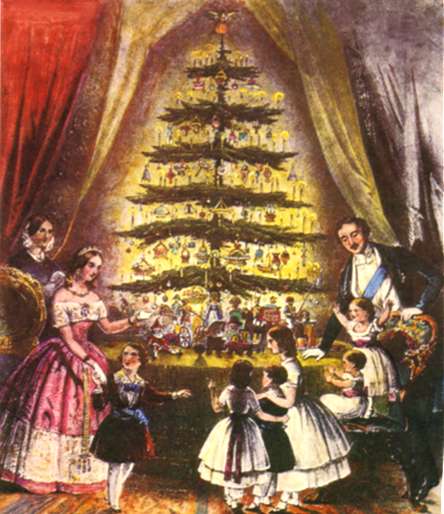
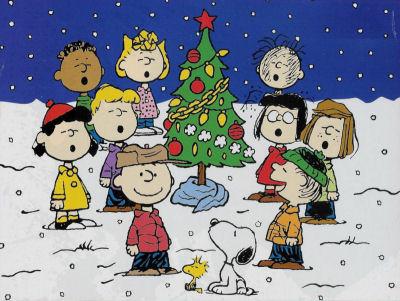
Christmas Tree Facts and Legends

 
I started out thinking of posting some kind of historical summary of Christmas trees but abandoned that notion after the first Google search.  Who knows when humans first noticed the start of the sun’s return at the darkest time of the year?  When did we first wonder why some plants stay green while others wither?

For a good overview, check out history.com: http://www.history.com/topics/history-of-christmas-trees. Rather than compete with the History Channel, I decided to simply post a few interesting tidbits and legends I happened across.

In Ancient Times:

The Egyptians did not have pine trees, but they did have palms, another evergreen tree, and they brought the fronds inside at the time of the winter solstice to celebrate the return of Ra, the sun god.

The prophet Jeremiah condemned the middle-eastern practice current in his time, of bringing trees indoors (often carved in the shape of a god or goddess) and decorating them.  Jeremiah 10:2-4 has often been cited by Christians who oppose the custom, even though the passage was written centuries before the birth of Christ.

As a Tool for Evangelism?:

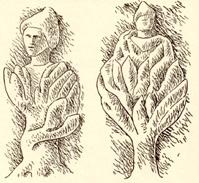
Early Christians in Rome apparently set the date for Christmas to December 25 in an effort to convert members of the popular cult of Mithras, a dying and resurected god whose birth fell on that date.  Supposedly, these early Christians incorporated trees into their celebration, as an additional appeal to the Mithraic cult.

Mithras in a tree

Tertullian (160-230) a church leader and prolific writer, complained of those Christians who adopted the pagan custom of lighting lamps and hanging laurel wreaths at the time of the solstice.  With or without trees, Constantine ratified Dec. 25 as the birth of Christ, a move aimed at followers of both Mithras and Saturn, who had major holidays at the time of the solstice.

The Evergreen Vs. the Oak:

On a mission to the Germanic people in 725, St. Boniface, in an effort to stop human sacrifice, cut down Thor’s tree, a scared oak, supposedly with one blow of the axe.   A little fir tree appeared on the stump, which Boniface said was the tree of the Christ Child, and a symbol of eternal life.  He instructed the people to take such trees into their homes and place gifts at the base, “as symbols of love and kindness.”

The Paradise Tree:

Beginning in the eleventh century, one of the popular “Mystery Plays” depicted Adam and Eve’s expulsion from the Garden of Eden.  The plays were presented in winter, so evergreens were the logical choice to represent the lush trees of the garden.  They were decorated with apples, the forbidden fruit, and over time, with communion wafers as well – the tree of knowledge became the tree of life.

This resulted in a very old European custom of decorating a fir tree in the home with apples and small white wafers representing the Holy Eucharist at Christmas time. These wafers were later replaced by little pieces of pastry cut in the shapes of stars, angels, hearts, flowers, and bells. http://www.eldrbarry.net/mous/saint/xmastree.htm

The First Written Record of a Christmas Tree:

1510, in Latvia.  Men of the Merchant’s Guild decorated a tree with artificial roses, set it on fire, and danced around it while it burned – well, okay, that might be just a little bit pagan… 

The rose was already a symbol of the Virgin Mary, which makes me wonder if they were using the smoke to send prayers or offerings to heaven.  Or maybe they just had a little too much mulled wine.

The First Lighted Candles on Christmas Trees:

One account credits Martin Luther, who was pondering a sermon while walking home, and happened to look up at a dazzling sky full of stars, shining through evergreen boughs.  As a result, he is said to have set up a lighted Christmas tree for his family.

Martin Luther's Christmas Tree

Another source claims the custom of lighted candles originated in France in the 18th century, but every other bit of European Christmas tree lore I’ve found is Germanic in origin, which makes me doubt that claim.

The First Christmas Trees in America:

On the night of December 25, 1776, while Washington led his rag-tag army across the Deleware in a driving snowstorm, unsuspecting Hessian troops in Trenton celebrated what they expected to be a peaceful Christmas night.  One source speculates that their Christmas trees, fueling nostalgia for home, helped draw them from their guard posts to go indoors and celebrate.  Hessians, including the mercenaries who fought with the British, are credited with bringing the custom in America.

The First Christmas Tree in a Church:

The prize for this innovation goes to Pastor Henry Schwan of Cleveland, OH, who decorated a tree in his church in 1851.  The congregation initially objected to this pagan practice, and Schwan received threats of physical violence, but “objections soon dissipated.”

The First Christmas Tree in the White House:

December, 1853, under the administration of Franklin Pierce.

The Christmas Tree Ship:

Thanks to Gordon Lightfoot, everyone knows of the Edmund Fitzgerald, a freighter that sank on Lake Superior in November, 1975, but an earlier disaster, “when the storms of November came early,” also captured the public imagination.  On Nov. 23, 1912, the Rouse Simmons (named for the industrialist whose name still appears on mattresses) was bound for Chicago with a load of Christmas trees.  She sank in a storm off Two Rivers, WI with fifteen men and one woman aboard.

The Rouse Simmons

Legend says the Rouse Simmons can sometimes be seen rising out of the fog on Christmas Eve.

The Christmas Truce:

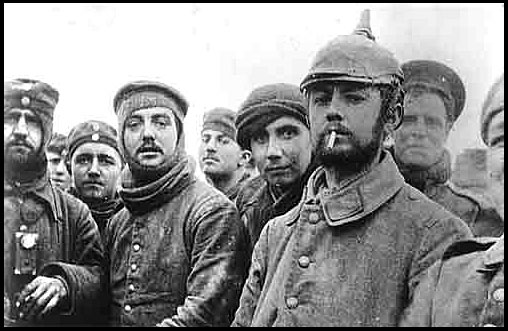
To the later consternation of generals, peace broke out all along the western front on December 25, 1914.  There was no plan, no prearrangement, and it seems to have happened differently in different sections of the line.  In one account, the Germans began singing, Stille Nacht, the British responded with Silent Night, and men on both sides spontaneously climbed out of their trenches, hands in the air,  to meet in no-man’s land.  They traded cigarettes, food, and song.  When daylight came, they played soccer.  The story usually has hostilities resuming the next day, but in some parts of the line, the men were able to resist orders to resume fighting for several weeks.

British and German soldiers together, Dec. 25, 1914
In one account, on FirstWorldWar.com: Along many parts of the line the Truce was spurred on with the arrival in the German trenches of miniature Christmas trees–Tannenbaum. The sight these small pines, decorated with candles and strung along the German parapets, captured the Tommies’ imagination, as well as the men of the Indian corps who were reminded of the sacred Hindu festival of light.

Festivals of Light:

Light is what the solstice is about all over the world, in any number of ways. Hanukkah is the eight day Jewish Festival of Lights in early December.  Diwali is the five day Festival of lights in early December for Hindus, Sikhs, and Jains.  Both holidays celebrate the victory of good over evil, of light over darkness.

Until the 20th century, December 13, was thought to be the longest night of the year in Scandanavian countries.  December 13 is the feast day of St. Lucy, one of the few festivals of a saint celebrated in Northern Europe.  On Saint Lucy, or Santa Lucia’s day, young girls in march in procession carrying candles or even wearing crowns of candles in the north, and in Italy, Malta, and the Balkans.

Paramahansa Yogananda said it only takes one little flame to drive a thousand years of darkness out of a cave.  In this time of cold and darkness, may we consider the way that light and warmth manifest and can manifest in our own lives.

The Dream-Maker’s Magic

I have loved fantasy since I was little, growing up on a diet of Norse Mythology, British folklore, and Godzilla.

For years, I helped bankroll the fantasy genre; I patronized specialty bookstores, and even (introvert that I am) went to conferences and Renaissance Faires.  I probably ate up every Tolkien-spinoff quest series ever written.  Eventually, I burned out and wandered to other sorts of reading, but over the last decade, several wonderful books revived my love of fantasy.  One of those gems was Sharon Shinn’s, The Dream-Maker’s Magic.

Shinn’s first book, The Shape-Changer’s Wife, (1995)was critically acclaimed. With her Samaria series, she went on to make a name for herself as an author of adult fantasy. In 2004 she launched a trilogy of thematically connected young-adult fantasies, publishing one a year: The Safekeeper’s Secret in 2004, The Truth-Teller’s Tale, 2005, and The Dream-Maker’s Magic in 2006.

The stories are set in the same world, where magic is part of the fabric of life, and yet it plays a surprisingly minor role. These are not sword-and-sorcery tales. They are more akin to Shakespearean comedy. They are coming of age stories with romantic intrigue, complicated by plot twists and questions of identity, some even resulting from babies swapped at birth.

In The Dream-Maker’s Magic, Kellen Carmichael’s mother almost dies in childbirth. Two weeks later, when she is well enough to care for Kellen, she becomes hysterical, convinced beyond reason, that she gave birth to a boy – and Kellen is a girl.

Kellen says: I was that baby. I was that strangely altered child. From that day on, my mother watched me with a famished attention, greedy for clues. I had changed once; might I change again?  Into what else might I transform, what other character might I assume?  As for myself, I cultivated a demeanor of sturdy stoicism…It was as if I hoped my unvarying mildness would reassure my mother, convince her to trust me.  It was as if she was some animal lured from the wild lands and I was the seasoned trainer who habitually made no sudden moves.

But, Kellen concludes, She never did learn to trust me…or accept me for who I was. It was my first lesson in failure, and it stayed with me for the rest of my life.

If life is hard for her as a child – growing up in boy’s clothing, with sugar-bowl haircuts and a mother who refuses to acknowledge what she is – it becomes even worse in adolescence. Luckily, Kellen begins to meet allies, none more important than Gryffin, a boy who was born lame, whose legs are getting worse, and whose uncle periodically beats him.  Kellen initially scoffs at his unquenchable optimism, at his belief that with an education, he can be anything he desires.  Several days after they meet, however, these two broken people are inseparable friends.

Betsy Palmer, an innkeeper, and her daughter, Sarah, also befriend Kellen, and teach her such arcane mysteries as how to sew a dress that fits and how to do her hair, yet that alone does not end Kellen’s confusion:

…there was one person who was not fooled by my new looks or my modulated personality, and that was Gryffin…He did not seem to notice what I was wearing or how I had arranged my hair…I did not bewilder or surprise him.  He did not think I was trying to be something I was not, as my mother did; he did not think I was trying to break a chrysalis and become something I was meant to be, as Betsy and Sarah surely believed.  He just thought I was Kellen.

I found this the most comforting thing that had ever happened to me.  At times, when I lay awake at night, confused myself about what role I should take and what direction I should try to follow, all that kept me from slipping into tears was knowing I was not completely lost if Gryffin knew how to find me.

That was the point where I put the book down on my first reading, and have every time since, to marvel at the simple way Shinn breaks through all the limits of genre, to evoke something everyone probably longs for:  I was not completely lost if Gryffin knew how to find me.

The Dream-Maker’s Magic is about magic, but it cuts both ways when it appears, and separates Kellen and Gryffin.  The story is a lyrical romance, though you have to watch for the two kisses that Kellen and Gryffin exchange at the very end of the book.  It is a novel whose ending surprises Kellen and the reader; she is not the person she and we imagine her to be.

The ending satisfies in the way that Shakespearean comedies satisfy: what was lost is found, those who were separated are reunited, and poetic justice is meted out.  The story ends on Wintermoon, the holiday when people attach tokens of their hopes and dreams to a wreath, and burn it at midnight, to let the smoke carry their desires to heaven.  Kellen asks Gryfinn what he wishes.  “That every Wintermoon be better than the last,” he says.

Not a realistic wish, as anyone could have told him – but I would not be the one to say so.  Why limit your dreams, after all?  Why not hope for the grandest and the best?  I watched Chase throw the wreath into the bonfire, and I saw the flames scrawl secrets on the sky, and I closed my eyes and knew no end of dreaming.

Be sure to check out Sharon Shinn’s website.  There’s a permanent link in my Blogroll.

The Blogisattva Awards

Yesterday, December 8, was celebrated by some Buddhists as Bodhi Day, a commemoration of the 8th day of the 12th lunar month, when Shakyamuni Buddha is said to have reached enlightenment.  Here is the event as imagined in the excellent movie, Little Buddha:   http://www.youtube.com/watch?v=2xV8xgWlZy0&feature=related

In commemoration, the finalists for the 2010 Blogisattva Awards were announced.  These commendations are given in various categories for “excellence in English-language Buddhist blogging,” aka, “the Buddho-blogosphere.”

Blogisattva: a portmanteau combining the English word for ‘blog’ [which is ‘blog’] with the Sanscrit word for ‘being’ [which is ‘sattva’]. The letter ‘i’ is used as caulk to hold the word-tiles together. Thus, Blogisattva means BLOG BEING.

But as the website notes, this is first and foremeost about excellence in blogging and is only about Buddhism in so far as that is what flavors how we blog and what we write about.

The “what we write about” of these links is life itself:  the joys and pains of raising children, caring for parents with Alzheimer’s, wondering if John Lennon was a boddhisattva, and many many thoughts on the effort to practice meditation and live wisely and compassionately in an ever more complex and confusing world. 

There is now a permanent link here in the right hand column.  Click it for some intriguing and thought provoking articles.

Donald Maass and the Breakout Novel

I first heard about Writing the Breakout Novel by Donald Maass in a notice from Amazon, but dismissed the book, reasoning that writing a novel is hard enough without the added burden of trying to invent the next Harry Potter.

Later, a friend in one of my critique groups recommended the book and passed around his copy. I found it interesting enough to order and  give a quick read, but it wasn’t until a few months later that I really started to pay attention.   In that time, my friend’s fiction improved so dramatically that I gave the book a second reading and ordered its companion, the Writing the Breakout Novel Workbook.

As a literary agent for 25 years, and the author of 14 novels (under pseudonyms), Maass knows the publishing industry. In the Breakout Novel introduction, he says good enough is not good enough anymore: “the midlist has been in crisis since I was a green editorial assistant in 1977. Its demise has been pronounced many times. I never believed it…until now.”

The reasons he cites pale beside the experience of another critique group friend, author of ten published biographies for children.  She passed around a rejection letter she had received from an editor for a novel she recently submitted:  I loved your story.  I stayed up late to finish it.  Unfortunately, I do not think it has the qualities that will allow it to break out.

It’s not hopeless, according to Maass, and as a matter of fact, we not simply pawns at the mercy of the publishing industry, or demographics, or new technologies spinning out of control.  In a 2007 interview, Maass insists that “99% of success is in the manuscript.  Everything else flows from that.” http://writerunboxed.com/2007/11/30/interview-donald-maass-part-1/.  Not that he claims that anything about it is easy.

One of Maass’ motives in writing these books was to explore why some novels, regardless of genre, are dramatically successful and others are not.  What are the qualities of those stories we come back to read and reread?  The ones we can’t wait to share with our friends?

I actually prefer the Breakout Novel Workbook, since it breaks the humongous task of creating “cut above” fiction into manageable chunks. Here is one from the second part of that interview, an exercise he presents at his fiction seminars, which are clearly not for beginners, but for those who actually have a manuscript in hand and want to take it to “the next level:”

Maass: The absolutely essential exercise that everyone should do, with every novel, is to toss the manuscript pages in the air and collect them again in random order. (The pages must be randomized or this won’t work.) Next, go through the manuscript page-by-page and on each page find one way to add tension. Now, that sounds easy enough but most people are quickly stymied. That is because they do not truly understand what tension means. In dialogue, it means disagreement. In action, it means not physical business but the inner anxiety of the point-of-view character. In exposition, it means ideas in conflict and emotions at war. Study your favorite novelists. If they make you read every word, even while turning pages rapidly, it is because they are deploying tension in a thousand ways to keep you constantly wondering what’s going to happen. Tension all the time is the secret of best selling fiction, regardless of style, genre or category. If it sells big, it’s got tension on every page. http://writerunboxed.com/2007/12/07/interview-donald-maass-part-2/

One page at a time – the same way any writing is going to happen.  I got hooked on the Workbook in the first exercise, which starts with the importance of a character we can identify with and care about.  From Winnie the Pooh on, the books in my life that have mattered have all had living characters that shaped my imagination and personality. How does that come about?

Who are your heroes? What are their special qualities? How can your own fictional characters manifest those qualities? These are the first exercises in the workbook, and…hey, I can do that!

For anyone writing fiction, in any genre, I seriously recommend that you take a look at both of these books.

Annual “Bad Sex in Fiction” Prize Winner Announced

And now for something completely different:

British author, Rowan Somerville, has been awarded the annual “Bad Sex in Fiction Prize,” for his stunning use of animal and insect imagery in his novel, The Shape of Her.  Judges said they were especially impressed by a passage comparing lovemaking to “a lepidopterist mounting a tough-skinned insect.”

http://www.usatoday.com/life/books/news/2010-11-29-bad-sex-in-fiction-prize_N.htm

Somerville, who beat out such luminaries as Jonathan Franzen, noted during the award ceremony that, “There is nothing more English than bad sex.”   The Shape of Her is not yet available in this country, although I suspect Amazon.UK could ship in time for a holidays.

Rowan Somerville joins an select group of past winners, which includes Tom Wolfe, Norman Mailer, and the late John Updike, who was awarded a “lifetime achievement bad sex prize in 2008.”

Last year’s winner was Jonathan Littell for his novel, The Kindly Ones, in which he described the sex act as “a jolt that emptied my head like a spoon scraping the inside of a soft-boiled egg.”

Show, don’t tell in action…