Charis – a Dog Story

We named our first dog Charis after Merlin’s mother in an Arthurian fantasy novel.  Some time later we realized the word meant “grace” in Greek.  That was just one of many things she brought into our lives.

We walked into the breeder’s living room where five little puppies huddled together in their pen.  Charis raised her head and hopped over her litter-mates to dash up to us, her little tail wagging furiously.  We took it as an omen – only later did we understand it was fairly predictable alpha behavior.  One of her mottoes could have been, “Obedience is optional.”  Luckily, “Will work for food,” was a motto too, so with the help of dog treats, we came to an understanding.

She was a purebred bichon frise, and we only got her because her red nose and blue eyes didn’t match the breed standard, so the breeder couldn’t use her as a show dog.  Her blue eyes turned gold by the time she was a year old, just like a wolf.  I thought she was about the most beautiful puppy I’d ever seen.

Charis as a puppy

Once we took her to a pet friendly motel on the Oregon coast that had it’s own nine-hole golf course. She was a trickster and a runner.  She scampered out the door as we were carrying things in and ran a merry chase, stopping to pee on several greens until another golfer called and she pranced up to him, wagging her tail, and for all you could tell, pleased as could be with herself.  The following year when we called, the motel was no longer pet friendly.  I’m not saying that Charis changed that all by herself, but still…

In the trickster mode - can you see it?

The same recessive gene that gave her wolf eyes, probably took her eyesight when she was 13.   She adapted to that pretty well, but also,  she was large for her breed, so by 14, she was blind and needed medication for joint problems. The vet said it might not be much longer. That night I dreamed that the aging Charis was not the real one. In the dream, I saw the real Charis dashing through the back yard, jumping over rocks and hurdles as if gravity didn’t exist.

But the Charis who had to deal with gravity and the passing of time could still go for walks, find her way around the house by smell and touch, and generally enjoy our company and that of her younger “sister.” It wasn’t quite time.

Charis

I think of her in November because the time finally came when she was 15 1/2.  We took her in to the vet for our final act of kindness four years ago on Veteran’s Day.  Extraordinarily difficult things happen to every one, but I have never had to initiate anything harder in my life.

There are some permanent lessons I learned at the end of her life, things that have stayed with me, but that’s for another time.  This is just a moment to remember, and put up several of my favorite photographs of a beautiful little soul that wore the shape of a dog for a few precious years.

Murder, Magic, and Redemption – the Story of Milarepa

This rather dramatic lead-in comes from a movie teaser: “Milarepa is a tale of greed and vengeance – demons, magic, murder and redemption. It is the story of the man who became Tibet’s greatest mystic.” http://www.imdb.com/title/tt0499238/
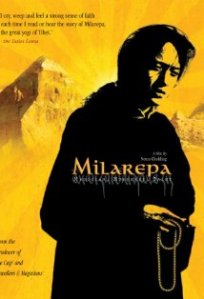
Milarepa film poster

“Milarepa is one of the most powerful and moving stories of love and transformation in world literature” – Richard Gere

To borrow a term from the previous post, the stories of mystics and prophets are almost always strange attractors. History, shaped by our collective imagination of ultimate things, is guaranteed to be larger than life. Milarepa’s (1052-1135 CE) own teachings are found in the songs and poems he wrote, while the magical legends are from a biography written several centuries later.  The Dalai Lama said, “I cry, weep, and feel a strong sense of faith each time I read or hear the story of Milarepa, the greatest yogi of Tibet.”

Here is a one sentence synopsis: A young man in ancient Tibet commits mass-murder to save his mother, undertakes rigorous spiritual practice to expiate his sin, and becomes a saint whose teachings are still alive nine-hundred years later.

This is the story in greater detail:  Milarepa was born into a prosperous family, but his father died when he was seven, and the house and property went to a greedy aunt and uncle, who treated the family like slaves; they lived in a hovel, ate swill, and toiled in the fields all day.  When he was 15, Milarepa’s mother demanded that he visit a certain sorcerer and learn black magic to extract revenge.  If he didn’t do her bidding, she threatened to kill herself in front of him.

In our culture, where obeying your parents is optional, it’s easy to think the mother was just a whack job, and why didn’t someone think to call CPS?  To understand Milarepa’s story at all, we have to imagine a culture where family honor was more important than life itself.  Where a human incarnation was held to be infinitely precious, and your mother was revered as the chief giver of this gift.  Where allowing harm to come to your mother if you had the power to prevent it was an unimaginable sin.

We speak casually of choosing the lesser of two evils, and for most of us, the dilemma will be over once election day is past.  Not so for Milarepa.  The closest I can come to imagining him wrestling with his choice is to recall the scene of Gary Cooper on the mountain in Sergeant York, a Bible in one hand and the Constitution in another, trying hear the voice of his own conscience.
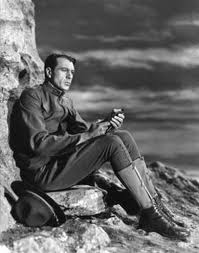
Gary Cooper as Sergeant York

Milarepa chose to obey his mother.  He went to the sorcerer and learned a complex practice that allowed him to invoke spirts who pulled down the stone house where his uncle’s family was celebrating a wedding.  Thirty-five people were in the house.  Ironically, only the aunt and uncle survived.

All hell broke loose.  The relatives of the dead were furious and gave chase.  Milarepa barely escaped pursuit, but he couldn’t escape his own conscience or the negative karma for 33 murders that was sure to land him in Buddhist hells for quite a few incarnations.  His sorcerer contact advised him to seek out a famous guru named Marpa.  When he heard the name, a thrill went through Milarepa, as if a glimpse of his destiny had just opened up.  The night before he arrived, the guru dreamed of someone very special coming into his life.  Though he instantly recognized Milarepa’s potential, he also saw the dark karma and knew the boy would have to work it out before anything else could take place.

Milarepa asked for initiation into spiritual practice, but Marpa refused, saying such treasures were not for someone as “worthless” as he.  Instead, he told Milarepa to move a stone tower to another location three miles away.  It took Milarepa three years to carry the rocks on his back.  Marpa looked at his work, scratched his chin, and said, “You know what?  I think I liked it better at the first location.  Move it back.”

At that point, most of us would be on the phone to our therapist, but Milarepa did what he was told.  In those days, spiritual seekers sometimes endured great hardships and life-threatening journeys for spiritual instruction.  It was all right;  Marpa never wound up on the 6:00 news with charges of fraud or scandal.

Milarepa toiled for for twelve years before receiving spiritual initiation.  After that, he undertook an eleven month retreat in a sealed cave with only a butter lamp for light, and a little slot where someone passed him one meal a day.  Later he moved to another remote cave where he lived on nothing but nettles and local vegetation.  He looked like a living skeleton, but there he attained final awakening.  Just like the parable of the Prodigal Son and related stories from India, Milarepa’s tale asserts that no one is beyond redemption once they sincerely turn in that direction.
View from Milarepa's cave

Naturally, there are miracle stories about Milarepa.  One of them tells that he pressed his hand into the rock wall of his cave where it still holds the impression.  Here is an online account of someone who visited the site:  http://www.dreammanifesto.com/milarepa-miracle-set-stone.html

During a group pilgrimage to Tibet in the spring of 1998, I chose a route that would lead us into directly to Milarepa’s cave…To demonstrate his mastery over the limits of the physical world, Milarepa had placed his open hand against the cave’s wall at about shoulder level . . . and then continued to push his hand farther into the rock in front of him, as if the wall did not exist! When he did so, the stone beneath his palms became soft and malleable, leaving the deep impression of his hand for all to see…

In anticipation of my questions, our Tibetan translator…answered before I even asked them. “He has belief,” he stated in a matter-of-fact voice. “The geshe [great teacher] believes that he and the rock are not separate.” I was fascinated by the way our 20th-century guide spoke of the 900-year-old yogi in the present tense, as if he were in the room with us. “His meditation teaches him that he is part of the rock. The rock cannot contain him.”

Milarepa

“In my youth I committed black deeds. In maturity I practiced innocence. Now, released from both good and evil, I have destroyed the root of karmic action and shall have no reason for action in the future. To say more than this would only cause weeping and laughter. What good would it do to tell you? I am an old man. Leave me in peace.” – Milarepa http://en.wikipedia.org/wiki/Milarepa

I’m all for stories of solitary heroes going against the crowd.  For stories of finding your life’s purpose and for tales of redemption and spiritual mastery.  My fiction always seems to circle around such themes, but for me, there is even more to the tale of Milarepa.  I’ve been fortunate enough to experience the living nature of his teachings in the person of Lama Kunga Thartse Rinpoche.

Born in Lhasa in 1935, he was recognized at the age of 7 as a reincarnation of Sevan Repa, one of Milarepa’s closest disciples.  He entered a monastery at 8, was ordained as a monk at 16, and became a Vice-Abbot at 24.  Lama Kunga fled from Tibet in 1959, and in 1972, he founded Ewam Choden Tibetan Buddhist Center in the hills just north of Berkeley (there’s a permanent link to the website on this blog).
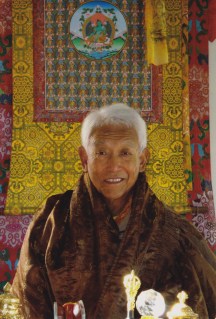
Lama Kunga Thartse Rinpoche

I met Lama Kunga two years ago while searching online for a particular Tibetan ceremony. I knew there was a place in Tucson and had calculated the cost of plane tickets when I found the ceremony was being offered at Ewam Choden, in two days time. I left a phone message, afraid there would be some barrier or pre-requisite, but when Rinpoche returned my call a little while later, he said, “Just come!” I asked if he was sure, and he said once more, “Just come, you are very welcome.”

Ewam Choden is just 90 minutes away, and I’ve been back many times.  On several occasions, I’ve sat through all day teaching sessions that end with the 75 year old lama more energetic than the students who are – at least speaking personally – desperate for a cup of coffee.

No rocks on the back or towers to move.  Lama Kunga is not that sort of teacher at all, as one can gather from the story written about him in the November, 2002 issue of Golf Digest, where he told the interviewer that good golf demands getting past the ego, but then said, “I would like to be reincarnated as a better golfer someday.” http://www.ewamchoden.org/?page_id=46

And finally, if the story of Milarepa seems like a pretty decent fantasy tale and nothing more, that’s fine. It would be fine with Milarepa and with the Buddha before him, who told a group of seekers, “Don’t take my word for anything.”

“Do not go by oral tradition, by lineage of teaching, by hearsay, by a collection of scriptures, by logical reasoning, by inferential reasoning, by a reflection on reasons, by the acceptance of a view after pondering it, by the seeming competence of a speaker, or because you think: ‘The ascetic is our teacher.’ But when you know for yourselves, ‘These things are wholesome, these things are blameless; these things are praised by the wise; these things, if undertaken and practiced lead to welfare and happiness’, then you should engage in them. (Numerical Discourses of the Buddha, p. 66)

Of High-Concepts and Strange Attractors

I get a lot from reading and listening to screenwriters.  Today, while skimming some of the links posted below, I happened upon, Wordplay, the site for Scheherazade Productions, the company of screenwriters/producers, Ted Elliott and Terry Rossio. http://www.wordplayer.com/

The heart of the site, according to the Intro page, is the Columns tab, a growing collection of essays where Elliott and Rossio share some of what they learned during the five years it took them to earn their first paycheck as screenwriters.  I was hooked at the start of Column 01, A Foot in the Door.

Somewhere in my own efforts, I stumbled upon a stunningly simple and vital concept: before setting pen to paper (or fingers to keys), I should be able to describe my story in a single sentence. Trial and error (error meaning tens of thousands of words of meandering prose) has made it an article of faith.

In his essay, Terry Rossio brings the concept alive in graphic detail as “The Warner Bros. Hallway Test:”

As a screenwriter, your choice of film premise is your calling card. Not your witty dialog, not your clever descriptions. Not your knowledge of structure and subplot and subtext.  The very first decision you make as a writer — ‘what is my film about?’ — will define your creative instincts in the eyes of the industry.

Rossio asks us to imagine a busy producer and director stopping by an office where a first reader is 40 pages into our screenplay. “What’s it about?” they ask.  What will the reader say?  What brief reply would catch and hold a director’s attention?

Once I heard a screenwriter try to describe, “High Concept,” which he claimed was a necessary ingredient for a story these days. Like most of the audience, I didn’t quite get what he was talking about. In Column 02, Rossio says that as a matter of fact, a story that can be summed up in a sentence is High Concept, but for him, that does not convey the special mojo that lifts a story above its peers. He “stole” a phrase from the mathematics of fractals: Strange Attractor.

I know this sounds a bit silly, but bear with me. Put ‘strange’ (meaning ‘unique’) and ‘attractor’ (from ‘attractive,’ meaning ‘compelling’) together and you get ‘strange attractor,’ or ‘something unique that is also compelling.’

Which would be just another, forgettable, “yeah, yeah,” bit of advice, if the author didn’t go on to give some examples:

“A group of ex-psychic investigators start a commercial ghost extermination business in New York City.”

“A defense attorney falls in love with her client. As the trial progresses, she doesn’t know if she’s sleeping with an innocent man, or a murderer.”

It begins to make sense. What is unique is not ghost stories, or love stories, or murder mysteries, per se, but the unexpected or quirky slants that were central to these movies. I remember coming across this “high concept” description of The DaVinci Code online some time ago – so simple yet so forceful I remember it without even trying:  A late night murder in the Louve leads to the discovery of a secret the Vatican has tried to suppress for two-thousand years.”

When he starts to outline specific qualities these strange attractor stories seem to share, Rossio begins with this image:

It’s as if thousands of people in Hollywood are combing the beach for that next great film idea, magnifying glasses out, checking every facet on every tiny grain of sand they come across. And then somebody points at a big, beautiful conch shell laying right out in the bright sun and says, “Hey, let’s make that!” You look at that big glorious pink and white crustacean and can’t believe you missed it.

If there were a magic formula, it wouldn’t be magic for very long. There are, however, some fifty essays on this site that promise to offer a lot of ideas and food for contemplation about the special qualities that can make a story come alive.

Of Words and Wolves: Thoughts on Jack London

By the end of grade school, I knew, or sensed, that vast forces – parents, teachers, and church – were arrayed against me in a vast conspiracy to civilize me. My relationship with them had become one of wariness and secrets. I had friends of course, but after changing schools fairly often, I regarded friendship as a tenuous thing, subject to disruption at any time. I tended not to get too close to anyone.

My one constant companion was Ranger, the German Shepherd I had grown up with since the age of six. Once, alone in the woods in my coonskin hat, something exploded out of the brush at my back – a buck, with Ranger at his heels. The twentieth century vanished. We were back in the era when Daniel Boone would pack up and move when things got so crowded he could see the smoke of a neighbor’s chimney.

By the sixth grade, there weren’t any woods. We had moved from rural New York to the San Jose suburbs, where you had to look hard to find a decent tree to climb. Ranger hadn’t fared well either – he grew listless in our little fenced in yard, and within a year, developed a tumor. We put him down when he was six.  I was on my own and largely clueless.  And then, something wonderful happened.

They used to bring carts of inexpensive books into the sixth grade class, and one day I spent my lunch money on a paperback because the dog on the cover looked like Ranger. I hadn’t heard of Jack London or Call of the Wild, and though I loved to read, I didn’t yet know how deeply an author could speak to your soul.

For several years I followed Jack London through his dreams of silent forests, solitary men, dogs, and wolves.  I read everything of his I could find, but especially his tales of the Klondike – Call of the Wild, White Fang, and the collected of stories.  This past week I finally got to visit Jack London State Park and learn much I didn’t know about this author.  I didn’t realize what a toll his various adventures took on his health.  During his year in the Klondike, he:

” developed scurvy. His gums became swollen, leading to the loss of his four front teeth. A constant gnawing pain affected his hip and leg muscles, and his face was stricken with marks that always reminded him of the struggles he faced.” http://en.wikipedia.org/wiki/Jack_London

London tried to live out the dream of sailing to tropical islands.  He built a ship, the “Snark,” to carry him and his second wife, Charmian, on a seven year, round the world voyage.  Instead, plagued by mechanical problems with the ship, and health problems of his own, London sold the “Snark” after 27 months.  That was one of his heartbreaks.  http://www.parks.sonoma.net/JLStory.html Another was the miscarriages that prevented him and Charmian from having children.   A third was the fire that destroyed “Wolf House,” the 27 room, rustic mansion he and Charmain were building, at a cost of $80,000 pre-WWI dollars.  The house was nearly complete, and London remained severely depressed after its destruction.


Wolf House Ruins


In addition to these travels, London was constantly on the go. He’d been a war correspondent twice, had an active social life, tried unsuccessfully to make his ranch profitable, and wrote more than 50 books. For long stretches, he slept only 4 or 5 hours a night. His flesh could not keep up with his spirit, and he died in November, 1916, at the age of 40. The certificate lists the cause of death as uremic poisoning, complicated by hepatitis and kidney problems. The morphine he took for the pain of his other conditions apparently played a part, and though there was talk of suicide at the time, most historians now agree that if there was an overdose, it was accidental.  His correspondence and papers were always full of plans and projects for the future – his dreams were far bigger than his human capacity.


OF JACK LONDON’S WOLVES.


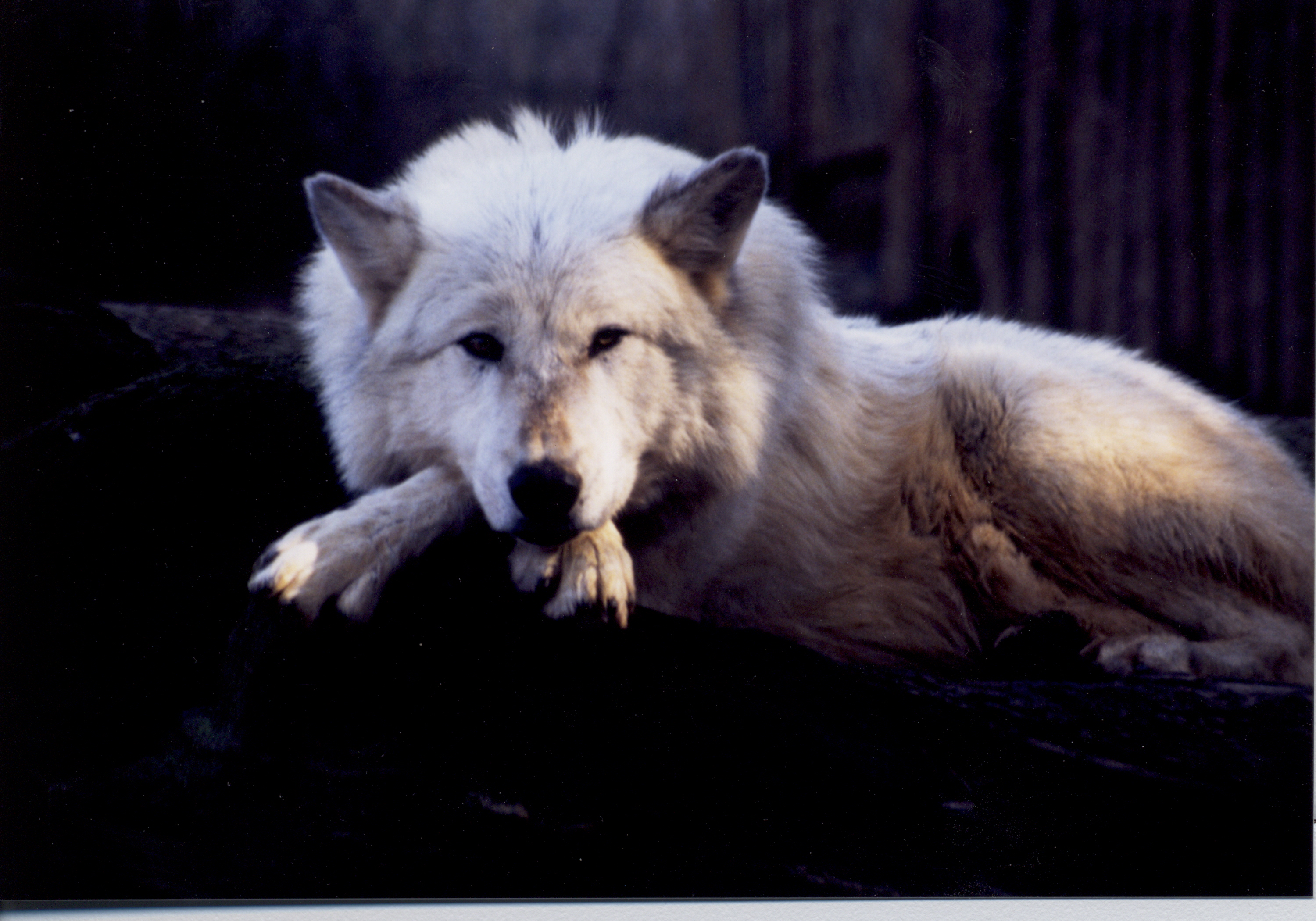
Sage at the Folsom City Zoo, ca. 1994


His best friend called him “Wolf.”  He named his dream home, “Wolf House.”  James Dickey notes how closely London identified with his totem animal, and says:

The reader should willingly…conjure up the animal in the guise of the mysterious, shadowy, and dangerous figment that London imagines it to be. We should encounter the Londonian wolf as we would a spirit symbolic of the deepest forest, the most extremely high and forbidding mountain range, the most desolate snowfield: in short, as the ultimate wild creature, supreme in savagery, mystery, and beauty.” – (Dickey’s intro to the Penguin edition of The Call of the Wild, White Fang, and Other Stories_

The “reality” of wolves as observed by biologists is very different, and Dickey says:

The mythic wolf that London “found” in his single winter spent…in the Klondike Gold Rush…bears in fact little resemblance to any true wolf ever observed. In studies…the wolf emerges as a shy and likable animal with a strong aversion to fighting. There is no evidence that any wild wolf has ever killed a human being in North America.

Reality and Truth can appear in different places depending on where and how we look for them. I don’t think I would have stayed up late as a kid – the old flashlight under the blanket trick – to read stories of lost trappers whose fires burn low while packs of shy, likable, creatures pace the perimeter.

Besides, it is the fact that wolves, like dogs, can accept humans as members of their pack, that allowed me to bond with several wolves when I was a volunteer at the Folsom City Zoo Sanctuary.  This was a marvelous opportunity I stumbled into – right place at the right time – and I often thought of Jack London, and imagined it as an inoculation of wildness – I got my fix without having to risk scurvy on the tundra.


A kiss from Redbud, a wolf pup, ca. 1996


OF JACK LONDON’S WORDS

Sometimes a degree of sophistication is a real pain in the ass.  I’d long lost my copies of Jack London’s books, so I picked up a collection on our visit.  I sat back that evening and looked at some of the stories, and noticed things I never saw as a kid:  in George Orwell’s words, “the texture of the writing is poor, the phrases are worn and obvious, and the dialog is erratic.” Yep – the agents at any writing conference would hammer him today.  And yet…

“The key to London’s effectiveness is to be found in his complete absorption in the world he evokes.  The author is in and committed to his creations to a degree very nearly unparalleled in the composition of fiction.  The resulting go-for-broke, event-intoxicated, headlong wild-Irish prose-fury completely overrides a great many stylistic lapses and crudities that would ordinarily cause readers to smile….Once caught in London’s swirling, desperate, life-and-death violence, the reader has no escape.” – James Dickey.

Fifty of Jack London’s stories and books have been made into movies. I’m not sure that can be said of any other author, let alone one whose youth was spent in abject poverty, and whose life was over at 40. And even those facts pale when the sight of a cold winter moon, or the scent of a pine, or the yip of a coyote in the distance sends shivers down the spine and spins you off, just for a moment, into arctic dreams.


Grave of Jack and Charmian London


Lighter Than Air

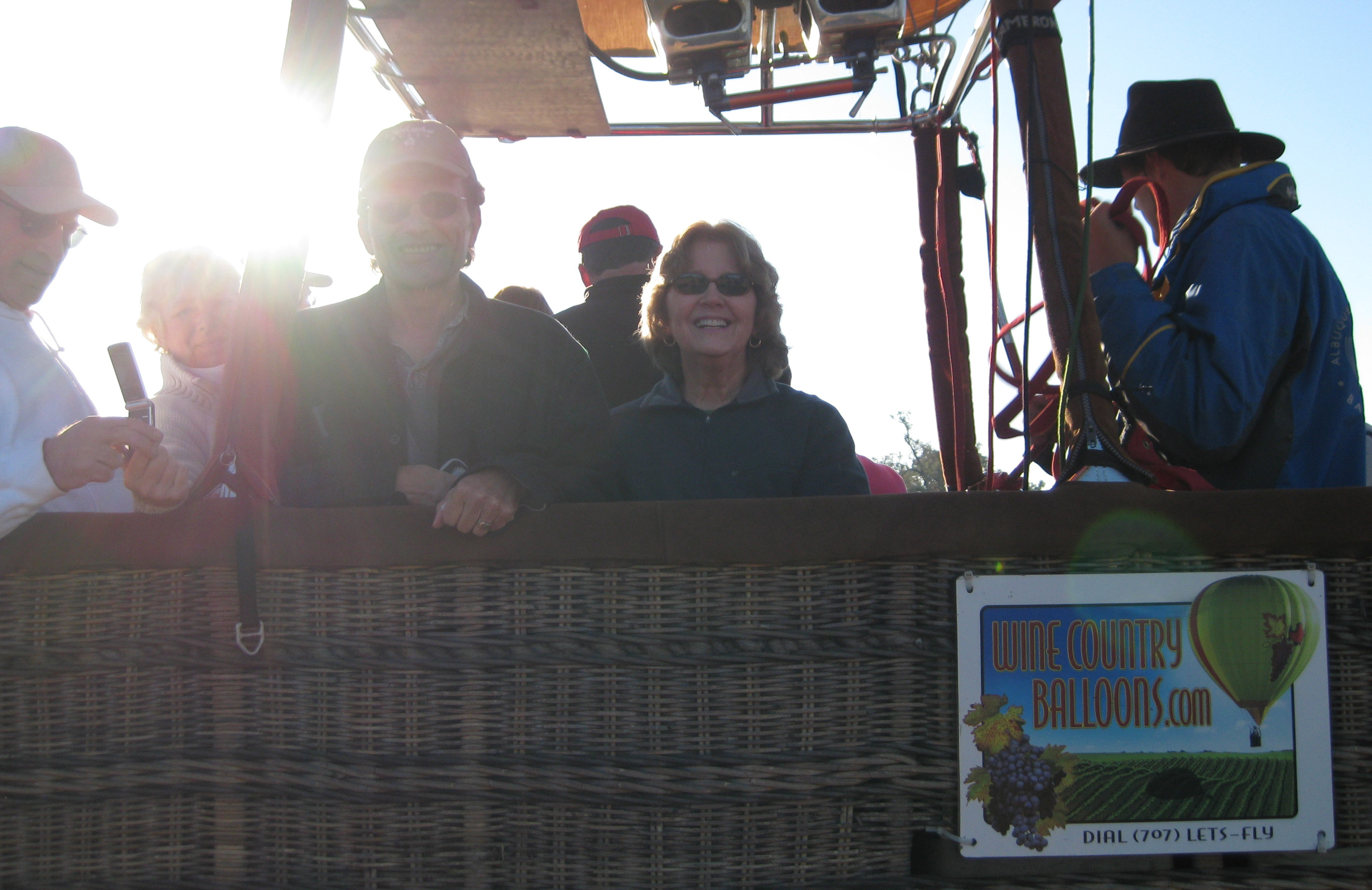
It was one of those things we had always wanted to do. I had witnessed the huge balloon festival in Albuquerque, and vaguely thought, “Well, next time we go to New Mexico…” Then Mary discovered balloon tours in Santa Rosa and called up Wine Country Balloons.   http://www.balloontours.com/

So one mid-October morning, we were up at 5:30 to meet the crew and other passengers for a winding drive of 45 minutes or so in the dark to get out of the fog.  Just after sunrise, we came to a field where another group was inflating their balloon.  “Do you know why we take off early?” Scott, the pilot, asked. No one did. “So we’re done by the time the wineries open, of course.”

Balloon "envelopes" spread out in a field. The one behind Mary starts to inflate.

He did supply an alternative explanation for the scientifically minded among us – that the colder, denser, molecules outside the balloon push the lighter, heated ones inside, and this causes the lift, the way dense water molecules push an inflated beach ball to the surface.   The colder the outside air, the easier it is to gain altitude.

Using a generator and a large fan to inflate the envelope.

First ballon almost ready to go as ours expands.

The pilot, checks cables inside the expanding envelope.


Gaining altitude lifts you into wind currents flowing at different speeds in different directions, and one of the disclaimers was, there are no guarantees on what we’ll find or where they will take us. “I can influence the outcome but not control it,” Scott said. “Which isn’t a bad metaphor for life itself.”

Scott, far right, fires the burners.  Liftoff is immanent.

Mary and I mug for the camera, as Scott, far right, fires the burners for liftoff

You don't feel the wind while it carries you.

No one spoke much during the flight. Have you ever been drawn into the blue of the sky from a plane window? Much more so in this experience.

The shadow of our balloon in the foreground, another balloon in the distance

Given my own mindset, I really, really got why “space” is the image most often used to describe the indescribable “mind of clear light” that Buddhists hold to be our common core of awareness.

We rode until the cows came home

The first hot air balloon flight, in France, was witnessed by Louis XVI, Marie Antoinette, and Benjamin Franklin who was at the French court that day. The 20 minute voyage resulted from the experiments of a pair of paper-makers, and was celebrated with champagne. Scott related this piece of history after the ride back to town for a champagne brunch. Balloons and champagne have gone together since day one – and no one had any objections.

Election Stories

By “election stories,” I do not mean tales of all the adventures we’ve had on the way to the polls, fighting off pirates and dragons and the like.  Nor do I mean telling young people how good they have it: “When I was your age I had to walk six miles barefoot through snow to vote.” I do not even mean the attack add that shows a local congressional incumbent with a tan and claims he took junkets to Hawaii.  I mean the kind of ideas and national legends or mythologies that can energize large numbers of people for good or ill.

Take “The Domino Theory,” which led a generation of apparently well meaning leaders to conclude that if the communists were not stopped in Viet Nam, they would be knocking on our doors before long.  http://en.wikipedia.org/wiki/Domino_theory

A different story from the same time – that the United States could and should put a man on the moon – led not too indirectly to the technological revolution that has allowed me to earn a living for a quarter of a century and built the remarkable laptop computer I’m typing on now (Intel was founded in 1968, a year before the moon landing).

Strangely enough, it was an interview with a Tea Party spokesman that got me thinking about political stories in the air this election season.  His story was very simple “It’s about fiscal responsibility.  In my household, if debt outgrows income, bankruptcy is sure to follow.  Is it any different for the government?”

I heard Ben Bernanke argue the same week that, yes, the deficits will cause problems eventually if not addressed, but it is too early in the recovery to cut off government spending.  To me, that sounds like a true economic fact, but it doesn’t have the force, the power, the mojo, of a story.  It’s not the kind of thing that is going to hook my imagination the way the effort to balance the family books can do.  It certainly isn’t starting any grassroots movements.

Supposedly, both mainstream political parties are uncomfortable with the Tea Party.  Do mainstream Republicans or Democrats have any coherent stories this election season?  Beyond, “It’s their fault,” I mean.

I honestly cannot think of any at the moment.

Of Hamsters, Wisdom, and Persephone

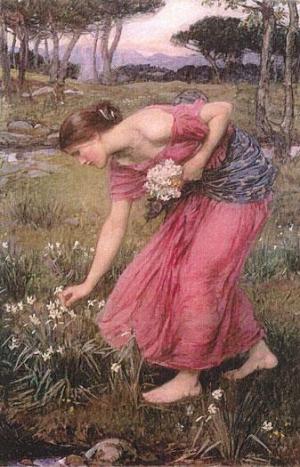
Persephone the Innocent

The protagonist of Karyn’s Magic, the young adult novel I’m writing, is a teenager who lets something evil into the world.  Not only must she scramble for damage control, but she is forced to see the same evil as a potential within herself.  I usually think of “loss of naiveté” as theme of adolescence, but remembering hamsters brought to mind a personal experience that happened earlier than that.

My fifth grade teacher had a pair of hamsters, favorite classroom pets.  At one point she could no longer keep them, and asked if anyone could provide them a good home.  I spend my Saturdays at a small museum in Alum Rock Park, in San Jose, that had a small zoo and classes and field trips for young people.  We had day trips to ocean tide pools, a weekend camping trip to the Mojave, plus at the museum we got to play with some of the critters.  One of my favorite stunts was to wrap a boa constrictor around my neck and explain to startled visitors that these snakes never squeezed anything they didn’t regard as food.

I told the teacher I had a home for her hamsters and took them to the museum.  “Great, we can use these,” the director said.  At the end of the day, after the museum closed to visitors, I learned what he had in mind.  Before I quite realized what was happening, he dropped one of the hamsters into a glass case with a huge rattlesnake.

The ensuing drama seemed to go on forever:  the hamster sniffing, scooting around, knowing something was wrong but not quite knowing what.  I wanted to look away but couldn’t.  The snake coiled in slow motion, almost lazily, with hard, unblinking eyes.  It’s strike was a blur, you couldn’t see it;  you could only hear, not see, the hamster slammed into the top of the cage by the force.  It was over in less than a second.  The animal did not even twitch.

I asked about the other hamster and learned that a snake that big cost several hundred 1960’s dollars, and live food was expensive.  I didn’t demand the other hamster back.  There were older kids there, some in jr. high, and I wasn’t about to wimp out. And scientists sometimes have to suck it up, right?

On Monday, the teacher asked how the hamsters were doing.  I told her and the class that they were fine.  I never put another boa constrictor around my neck.  I was at the edge of adolescence, and the world was poised at the edge of “the sixties;” there would be more and bigger occasions for guilt soon enough, but most of those are long forgotten.  This is the event I come back to when I think or write about the loss of innocence.

***

What does she hear on the wind?

James Hillman, the prolific author who coined the phrase, “archetypal psychology,” for his own brand of post-Jungian thought, borrows a phrase from Keats and calls our world, “the vale of soul-making.”  For Hillman, the natural movement of soul is down, into the depths, where a darker kind of wisdom lies.

(to understand Hillman it is critical to know that he uses the world “soul” as the ancients did:  not as the “eternal soul” of western religion, but more as we use the phrase, “psyche.”  He places “soul,” the source of imagination and fantasy, between the “eternal spirit,” and the body – a three-part image of personality you seem to see in biblical references, as well as in eastern religion even now).

The story that illustrates Hillman’s perspective on “innocence,” is the myth of Persephone.  As a beautiful young girl, she is playing one afternoon with her friends, when she bends to pluck a narcissus flower.  The ground opens up, and Hades, the Lord of the Underworld, scoops her into his chariot and carries her into the depths.  Hillman writes:

“Each of us enacts Persephone in soul, a maiden in a field of narcissi or poppies, lulled drowsy with innocence and pretty comforts until we are dragged off and pulled down by Hades, our intact natural consciousness violated and opened to the perspective of death.”  Revisioning Psychology

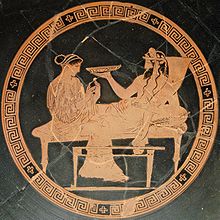
By the time the Olympian gods put enough pressure on Hades to cause him to relent, Hermes, messenger of the gods is stunned to see Persephone transformed. No longer the naive maiden, she is the darkly radiant Queen of the Underworld. She has eaten the food of the underworld – six pomegranate seeds, and must spend that six months of every year under the earth.

Supposedly that explains why there is winter, but in a far more interesting sense, it gives us an image of why, despite our wishes, wisdom doesn’t lie in the sunny, flower dotted fields of youth, but in the depths of a soul that knows both light and darkness.

Persephone and Hades

Hamster Collaborates with Nobel Laureate

I love NPR!

During this morning’s commute, I learned how the spirit of play led two Russian-born scientists, Andre Geim and Konstantine Novoselov, to the discovery that won this year’s Nobel Prize in physics.

http://www.npr.org/templates/story/story.php?storyId=130344815

The pair teach at the University of Manchester in Britain, and the custom in their lab is to dedicate Friday afternoons to “crazy experiments.” One day, while picking up graphite with scotch tape, the idea that led to graphene was born. Graphene is a sheet of carbon one atom thick. It is the thinnest material on earth, 100 times stronger than steel, transparent, and an excellent conductor. Experiments with photovoltaic cells are already underway, and potential uses include better touch-screens, replacements for silicon transistors, and power generating clothing.

Geim, in particular, has a wacky streak. He once used magnetic fields to levitate a frog, and another time, listed his favorite hamster, Tish, as a collaborator on a scientific paper.

I can very much identify with that; my first serious literary project, in the fifth grade, was a sequel to Wind in the Willows, starring my hamster, Herman.

Herman gets some exercise

Doesn’t it seem like the funniest people are very, very serious about their humor?