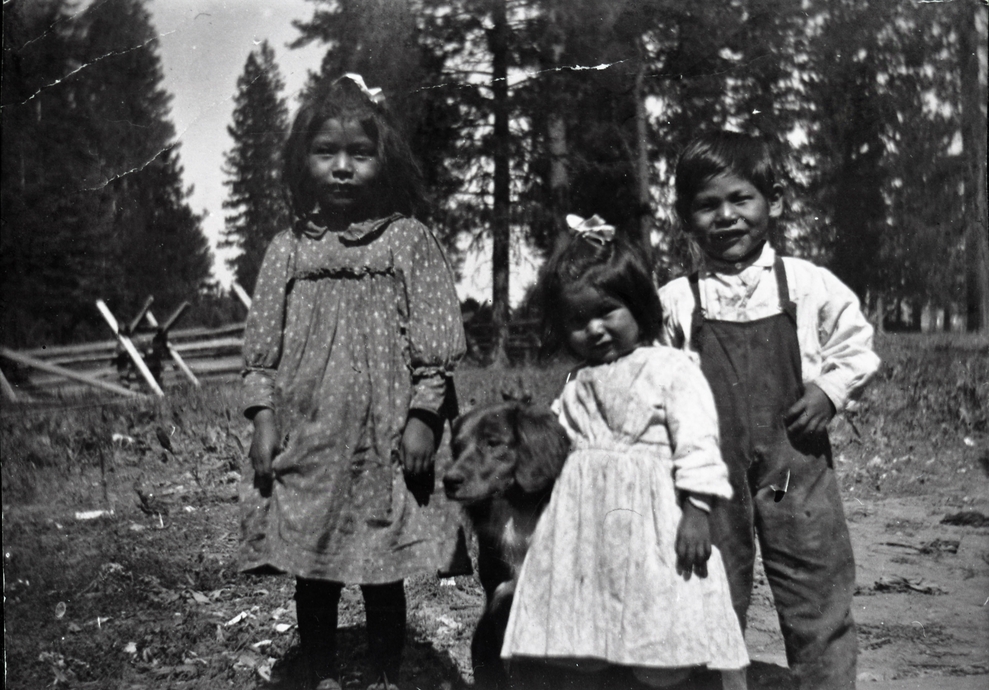
California Indians and their Dogs

Three-thousand archeologists are on the loose in Sacramento, gathered for the 76th annual meeting of the Society for American Archaeology, which runs through sunday.  According to the local paper, members of this tribe are avid researchers one of humankind’s oldest recreational beverages.  The Bee reports that in 1993, they drank all the beer in the conference hotel, and this in St. Louis, hometown of Anheuser-Busch.

When they are not partying like ancient Egyptians (one theory holds that pyramid-builders were paid in beer), the Society’s members will hear numerous research papers.  One of them, by Paul Langenwalter, professor of archaeology and antropology at Biola University in La Mirada, contradicts a popular prevailing view, and asserts that California Indians had close personal relationships with their dogs. http://www.sacbee.com/2011/03/29/3510650/indians-dogs-were-companions-in.html
 

Native American Children and Dog, near Susanville, ca 1900 - From Sacramento Bee

This is good news for those who have wondered if we are the only culture in the historyof the world that buys our dogs presents at Christmas and Jackalope horns at Halloween.  Actually, we probably are.  Langenwalter, who has studied Indian burial sites dating to 1700 has not recovered any Jackalope horns, but he has found many other things of interest.  Native people and their dogs were often buried side by side, curled up in a sleeping position.  Dog graves were also marked with stone cairns. 

Early European observers noted the close relationship between native Californians and their dogs, and this is confirmed by Debra Grimes, a Miwok Indian, and cultural preservation specialist for her tribe.  Grimes agrees that dogs were historically buried as a member of the family, because they were.

I am reminded of a story I heard so long ago that I cannot even remember its source.  My best guess is that it is either a plains Indian legend or that it comes from the Pacific Northwest.

When the earth was young, humans and animals were natural allies, and the friendship of the animal tribes made us very powerful.  So powerful, in fact, that gods were worried.  (Even then we had a tendency to get too big for our britches).   The gods decided to separate the human and animal nations, so they opened a chasm between us in the earth.  From a small crack it grew deeper and wider, the animals on one side, people on the other.  At the very last possible moment, Dog jumped across the gap to stand with humans, and that is why dogs have been our special friend ever since.

Enjoy the article and wish the archaeologists well.  Who knows, they could find the Jackalope horns any day!

A Seven Figure Contract for Amanda Hocking

Thanks to my friend Rosi Hollinbeck for sending me a link to the latest episode in the ongoing eBook “explosion.”  (Be sure to check out Rosi’s excellent blog, The Write Stuff, at:  http://rosihollinbeckthewritestuff.blogspot.com/ ).

Amanda Hocking, the poster-girl for rags to riches in eBook publishing, sold  the rights to an upcoming, four book YA fantasy series to St. Martin’s Press for a reported $2 million dollars.  http://tinyurl.com/4l2kddj

One year ago, Hocking, after repeated rejections by traditional publishers, uploaded two books to Amazon, hoping to make several hundred dollars by October to attend a Jim Henson exhibit in Chicago.

Something in our national character loves pathfinders and likes to see “ordinary people” get ahead, especially when they have Amanda Hocking’s humor and sense of irony.  Too bad Oprah is going off the air; that would have been a fun interview.

Several other points come to mind:

  • This is confirmation of the buzz I’ve been hearing, most recently at a local agent’s workshop, that good ebook sales have become another viable avenue into traditional publishing – arguably with better odds for some kinds of books than the query-an-agent route.
  • A critique group friend who runs her own small press and follows the publishing industry reports that genre fiction does especially well in the ebook format.  I would imagine it has to do with the price spread:  $9.99 these days for a paperback at Barnes&Noble vs. $0.99-2.99 for Indie ebooks.  Are the “official” books better written?  Based on my limited sampling, in general they are, but not in every case.  One nice thing about Smashwords.com is that you can sample half of the text of their ebooks before purchase, so you pretty much know what you are getting.
  • Most surprising to me is that segments of the writing community do not get it either.  Case in point:  I just got a card announcing the 19th annual “Writer’s Digest Self-Published Book Awards,” which completely ignores the world of ebooks.  (Can we say it?  “Hard-copy is sooo last year!”)

A few years ago, I attended one of the better writing conferences.  I booked some appointments with editors and agents, but I wasn’t really trying to sell anything; I wanted feedback on my WIP.  I had several plot ideas and wanted to sound them out, and it was very valuable overall.  Other people were suffering in the job interview mode, all their self-esteem on the line with their manuscripts.

I made a mental note to myself – my manuscript is not my self.  I forget it from time to time but the principle is still valid.

I truly enjoy the brave-new-world of ePublishing because it supports that realization by giving me a look behind the curtain.  Traditional publishers and even Writer’s Digest are run by busy business people who are doing their best but sometimes miss the boat and make mistakes.  I find it refreshing to find we have a thriving alternative that few of us even knew about six months ago.


Notes on T.S. Eliot

Here is what the man I consider the greatest english language poet of the 20th century had to say about his own work:

So here I am, in the middle way, having had twenty years-
Twenty years largely wasted, the years of l’entre deux guerres-
Trying to learn to use words, and every attempt
Is a wholly new start, and a different kind of failure
Because one has only learnt to get the better of words
For the thing one no longer has to say, or the way in which
One is no longer disposed to say it. (The Four Quartets)


Thomas Stearns Eliot, 1888-1965

Eliot was a modernist who believed that a new poetic language was needed to address the complexities of a new century.  It takes a bit of effort now to understand that he offended the literary establishment of his day the way Picasso offended the art establishment.  The first poem in his first published book, “The Love Song of J. Alfred Prufrock,” (1917) begins:

Let us go then, you and I,
When the evening is spread out against the sky
Like a patient etherised upon a table;

The literary world was still immersed in the 19th century sensibility; to describe the sky with such a simile was as shocking as a cubist landscape.   At the same time, Eliot alienated the bohemian crowd:  he became a devout Anglican, wore three-piece suits, worked in a bank, and spoke in the most precise possible manner.  He went his own way in everything but kept enough humor to describe himself in this way:

How unpleasant to meet Mr. Eliot!
With his features of clerical cut,
And his brow so grim
And his mouth so prim
And his conversation, so nicely
Restricted to What Precisely
And If and Perhaps and But.
…………………………………….
How unpleasant to meet Mr. Eliot!
(Whether his mouth be open or shut).

I read poems like “Prufrock” and “The Wasteland” in high school.  They were cool enough that as a sophomore in college, I signed up for a class called, “Yeats and Eliot.”  It probably had a more lasting effect than any other college class, since forty years later I still read T.S. Eliot often, usually from “The Four Quartets,” the capstone of his poetic career.  The four sections were written and released separately over six years, and first published together in 1943.  After the Quartets, he wrote, “Old Possum’s Book of Practical Cats,” which inspired the musical, “Cats,” and spent the rest of his life writing plays and literary criticism.  Eliot was awarded a Nobel Prize in 1948.

The title of this blog came from an opening line in “The Four Quartets:”  Through the first gate, Into our first world, shall we follow the deception of the thrush?

As I said, I have been reading this poem for forty years, always finding something new in Eliot’s rendering of the human longing for the ineffable (among many other themes).  George Orwell dismissed the poem for it’s “religiosity,” though I find that a shallow reading.  A passage like the following uses religious symbols, not in the service of preachiness, but to invoke an experience that is perhaps as common as it is difficult to name:

I sometimes wonder if that is what Krishna meant –
Among other things-or one way of putting the same thing:
That the future is a faded song, a Royal Rose or a lavender spray
Of wistful regret for those who are not yet here to regret,
Pressed between the yellow leaves of a book that has never been opened.

Here is another such passage which I still see quoted from time to time by spiritual authors:

I said to my soul, be still, and wait without hope
For hope would be hope for the wrong thing; wait without love
For love would be love of the wrong thing; there is yet faith
But the faith and the love and the hope are all in the waiting.
Wait without thought, for you are not ready for thought:
So the darkness shall be the light, and the stillness the dancing.

No single blog post could be more than an introduction to the life and work of a poet like T.S. Eliot, but if these notes inspire anyone to read “The Four Quartets,”  http://www.ubriaco.com/fq.html I will be more than satisfied.

Let me end with the end of the passage I began with.  After the poet tells us “success” is forever out of reach, he says:

And what there is to conquer
By strength and submission, has already been discovered
Once or twice, or several times, by men whom one cannot hope
To emulate-but there is no competition-
There is only the fight to recover what has been lost
And found and lost again and again:  and now, under conditions
That seem unpropitious. But perhaps neither gain nor loss.
For us, there is only the trying. The rest is not our business.

Footnote on Plotting, and Tolkien’s Method

In a post here on March 13, “Between a Plot and a Hard Place,” I talked of the two poles of plotting a novel – letting it unfold vs. planning everything in advance.  I said I had seen one of Tolkien’s letters indicating that he leaned toward the former approach, but I found confirmation yesterday, while reviewing his essay, “On Fairy Stories,” in the Tolkien Reader. In the author’s introduction, he says the essay was written in 1938 or 1939 and mentions he was working on The Lord of the Rings at the same time.  He says the story was:

…beginning to unroll itself and to unfold prospects of labour and exploration in yet unknown country as daunting to me as to the hobbits.  At about that time we had reached Bree, and I had then no more notion than they had of what had become of Gandalf or who Strider was; and I had begun to despair of surviving to find out.

The image that came to mind (thought it did not literally enter the story until later) was the light of Galadriel illuminating his way.  What do you do when you find yourself in the dark like that?

On Fairy-Stories by J.R.R Tolkien

Once in a while, I worry that I have said everything I have to say, that I have nothing left to blog about.  The mood hit yesterday, after I hit the “Publish” button, and it lasted a good 20 minutes.

Then I remembered that for the last three years or so, my battered and yellowing copy of The Tolkien Reader has been stashed in the software cabinet, along with CD’s for Office, Photo-Shop, and Quicken.  I have no idea why I put it there, but that’s where it stayed because I knew where it is was and it seemed as good a place as any.

When I say yellowing, I mean the pages of this book are really yellow:  it must be at least twenty-five years since I opened it, but I remembered Tolkien’s essay, “On Fairy-Stories” and had a look.

It was downright eerie to see how certain passages I had underlined decades ago are relevant to my present writing interests and concerns.  For instance, those who followed this blog in February will remember a three-part series I wrote on shape-shifters.  “The trouble with the real folk of Faerie is that they do not always look like what they are,” says Tolkien.

Tolkien asks what a fairy story really is and notes that it is not just a story about fairies.  It is also not a story for children, a connection he dismisses as a cultural quirk.  Fairy stories are, he says, “stories about…Faerie, the realm or state in which fairies have their being.”

Faerie lies beyond this world, in an intermediate realm, between the extremes of heaven and hell.  Tolkien quotes the ballad of “Thomas the Rhymer (Child #37) where the Fairy Queen shows Thomas three paths.  They will take the third, which winds into the unknown hills:

O see ye not yon narrow road,
So thick beset wi’ thorns and briers?
That is the Path of Righteousness,
Though after it but few inquires.

‘And see ye not yon braid, braid road,
That lies across the lily leven?
That is the Path of Wickedness,
Though some call it the Road to Heaven.

‘And see ye not yon bonny road
That winds about the fernie brae?
That is the Road to fair Elfland,
Where thou and I this night maun gae.

Analogies jump to mind:  the imaginal realm of Archetypal Psychology, the place of soul, between the physical world and the formless world of transcendent spirit.  The astral world of Hindu cosmology, described in detail in Paramahansa Yogananda’s Autobiography of a Yogi, which is far more subtle than physical reality, and far more dense than the realm of spirit.  I am not just being scholarly here, but trying to point to a key fact:  Faerie is analogous to the place of dreams and nightmares, of angels and demons, in old and new traditions around the world.  I could cite a lot more examples.

According to Tolkien, some our most primal desires lie in our fascination with tales of Faerie:  the desire for “the realization, independent of the conceiving mind, of imagined wonder.”  Another is “the desire of men to hold communion with other living things.”  And finally, we look to “the land of the ever young” in our longing to escape death.  And though we can’t pull that off in physical reality, Tolkien says that “fully realized” or “complete” fairy tales end with “imaginative satisfaction” of some of our deep desires.  They give us “a fleeting glimpse of Joy, Joy beyond the walls of the world, poignant as grief.”

I’d recommend this essay, written in 1939, especially to writers of fantasy literature, but to writers in general, for Tolkien has much to say about another primal desire, the desire to be a creator of worlds – “sub-creator” is the phrase he uses.

***

And finally I will end with some unexpected good news for Tolkien fans.  Today’s Sacramento Bee reported that filming of The Hobbit has started after numerous delays.  This will be a two year, two film project, directed by Peter Jackson, staring Martin Freeman as Bilbo, and also featuring Elijah Wood, Ian McKellan, Cate Blanchett, and Orlando Bloom.   Release of film number one is expected in late 2012.  Something else to look forward to for those who love to explore the world that Tolkien created.

The Tassajara Bread Book

Three decades ago, I stumbled into a three year period in my working life where I had time to pursue all the extra-cirricular activities I desired.  Through a spectacular right place/right time moment, I landed a part time teaching job.  We lived in a small but cozy and affordable house in Chico, California where we could walk to the market and downtown.  We got by with one car, a Beetle that I maintained with the help of the Idiot’s Volkswagen book.  We grew veggies, and somewhere along the line, I started making bread, not just to save a few pennies, but because I found it satisfying and delicious.  That was one of several things that went by the wayside when I joined the high-tech workforce – until two days ago.

In a recent post I wrote of attending a retreat with Edward Brown, a long-time Zen student, teacher, chef, and the author of The Tassajara Cookbook and The Tassajara Bread Book.  I purchased both books.  This was not an impulse buy – I attended a workshop with Edward a year ago and almost bought the books then, but worried that I didn’t have enough time.  This year I decided to make time, with the results you can see above.  The loaves taste as good as they look.

I’d show you the Orange Whole Wheat Pancakes, but unlike the bread, they did not have to cool before eating, so they didn’t last long enough for snapshots.

The directions in the Breadbook are clear and lively.  Brown takes the time to explain why you do things this way and not that, a feature lacking in many cookbooks.  There is something elementally satisfying in baking one’s “daily bread,” and I cannot think of a better book on how to do it.

More About Tension

In my previous post, I considered literary agent, Donald Maass’, statement that “tension on every page” is the key ingredient of successful fiction.  I proposed an experiment:  open a few of your favorite books to random pages, (avoiding the obvious chills-and-thrills moments exemplified by the poster) and see if there is tension on that page.  I said I would try it with some of my favorite novels.

I’ve posted about all four of these books before.  The first two are YA fantasy novels I have read and enjoyed three or four times.  The last two are recent reads, adult fiction, that I’ve only read once but found compelling.  So here (drum roll) are my results:

Lirael (2001) by Garth Nix.

Lirael is the story of a seeming misfit and washout from a magical sisterhood, who is actually destined to spearhead the defense against an army of zombies.  Although the climax comes in a sequel, Nix breaks all kinds of rules by devoting the first 450 pages to the coming of age of Lirael and her cousin, Sam.  Three-quarters of the book passes before the battle is joined.  So why have I read this book so many times, and why do I still enjoy dipping back into certain sections?

For one thing, even Lirael’s lesser battles matter and carry public as well as private consequences.  Nix also gives us regular updates on the bad guys, so we know a storm is brewing.  For the “tension on every page” test, I opened to one of many instances where Nix reminds us of the growing menace and Lirael’s nagging self-doubts:

“It’s not so simple,” interrupted a stern-voiced Deputy, bearing down on them like a huge white cat on two plump mice.  “All the possible futures are connected.  Not being able to See where futures begin is a significant problem.  You should know that, and you also should know not to talk about the business of the Watch!”

The last sentence was said with a general glare about the room.  But Lirael, even half-hidden behind a huge press, felt it was particualrily aimed at her.

As a how-to tidbit, we have a fine example of Maass’ comments on the power of threatening images to ramp up the tension in “quiet” moments.  The Deputy does not just “approach” the girls, she “bears down on them like a huge cat on plump mice!”


The Dream-Maker’s Magic (2006) by Sharon Shinn

I reviewed this favorite here on December 10, 2010.  This randomly chosen passage really needs no additional comment – it is a great illustration of Maass’ conviction that disagreement is the factor that most easily spices up dialog:

She thinks of him as her brother,” Sarah murmured to me one day as I paused in the act of wiping down a table to frown over at Gryffin and Emily.  “There’s no need for you to be jealous.”

Now I was frowning at Sarah.  “I’m not jealous,” I sputtered.  “I’m – what?  I don’t care if they’re friends.  Jealous.  That never occured to me.”

Sarah was smiling a little.  “Oh.  I’m sorry.  Well, maybe you’re frowning because you have a headache or something.”

“I’m not frowning,” I said, giving her a fierce smile.


The Cypress House (2011) by Michael Koryta

If I had to classify this book, I would call it a supernatural thriller, which makes its inclusion here a little unfair.  After all, thrillers have more chills and thrills than other genres, by definition.  Still, we are talking of “tension on every page,” not adrenalin on every page, which is impossible.  My criteria was, tension in a spot where “nothing is happening,” and this is what I found with a random flip of the pages:

He sat there for a while and looked at the stone.  No words of sorrow or love marked Isaac’s stay in this place.  Just those dates, and too short a time between them.

That was all right, though.  It wouldn’t have troubled Isaac, Arlen knew that.  This life was nothing but a sojourn anyhow.  A temporary stay, that of a stranger in a strange land.

“Love lingers,” Arlen said, and then he straightened, put his jacket back on so that it covered his pistol, and left the graveyard.


The Forgotten Garden (2008) by Kate Morton

Donald Maass devotes an entire chapter in his Workbook to the problem of backstory as a tension-stopper, and suggests various ways around it.  One of them is to open with a minimal amount of needed history and sprinkle more in later.  That is exactly what I found when I opened this book to Chapter Fourteen, with the heading, “London, 1900,” where we meet the third of three major characters:

Despite its meanness, the room above the Swindells’ shop was the only home Eliza Makepeace and her twin brother, Sammy, had ever known, a modicum of safety and security in lives otherwise devoid of both.  They had been born in the autumn of London’s fear, and the older Eliza grew, the more certain she became that this fact, above any other, made her what she was.  The Ripper was the first adversary in a life that would be filled with them.

It was interesting to happen upon this passage as it reminds me of several writing friends who are quite averse to narrative.  I think it has to do with a misunderstanding of the advice to “show rather than tell.”  There are times when skillful telling is exactly what a story needs.  In Morton’s hands, it is hard to imagine a more economical way to paint the initial sketch of a girl who constantly battles to rise above difficult circumstances in a difficult time.  Morton later shows us in detail what she tells us here, in a scene where Eliza and Sammy play the “Ripper game” to try to deal with their fear.

***

I tried this experiment with other books too, and found the very same thing – some sort of tension, mystery, anxiety, discomfort, or unease everywhere.  Maass supplies a name for a factor I never quite saw in such sharp relief before.  Sure, I knew a page-turner when I had one, but I didn’t quite know how the magic was brewed.  Here is a concept and a field guide that makes it easier to spot the quarry, like when you suddenly notice a lizard hidden on a pile of rocks.  Maass tells me it’s simple, and in these examples, it is.  Now it is just a matter of creating this page-turning tension, one word and one page at a time..

A Day With Edward Espe Brown: Zen, Cooking (and Writing Too)

When Edward Espe Brown was head cook and baker at the Tassajara Zen Center in the mountains above Big Sur, he had a serious problem with biscuits.  As described in the recently updated, Complete Tassajara Cookbook, no matter what he tried, he couldn’t get them “right” – right to himself that is.  Other people raved about the biscuits.

Then one day he realized he was comparing them to the Pillsbury biscuits that he had enjoyed as a kid. He actually tasted his own biscuits and was amazed at how delicious they were. Brown writes:

Those moments – when you realize your life as it is is just fine, thank you – can be so stunning and liberating. Only the insidious comparison to a beautifully prepared, beautifully packaged product makes it seem insufficient. The effort to produce a life with no dirty bowls, no messy feelings, no depression, no anger is bound to fail – and be endlessly frustrating.

The Sacramento Buddhist Meditation Group, http://www.sbmg.org/,  hosted Brown for a one day retreat last Saturday.  First you need to know that Brown is an ordained Zen priest and Dharma heir of the late Shunryu Suzuki Roshi, the teacher who, more than any other, first put Zen on the American cultural map.

Then you need to understand that Edward Brown is one of the funniest men I’ve ever met.  A lot of Zen teachers and students come off as stern and unsmiling, but Brown reminds me of Steve Martin and the late Leslie Nielsen, in his ability to crack up a room of 50 people with the lift of an eyebrow or the subtlest “Who, me?” expression.  As in his cooking, so in his teaching, Brown has gone his own way.  Learning to trust your own heart and find your own way was the core of the message he gave on Saturday.

Brown relates that one time he was the meditation leader during a three month retreat with 20 students at Tassajara.  One day, as he debated which technique to practice, an unexpected thought bubbled to the surface:  “Why don’t you just touch what’s inside with warmth and kindness?”  He spent the rest of the session in tears and left the organization not long after.

No cookie-cutter biscuits, no cookie-cutter Zen, no cookie-cutter life.  “Are you going to be a rule follower or are you just going to be you?” he asked on Saturday.  That particular quote is highlighted in my notebook for its importance to anyone trying to write.

“Are you going to be a rule follower or are you just going to be you?”

***

Edward Brown leads The Peaceful Sea Sangha.  The website has a calendar of his activities, a recent article about his cooking, and a large number of Dharma talks available for free download.  http://www.peacefulseasangha.com/default.html