More notes on Buddhism

Prajnaparamita, Sanskrit for "The perfection of wisdom," is often personified as a goddess of transcendental wisdom in Buddhist iconography, as in this 13th c. stature from Java. Public domain.

Prajnaparamita, Sanskrit for “The perfection of wisdom,” is often personified as a goddess of transcendental wisdom in Buddhist iconography, as in this 13th c. stature from Java. Public domain

If you have not already done so, please read the previous post as an introduction to this one. I’m going to discuss two additional questions that are commonly asked about Buddhism. Then I’ll list some of my favorite references.

Is Buddhism a religion?

For some people it is and for some it’s not. There are Buddhist churches, similar to any other church, though westerners usually focus on the contemplative dimension with its “spiritual but not religious” nature.

The first long Zen retreat I attended was led by a Catholic priest at a Sisters of Mercy Retreat Center. This was not watered down Zen. The priest, who bears the title, Roshi (master) is member of a recognized Japanese lineage, as are other Catholic priests and nuns. The church allows this, holding that Zen is not a religion, but a means for exploring the nature of awareness. I’m not aware of any contemplative Buddhist tradition that requires members to drop their other religious affiliations.

Is Buddhism atheistic?

Buddha never talked about metaphysics. He focused on suffering and the path to enlightenment as the end of suffering. Often when he was asked about ultimate things, he refused to answer. Once a monk asked, and Buddha told “the parable of the arrow.” As Thich Nhat Hahn, a Vietnamese Buddhist monk explained it:

[Buddha] said, “Suppose a man is struck by a poisoned arrow and the doctor wishes to take out the arrow immediately. Suppose the man does not want the arrow removed until he knows who shot it, his age, his parents, and why he shot it. What would happen? If he were to wait until all these questions have been answered, the man might die first.” Life is so short. It must not be spent in endless metaphysical speculation that does not bring us any closer to the truth. (the parable of the arrow).

So it’s accurate to say Buddhism is non-theistic, but it isn’t explicitly atheistic either; Buddha never said one way or the other. As Brad Warner, a Zen priest for 30 years, puts it in his book on the subject, There is No God, and He is Always With You, it depends on what you mean by “God.” If we mean some large, powerful being “out there,” who created us at some finite point in time and pulls strings, then no, Buddhists don’t believe that. If we’re speaking of something like Paul Tillich’s “Ground of Being,” then I think it’s implied in much Buddhist writing and by many Buddhist teachers I’ve heard. To quote Anam Thubten as I did in the previous post:

There is Buddha in each of us right now who can never be defeated by the force of inner darkness, the force of greed, hate, attachment, and delusion, and that Buddha has no form, no image. That Buddha, indeed, is residing in all of us as our pure, quintessential being. We must always turn our attention inward whenever we have the desire to seek divinity, or Buddha, God, or Brahma. (The Magic of Awareness)

Japanese brush painting, by Lone Primate, 2007, CC By-NC-SA 2.0

Japanese brush painting, by Lone Primate, 2007, CC By-NC-SA 2.0

Buddhist Resources

The best resource of all is a nearby sangha (group of practitioners) or meditation group in one’s own area, if it’s a good fit. Meanwhile, here are a few books and websites that I find valuable.

Books:

A Path With Heart (1993) by Jack Kornfield.
This is the first book on Buddhism I’d recommend to someone wanting to learn more. Part spiritual autobiography and part introduction to Buddhist thought and practice by an influential teacher of Vipassana (Insight Meditation). Kornfield, a co-founder of Spirit Rock (web link below), gives fine descriptions of some of the difficulties westerners may have when approaching eastern traditions.

No Self No Problem (2009) by Anam Thubten
The most important single work in turning my attention to Buddhism. I found an earlier edition of the book and attended a daylong retreat (the first of many) with Anam Thubten a few weeks later. There’s a link to Anam Thubten’s website below.

An Introduction to Tantra: A Vision of Totality (1987) by Lama Thubten Yeshe
The best introduction I’ve found to Tibetan Buddhism by a renowned 20th century lama and member of the Dalai Lama’s tradition. “Dwelling deep within our heart, and within the hearts of all beings without exception, is an inexhaustible source of love and wisdom. And the ultimate purpose of all spiritual practices, whether they are called Buddhist or not, is to uncover and make contact with this essentially pure nature.”

Awakening Joy (2010) by James Baraz
James is a teacher at Spirit Rock. I bought this book several years ago, when he gave a local daylong retreat here, and just started reading it. It’s the most “ecumenical” of all these books. The author presents 10 themes, with exercises, to increase our wellbeing now, where we are, not at some future time when we are enlightened. The book meshes with an online course he teaches. Website below.

Online Resources:

Spirit Rock. An insight meditation center north of San Francisco that hosts retreats all year long. See especially the “Meditation101 tab” for the basics of insight meditation and dozens of talks by visiting instructors.

Dharmata Foundation. This is Anam Thubten’s home page. Well worth checking the calendar from time to time. From his home center in Point Richmond, CA, this Tibetan master travels extensively. In May he gave retreats in South Korea, Little Rock, AR, and Maine. In June, he will teach in Princeton, NJ, New York, NY, Maui, and Grass Valley, CA. Hearing him is well worth the effort (here is one account I’ve posted of a retreat with him).

James Baraz. Here is James’ website and teaching schedule with a link to his Awakening Joy course (available online).

Tricycle. The pre-eminent Buddhist magazine, with 20+ years of articles from all traditions. Check out a hard copy in a bookstore for a directory of dharma centers by region. There are always online retreats available to subscribers.

Peaceful Sea Sangha. Website for Edward Espe Brown, who I’ve posted about here several times. He also travels and teaches widely, with a trip to Prague, Austria, and Germany scheduled over the next month and a half. His audio teachings are wise and hilarious. I discovered a poem I recently referenced, “10,000 Idiots” by Hafiz, in one of them.

I could go on and on, but this is already long enough. These are only a few suggestions. Feel free to comment or email with any specific questions, observations, or resources of your own.

 

It’s In His Kiss by Vickie Lester: a book review

IIHKCover5x8final291p copy

Death is a sidewinder. It strikes from a place concealed and unthinkable, triggering a reality completely unexpected. – Vickie Lester

Anne Brown, a New York teacher and author of literary novels is on her way to Palm Springs in the middle of winter. Movie studio bigwigs are flying her out to renew the option on her first novel, a decade out of print. Why do the rich and beautiful people welcome her with open arms? Is it because she’s the out of wedlock daughter of a retired movie mogul?

No, it’s a bit more sinister than that, Cliff, the most beautiful person there, tells Anne. An acting agent, he fills her in and offers to help her navigate the proverbial shark infested waters. And draws her into a whirlwind affair that is hardly the norm for Anne, a confirmed bachelorette, who thinks of herself as the girl that guys just want to be friends with.

It seems too good to be true, but it is, until the following morning, when Cliff is found dead by the side of the road in his Ferrari. It looks like a tragic heart attack until the coroner finds he overdosed on the kind of drug cocktail used to enhance pleasure at the gay sex club up the road. Cliff hardly seemed gay to Anne, and everyone who knew him swears he was straight in every sense of the word.

Filled with grief, anger, and curiosity, Anne begins to ask questions. It soon becomes apparent that everyone at the Palm Springs house that weekend was hiding something. “Was there not one single normal person in all of L.A.?” she wonders. And then a black Escalade tries to chase her down on the freeway…

Vickie Lester, who blogs at Beguiling Hollywood, used to write screenplays, “Horrid, arty, little things,” she says, “that were…optioned again and again, but never made into movies. Perhaps, because they were neither commercial or cinematic?”

Now she has turned her considerable talent and insider’s knowledge of Hollywood into a gripping mystery, with an ending I never saw coming.  It’s In His Kiss is funny and smart and offers an insider’s view of a world of illusion that still fascinates.

The City of Angels was named for beings most often seen by children, visionaries, and the insane. The best novels out of LA are woven with a noir tone – all that sun and all those palm trees have to cast a shadow. Anne Brown and Phillip Marlowe are very different characters, and yet I imagine the spirit of Raymond Chandler is pleased. As a fan of both authors, I know I was!

Vickie Lester at Joshua Tree

Vickie Lester at Joshua Tree

Gabriel García Márquez, 1927-2014

Gabriel Garcia Marquez, 2009. Creative Commons

Gabriel Garcia Marquez, 2009. Creative Commons

“On a day like today, my master William Faulkner said, ‘I decline to accept the end of man’. I would fall unworthy of standing in this place that was his, if I were not fully aware that the colossal tragedy he refused to recognize thirty-two years ago is now, for the first time since the beginning of humanity, nothing more than a simple scientific possibility. Faced with this awesome reality that must have seemed a mere utopia through all of human time, we, the inventors of tales, who will believe anything, feel entitled to believe that it is not yet too late to engage in the creation of the opposite utopia. A new and sweeping utopia of life, where no one will be able to decide for others how they die, where love will prove true and happiness be possible, and where the races condemned to one hundred years of solitude will have, at last and forever, a second opportunity on earth.”

– Gabriel García Márquez, from his Nobel Prize acceptance speech, December 8, 1982

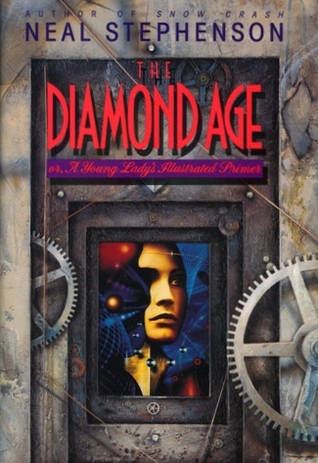
The Diamond Age: Or a Young Lady’s Illustrated Primer by Neal Stephenson

Diamond Age cover

I have written on several occasions of Snow Crash, the visionary science fiction novel that Neal Stephenson published in 1992. The book envisioned a future where nation-states had diminished importance. Most people lived as citizens of corporate enclaves and spent their free time jacked into virtual worlds. Snow Crash was written a year before the release of Mosaic, the first popular internet browser, and eleven years before the inception of Second Life, the best known virtual world.

Stephenson’s next book, The Diamond Age (1995), gives us a world transformed by nanotechnology, the manipulation of matter at the molecular level. In Stephenson’s 21st century, the integration of molecular biology and semiconductor physics has transformed everything. In the first scene, we meet Bud, a would-be enforcer for the lucrative “alternate pharmaceutical” industry, who has bulked up his muscles with intelligent, micro-robotic implants and wears what we now know as Google glasses to precision aim his “skull gun,” an implant as nasty as it sounds. In passing, Stephenson shows Bud in a waiting room, where people read articles on smart paper, essentially tablet computers, that have replaced magazines. Remember: The Diamond Age was published 15 years before the iPad and 17 years before the first Google Glass prototype.

In the diamond age, so named because synthetic diamond is cheaper than glass, objects made by hand are expensive and revered, since everything else is produced by matter compilers (a generation beyond 3d printers)? Just as in Snow Crash, nation states are obsolete. The upper classes live as members of cultural enclaves known as phyles or tribes, whose settlements are often above ground level, while the lower class “thetes” or people without a tribe, live below.

John Perceval Hackworth is a nano tech engineer for the Neo-Victorian, “New Atlantis” tribe. New Atlantis sits on an artificial mountain a mile above the polluted streets of Shanghai.  The clave is ruled as a corporate oligarchy by “Equity Lords” who style their culture after 19th century English royalty.

Hackworth is commissioned by Lord Finkle-McGraw to program an artificially intelligent book, A Young Lady’s Illustrated Primer, a subversive text, which will help his daughter Elizabeth lead a life beyond the boundaries of the status quo. Hackworth makes an illegal copy for his own daughter, Fiona, but this is stolen when Hackworth is mugged. It falls into the hands of Nell, Bud’s daughter, a thete who lives in a ground level slum. Hackworth, Fiona, Nell,her brother Harv, an actress named Miranda, and a Chinese black market engineer named Dr. X are all involved with the Primer for reasons of their own; at its deepest level, the Primer holds the key to decoding and reprogramming humankind’s future.

The Diamond Age, which won Hugo and Locus awards in 1996, is classified by genre wonks as “post-cyberpunk,” whatever that means. As he was in technology and socio-economics, so was Stephenson decades ahead of his time in speculative fiction. We call this kind of book “dystopian” now.  I can think of at least two recent movies that play upon themes explicit in The Diamond Age. I won’t name them because I have no evidence that their creators read the book. Still, it is hard to imagine any serious writer of dystopian fiction who hasn’t marveled at Neal Stephenson’s vision.

How to Fail at Almost Everything and Still Win Big by Scott Adams

How to Fail

“Don’t let reality control your imagination. Let your imagination be the user interface to steer your reality.” – Scott Adams.

How to Fail at Almost Everything is a quirky, funny, irreverent, and often inspiring “sort of autobiography” from the creator of Dilbert, that quirky, funny, irreverent, and often inspiring comic strip that lays out the truth of working in the trenches cubicles of corporate America.

This is not another collection of Dilbert cartoons or Dilbert philosophy.  It’s more of a Dilbert origin story.  We know we’re in for a different kind of kind of how-to-book when Adams begins by advising us to make sure our bullshit detectors are working before we take advice from a cartoonist.

He dismantles many self-help cliches in order to clear the way for fresh perspectives.  “Goals are for losers,” he says, and recommends strategy instead.  “I will finish my first novel,” is a goal. “I will write for an hour a day,” is a strategy.  Every day we don’t attain a goal is slightly depressing, he says, and soon after we reach it, the “what next?” question arises.  A strategy, on the other hand, brings a daily sense of satisfaction as we move in the right direction.

“I tried a lot of different ventures, stayed optimistic, put in the energy, prepared myself by learning as much as I could, and stayed in the game long enough for luck to find me…with Dilbert it did.” – Scott Adams

Adams gives a chronology of his many failed careers and entrepreneurial ventures. Shining through the story is a positive attitude that allowed him to find key lessons and life experience in every failure.  His optimism is gold, and he spends a lot of time writing of health, especially, diet and exercise, although he cautions that there is a “non-zero chance” that health advice from a cartoonist could be fatal.

“I’m here to tell you that the primary culprit in your bad moods is a deficit in one of the big five: flexible schedule, imagination, sleep, diet and exercise.”  The “big five” benefit mood, which builds personal energy, which is the driver of aspiration and effort.

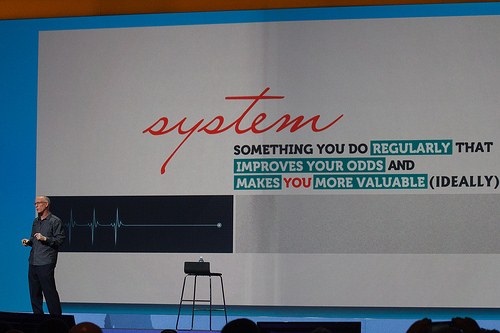
Scott Adams shares his ideas at IBM Connect 2014.  Photo by Greyhawk68, CC BY-NC-ND 2.0

Scott Adams shares his ideas at IBM Connect 2014. Photo by Greyhawk68, CC BY-NC-ND 2.0

Adams packs an abundance of topics into his book. Not every one resonated, and several dragged for me, but much of my copy is highlighted and underlined, and I’ve reread several chapters already.  If you like Dilbert, you will value this story of the life twists and turns of his creator, and you will benefit from the lessons he learned along the way.

A retreat with Edward Espe Brown

Edward Espe Brown

Edward Espe Brown

Saturday was the fourth time in as many years that I’ve attended a daylong retreat with Edward Espe Brown,  Zen abbot, author, cook, and altogether a charming and extremely funny man.  In 1965, Edward became a student of Shunryu Suzuki Roshi, author of Zen Mind, Beginner’s Mind.  When his teacher founded the Tassajara Zen Center near Big Sur, Ed became the head cook (as an author, he is best know for the Tassajara Cookbook and the Tassajara Bread Book).

Much of his learning took place in the kitchen, which gave him several unforgettable teaching stories. He relates his frustration in trying, without success, to produce a “perfect” muffin.  He tried numerous recipes and variations.  Everyone else thought they were great, but he was never satisfied.

One day he managed to taste a muffin without his usual preconceptions and found it delicious.  In that moment, he realized the source of his earlier discomfort – he’d been comparing his muffins to the “perfectly” shaped Pillsbury muffins he’d eaten as a kid.  This discovery led to one of the core ideas he tries to communicate as a teacher: we have the choice of living our lives according to someone else’s recipe or trying to discover our own.  “There is no by-the-book way for you to be you,” he says.

Given this background, it’s no surprise that he started the day by saying, “I’m not going to give you any meditation instructions, because then you might try to follow them – and be looking over your shoulder to ask, ‘How am I doing?”  The simplest instruction in Zen, “Just sit,” is the hardest to practice.  Similar things can be said for writing or painting (“Just write/paint what’s in your heart”) – and many other areas of life as well.

Such instructions (or lack thereof) assume the student knows the basics and some has experience.   This was true for the group that gathered on saturday.  It allows a generous teacher like Edward Brown to invite the student to seek what lies beyond a lifetime of learning how they are supposed to be.

Ed once said, “What is precious in us doesn’t come and it doesn’t go.  It is not dependent on performance.”  That’s a nice sounding aphorism, the kind of thing I jot down in notebooks.  Saturday’s retreat was a chance to test the waters, and as I hope I’ve made clear, at its best, Zen is about everything in our lives. I’d heard that Ed had written a new book, and it proved to be a fine example of finding our own way.

He has several traditional books in print on Zen and cooking, and he also edited a collection of Suzuki Roshi’s teachings.  When I’d read the title of his new book, By all Means A Zen Cautionary Tale, I assumed I’d be in for traditional reading.  Instead, I was surprised and delighted to find he’d written a semi-fictional, semi-autobiographical story of his adventures a little pig hand puppet.

When I asked him to sign a copy, I said, “This is great.  For my first 10 years, I had hand puppets.  They were my closest friends and confidents.”

“Ah, then you know,” he said.  “They’re powerful, aren’t they?”

In my next post, I’ll review By all Means, and after that, maybe the topic of conversing with inanimate things.  Please stay tuned!

——————————————————————————————–

PS:  When I posted this, I forgot to add a link to Edward’s home page, Peaceful Sea Sangha. In particular, I recommend the recordings of his talks, which give the flavor of his teaching style, his concerns, and his humor.

Dr Seuss to the rescue

A few days after his birthday 110 years ago, here’s a wonderful list of wise aphorisms by Dr. Seuss, courtesy of Rachael at Street of Dreams

beautiful loser's avatarStreet of Dreams

In honor of Dr. Seuss’s birthday, I’ve come across a fun little collection of life sayings (from his books) to live by.

I know I’ve posted similar things in the past, but everytime, I come across one of his books or a collection of his work, I am amazed at how insightful he was. And I am amazed at how complicated adults must make things.

Note: sorry this is a few days late. I thought I published this piece but apparently word press had other plans.

Dr Seuss to the rescue

View original post

Anatomy of the Deep State by Mike Lofgren

Be warned, this post has disturbing content.  If it was a movie, I’d rate it “R,” not because of sex or violence, but because it concerns a penetrating essay on the current state of the US government.  Change the channel now if you’re squeamish.

If you’re still here, good, because disturbing or not, I think everyone ought to read Anatomy of the Deep State, by Mike Lofgren, a former GOP Congressional aide who retired after 28 years as a staff member for Congress and the Senate.  This article is a distillation of ideas he explored in his recent book, The Party is Over: How Republicans Went Crazy, Democrats Became Useless, and the Middle Class Got Shafted.

party is over

Lofgren says what many of us have long suspected, that our visible political landscape is merely the tip of a much bigger iceberg – that our various issues, debates, and elections often have little to do with the real trajectory of power in this country.  Much of this “real” trajectory is hidden in plain sight.  With almost three decades inside the belly of the beast, Lofgren can show us where to look.

He cites many examples.  During the political circus surrounding the 2011 debt ceiling “crisis,” our leaders had no problem finding money to topple Gaddafi.  A few months later, during the government “shutdown”, while debates raged over canceling meat inspections and air traffic control, we gave $112 million to Syrian rebels, to keep that conflict going.  And since 2007, as our bridges collapse, schools fail, and cities go bankrupt, we’ve spent $1.7 billion on an NSA building in Utah the size of 17 football fields.  Its purpose is to house a yottabyte of data.  A yottabyte, the largest number computer scientists have so far coined, equals 500 quintillion pages of text.  “They need that much storage to archive every single trace of your electronic life,” Lofgren says.

The best news, according to Lofgren, is that what he calls the Deep State is far from invincible.  He notes how sufficient ineptitude draws pushback even from allies, citing our two failed wars and the Snowdon revelations among other things.  Past elites have often reacted to challenges in one of two ways.

Some have tried to “stay the course,” and Lofgren observes that,“The dusty road of empire is strewn with the bones of former great powers that exhausted themselves in like manner.”  Others have followed reformers, as diverse as Franklin D. Roosevelt, Charles de Gaulle, and Deng Xiaoping.  What each of these men developed in common was a deep understanding that their cultural stories and myths were ossified and that survival depended upon renewing both vision and action.

Mike Lofgren, a self-described “former proud Republican” now says, “there is…a deep but as yet inchoate hunger for change. What America lacks is a figure with the serene self-confidence to tell us that the twin idols of national security and corporate power are outworn dogmas that have nothing more to offer us. Thus disenthralled, the people themselves will unravel the Deep State with surprising speed.”

The first step in dealing with any problem is understanding its nature.  In this time of deliberate political and economic obfuscation, I highly recommend Anatomy of the Deep State as one of the best and most succinct diagnoses I’ve yet seen of what ails us.