Huh, what? Oh yeah, I remember

Until the 20th century, most people in the western world believed in objective memory, that what we remember is an accurate mirror of events that actually happened.

With the birth of psychoanalysis and concepts of the Id and unconscious mind, that began to change. Modern brain research confirms that not only do memory and imagination overlap, but that memories can be deliberately changed or altered.  Such manipulation is a core element of The Cloud by Matt Richtel, a page turning thriller I started to read after seeing this interview with the author on Sciencthrillers.com  http://www.sciencethrillers.com/2013/author-interview-matt-richtel-the-cloud/

The Persistence of Memory by Salvadore Dali, 1931

Freud was ambivalent about the accuracy of his patients’ memories. At the start of his career, he attributed several several cases of hysteria to real childhood sexual abuse that his methods uncovered.  Later he said that such episodes were patient “phantasies.”

The issue surfaced again at the end of the 20th century, with “recovered memory” therapy causing tremors in the field, to say nothing of lives disrupted by allegations of sexual abuse, in what is now widely viewed as abuse by helping professionals who implanted memories in the course of trying to treat patients.  “False memory syndrome” still evokes passionate disagreement in the field.  The AMA and the American Psychiatric Association, as well as the Royal College of Psychiatrists in Britain have condemned recovered memory therapy, and in the late 90’s, a number of patients who once believed they’d been victims of childhood abuse successfully sued the therapists who had led them to that belief.

Since the turn of the century, the “hard science” of biology has confirmed what most therapists since Freud have known – that memory is always mixed with imagination.  The area of the brain that perceives an object overlaps the part of the brain that imagines the same object.  In 2009, scientists implanted memories (involving smells) in flies by using light signals to trigger “genetically encoded switches.”

The day after I started reading The Cloud, I heard “Sure, I remember that,” on Marketplace, in which the work of Elizabeth Loftus was highlighted. Loftus, of UC Irvine, is one of the key researchers who have demonstrated how easy it is to implant memories, in this case using altered photographs. http://www.marketplace.org/topics/life/freakonomics-radio/sure-i-remember.  I invite you to listen to this timely piece, which is only five and a half minutes long.

Yep.  We now something new to worry about – hacking at the cellular level!  I’ll have to remember to worry about it later, though.  Right now I have to get back to my novel…

The Annotated Wind in the Willows

“The Mole had been working very hard all the morning, spring-cleaning his little home.” So begins one of the great literary adventures of my life, The Wind in the Willows, published in 1908 by Kenneth Grahame.

I’ve written about The Wind in the Willows before: http://wp.me/pYql4-19a.  My parents read it aloud when I was little, and since then, it has been part of my life.  Now the annotated edition, which I got this month, reveals details about the text and the author that I never knew before.

The opening paragraph details the Mole’s spring cleaning.  Soon he has dust in his throat and eyes and splotches of whitewash on his fur.  Then the text says something rather strange:  “Spring was moving in the air above and in the earth below and around him, penetrating even his dark and lowly little house with its spirit of divine discontent and longing.”

I’ve been known to put off spring cleaning for months, but from laziness not “divine discontent.”  As a younger reader, this phrase escaped me.  Only now do I realize how Mole’s spirit of longing belonged to the author.  I always imagined Kenneth Grahame as a country gentleman, strolling quietly by the river.  Notes in the annotated edition make clear that while this came later, for much of his life, Grahame lived with a frustrated dream of living like that.

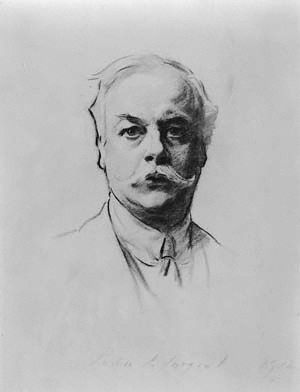
Kenneth Grahame by John Singer Sargent, 1912.  Public domain.

Kenneth Grahame by John Singer Sargent, 1912. Public domain.

He knew and loved the country life, but economic necessity tied him to London.  He abandoned his dream of going to Oxford and took a post at the Bank of England.  He married late in life, and both he and his wife had health problems.  Their only son, Alastair, was born with a congenital vision defect.  One day in November, 1903, a respectably dressed man came into Grahame’s office, pulled out a revolver, and began shooting.  The man didn’t hit anyone and was later sent to an asylum, but Grahame was shaken.  Already a private man, he kept even more to himself, his home, and vacations near the sea.

Grahame was already a popular author of several books of essays, but he stopped writing entirely between the years of 1903 and 1908.  Because of his wife’s health problems, Kenneth was Alastair’s primary care giver.  In the evenings, he made up stories about a mole, a toad, and various other animals, who lived beside a river.  A governess would later recall hearing Alastair ask questions and make suggestions; the two of them worked the stories together.

Alastair Grahame, 1907

Father and son spent the summer of 1907 apart.  Kenneth sent Alastair  a series of 15 letters which continued the tales and became the seeds of chapters for the book he would write the following year.  The letters are included in the annotated edition.  Also in this edition is an introduction by Brian Jacques, contemporary author of the Redwall series of animal stories.  Jacques lets us know what he thinks of the editors and agents who hesitated in printing The Wind in the Willows.  He has nothing good to say about people so short of imagination that they could not imagine a toad disguised as a washerwoman.

Arthur Rackham, 1940

An enthusiastic recommendation from President Theodore Roosevelt helped Grahame’s publishing efforts and the book has been in print ever since.

Some have suggested that Wind in the Willows is two books in one.  The madcap adventures of toad seem geared to please children – they were Alastair’s favorites – while other sections explore deeper emotions like homesickness, fear, wanderlust, and of course the theme of divine discontent.  This takes center stage in chapter 7, “The Piper at the Gates of Dawn,” in which the animals, searching for a lost baby otter, encounter the ancient god Pan.

The Piper at the Gates of Dawn. Frontispiece to a 1913 edition by Paul Bransom. Public domain.

Grahame first wrote about Pan in 1891 in an essay that appeared in his first book, The Pagan Papers 1893.  His longing for unspoiled nature on the eve of the 20th century was widespread in Victorian and Edwardian society.

As Mole and Rat approached the god, they were seized with the kind of awe and fear that scriptures around the world describe when people encounter angels.  When the vision ended, the animals “stared blankly, in dumb misery deepening as they slowly realized all they had seen and all they had lost.”

Then a little breeze “blew lightly and caressingly in their faces; and with its soft touch came instant oblivion.  For this is the last best gift that the kindly demigod is careful to bestow on those to whom he has revealed himself in their helping:  the gift of forgetfulness.  Lest the awful remembrance should remain and grow, and overshadow mirth and pleasure, and the great haunting memory should spoil all the afterlives of the little animals helped out of difficulties, in order that they should be happy and lighthearted as before.”

Life brought less solace for Grahame. His son, Alastair, who inspired the stories, was a budding artist and creator of his own literary magazine, but he was plagued with emotional problems. He enrolled at Eton but had to leave for this reason. He went up to Oxford in 1918, but didn’t do well with exams. On top of this, numbers of WWI veterans were returning to college, bringing the focus and maturity they had learned in the trenches.

In May, 1920, Alastair Grahame asked for a glass of wine after dinner, then walked to Port Meadow, outside Oxford, where a number of railroad lines merged. During the night, he was hit by a train and died. His father wrote that his vision problems might have led to disorientation.  The autopsy report suggested he lay on the tracks and waited for a train.

The Grahames were devastated. They spent the next four years in Italy. When they returned to England, they moved to a town beside the Thames where they lived for the rest of their lives. Kenneth was able to spend his days by the river, as he had always dreamed of doing, but the joy he once had making stories for his son must have been absent.

Arthur Rackham, 1940

Arthur Rackham, 1940

Some biographers have suggested that Grahame, good at everything he tried, must have been disappointed with his son. Annie Gauger, editor of the Annotated edition says no.  She includes letters and other material to demonstrate that The Wind in the Willows was a joint creation of father and son.  Since the stories were first told out loud, I have to agree – from experience I know that oral storytelling is a complex dance between teller and audience.  Out of their limitations, their longings, and divine discontent, Kenneth and Alastair Grahame  gave readers over the last hundred years a world of peace and friendship, far from “the wide world” trials, where if you listen, you can sometimes make out the music of the gods of nature on the wind.

A Dilettante Among Symbols

Heinrich Zimmer (1890-1943), was a scholar of eastern art and folklore, a friend of Carl Jung, a mentor to Joseph Campbell, and the author of a classic book on the psychological interpretation of folktales.  In The King and the Corpse, 1948, Zimmer included an introduction he called “A Dilettante Among Symbols,” a name he chose to sum up his approach.  Dilettante, from the Italian verb, dilettare, means “one who takes delight in something.”  Zimmer explained that his book was for “those who take delight in symbols, like conversing with them, and enjoy living with them continually in mind.”

I discussed The King and the Corpse on this blog in December, 2011 (http://wp.me/pYql4-1vt), but I focused then on the title story rather than Zimmer’s methods of interpretation.  That is what I want to consider here.

Zimmer analyzed stories from the perspective of psychology without ever falling into psychobabble.  Jung’s theories inform his work, but knowledge of those theories is never required to understand him.  Readers of Joseph Campbell will recognize the similarity in both men’s approach, and there’s good reason for this.

In 1938, the nazi’s dismissed Zimmer from the University of Heidelberg.  He migrated to England and taught at Oxford until 1940 when he moved to New York and found a teaching position at Columbia.  Joseph Campbell attended his lectures and the two became close friends.  After Zimmer died in 1943 of pneumonia, Campbell spent the next 12 years compiling Zimmer’s lecture notes into four books, including The King and the Corpse, which Bollingen Press published in 1948.

Heinrich Zimmer, 1933 (public domain)

The King and the Corpse features Zimmer’s discussion of stories from India, from the middle-east, from Ireland, Wales, and England.  Whether in Baghdad, Camelot, or an Indian cremation ground, his tone is one of engaged curiosity.  He insisted that all attempts to systematize the living reality of symbols are doomed: “Whenever we refuse to be knocked of our feet…by some telling new conception precipitated from the depths of our imagination by the impact of an ageless symbol, we are cheating ourselves of the fruit of an encounter with the wisdom of the millenniums…the boon of converse with the gods is denied us.”

I discovered Heinrich Zimmer during my freshman year in college.  The King and the Corpse introduced me to a number of marvelous stories, and gave me a way of approaching them, with head and heart, that I rely on to the present day.

Dylan Thomas reading, “A Child’s Christmas in Wales”

Here is the poet himself, reading one of my all time favorite pieces of Christmas writing.  Enjoy!

“One Christmas was so much like another, in those years around the sea-town corner now and out of all sound except the distant speaking of the voices I sometimes hear a moment before sleep, that I can never remember whether it snowed for six days and six nights when I was twelve or whether it snowed for twelve days and twelve nights when I was six…”

“…Looking through my bedroom window, out into the moonlight and the unending smoke-colored snow, I could see the lights in the windows of all the other houses on our hill and hear the music rising from them up the long, steady falling night. I turned the gas down, I got into bed. I said some words to the close and holy darkness, and then I slept.” 

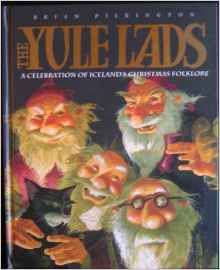
The Yule Lads: Icelandic Christmas folklore.

The Yule Lads

In most Christian countries, Christmas was slower to catch on than other major church holidays.  The clergy may have been wary of pagan solstice celebrations which happened at the same time of year and included serious revelry.  Some early Christmas festivities mimicked the custom.  They were banned in 17th century England, and American Puritans outlawed them too.

According to Brian Pilkington, author of The Yule Lads, Iceland was ahead of the curve. A 16th century law stated that “All disorderly and scandalous entertainment at Christmas and other times and Shrovetide revels are strongly forbidden on pain of serious punishment.”

Icelandic winters are long and dark, with fewer than five hours of daylight at this time of the year.  Imagination tends to fill the darkness with what we fear, and Pilkington’s book describes “the lads” that kept Icelandic children awake at night.  The gentlemen pictured on the cover are not our shopping mall Santas!

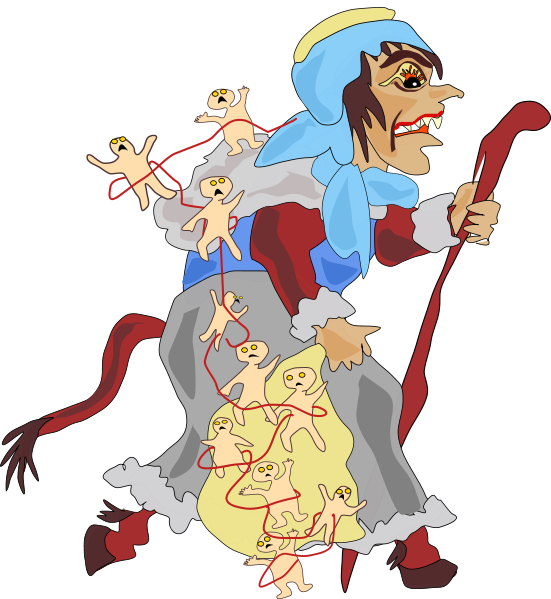
The matriarch of the clan was the ogress, Gryla, who loved to eat stewed children.  It couldn’t be just any kid though.  It had to be one who was “naughty, lazy, or rude.”  In one 13th century account, Gryla had 15 tails, and tied to each was a sack full of naughty children.  It was not “the most wonderful time of the year” if you were young!  The Icelandic word for icicle is “grylukerti” which means “Gryla’s candle.”

Gryla. CC-by-SA-2.5

Gryla had three husbands and 80 children, though legend now boils it down to 13 sons who visit the homes of children on successive nights from Dec. 12 – 25.  Time and the law have taken the edge off the Yule Lads, for a 1746 decree said “The foolish custom, which has been practiced here and there about the country, of scaring children with Yuletide lads or ghosts, shall be abolished.”  By the 19th century, the Lads had morphed from cannibals into rascals and petty thieves, who even began to leave gifts for good children who left their shoes on a window ledge.

The first to arrive was Stekkjarstaur, the “Sheep Worrier.”  He would visit the the sheep cot and try to suck milk from the ewes.  That doesn’t work in December and led author, Brian Pilkington to suggest that Sheep Worrier’s IQ is “somewhat less than three digits.”  These days  he heads for the fridge to get his milk.  If a child has been good, Stekkjarstaur leaves a sugary sweet.  Bad children get a potato.

Next comes Giljagaur, aka, “Gully Gawk” who travels through gullies and ravines, also in search of milk, but he looks for cow barns and inattentive milkmaids.  “Stubby” arrives the third night, as short as his name suggests.  He likes to raid the kitchen, as do the brothers that follow, “Spoon Licker,” “Pot Licker,” and “Bowl Licker.”  In their present forms all they do is mischief, but food thieves were no joke in earlier times.  For northern farming families, the time between Christmas and the spring thaw in April or May could be times of famine if food or fodder for livestock ran short.

The next lad to show up is Hurdaskellir, or “Door Slammer,” one of only two of Gryla’s sons who isn’t out to fill his belly.  Imagine loud bangs in the dead of night and you know how he gets his jollies.

And as if the sons of Gryla were not bad enough, children also had to contend with Jólakötturinn, the Yule Cat, a huge feral creature who hunts children on Christmas Eve instead of mice. Like the lads, the cat discriminates in choosing his victims, eating only those who have not received a new item of clothing for Christmas. Pilkington says that “Until fairly recently in Iceland, all clothing came directly from sheep. The wool had to be washed, combed, and spun before it was painstakingly crafted into a garment. It was a long, arduous process.”  Fear of the Cat induced lazy children to do their part!

This is a fun book and a fine counterbalance to the usual TV holiday movies.  You can picture families gathered around the fire as the wind howls outside, thinking as we do when hearing a good ghost story, “This can’t be true…can it?”  Something within the listeners then and within us now loves to be scared, to confront monsters and vanquish them in imagination.  On that score, Gryla & Sons and the Yule Cat satisfy!

A click on the book cover at the top of this post will take you a site where you can order The Yule Lads.

Marina, a poem by T.S. Eliot

One of best educational experiences I ever had was a class called “Yeats and Eliot” that I took as a college sophomore. I’ve been reading and rereading his work ever since. The name of this blog, “The first gate(s)” comes from the opening of Eliot’s long poem, “The Four Quartets,” which matches the scope and depth of the work of any poet who ventures into ineffable realms.

T.S. Eliot by Lady Ottoline Morrell, 1934. Public Domain

Eliot must have been quite a character.  He scandalized the early 20th century literary establishment with images like this, from the opening of “The Love Song of J. Alfred Prufrock:”

“Let us go then, you and I,
When the evening is spread out against the sky
Like a patient etherised upon a table;”

At the same time he offended the avant garde because he worked in a bank and joined the Anglican church.  Aware of such contradictions, he was never afraid to parody himself:

“How unpleasant to meet Mr. Eliot!
With his features of clerical cut,
And his brow so grim
And his mouth so prim
And his conversation, so nicely
Restricted to What Precisely
And If and Perhaps and But.”

By all accounts, he was also a joker, who served whoopee cushions and exploding cigars to dinner guests.  He and Groucho Marx were mutual fans.

***

“Marina” was one of the first Eliot poems I came to love, but I hadn’t read it for quite a while.  Ironically, it was the political conventions that brought these lines from the poem to mind:

Those who sharpen the tooth of the dog, meaning
Death
Those who glitter with the glory of the hummingbird, meaning
Death

Marina was #29 in Eliot’s series of  “Ariel Poems,” first published in September, 1930.  It was based on the Jacobean play, Pericles, Prince of Tyre.  Shakespeare is credited with the last acts of the play, the story of Pericles’ separation from, and reunion with, his daughter, Marina (most scholars believe the opening was composed by an inferior collaborator).

The play however, was simply a catalyst for poem that lives a life of its own, with haunting imagery that I think can speak to any of us, wherever we are.

Marina

By T.S. Eliot

Quis hic locus, quae regio, quae mundi plaga? 

What seas what shores what grey rocks and what islands
What water lapping the bow
And scent of pine and the woodthrush singing through the fog
What images return
O my daughter.

Those who sharpen the tooth of the dog, meaning
Death
Those who glitter with the glory of the hummingbird, meaning
Death
Those who sit in the sty of contentment, meaning
Death
Those who suffer the ecstasy of the animals, meaning
Death

Are become insubstantial, reduced by a wind,
A breath of pine, and the woodsong fog
By this grace dissolved in place

What is this face, less clear and clearer
The pulse in the arm, less strong and stronger—
Given or lent? more distant than stars and nearer than the eye
Whispers and small laughter between leaves and hurrying feet
Under sleep, where all the waters meet.

Bowsprit cracked with ice and paint cracked with heat.
I made this, I have forgotten
And remember.
The rigging weak and the canvas rotten
Between one June and another September.
Made this unknowing, half conscious, unknown, my own.
The garboard strake leaks, the seams need caulking.
This form, this face, this life
Living to live in a world of time beyond me; let me
Resign my life for this life, my speech for that unspoken,
The awakened, lips parted, the hope, the new ships.

What seas what shores what granite islands towards my timbers
And woodthrush calling through the fog
My daughter.

The Limits of Power: The End of American Exceptionalism by Andrew Bacevich – A book review

Anyone paying attention knows that our nation has lost its way, but that’s where clarity ends.  How and when did we go wrong?  Sometimes I wish I could read the histories that will be written a hundred years from now, after time has lent perspective to the chaos of current events.  Thanks to Andrew Bacevich, we don’t have to wait for at least one piercing analysis.

Bacevich, a Viet Nam veteran, retired as a colonel after 23 years in the army.  He holds a PhD in American Diplomatic History from Princeton and taught at West Point and Johns Hopkins before joining the faculty at Boston University in 1998.  In March, 2007, he described the US doctrine of “preventative warfare” as “immoral, illicit, and imprudent.”  Two months later, his son died in Iraq.

Andrew Bacevich

In The Limits of Power, published in 2008, Bacevich steps back to examine our history from WWII to the present, to look at the root cause of the folly that has made constant warfare, with its huge cost in lives and resources, our norm.  Foreign policy and domestic policy are wedded together, he says.  Despite political rhetoric, our seeming state of perpetual warfare is not simply the result of international villains like Slobodan Milošević, Saddam Hussein, or even Osama Bin Laden.  To blame them, he says, is like “blaming Herbert Hoover for the Great Depression or…attributing McCarthyism entirely to the antics of Senator Joseph McCarthy.”  Foreign policy has become “an expression of domestic dysfunction.”  Bacevich pulls no punches, and pinpoints the nature of this dysfunction in the title of his first chapter, “The Crisis of Profligacy.”

“For the majority of contemporary Americans, the essence of life, liberty, and the pursuit of happiness centers on a relentless personal quest to acquire, to consume, to indulge, and to shed whatever constraints might interfere with those endeavors.”

Bacevich says the critical, though seldom acknowledged, turning point was bookmarked by two presidential speeches.  The first was President Jimmy Carter’s so-called “malaise” speech, though he never used the word.

The seventies was a decade of severe economic shocks that saw the first oil crisis, a stock market meltdown, and our transition from a producer to a consumer economy.  On July 15, 1979, Carter said the real crisis was not what OPEC was doing to oil prices, but our way of life, which makes us depend on foreign oil.

“In a nation that was proud of hard work, strong families, close-knit communities and our faith in God…too many of us now tend to worship self-indulgence and consumption.  Human identity is no longer defined by what one does, but by what one owns.  But we’ve…learned that piling up material goods cannot fill the emptiness of lives which have no confidence or purpose.”

To continue down that road, Carter said, was “a certain route to failure.”  He urged a renewal of national purpose, characterized by national restraint and an effort to find and develop alternative energy sources.  The main effect of his speech was to provide ammunition to his political opponents.  Republican presidential candidate, Ronald Reagan, in his “morning in America” speech told us there were no restraints.  The energy crisis was the government’s fault.  The solution was to reduce federal spending and cut taxes.

In an effort to salvage his re-election prospects, Carter adopted a pugnacious tone, articulating the “Carter Doctrine” in January, 1980.  He said the nation would “use any means necessary, including military force,” to prevent any other power from dominating the Persian Gulf.”  Sadly, this endorsement of American imperialism rather than his earlier call to fiscal and moral balance is what guides our politicians to this day.  It isn’t hard to see why.  In the 1980 presidential election, Carter won just four states, while Reagan carried 48.  No one in Washinton missed the message:  the way to get elected is to pander to our illusions, to suggest that our credit is infinite and the bills will never come due.

In 1983, President Reagan proposed his “Star Wars” missile defense shield, implying that our national security and way of life were wedded to military superiority.  “Defense is not a budget item,” he said.  George Bush didn’t think so, nor do this year’s presidential candidates.  The President criticizes the Ryan budget for draconian cuts to key domestic services, but says nothing about its huge uptick in military spending – perhaps because for Democrats too, “defense is not a budget item.”

Bacevich articulates solutions akin to Carter’s – an end to the fool’s errand of trying to reshape the world in our image and an effort to set our own house in order.  He cautions that expecting those in power to adopt such a course of action is like expecting the CEO of a major car company to lobby for public transportation – there’s too much power and money vested in the status quo. Among other suggestions, he says:

“No doubt undertaking a serious…national effort to begin the transition to a post-fossil fuel economy promises to be a costly proposition.  Yet…spending trillions to forcibly democratize the Islamic world will achieve little, while investing trillions in energy research might actually produce something useful.” 

Technical innovation has been an American strongpoint, from the Mahattan Project to the space race, to the digital revolution.  In contrast, our efforts to reshape other cultures has been rather dismal.

If a change of course is possible, Bacevich does not think it likely.  Throughout his book, he quotes Reinhold Niebuhr, a pastor, theologian, and author who wrote between 1930 and 1960.  He gives us this quote by Niebuhr:

“One of the most pathetic aspects of human history is that every civilization expresses itself most pretentiously, compounds its partial and universal values most convincingly, and claims immortality for its finite existence at the very moment when the decay which leads to death has already begun.”

The Limits of Power is a disturbing book to read, but one I can recommend to everyone who prefers hard truth to subterfuge and lies.  For a more recent look at Andrew Bacevich and his ideas, I recommend this interview, conducted in March, on “Moyers and Friends:” http://billmoyers.com/episode/moving-beyond-war/

As they say in 12 step programs, admitting there is a problem is the first step toward a solution.
The Prophet by Michael Koryta: a book review

Half the storefronts are empty in Chambers, Ohio.  Abandoned steel mills stand as silent monuments to a past that will never return.  Two brothers, Kent and Adam Austin, work in two of the biggest industries that remain in the town – high school football and bail bonds.  Their careers, like most everything else in their lives, were defined the night someone kidnapped and murdered their sister when the three of them were in high school.

The brothers have hardly spoken during the 22 years since their sister was taken.  Kent is a local hero, a winning football coach and a man of faith, who talks of God and family to murderers in his prison ministry.  Adam drinks too much, aches for revenge, and lives so close to the Chambers criminal element that differences often blur.

A man who calls himself “the prophet” slips into town.  His passion is murder and something more:  “Bring him the hopeful and he will leave them hopeless.  Bring him the strong and he will leave them broken.  Bring him the full and he will leave them empty.”  When a 17 year old girl is murdered, one whose faith Kent had tried to nurture, both brothers understand that that the killing is personal.  Someone has come to town to rip the old wound open and threaten them with new ones.

Michael Koryta (pronounced koo-ree-ta) decided he wanted to be a crime novelist at the age of 16.  While still in high school he interned with a private detective.  His first  novel, Tonight I Said Goodbye (2004) won the St. Martin’s Press/PWA Best First Novel prize before he was 21.  He had four more crime novels under his belt when he took a stunning turn by injecting supernatural elements into his thriller, So Cold the River (2010), which I reviewed here http://wp.me/pYql4-8W.  He followed this up with two more books in the same vein, The Cypress House http://wp.me/pYql4-xF and The Ridge in 2011.

The Prophet has no overt ghosts, though people are haunted, and Adam regularly talks with his dead sister. The prophet is flesh and blood, but his menace lurks in every shadow.  The “un-natural” and the “super-natural” are so “natural” in Michael Koryta’s novels that his evil terrifies more than it does in most horror stories.  We never know much about the killer, but we do see, in his memory, his methodical method of stalking and killing a bird when he was 11.  That’s enough to make him more chilling than Count Dracula.

In crossing genre boundaries at will, Koryta’s new book delves deeper into the 21st century human condition than mystery and horror novels usually do.  A chill wind blows through this rust belt town, under gray and threatening skies, as well meaning men and women find redemption and renewal elusive – and yet, heroism, loyalty, faith, and family all matter.  As the high school football players learn, you get back on your feet and back into the line because there is nothing else you can do.

There are very, very few authors whose books I will buy they day they come out.  There are few books these days that I find I cannot put down.  Once again, Michael Koryta did not disappoint.  I downloaded The Prophet the morning it came on line and put everything else on hold until I had finished.  You may well find yourself doing the same.

Here is a recent interview in which the author discusses The Prophet: