The Nikola Tesla Guide to Writing

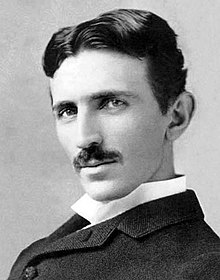
Albert Berg’s Unsanity Files is one of the blogs I follow, enjoy, and draw inspiration from. Here is a uniqute take on Nikola Tesla, the famous inventor who held more than 100 patents. Albert discovered more than electro-mechanical genius in Tesla’s book, “My Inventions.” Here are several valuable principles about writing he discovered.  Enjoy

Albert Berg's avatarThe Unsanity Files

Those of you who follow my Twitter feed know that I recently finished reading a book called My Inventions by Nikola Tesla. Before reading this book, I had a nominal knowledge of Tesla. I read a short biography on him back when I was in high school, and I was aware of his hero status on the internet, but reading his life story in his own words gave me a new appreciation for the man.

As a child who grew up idolizing the likes of Thomas Edison, and dreaming of what it might be like to have a career as an inventor, Tesla has always held a special place in my heart. But as a writer, I realized that his approach to life was something I could emulate as a writer as well. What follows is a short list of the things I learned from Tesla’s life that I think could benefit writers…

View original post 1,223 more words

An Author’s Guide to Publishing in 2012, by Amy Rogers.

Those who have followed thefirstgates for a while will be familiar with Dr. Amy Rogers.

Amy Rogers

I reviewed her excellent first novel, Petroplague, in September, 2011 http://wp.me/pYql4-1ep.  In March of this year, she contributed a two part guest post detailing some of the rapid changes in today’s publishing landscape, an issue she follows in depth http://wp.me/pYql4-1MR.  Last Friday, Amy gave an updated presentation on  publishing options to the Sacramento branch of the California Writer’s Club during our monthly breakfast meeting.

Not long ago, there were only two publishing choices:  traditional publishing and the so called vanity press.  Now we have a spectrum of possibilities which keep getting harder to navigate.  Hybrid arrangements are multiplying:  traditional agencies offering ebook options, and agented independent publishing companies.

Rogers began her presentation by stressing the importance of every writer evaluating their individual goals.  Why do we want to publish this particular book?  How will we measure success?

Do we seek the implied approval that selection by a traditional publisher confers?  If so, do we have the time to invest in the process, knowing there is no guarantee of ultimate success?

If we choose to go the independent route, are we ready and willing to spend the time and/or money on five key tasks required for any book to be successful:  editing, cover design, layout, getting an isbn number, and marketing/distribution?

With a sense of our goals, Amy Rogers presentation, posted in full on her blog, will prove especially valuable.  A downloadable pdf version, is available too http://tinyurl.com/739ga5s.

After reviewing the presentation, take the time to explore Ms Rogers’ website, ScienceThrillers.com.  With a Ph.D in immunology, teaching experience in microbiology, and a writing career that began in grade school, Amy is uniquely qualified to write and review thrillers involving the depredations of “wee beasties.”  ScienceThrillers has grown to include reviews of books in multiple genres, publishing news, book giveaways, notices of writing contests, and her own quarterly newsletter.  It’s a site I’m very happy to recommend.

The Wind Through the Keyhole, by Stephen King: A Book Review

I recently said I look for “imaginative escapism” in summer reading, and Stephen King’s, The Wind Through the Keyhole, 2012, qualifies on both scores.

This book is a celebration of stories by a consummate storyteller.  It is structured as a frame tale, three levels deep – a story within a story within a story, something you find in some our oldest epics and story collections like The Odyssey and The Arabian Nights.

In case we we miss that connection, King says it another way through his main character, Roland Deschain, who tells his traveling companions, “There’s nothing like stories on a windy night when folks have found a warm place in a cold world.”  Later, during a story concerning his younger self, Roland says, “A person’s never too old for stories…Man and boy, girl and woman, never too old.  We live for them.”

This is the eighth of King’s Dark Tower Novels, and the first I have read, but the introduction caught me up well enough to proceed.  Roland Deschain is a gunslinger in Mid-World.  A gunslinger is a cross between a knight errant and an old west marshall.  Many gunslingers are descendants of “the old White King, Arthur Eld.”

Mid World borders our own and is “filled with monsters and decaying magic.”  In places, there are gates between the worlds, or places where “the veils are thin.”  Three of Roland’s companions come from New York.  The fourth is a billy bumbler, a talking, dog-like creature.

Roland and his companions – his ka-tet – barely have time to find shelter from a starkblast, a devastating storm, with winds like a hurricane, the sudden onset of a tsunami, and temperatures so cold that trees snap and explode.  While the friends shelter by the fire in the only stone building in a deserted town, Roland tells of one of his first assignments as a gunslinger.

In the first story, “The Skin-Man,” Roland rides with his partner, Jamie Red-Hand, to the desolate mining town of Debaria, where a shapeshifter has slaughtered dozens of people.  This a gritty western world, like the bleakest of early Clint Eastwood’s westerns, and the monster is more deadly than the bad and the ugly Clint faced down.

While talking to an 11 year old survivor of an attack, a boy whose father and a dozen others were slaughtered, young Roland tells the second tale, “The Wind Through the Keyhole,” about another 11 year old, Tim Ross, who goes on a dangerous quest to save his mother who has been injured by a treacherous step-father.  Tim sets off to find Maerlyn, aka Merlin, at the heart of The Endless Forest.

Picture an 11 year old on an Arthurian quest, who stumbles into a swamp filled with gators and is saved by a group of plant people who communicate telepathically and give him a strange disk with buttons and lights that speaks and answers his questions in a female voice.  Her name is Daria.  Once she tells him she’ll be “offline” for half an hour, “searching for a satellite link.”

Just when he’d begun to believe she really had died, the green light came back on, the little stick reappeared, and Daria announced, “I have reestablished satellite link.”

“Wish you joy of it,” Tim replied.

Well, why not?  Is a magical iPhone so different from an enchanted sword or magical ring?  A master storyteller like Stephen King can pull of escapades like this because he always has me asking the one question that really matters in storytelling.  To quote Neil Gaiman, that question is, “What happened next?”

There’s adventure, courage, cruelty, humor, horror and much more as Roland Deschain takes us in and leads us back out of three levels of story.  One constant throughout all the tales is the wind, and I think Roland speaks for King when he says:

In the end, the wind takes everything, doesn’t it?  And why not?  Why other?  If the sweetness of our lives did not depart, there would be no sweetness at all.

The Wind Through the Keyhole is a very satisfying summer read – and quite a bit more.

RIP Maurice Sendak

If you haven’t heard, Maurice died today of a stroke, at age 83.  Here is a nice five minute interview he gave in 2002 that ran on the PBS Newshour tonight.  It’s illuminating to hear him say, “I don’t know how to write for children.  I don’t think anyone knows how to write for children, and those that say they do are frauds.”

He goes on to say, “I write for me,” and adds that it isn’t always easy to be driven by something internally that is “riotous and strange.” What a great gift he gave to riotous strangers!

http://www.pbs.org/newshour/bb/entertainment/jan-june12/wildthings_05-08.html

The Secret Life of Pronouns

Who knew that pronouns can predict romantic compatibility, reveal power dynamics, lying, and who will recover from trauma?  James Pennebaker, a psychologist at the University of Texas at Austin has been tracking the truth of pronouns for 20 years.

James Pennebaker

He includes them in the group he calls “function words,” necessary parts of speech that are invisible to us in conversation:  the, this, though, I, and, an, there, that, he, she, where, when.  Pennebaker contrasts these with “content words,” which carry meaning and evoke images in our minds, words like, school, family, life, friends.

In a recent NPR interview, Pennebaker related that he and his students studied couples’ compatibility in the context of speed dating, http://tinyurl.com/7skcgf4.  Computers proved an essential tool for analyzing results, since try as we might, we really don’t hear function words.  By entering both the transcript and the speed dating outcomes, Pennebaker’s team discovered a strong correlation between matching function word usage and the decision to get together after the first meeting.  The computer predicted who would hit it off more accurately than the couples themselves.

This is not because similar people are attracted to each other, Pennebaker says; people can be very different. It’s that when we are around people that we have a genuine interest in, our language subtly shifts.

“When two people are paying close attention, they use language in the same way,” he says. “And it’s one of these things that humans do automatically.  They aren’t aware of it, but if you look closely at their language, count up their use of ‘I, and, the,’… you can see it. It’s right there.”

The other discovery Pennebaker discussed in the interview centers on power dynamics.  When two people with different status or power interact, the subordinate uses “I” much more frequently.  Pennebaker suggests self consciousness is the cause, concern about how we’ll be perceived.

Finally, Pennebaker weighed in on the My Fair Lady question:  if we change our language, do we change?  After 20 years of research, Pennebaker says no.  Change who you are and your language will change, but not vice-versa.

What’s interesting is that several people I respect claim that changing your handwriting changes personality.  Organize your penmanship, for instance, and other aspects of your life will follow.  This suggests the added visceral dimension makes the difference.  Makes you wonder – The rain in Spain falls mainly on the plain.  Probably doesn’t work as well on a keyboard…

You can read about Pennebaker’s research in The Secret Life of Pronouns, 2011:

Mark Coker on the Justice Dept. vs. publishers

Mark Coker, the founder of Smashwords, is probably the best known advocate of ebooks as an alternative to traditional publishing, yet he doesn’t want those publishers to disappear.  He made this clear in an article on cnn.com on Sunday entitled, “A dark day for the future of books.” http://www.cnn.com/2012/04/15/opinion/coker-book-publishing/

Mark Coker

The Justice Department launched an anti-trust suit against Apple and five large publishing companies for adopting “agency pricing” and allegedly forcing Amazon to comply.  At the time, Amazon was pricing many books below cost, a move the other publishers feared would harm their print book sales. Three of the publishers have settled, while the remaining two, plus Apple, are going to court.

Coker seldom sides with big publishers, but in this case his reasons are clear:  he fears the Justice Department’s intention to protect consumers could actually harm them by harming the publishing industry by “forcing them to comply with onerous conditions…including restrictions on collaboration with fellow publishers and increased federal auditing and reporting requirements — [which] will increase publisher expenses and slow their business decisions at the very time when publishers need to become faster, nimbler competitors.”

Coker says that although agency pricing raises ebook prices, it “prevents deep-pocketed retailers or device makers from engaging in predatory price wars to harm competitors or discourage formation of new competitors. It would enable the marketplace to support more retailers, which would mean more bookstores promoting the joys of reading to more readers. And it would force retailers to compete on customer experience rather than price. Customers are best served when we have a vibrant e-book retailing ecosystem.”

As I understand Coker’s argument, if ebook prices drop too low, print publishing, the staple of brick and mortar stores as well as libraries, will become a money losing proposition.  I think we all know a certain “deep-pocketed retailer or device maker” who isn’t above “predatory price wars.”  Much as I love my kindle, I don’t want Amazon to become the only game in town.

I suggest everyone with an interest in writing, publishing, and ebooks read Coker’s article, the latest installment in a very convoluted drama.

Snowcrash by Neal Stephenson – An Appreciation

Twenty years ago, Mary and I got our first real home computer (the Commodore 64 didn’t quite count).  With an Intel 486 processor, 500k of ram, an 8k external modem, and AOL memberships, we were wired!  Full-fleged members of the information age, at least by the standards of the day.

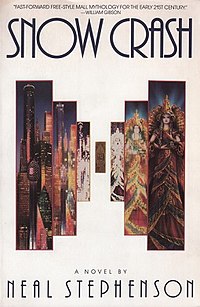
The same year, 1992, Neal Stephenson published a visionary novel called, Snowcrash. In retrospect, it merits the word, “prophetic,” for its sketch of life in the metaverse – a word Stephenson coined – and in the inconvenient world we call “reality.”

Consider:

In Snowcrash, Stepenson posits a world where nation states have transferred most of their power to corporations. Most people are corporate citizens and live in corporate enclaves, or less prestigious burbclaves.  The hero of Snowcrash, Hiro Protagonist, is a citizen of “Mr. Lee’s Greater Hong Kong.”  Military power belongs to private contractors, as do the roadways, which vie for driver/customers.  The post office is gone; private couriers deliver snail-mail.  The United States occupies a smallish territory centered in the Mohave Desert, and keeps it’s employees busy with make-work projects.  The former United States economy hinges on two industries – computer microcode and high speed pizza delivery, which has been revolutionized since the Mafia took control.

Though Hiro is a citizen of Hong Kong, as a pizza driver, he can’t afford to live in their enclaveclave.  Home is a self-storage unit under the flight path at LAX.  Like most of his hip and cyber-savvy generation, he spends most of his time online in the guise of his avatar, navigating virtual worlds.  But something is happening in the online world.  A strange new computer virus, when opened, generates a graphic pattern that scrambles the brains of the user.  They are dazed and speak in tongues.  With a young woman named YT, for Yours Truly, Hiro sets out to unravel the mystery.

The villain turns out to be a charismatic preacher.  In his attempt to secure both temporal and spiritual power, he has tapped into the ancient Sumerian glyphs that first scrambled human speech patterns in the event known as the Tower of Babel.

It’s been 20 years since I’ve read Snow Crash, so I’m writing this from memory.  I’m not necessarily recommending the whole novel.  The first jaw-dropping 100 pages, where Stephenson built his world, flew by and still leave me in awe.  I remember the rest of the book dragging in parts, but I still think of the story all the time.  Most futuristic fantasies prove as silly as the 1930’s movie shorts that show humans zipping along in their air cars between high rise buildings, happy and without any accidents.  This book is different.

In 1992 there were no virtual worlds.  Now there are, and you have to create an avatar to negotiate them.  These days, it isn’t so hard now to imagine a bright young man living in a self-storage shed.  But above all, Snow Crash comes to mind because in the wake of “citizens united,” it’s so easy to see corporate power growing while government power wanes.  With Super Pac money rolling the election year dice, does the government control corporations or do corporations control government?  Neal Stephenson saw this and other aspects of our world coming 20 years ago.

Snow Crash, is a visionary novel that all lovers of fantasy should know.

An Author’s Guide to Publishing in 2012 – A Guest Post by Amy Rogers, Part 2

This is the second part of a guest post outlining ways writers can understand and respond to the rapid changes in the world of publishing.  If you haven’t read Part 1, I suggest you start with that post, which immediately precedes this one.

_____________________________________________________________________

An Author’s Guide to Publishing in 2012 – Part Two, by Dr. Amy Rogers

Part 2: Indie Publishing

Take all of the above and add another, less glamorous tech advance: print-on-demand publishing.  What you get is a slew of new publishing options.  Traditional New York-based publishers (now consolidated into six major houses with many imprints) used to be the only game in town.  What was once derisively called vanity publishing has become “indie”, and indie publishing encompasses a wide range of approaches.

Self-publishing:

This is the buzzword on everyone’s lips, but what does it mean?   I find that many people use the term “self-published” to broadly describe any book in any format that does not have the imprimatur of a Big Six publisher.  This fails to account for the various degrees of self-publishing and also the new professional indie publishing options out there.

1.  A truly self-published book is written, edited, designed, formatted, and distributed all by the author.  The main advantages of this approach are total control and minimal financial expense (though the investment of time may be substantial).  Some writers create their own publishing company to do this.  However most self-pubbing authors hire out at least some the non-writing tasks.  In fact, the majority of “self-published” titles were published by a subsidy publisher chosen and paid for by the author.

2.  Subsidy publisher

A subsidy publisher is a company hired by the author to turn his text file into a paper or digital book.  In most cases, the subsidy publisher provides online distribution but NOT to bricks-and-mortar bookstores.

With subsidy publishing, the author pays out of pocket for all expenses.  The cost and services provided vary a lot, so it pays to shop around.  Unlike old “vanity” publishing, print on demand technology frees the author from having to pay in advance for a print run of books that might never sell.  This keeps the costs low relative to the old days.  In this model, the author is the publisher’s customer.

The next step closer to a traditional publishing arrangement is assisted self-publishing where the author does not pay the costs upfront but rather shares future royalties with the service provider.  This means the book has to be good enough that somebody is willing to take a modest financial risk in publishing it.  Several literary agencies are now offering this type of “consulting” service to their existing clients in exchange for a commission.

3.  Not self-pub: Small presses

A small press is any traditionally-structured publisher that is not owned by the Big Six.  University presses, regional presses, niche publishers and others fit in this category.  Such companies may only publish a few titles per year.  The key distinction that makes this “not self-pub” is the publisher, not the author, pays the costs of getting the book out there.  In this model, booksellers and readers are the publisher’s customers.  Unlike self-publishing, the author must provide a manuscript that is deemed commercially viable on at least a small scale.

4.  Digital-only full-service publishers

This category didn’t exist until a few years ago.  Digital-only publishers operate like small presses but release their titles only in e-book formats.  This keeps their costs lower and allows them to take on riskier projects—such as first novels—that may not sell enough copies to catch the attention of a Big Six imprint.  My own publisher, Diversion Books, is a leader in this category.

With Diversion, the author retains the right to self-publish in paper.  This creates an interesting situation: my science thriller Petroplague is currently on sale with two different covers and two different publishers.  One cover is for the professional e-book with Diversion; the other cover is on the paper books I produced at my own expense with the help of a subsidy publisher.

One size does not fit all in publishing these days.  Indie authors can choose to learn a variety of non-writing skills and publish their books themselves, or they can hire others to do it for them.  If the book is marketable and the author is willing to split royalties, a small press or a digital-only publisher may be an alternative to the Big 6.  For the first time in the history of the book, barriers to entry are low and every writer has the power to bypass the gatekeepers and put his or her words in the hands of readers.

—–

Amy Rogers is a Harvard-educated scientist, educator, and critic who writes science-themed thrillers. Her debut novel Petroplague is about oil-eating bacteria contaminating the fuel supply of Los Angeles and paralyzing the city.  She is a member of International Thrillers Writers Debut Class (2011-2012).  At her website ScienceThrillers.com [there’s a link on thefirstgates blogroll], Amy reviews books that combine real science with entertainment.  You can follow Amy on Twitter @ScienceThriller or on her Facebook fan page http://www.facebook.com/pages/Amy-Rogers/202428959777274

_____________________________________________________________________

Please stop by Amy’s blog, ScienceThrillers.com, to leave a comment if you enjoyed this series.  While you are there, take a look at the features, sign up to receive the newsletter, and enjoy the reviews of a number science-related thrillers, ranging from The Hound of the Baskervilles to Jurassic Park.