More notes from the Wasteland

Joseph Campbell considered the Wasteland and the quest for the Grail that heals it to be a core myth for our time.  During “The Power of Myth” series at the end of his life,  Campbell said the Wasteland results from a worldview that divides matter and spirit.  Referring to the Fisher King’s wound he said:

“the Christian separation of matter and spirit…has really castrated nature. And the European mind, the European life, has been, as it were, emasculated by this separation. The true spirituality, which would have come from the union of matter and spirit, has been killed.” (1)

Generations of western thinkers, culminating in Descartes, built upon the split Campbell cites to elaborate a mechanistic view of nature that made the world ripe for human exploitation.  Results of this world view are visible everywhere, both in the headlines and in the landscape around us.  This part of California, for instance, still bears the scars of hydraulic mining 150 years after the gold rush.
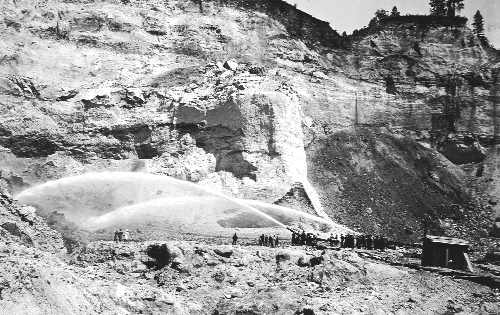
Hydraulic mining along the Yuba river.  Malakofdigginsstatepark.org

Hydraulic mining along the Yuba river. Malakofdigginsstatepark.org

Deliberate exploitation isn’t always the culprit.  We think of Native Americans as attuned with nature, but even they made mistakes.  From AD 900-1150, such a large concentration of Pueblo people lived in Chaco Canyon, NM that they cut an estimated million trees from the surrounding Colorado Plateau.  The resulting erosion, loss of game habitat, and flooding is thought to be one reason why they abandoned the site.  The surrounding landscape, once forest, has been desert ever since.
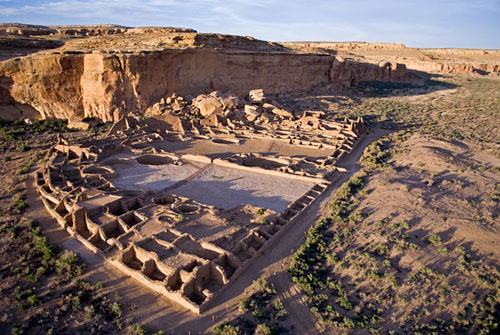
Pueblo Bonito ruins, Chaco Canyon.  Photo courtesy of Scott Haefner, scotthaefner.com

Pueblo Bonito ruins, Chaco Canyon. Photo courtesy of Scott Haefner, scotthaefner.com

Now that humans have the power to disrupt the environment on a global scale, the question of whether the harm is deliberate or inadvertent may be moot, but serious differences still lie at the heart of competing world views.  Campbell touched on this issue in Creative Mythology, the last book of The Masks of God, a four volume study of world mythology that he wrote between 1962 and 1968.  In this series, he ascribed four functions to myth (2)

  1. The Metaphysical Function: Awakening a sense of awe before the mystery of being
  2. The Cosmological Function: Explaining the shape of the universe
  3. The Sociological Function: Validate and support the existing social order
  4. The Pedagogical Function: Guide the individual through the stages of life

The Grail story resonates on all of these levels, but since I want to consider the Wasteland myth in light of our current environmental crisis, the third and fourth functions have the greatest relevance here.

Campbell points out that humans are born too soon, “absolutely helpless,” and unlike most other animals, learn how to survive from a social group.  Our earliest myths derive from the hunter/gatherer era, “hardly greater than large families, of which every adult member was in possession of the entire cultural heritage.”  

These earliest myths “served a fostering, educative function, bearing the unfinished nature product to full, harmonious unfoldment as an adult specifically adapted for survival in a certain specific environment, as a fully participating member of a specific social group; and apart from that group he would neither have come to maturity nor have been able to survive.”  There was room for diversity, but no one who threatened the group was tolerated.

The next strata of myth emerged when humans settled into agricultural communities, beginning around 7500 B.C..  Villages grew into towns and then into cities and “it was precisely at this point of space and time, in the Near East, and specifically Sumer, c. 3500-3000 B.C., that the evidence first appears among the ruins…first, of a disciplined social order imposed from above by force, and next, of deliberate expeditions of military conquest against neighbors…campaigns of systematic conquest and subjugation.”  The principle here, said Campbell, was “greed for more than one’s share.”

Imposed social orders are not inherently bad, says Campbell.  Despite romantic fantasies of the noble savage, few people really want to live in caves or give up such boons as advanced medicine, arts, spirituality, and transportation, to say nothing of indoor plumbing.  Like conventions in writing, music, or painting, cultural conventions may spark creativity when they are new and later stifle it as they atrophy.

“The Waste Land, let us say then, is any world in which…force and not love, indoctrination not education, authority not experience, prevail in the ordering of lives, and where the myths and rites enforced and received are consequently unrelated to the actual inward realizations, needs, and potentialities of those upon whom they are impressed.”

This was the situation when the European Grail myth emerged; the first written version was composed in the 12th century by Cretien de Troyes at the very time the inquisition began.  The Grail legend served as a counterpoint to the institutional church; the tale can be read as the map of a quest for personal realization, safely couched in a story of ladies and knights.  In the earliest versions, the Grail was not the cup of the last supper but a stone or a large stone dish, which like the philosopher’s stone of alchemy, granted the heart’s deepest desire.

Even at our remove from the middle ages when the stories emerged, the Grail remains one of our living myths, at least if you pay attention to popular fiction and movies.  Think of The Da Vinci Code, Indiana Jones and the Last Crusade, and even Monty Python and the Holy Grail.
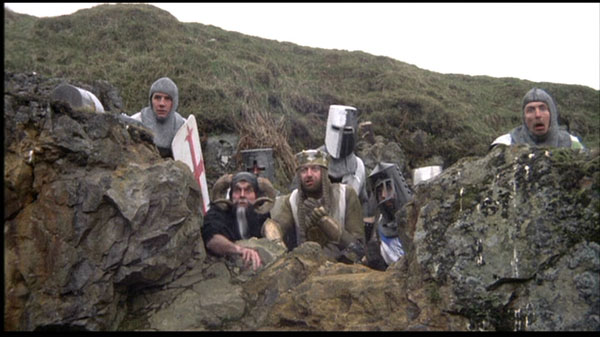
Pythons on the quest: at the lair of the Killer Bunny

Pythons on the quest: at the lair of the Killer Bunny

As much as the population of the middle ages, we are, in the words of 19th century poet, Matthew Arnold, “Wandering between two worlds, one dead, the other powerless to be born.”  The Grail continues to speak to such eras, especially one in which the Wasteland is not just the metaphor of an inner desert, but a world in which that desert is visible around us.

The Grail remains a shining image, never quite clear, but unforgettable, of the kind of life and world we seek among the confusion of possible futures.  At the end of “The Power of Myth” series, Bill Moyers asked Joseph Campbell what the myth of the future might be.

“You can’t predict a myth anymore than you can predict what you’re going to dream tonight,” Campbell replied (3).  “Dreams and myths come from the same place.”  Then he went on to say, “The only myth that’s going to be worth thinking about in the immediate future is going to be one that is talking about the entire planet.”

Earth from space

“You don’t see any divisions there of nations or states. This may be the symbol of the mythology to come. That’s going to be the country we are celebrating.” – Joseph Campbell, 1987″

Next:  Some people who are already question for the Grail.

Chimps in charge

chimp

The day after my post on how to find healthy veggies, Mary and I decided to grab some burgers for lunch.

As we sat down, I noticed “Heart of Stone,” from the Rolling Stones’s first album, playing in the background.  I was contemplating impermanence – how quickly the songs of youth wind up on the oldies station – when the song ended, and “Rudolph the Red Nosed Reindeer” came on.

I looked at Mary.  I muttered an expletive and said, “I thought we were done with all that!”

Our food came, and the music shifted to “Chain of Fools,” a good old Motown classic.  I sighed with relief.  Life was good.  January was good.  January means months and months without “holiday music.”

Or so I thought…

Until “Holly Jolly Christmas” began to play…

More than any other song, “Holly Jolly Christmas” reminds me of pre-transformation Scrooge and the wisdom of his comments concerning boiling certain people in their own Christmas puddings.

“Maybe they just want to hurry us out the door,” Mary said.

I slugged down the rest of my drink.  “It’s working,” I said.

The question I’m left with is, who put together that playlist?  I’m ruling out computer generation, since in my experience, the algorithms, (like iTunes’s “Genius” function) are too sophisticated to create such a mishmash.  I’m left with two theories:

  1. In an effort to save money, satellite radio stations now use institutionalized sociopaths to assemble their playlists.
  2. In an effort to save money, satellite radio stations now use chimps.

I kind of hope it’s the latter, although chimps-in-charge is not a trend that bodes well for things like TV schedules or mid-term election advertising, which will probably start up next week.

If you have any other ideas on who is to blame for Burl Ives in January, please let us know so we can free the poor chimpanzees from blame!

photo by Will Brenner, CC BY-ND 2.0

photo by Will Brenner, CC BY-ND 2.0

Another great story rediscovered: Bamboo Charlie

Here is another inspiring tale that I bookmarked some time ago and then forgot.  Coincidentally, like the previous post, its subject is a uniquely creative folk artist.  I read about Bamboo Charlie in a memorial published in the L.A. Times in September, 2012.

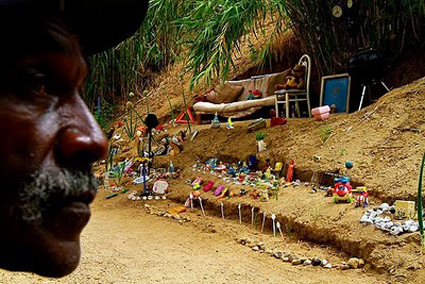
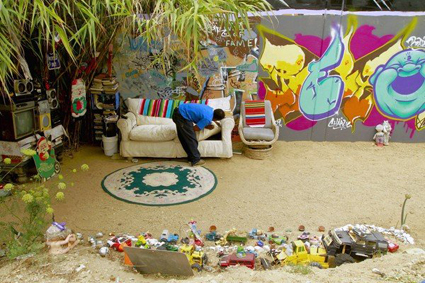
Bamboo Charlie and his whimsical paradise

Bamboo Charlie and his whimsical paradise

Twenty years ago, a homeless Texan named Charles Ray Walker noticed a bamboo grove along a narrow stretch of land by the Los Angeles River in Boyle Heights.  The property owner told Charlie he could stay there if he kept the place clean.

On the strip of land, about 40′ x 200′, squeezed between a parking lot and a warehouse, Walker grew fruits and vegetables.  He carved stairs into the bare slopes and decorated them with hundreds of discarded toys and signs.  He built a shack under a tree, with a TV, bed,and sofa, and then he invited guests to visit: graffiti artists, children and their parents, musicians, police officers, and homeless friends.  He assembled a library out of salvaged books, including best sellers and one called The Semi-Complete Guide to Sort of Being a Gentleman.  Bamboo Charlie was featured on the front page of the L.A. Times in 2010.

"Bamboo Charlie"

During the 20 years he spent on the parcel, he collected cans for money, sometimes working late into the night. Duruing occasional trips back to Texas to visit his family, he operated a crane at a steel company. “I’m not going to ask another grown man for money. I never have, and I never will,” he said. “People expect that from a homeless man.”  

That pride may have contributed to an early death.  He suffered greatly from ulcers during his final years, but insisted he was fine when friends suggested he see a doctor. On Aug. 26, 2012, a young friend named Teyuca found him dead in his shack, of what the coroner determined was heart disease.  He was 61.

“I really think what he did was folk art, built out of scraps and things found, things that people gave him,” Teyuca said.  “He was a mad genius.  He had such a wild imagination.”

A great story I neglected to post

I found this during a year-end cleaning of my “Drafts” folder – an unfinished post inspired by a newspaper article in July which details the life’s work of unsung folk artist, Arthur Harold Beal, garbage collector for the town of Cambria, CA.

Just down the road from the Hearst Castle, that world-famous monument to excess, lies Nitt Witt Ridge, the house on the hill that Beal lovingly crafted of driftwood, river stones, beer bottles, abalone shells, toilet seats, and other assorted junk.  Beal started work in the 30’s was still going in 1992, when he died at the age of 96.

Nitt Witt Ridge by megpi, CC BY-NC-SA-2.0

Nitt Witt Ridge by megpi, CC BY-NC-SA-2.0

Michael O’Malley, a plumber in town, bought the Ridge for $42,000 in 1999.  Unfortunately, the sale price did not include water rights, so he and his wife cannot live there, and because it is zoned residential, they can’t open the house for public tours.  Several times a week in the summer, O’Malley gives private tours, in return for donations, to people who contact him directly.  He is something of an expert on stories surrounding the Ridge’s creator.

Beal used to say he salvaged his wood from the ocean, but O’Malley points out the quality of the material, and suggests that Beal might have “salvaged” it from local construction sites late at night.  Beal seems to have been a curmudgeon.  Some people asked to visit the house while he was still living.  If he liked their looks, he’d let them in, if not, he would shake his fist and yell, “Move along, small change.”  O’Malley found a video of Beal on a 1981 TV episode of “Real People.”  At age 81, with a long beard and a walking staff, “he looked like a mix of John Muir and Dennis Hopper.”

Here’s a brief but informative clip of O’Malley giving a tour of the house:

Last summer, when I started this post, I added descriptions of other architectural oddities, like the Watt Towers and the Bottle House of Rhyolite, NV.  The story grew too long and languished until now.

The end of the year is a good time to contemplate things like Nitt Witt Ridge.  While others compile their lists of “The Best of 2013,” here is my contribution to a list of things wacky and weird.

Virtual dreams

A few nights ago I had a 21st century dream in which the key event was losing my cell phone.  In days of yore – say five or ten years ago – losing a wallet was the common dream image for a disruption to one’s persona.  Now my smart phone probably tells me more about my public life than a wallet.  It shows me where I am, where I’m going, when I need to be there, how to find my way, and it gives me multiple ways to connect with people I need to see when I arrive.  In a few years time, I’m sure we’ll all have digital ID’s and credit cards.

Though I still think of dreams in terms of archaic elements, clearly the psyche will use whatever it needs to make a point.  As technology is part of our lives now, it is also part of our dreams.  All of which leads me to the heart of this post:  we ain’t seen nothin’ yet! 

Last Wednesday, I caught an amazing segment on virtual reality on the PBS Newshour.  I didn’t expect to be interested.  Since I don’t play video games or World of Warcraft, VR seems like just one more distraction in an ADHD world.  It may well be, but the Newshour piece demonstrates the power of this technology, beyond anything I’d imagined.  I instantly thought of the “Feelies” – multi-sensory movies in Huxley’s Brave New World.  We aren’t there yet, but it would be foolish to rule out the possibility.  Watch the clip and see what you think.

The power of imagined experience has long been established.  In the early 20th century, Jung developed a technique he called “active imagination” and used it in therapy.  In the 50’s, research proved that imagined practice was as useful as “real” practice for improving basketball free throws.  In reference to meditation, Lama Thubten Yeshe, a prominent 20th century Tibetan teacher, said, “What we have to learn is that the experiences we have through imagination and those we have through our senses are actually the same.”

All of these applications involve self-generated imagery, but if and when VR comes into our living rooms, it will come through the same corporate interests that flood us with adds already.  Do we want them reaching even farther into the deep psyche?

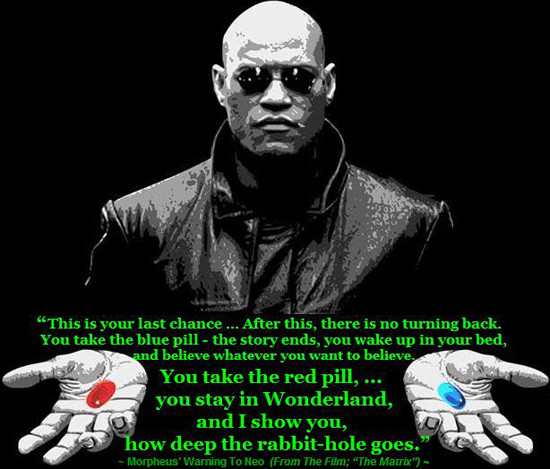
We’ll be clamoring for it!  If you have any doubt, check out Life, the Movie: How Entertainment Conquered Reality by Neal Gabler.  In terms of an obvious metaphor, The Matrix, once we have the ability turn our living rooms into personal holodecks, that blue pill of restless sleep will surge in popularity.

MorpheusWarning

To paint a huge subject in simple terms, over time, our race has transferred successive parts of our brain functions to technology.  Printed books marked the end of bards who could recite epic poems.  We don’t find the griots of Alex Haley’s Roots in literate cultures.  The imaginations of my parents’ generation got a better workout listening to The Lone Ranger on radio than mine did watching the masked man on TV.

I love technology, but I’m wary of it too, and not just the obvious stuff like the NSA.  I’m wary of all the ways we can use it to foster oblivion until, as T.S. Eliot put it, “Human voices wake us and we drown.”

We were hopeful once, and young

Bob_Dylan_-_The_Times_They_are_a-Changin

I just came upon a high quality clip of an unbelievably young Bob Dylan at Newport in 1963, singing one of his best early songs.  Watching it, I’m reminded of a line from another early Dylan song, “We never much thought we could get very old.”  I guess no one ever does.

Change a few particulars and the song is as timely today as it was 50 years ago.  What’s missing is the collective hope/dream/prayer of those days that music could change the world.

Maybe it can, in the sense of planting seeds.  Maybe, but if so, those seeds take longer to germinate than anyone who is young can possibly imagine.

Enjoy a great clip of “North Country Blues.”  And maybe water the seed.

Robots ‘R Us, installment 2

The Steam Man of the Prairies, 1868.  Public Domain.

The Steam Man of the Prairies, 1868. Public Domain.

An obscure author, Edward S. Ellis, who published a dime novel called The Steam Man of the Prairies 145 years ago, may prove to have been a visionary according to two recent news articles.

The first, in the New York Times, reports that Google quietly acquired seven robotics companies over the last six months (Google Puts Money on Robots).  The scale of the investment is huge and appears to be aimed at automating manufacturing processes.  “The opportunity is massive,” chirped Andrew McAfee, an M.I.T. research scientist.  “There are still people who walk around in factories and pick things up in distribution centers and work in the back rooms of grocery stores.”

The second article I noticed bears an uncanny relation to the cover of  The Steam Man.  The California DMV has set rules for companies aiming to test automated cars (Driverless Cars Could be Cruising California Roads by Spring).  To put it in the terms of the M.I.T scientist, we may soon be able to robotize trucks and remove even more inefficient humans from the workforce.

The problem with this manufacturer’s wet dream should be obvious.  Robert Reich, former Secretary of Labor under Bill Clinton puts it simply: “the economy remains lousy for most people. It will likely remain that way: As technology and globalization take over the economy, the U.S. has no national strategy for creating more good jobs in America.” (The True Price of Great Holiday Deals).

Economic discussion, with few exceptions, focuses on how to get back to the good old days of (relatively) full employment and opportunity for those who work hard.  Politicians bicker over which levers to pull, but no one dares to ask the fundamental question: has the structure of the world economy changed too much to recapture that particular sort of past “good times?”

A few years ago, news got out of worker mistreatment at Foxconn, the huge Chinese assembly plant where much of our high-tech gear is assembled.  Foxconn agreed to reforms, and the CEO announced plans to deploy a million robots.  By December 2011, robotic arms had reduced the number of workers on certain assembly lines from “20 or 30 down to 5.”  As we argue over fair wages for fast food workers, it’s a good bet their employers are working on ways to automate the task of making a burger, which can’t be harder than plugging components into a motherboard.

The problem, of course, is that downsized workers will not be buying either Happy Meals or iPhones.

Last March, in a post called Robots ‘R Us (?), a first look at such issues, I quoted a blogger named Orkinpod who was already considering them in depth.  On Feb. 27 he said:  “When the future arrives (and I believe that it is very, very close), and machines can supply all the things that humans could possibly ever want, what is everybody going to do?”

One thing many may wind up doing is working on food production.  Last summer I wrote of a compelling PBS NewsHour series, “Food for 9 Billion” (1).  That’s the total number of hungry humans who will occupy the planet in 2050 as the amount of arable land continues to shrink.  One of several examples given of coming change was Singapore, where five million people live on an island with only 240 acres of undeveloped land.  A 50 year old Singapore engineer developed a revolutionary type of vertical greenhouse that prompted the Directer of the National Institute of Education to say, “I think, eventually, urban factories for vegetable production will take the place of electronic factories in Singapore.”

It’s a grand irony to reflect that industrialism, which began by channeling people out of agriculture, may have succeeded too well; its end game my involve shifting some of them back into food production again.  But what about everyone else?  What happens as robotics and marvels like 3D printers leave ever more people idle?  Insiders aren’t even asking the question, though science fiction writers have since the mid 20th century.

robot3

Unfortunately, in stories where humans go up against robots, the outcomes are usually not the ones we would like to see.

Remembering George

George Harrison in the Oval Office at the invitation of President Ford, 1974.  Public Domain

George Harrison in the Oval Office at the invitation of President Ford, 1974. Public Domain

I didn’t call the Beatles by their first names – or even clearly know their names – when they first came to America.  Although the media wouldn’t let you forget Beatlemania, I was more of the Beach Boys persuasion at the time, and later got caught up in the San Francisco sound.  Then, in 1968, the Beatles did something amazing to me – they went to India to study with a guru.  They opened a door I had only vaguely known was there.

George was the Beatle whose life and work were forever altered by eastern religion, as was my own.  He learned to play the sitar with a master, while I learned the harmonium, (a wonderfully simple instrument that allows even a novice to produce a credible melody).  For a time he belonged to an organization I did, dedicated to meditation and the study of eastern philosophy.

In Vrindavan, India, 1996.  Public Domain.

In Vrindavan, India, 1996. Public Domain.

In early November, 2001 at the age of 58, he underwent a last ditch treatment in New York for lung cancer that had metastasized to his brain.  When that failed, he travelled to Los Angeles, where he died on November 29, surrounded by family and friends.  Deepak Chopra wrote:

“He always would say that when I die I want to be fully conscious of God, I want to be totally at peace, and I don’t want to have any fear of death. And believe me, being close to him, I know that he died very conscious of God and in peace and not afraid of death.”

Blood line ancestors pass on their physical substance to us.  Ancestors of the heart pass on their spirit, encourage us by example, and show us what a life well lived can look like.  For inspiration, I still listen to Harrison’s last album, Brainwashed, released posthumously in 2002.  His son, Dhani helped finish it and included this quote from the Bhagavad Gita in the liner notes:

“There never was a time when you or I did not exist. Nor will there be any future when we shall cease to be.”

Here is a very nice clip on one of my favorite George Harrison songs from the Concert for Bangladesh, 1971.

On this day, when I listen to his music, I remember a man I truly admire, who was genuine, who found his own path and followed it to the best of his ability.  “You got to walk that lonesome valley by yourself,” as the old song says, but we do not do so alone.  Somehow the spirits of those who went before are there to inspire us.