Full Faith and Credit: a personal story and parable.

My wife and I got married in Santa Fe in 1976.  We didn’t have a lot of money, but our mothers were gone and our families and friends were on the coasts, so there would only be eight in the wedding party.  We arranged to have the reception and put everyone up at the lodge in a nearby national monument.

I worked in a printshop that had been one of the finest in town.  We still did brochures for the Santa Fe Opera, but signs were clear that the glory days were over.  A husband and wife team had started the shop, but they divorced, and with only one of them running the business, glitches appeared in the billing system, the revenues, and the payroll.  About the time we booked the rooms and locked in arrangements, my paychecks started to bounce.

The pressmen and I started cashing our checks at grocery stores and the boss’s bank, since our own banks charged fees for deposits that bounced.  The day before the wedding, a teller said, “I’m sorry, I can’t cash this check.  Your employer’s account is $1000 in arrears.”

“Please,”  I said.  “We’re getting married tomorrow, and we have to pay the caterers.  If they’re $1000 in the hole, what does another $150 matter?”

She bit her lip and scrunched up her eyebrows, then smiled, and handed me the cash.  “Congratulations!” she said.  “Have wonderful wedding day.”

Crisis narrowly averted.  But

Do you think I ever put my faith in that employer again?

Do you think other nations will put their faith in United States credit again?

I’ll answer the first question.  We set about saving money to move back to California where economic prospects were better.

I don’t know the answer to question number two, but I do know that trust takes time to build and is easy to squander…

The Four functions of a living myth and the evening news

In The Masks of God: Creative Mythology, 1968, Joseph Campbell identified four major functions of a “living myth:”

1) ” To awaken and maintain in the individual an experience of awe, humility, and respect in recognition of that ultimate mystery, transcending names and forms.”
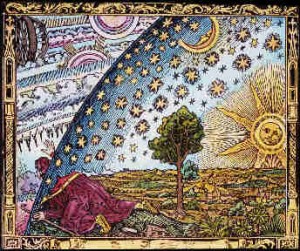
CC By-NC-ND-2.0

CC By-NC-ND-2.0

2) “To render a cosmology, an image of the universe.”  Today, Campbell notes, we turn to science for this.

Andromeda galaxy.  Nasa photo, public domain

Andromeda galaxy. Nasa photo, public domain

3) To shape “the individual to the requirements of his geographical and historically conditioned social group “
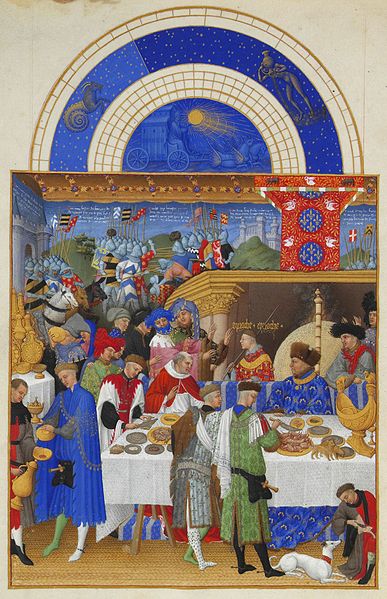
January from Les Très Riches Heures du duc de Berry, 15th c., public domain.

January from Les Très Riches Heures du duc de Berry, 15th c., public domain.

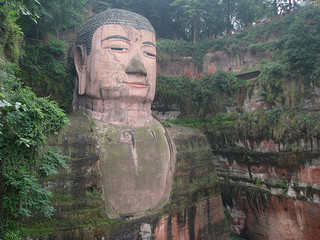
4)  “to foster the centering and unfolding of the individual…in accord with himself, his culture, the universe, and that awesome ultimate mystery.”

Leshan Giant Buddha, 2010, by Wilson Loo.  CC BY-NC-ND 2.0

Leshan Giant Buddha, 2010, by Wilson Loo. CC BY-NC-ND 2.0

Forty-five years ago, when conflict during the sixties was rending the social cohesion Americans had forged during WWII, Campbell wrote:  “The rise and fall of civilizations in the long, broad course of history can be seen to have been largely a function of the integrity and cogency of their supporting canons of myth.”

A mythological canon, said Campbell, is a group of symbols that “organize and focus the energies of aspiration.”  When the symbols no longer work for an individual, there is “dissociation from the local social nexus,” and, “if any considerable number of the members of a civilization are in this predicament, a point of no return will have been passed.”

In Creative Mythology, Campbell wrote at length of an earlier period of time when a different mythical canon broke down.  In 12th century Europe, Christianity ceased functioning as a socially cohesive world view.  Enough people stopped believing (even though belief was strictly enforced) that Europe went beyond the point of no return.

Many stories emerged during that era concerning the quest for the grail, which in the earliest written versions, had nothing to do with cup of the last supper, but everything to do with a quest to heal individuals and the land.  In Wolfram Von Eschenback’s Parzival, the grail was called lapis exiles, another name for the philosopher’s stone of alchemy.  The philosopher’s stone turns base metal into gold; the grail heals the wasteland, for that is what a country and culture become where there is a drought of aspiration and meaning.
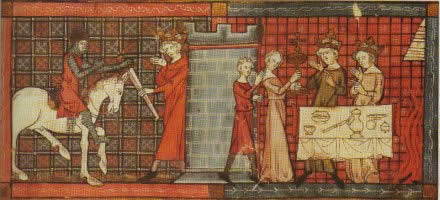
Scenes from Perceval's quest of the grail, 1385-1390.  Public domain

Scenes from Perceval’s quest of the grail, 1385-1390. Public domain

That is where we are in America today.  In the absence of a shared core of attitudes and beliefs to unify us as a people, we are a nation of warring factions at all levels of culture and government.  For now, the party is over in the land of opportunity.  Even if our politicos won’t admit it, a “considerable number of members of our civilization” know this is true.

Campbell ended Creative Mythology by asking what might feature in a new and vital mythology.  In my opinion, he dithered with his answer, as he sometimes did in his writing.  Twenty years later, he answered the same question when it was posed by Bill Moyers at the end of the Power of Myth series.  This time Campbell suggested that any world view adequate to our times and our future would have, as a mandala, a view of the earth from space.

Earth from space

Neither Campbell nor one else back then knew the full extent of the danger climate change would pose.  Now we know it’s worse than anyone thought, (see the Intergovernmental Panel on Climate Change report, released Sept. 27).  Our governments are as impotent as the wounded Fisher King of the grail legend when it comes to enacting meaningful change.

Yet as Campbell said, the quest for the grail of healing begins with individual searchers venturing into the forest alone, at the place that seems best to them.  Like Nelson Kanuk, a University of Alaska freshman, whose home in a remote Eskimo village was swallowed by the sea as a result of melting permafrost.  Kanuk sued the state of Alaska for not curbing carbon emissions and his case is now being heard by the Alaska Supreme Court.  Similar suits are pending in 12 other states.  Such headlines echo words I recently quoted by Wendell Berry, who puts his trust in “ordinary people” and said:

We don’t have a right to ask whether we’re going to succeed or not.  The only question we have a right to ask is what’s the right thing to do? What does this earth require of us if we want to continue to live on it?”

We don’t even have to rush out and sue our state governments, for as Campbell suggested, stories and world views spark action and change when a critical mass is reached.  Hopefully, we are at or beyond that point. All we, as individuals, have to do is be still enough to hear what the world is asking of us, and then enter the forest at the place that seems best.
Friday is World Animal Day

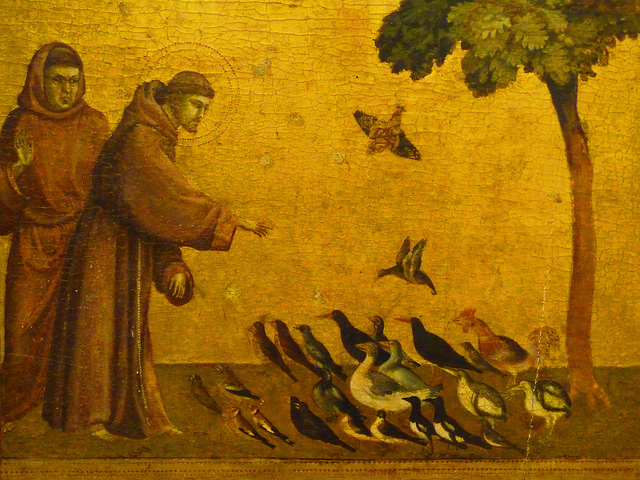
Saint Francis and the birds, by Giotto.  CC BY-NC-ND 2.0

Saint Francis and the birds, by Giotto. CC BY-NC-ND 2.0

“The greatness of a nation and its moral progress can be judged by the way its animals are treated.” – Mahatma Gandhi

October 4 is the Feast Day of Saint Francis, renowned for his love of animals. In 1931, a group of ecologists meeting in Florence, Italy, chose this date as World Animal Day to highlight the plight of endangered species.  Since then it has grown to a world wide day of celebration of animals by people who love them in all nations and religious traditions.

The Singapore SPCA held a three day celebration in September, with a theme of “Friends for Life.”  The Moscow Zoo is holding its celebration of Saturday.  World Animal Day celebrations are scheduled in Pakistan, India, Indonesia, Jordan, Dubai, France, Britain, Sweden, Bosnia and Herzegovina, the US, Canada, Serbia, Greece, Bolivia, Chile, Australia, the Ukraine, Palestine, Gambia – and these were just locations listed on a single website.

A revered Tibetan Buddhist teacher, Lama Zopa Rinpoche, urges his students to pray for the wellbeing of animals on October 4, and recite mantras to bring them auspicious rebirths.  If one is looking for a pet, he says, it’s a perfect day to visit a shelter and adopt, or adopt an animal via a contribution to an organization that benefits them.

Friday is a wonderful day to notice and appreciate the birdsong in the morning, the hawk in the noontime sky, and the creatures who bring so much to our lives.  What would our world be like without them?

Kit and Missy smiling

Ship of Fools

Ship of Fools.  German woodcut, 1549

Ship of Fools. German woodcut, 1549

I’m sure it won’t surprise anyone to learn that this is my second post of this title in two years.

“The ship of fools is an allegory that has long been a fixture in Western literature and art. The allegory depicts a vessel populated by human inhabitants who are deranged, frivolous, or oblivious passengers aboard a ship without a pilot, and seemingly ignorant of their own direction.“Wikipedia

The Wikipedia entry documents the origin of this image in a method that Renaissance people developed to rid themselves of their mentally challenged fellows.  As Michel Foucault put it in Madness and Civilization, “they were put on a ship and entrusted to mariners because folly, water, and sea, as everyone then ‘knew’, had an affinity for each other.”

OK, I gotta say it – don’t you wish we could send all members of the Federal government off on a Carnival cruise and hope the engine stalls at sea?

“Ship of Fools” has been a recurrent image in literature, art, and music for 500 years.  Somehow it’s comforting to to know that folly and madness are nothing new, even – or perhaps especially – at the helm of the Ship of State.

When governments work as they should

An inspirational article in Sunday’s Sacramento Bee reminds us of what can be done when governments are composed of adults who are willing to work together toward a common goal.

An agreement between the California State Parks Department and local Indian tribal governments allowed an important ceremonial structure, closed for five years because of fire damage, to be reopened for an annual all-tribes gathering for dance and ritual this past weekend.

In question was the roundhouse at Indian Grinding Rock State Park, or Chaw’se in the Miwok language.

Chaw'se Roundhouse, photo by Mary Mussell.  When this photo was taken, Jan. 2011, the structure was closed

Chaw’se Roundhouse, photo by Mary Mussell. When this photo was taken, Jan. 2011, the structure was closed

The state said the cedar roof on the roundhouse, which is 60′ wide, had to be replaced, but the tribes could not agree on how to approach the task without disturbing ancestral spirits. Finally, Adam Dalton, chairman of the Jackson Rancheria Miwoks, offered to bring in a native construction crew, to work in cooperation with a state appointed structural engineer, while dismantling the damaged parts of the roundhouse with proper ceremonies.

Local tribes gathered each fall for thousands of years in the Grinding Rocks area to harvest the abundant acorns.  The park takes its name from the 1185 mortar holes left in the soft limestone slabs, where native women ground the acorns.  Some of the petroglyphs, carved between the mortar holes, are 2,000-3,000 years old.

Grinding Rock Mortar Holes

Grinding Rock Mortar Holes

The park, some 50 miles southeast of Sacramento, near Jackson, is one of my favorite destinations in the foothills, especially at this time of year or in the spring.  If you’re ever in the area, it’s well worth a visit.  Detailed information and history can be found on the park’s website.

Now, in addition to natural beauty and historical interest, the grounds at Chaw’se stand for the way governments are supposed to work.

The Rim Fire, day 22

rim fire

Smoke from the Rim Fire, photographed from the Glacier Point road some 30 miles south.  The photograph fails to convey the sense of scale of the smoke plume, even at this distance.

On day 22, the blaze is 80% contained.  It has burned 394 square miles of timber, watershed, and wildlife habitat.  More than 3,600 firefighters are on the lines, and efforts to contain this 3d largest fire in California history have cost $89 million to date.

A team of 50 scientists is moving into the burn area to assess erosion and mudslide dangers once the rainy season comes.  Of particular concern are the Tuolumne River and Hetch Hetchy Reservoir which provides drinking water to 2.8 million people in the greater San Francisco area.

The fire began when a hunter’s illegal campfire burned out of control.

Big news for online education

In mathematics, an inflection point is the place on a curve where the curvature changes from concave upward (positive) to concave downward (negative) or vice versa.

point_of_inflection

Andy Grove, former Intel CEO, gave the term a new relevance.  In his management book, Only the Paranoid Survive, he wrote:  “A strategic inflection point is the time in the life of a business when its fundamentals are about to change.  That change can mean an opportunity to rise to new heights.  But it may just as likely signal the beginning of the end.”

Grove borrowed a parallel term, “disruptive technology,” from business writer, Clayton Christensen.  A disruptive technology is an innovation, very often appearing crude at inception, that can change or eliminate entire industries.  The first horseless carriage must have seemed silly to buggy makers, just as the first kindle looked like a toy to brick-and-mortar bookstores.

A week after my first post on free online college classes, an article in Sunday’s Sacramento BeeAn elite school offers master’s degree online, suggests that we’ve already  passed an inflection point and that online coursework is a “disruptive technology” that is destined to change higher education in ways we cannot yet grasp.

Online classes are nothing new; I took an early online programming class in 1998, with mixed results.  Online graduate degree programs in business as well as software exist, many offered by private colleges.  What’s different now is the scale.

Beginning in January, Georgia Tech will offer online master’s degrees in computer science at a cost of $6,600, compared to the $45,000 price tag for the same courses taken on campus.  Some of the funding comes from AT&T which “will use the program to train employees and find potential hires.”  Estimates of future interest in this degree run as high as 10,000 students a year, including international participants.

Because of Georgia Tech’s prestige and the ambitious nature of this undertaking, educators are watching closely.  There is no guarantee of success for this particular program, but from the perspective of student loans alone, there is a huge need for innovation of this sort.  The first producers of new technologies are not always the ones who succeed, but like the first makers of personal computers and ebooks, they define inflection points that change the world.  Georgia Tech may well be doing the same thing.

MIT Open Courseware

Open: characterized by ready accessibility and usually generous attitude: as (1) : generous in giving  – Webster’s Online Dictionary

“The idea is simple: to publish all of our course materials online and make them widely available to everyone.” – Dick K.P. Yue, Professor, MIT School of Engineering

Between 1968 and 1972, an idealistic Stanford educated biologist named Stuart Brand published an amazing compendium of ideas called, The Whole Earth Catalog:  Access to Tools.  The title came from photos of our planet taken from space – appropriate, since it was Brand who launched a public campaign in 1966 to get NASA to release the pictures.

In his 2005 Stanford graduation speech, Steve Jobs said, “When I was young, there was an amazing publication called The Whole Earth Catalog, which was one of the bibles of my generation…. It was sort of like Google in paperback form, 35 years before Google came along. It was idealistic and overflowing with neat tools and great notions.”

One of the great notions that inspired Jobs and other idealists was the thought of putting computing power into the hands of “the people.”  That much has been accomplished.  Every kid with a smartphone holds more computing power in the palm of one hand than NASA had when they made those pictures in space.  Now, off course, we see plenty of less-than-ideal side effect of the digital age – unintended consequences that dreamers like Brand did not imagine.  I won’t repeat the headlines – if you’re reading this blog, you’ve seen them.

That is all the more reason why it’s a pleasure to learn how one of our finest universities has embodied the best of the information age dream in order to benefit people all over the world.  The Massachusetts Institute of Technology has freely posted class materials from every one of its courses online – MIT Open Courseware.

Sign on Canal Street, New Orleans, CC-BY-SA-3.0

Sign on Canal Street, New Orleans, CC-BY-SA-3.0

Under the “Courses” button, you can see class offerings by department.  I invite everyone to look at some of the courses.  The technical classes are vast and impressive, as one would expect, but they aren’t the only ones.  I saw more than one syllabus in the Literature section I plan to check out.  This is attractive enough, but I think the importance of MIT’s move goes beyond personal enrichment.

Our system of higher education is floundering; while technical jobs go unfilled for lack of qualified applicants, tens of thousands of students who thought a college degree was the door to a better life find themselves saddled with debts that amount to 21st century indentured servitude.  The recent congressional “fix” will make few besides college administrators and bank loan officers happy over the long run.  I saw a different model in play during earlier days of the tech boom.

The best boss I ever had, now an industry expert in semiconductor design rules, went to work with a two year degree in drafting.  A friend who was a senior systems analyst studied math in college for three years and then dropped out.  After that, he went to work in a hospital that wanted to computerize; when no one else knew what to do, he gave it a shot.  My own experience was similar.  Clearly this doesn’t apply to every field – you don’t want your doctor learning by trial and error – but inventiveness, ability, and the ability to learn are not guaranteed by a formal degree.  The lack of a degree does not proves those qualities are missing.

As I noted in my review of The Unwinding by George Packer, Peter Thiel, a Silicon Valley entrepreneur and co-founder of Paypal believes that education is America’s “latest bubble.”  He offers grants to people under the age of 20 with ideas that “could make the world a better place,” if they are willing to leave school for two years to strike out on their own.  I see parallels between education now and traditional publishing at the start of the ebook era.

The digital world we now inhabit brings multiple ways of doing more and more things.  The good people at MIT, who live at the proverbial cutting edge of technology, should be applauded for their decision to share their vast resources with anyone, anywhere.  Good dreams change, but they survive.  Forty-five years after the first Whole Earth Catalog, “Access to Tools” has a whole new shape.  I hope we see much more of the same.