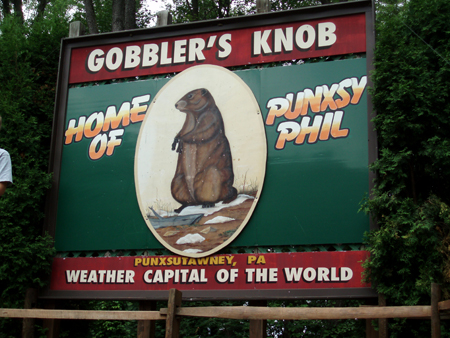
Phil sees his shadow!

Photo by Eddie~S, CC BY 2.0

Photo by Eddie~S, CC BY 2.0

In the key news event of the day, I’m sad to report that it was sunny in Punxsutawney, PA, spooking the groundhog and plunging us into another 6 weeks of winter.

This has not been a winter anyone wants to linger.  A mini-ice age threatens the east, while 11 western states are morphing into Death Valley.  And to add insult to injury, here in northern California, where legions of disgruntled football fans are settling in to watch those other teams play – all the while muttering that at least spring training starts soon – spring may be on hold!

So as the blues settle in like the overcast on this chilly, cloudy, but rainless day, only three suggestions come to mind:  (1)  book a flight to Hawaii, (2) drink some more caffeine, (3) watch a funny movie.

It just so happens that I have an idea for number 3:

"Don't drive angry!"

“Don’t drive angry!”

PostScript: For readers outside our borders, who may not get all my topical references, here is a brief glossary:

  1. February 2 is “Groundhog Day.”  When the groundhog emerges (most famously, Punxsutawney Phil, in Pennsylvania), if he sees his shadow, it will spook him and he’ll return to his burrow for another 6 weeks of winter.
  2. Here in the western US, where we have no groundhogs, it’s sometimes called Prairie Dog Day, but that hasn’t gained much traction in the media yet.
  3. Local sports fans are disgruntled because our beloved 49’ers were knocked out of the playoffs by the devil-spawned Seattle Seahawks.  No real rancor, although we hates them forever, my precious.

Let me know if I can be of any further assistance explaining my rant.

Cool water

“Cool Water,” a classic western song, was written in 1936 by Bob Nolan (1908-1980), a Canadian transplant to Arizona, who fell in love with the desert.  Nolan, an actor, poet, singer, and songwriter also wrote “Tumblin’ Tumbleweeds,” and is credited with the creation of “western music” as a distinct genre.

Bob Nolan in "The Lights of Old Santa Fe," 1944

Bob Nolan in “The Lights of Old Santa Fe,” 1944

“Cool Water” tells of a man and his mule, lost in the desert and beset with mirages.  The song has been widely covered by artists as diverse as Hank Williams, Marty Robbins, Joni Mitchell, Burl Ives, Johnny Cash, The Muppets, and Fleetwood Mac.

All day I’ve faced a barren waste
Without the taste of water, cool water
Old Dan and I with throats burnt dry
And souls that cry for water, cool, clear, water.

The song came to mind for obvious reasons last week:  Gov. Brown to declare California drought emergency.  Nobody here needs the newspaper to tell us we’re in trouble.  A glance at the brown lawns in January, and the American River, running lower than I’ve ever seen it at this time of year will do that.

My thoughts have been filled with many songs, stories, and images of water that I will be sharing here.  I was planning on writing a longer post today, but I never got past this clip of Marty Robbins’ version of “Cool Water.”

I first heard the song on my absolute favorite album as a kid, Robbins’ Gunfighter Ballads and Trail Songs.  Even though he’s kidding around with his friends (I think it’s a clip from “Hee Haw”), if you listen, it sounds like a prayer.  I think I’ll leave it at that for today.

Pope Francis on Economic Justice

Pope Francis

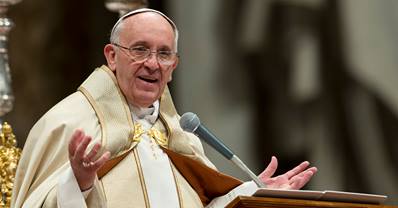
“How can it be that it is not a news item when an elderly homeless person dies of exposure, but it is news when the stock market loses 2 points?” – Pope Francis (1)

On Tuesday, Pope Francis delivered a sharp rebuke of unfettered capitalism as “idolatry of money” that will lead to “a new tyranny.” (2)  His language was specifically directed at those in the United States who continue to defend “trickle-down economics,” which he said “has never been confirmed by the facts, [and] expresses a crude and naive trust in the goodness of those wielding economic power.”

“Meanwhile,” he said, “the excluded are still waiting.”

President Obama said he was “hugely impressed with the pope’s pronouncements.”  Nevertheless, on Wednesday, the US announced it will close its Vatican embassy as a “cost saving measure.” (3)  The seven embassy staffers will be retained, just moved beyond the borders of Vatican City, which is the world’s smallest sovereign nation.

Republican senators, many of whom still advocate the trickle-down policies the pope condemned, were quick to denounce the administration’s move as “a slap in the face to Catholic Americans around the country.”

Though I’m not a Catholic, I find myself deeply grateful on this day of thanks, for the current Vicar of Christ.  When politicians of all persuasions spend most of their time defending an increasingly dysfunctional status quo, it is refreshing and marvelous to find a world leader willing to speak the truth.


Trust and belated reflections on November 22

I was going to pass on adding my $0.02 to the discussions of the Kennedy assassination.  I have nothing to add concerning the event itself.  I am writing this post because of a comment I cannot get out of my mind:

“Like a tornado, the Kennedy conspiracy theories have spun off whirlwinds of doubt about other national traumas and controversies…The legacy of that shocking instant is a troubling habit of the modern American mind: suspicion is a reflex now, trust a figment.” – David Von Drehle in Time Magazine, Nov. 25, 2013

You can’t argue with Drehle’s conclusion, that suspicion of government is a reflex,  but when and how did it come about? I truly don’t remember it starting in Dallas.  People at the time expressed shock and grief, and everyone shook their head and said the killing of Lee Harvey Oswald was “pretty suspicious,” but no one I knew, and not a single history teacher I ever had, obsessed about the conspiracy like we do now.

I wonder if that’s a key – like we do now.  I wonder if the weight given this month to assassination conspiracy theories isn’t history revised in light of our current mistrust of government, a mistrust that came about from a long string of incidents rather than a single one.

There was the Gulf of Tonkin the following year, used to justify escalating the war in Vietnam, which Robert McNamara, then Secretary of Defense, later admitted never happened.  There was the 1970 National Guard shooting of 13 students in Kent, Ohio, when fear and loathing of government rose to heights I’ve never seen before or since.  There was Watergate, the non-existent Iraq WMD’s, and now let’s all say hi to the NSA, both I who am writing and you who are reading this post.

Trust is the foundation of any honest relationship, slow to evolve and quickly broken by deceit.  In interpersonal relationships, once it’s gone it is pretty much gone for good – “fool me once…” as they say.

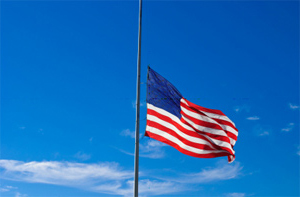
The flags flying at half-staff yesterday brought to mind a childhood grief, but we have moved on from the loss of one man.  What lingers and haunts is the memory of how that man could invite a public trust – “Ask not what your country can do for you…” – and seem worthy of it.  That level of hope and public trust is gone, and I don’t see it coming back.

More than a man, that is what I found myself mourning yesterday.

HalfStaffFlagNotification

Selling Thanksgiving

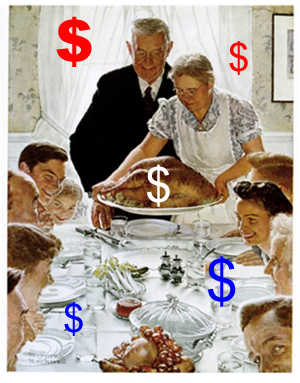
Norman-Rockwell-thanksgiving use

An article in our local paper’s Sunday Business Section both fascinated and sent a few chills up my spine at how effectively today’s marketeers can sell proverbial ice cubes to Eskimos.  They have persuaded large numbers of us to give up Thanksgiving as a day of gratitude for what we have, in favor of the chance to go buy more.

No one needs to wait for Black Friday now.  Major retailers will open their doors at 8:00 on Thanksgiving night, while Kmart’s shopping day will begin at 6:00 in the morning.  People like it and want it, the article says, but it’s instructive to look at the language used:

“The ever-earlier shopping frenzy is a source of dismay for traditionalists who view Thanksgiving more in terms of Norman Rockwell’s famous 1943 “Freedom from Want” painting…They ask: Isn’t the pace of life hectic enough without cutting into a day established for humble gratitude and quiet reflection?”

Is it just me or do you see a bias here?  Some implication that the traditional, quiet reflecting crowd, stuck in 1943, will probably spend the day watching reruns of “The Waltons.”

American Gothic by Grant Wood.  Public Domain

American Gothic by Grant Wood. Public Domain

The most interesting reason the article gave for jumping up from the table to hit the stores came from a “random” shopper at one of our malls, who said, “It’s fun, like a shared adventure for me and my friends.  We love it.”  An adventure is “an unusual, stirring experience,” according to Webster’s Dictionary, which isn’t what I equate with a trip to the mall, but hey, we all know Thanksgiving can be a chore.  

Millions of us have had the experience of traveling “home for the holidays,” only to remember exactly why we left in the first place.  And traditional Turkey Day roles still split along gender lines – who hasn’t heard women complain about working for hours preparing a meal, only to have the men snarf it down in 20 minutes, then pass out from tryptophans and beer in front of a football game?  From that perspective, a trip to the mall with friends might be, if not “an unusual, stirring experience,” at least a refreshing break.

Times are hard, and I can’t fault anyone for the Thanksgiving choices they make, but I do suggest a bit of reflection.  Many who read this blog are writers, and one of the best pieces of advice for writers is to create a mission statement; among all the choices I have now, what do I want from writing?  That’s a good question to ask as we face the holiday season.

Most of us long for peace and serenity, and a time of shared warmth in a community of family and friends.  Nobody wants to wake up on New Year’s Day saying, “Thank God all that is over,” though many will.  It’s a good time to review holiday options and “obligations” in light of the Dr. Phil question, “How does that work for you?”  

I’m no saint when it comes to keeping Thanksgiving “pure.”  For a number of years, when Tower Books was open, Mary and I and friends from work would gather for Thanksgiving dinner, then go browse Tower for an hour before having coffee and pumpkin pie.  Though we didn’t suspect it at the time, we may have been having a shared adventure.  So let’s admit that we’re free to spend Thanksgiving however we wish.  

It just saddens me to see corporate interests breech a once inviolate day, and turn it into an “ersatz” holiday, like Labor Day, stripped of all its original meaning and existing only so people can buy many things that they don’t really need.    

Heat and Air

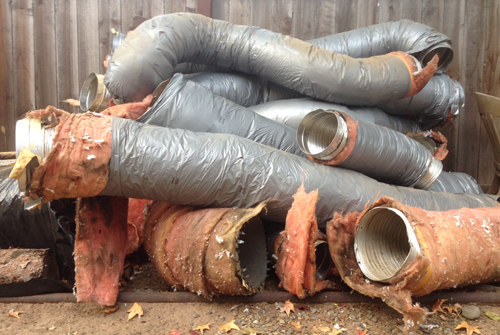
Day 1 - a portion of the old ducts

Day 1 – a portion of the old ducts

Here’s why I may be a bit light on blog posts for the next week and a half: we have an obsolete heat and air system and a lot of collapsed ducts.  We also have a trusted heat and air guy – an old school type craftsman who has helped us keep warm and cool at the proper times for over 20 years.  He’s going to retire soon, so last spring we worked out a plan to replace everything.

Day one was rendered somewhat chaotic by our two rescue dogs who were exceedingly vocal in their disapproval of someone crawling around the attic hammering things and sawing things.  As in vocal for hours.  We will also be without heat for about 10 days, but you know what?  We lucked out.  Temperatures are mild, and today is a burn day, according to the county air quality board, so there’s a fire in the wood stove right now.

As I lit the fire, I turned on the PBS News Hour, which put our minor inconvenience into perspective as I watched the horrific suffering in the Philippines:  tens of thousands of storm survivors with nothing – no shelter, no food, no water.

A few days ago, I tweeted a New Yorker blog post which discussed a leaked copy of the most recent installment of the  I.P.C.C. (Intergovernmental Panel on Climate Change) report, this one suggesting that “preparing for climate change,” an emerging theme in some quarters, is largely an illusory goal, at least for the most vulnerable portions of our world population.

The blog quotes the president in a speech he gave last spring:  “Those of us in positions of responsibility, we’ll need to be less concerned with the judgment of special interests and well-connected donors, and more concerned with the judgment of posterity. Because you and your children, and your children’s children, will have to live with the consequences of our decisions.”

The way I see it, everyone living and breathing is in a “position of responsibility.”  This is how I understand it for myself:

  1. Being responsible means I contribute to the relief effort for Haiyan, just as I have for Katrina, and Sandy, and the tornadoes last spring, and just as I will for the next superstorm.
  2. Being responsible means I cultivate gratitude for all I have and compassion for those who are suffering loss – all kinds of losses – and try to manifest this somehow every day.
  3. Being responsible means I can no longer tolerate those who would deny the reality of climate change.  Leaving aside the blame game, the world is changing, and there’s no time for those who pretend otherwise.

Not much in relation to the magnitude of the problems we are just beginning to see.  And yet…If enough people of goodwill face our situation and consider what may lie within their power to do…who knows what the outcomes may be?

Delisting the Wolf – Your Help is Needed!

If wolves are removed from Endangered Species protection, the day may soon return when there are none in the lower 48. I’ve worked with these magnificent creatures as a volunteer at the Folsom City Zoo Sanctuary, and in my opinion, that would be a tragedy. Please read this article and make your comment on the Federal website.
Update: As of November 6 at 5:00pm, the website is up again and I was able to comment.

Mungai and the Goa Constrictor's avatarMungai and the Goa Constrictor

The U.S. Fish and Wildlife Service is in its comment period on their proposal to remove the wolf from the Endangered Species Act in the lower 48.  Hearings are being held throughout the country.  If you can go, please do.  If that’s not possible, please write or call.  They need to hear from people who want the wolf protected, not only from those who don’t.

AMENDMENT
Many thanks to my good friend, Carmen Mandel, for providing a DIRECT LINK to add your comments. Please add yours. There are almost 32,000 signatures, as I write this, but this figure falls a long way short of previous opportunities.
This is so important
Please add your comment now
Your Voice in Federal Decision-Making

ALTERNATIVE WAYS TO COMMENT
Please click here for details

Click here for more details:
The U.S. Fish and Wildlife Service

Related links:
Defenders of Wildlife
Grey Wolves Left Out…

View original post 59 more words

James Hillman on world change and political polarization

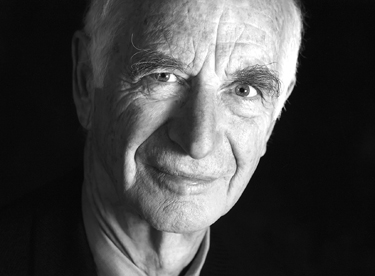
James Hillman, 1926-2011

James Hillman, 1926-2011

For decades, James Hillman brought us unique observations on modern life from the perspective of a depth psychology that embraced soul as its highest value.  Recently, I’ve wished I could hear his take on our current climate of political divisiveness, but Hillman, who died two years ago at the age of 85, wasn’t here to watch our most recent shenanigans.  Happily, I recently stumbled upon a pair of interviews in which Hillman discussed this very subject and set it in a context of massive cultural change.

Author and journalist Pythia Peay published the first interview on The Huffington Post in February, 2011 (Jungian Analyst Explains the Psychology of Political Polarization).  The occasion for their talk was the mass shooting in Tucson, which had happened a month earlier.  The most prominent victim was Representative Gabrielle Giffords.

Tragically, memory of that event, just two and a half years ago, has been lost in the wake of more recent carnage, including the Nevada school shooting earlier this week.  Though Hillman’s comments focused on the role of political divisiveness in the attempt to kill a congresswoman, his additional statements now seem eerily relevant to the 12 year old in Sparks who was so alienated that he ended his life with murder and suicide.

Hillman began with a general discussion of polarized thinking.  “Polarity,” he reminds us, is an electrical engineering term.  Batteries have poles; the psyche is far more nuanced than that, dwelling in shades of gray rather than black or white.  Ideological extremes subvert our ability to judge individual issues on their merit.

When asked if violently polarized politics caused the shootings, Hillman changed the focus to another kind of cultural rigidity and its effect on the Tucson shooter:

“I think that this kid was made a loner by an American educational system in which there is no room for the weird or the odd…We need to have an educational system that’s able to embrace all sorts of minds, and where a student doesn’t have to fit into a certain mold of learning. Our educational system has become so narrowed to a certain formula, that if you go through a weird phase, you’re dropped out — often at the age of schizophrenia, 19-23 — and that’s the danger.”

Arguments in the wake of gun violence bog down in specifics, like background checks and how many bullets a magazine should hold – we don’t ask why and how we’re producing more and more people prone to mass violence.  In the end, says Hillman, for a culture that pays so much lip service to “the individual,” we are terrified of real individuality, and attempt to stamp it out.

In the second interview, America and the Shift in Ages, Hillman suggests that much of that rigidity has to do with futile attempts to shore up outmoded systems and institutions during a period of massive change.  Not just one but “three or four” myths that are central to our culture are collapsing.

Everything we fear has already happened said Hillman:  “The fragility of capitalism, which we don’t want to admit; the loss of the empire of the United States; and American exceptionalism. In fact, American exceptionalism is that we are exceptionally backward in about fifteen different categories, from education to infrastructure. But we’re in a stage of denial.”  Other beliefs and structures are crumbling as well, he said.  White supremacy, male supremacy, the influence of monotheistic religions, and the belief that we are “the good people.”

If such institutions do not appear to be in decay, it’s because they are so staunchly defended, and that, Hillman says, is a sign of their lack of vitality — “If they were vital they wouldn’t need to be defended. And the fanaticism we’re witnessing goes along with the deterioration of the vitality of these myths.”

Many of our fundamental beliefs are under scrutiny and need to be.  Hillman mentions the meaning of “freedom.”  For many, freedom means, “I can do any goddamn thing I want on my property; that I am my own boss and don’t want government interference; that I don’t want anybody telling me what I can and can’t do.”  This, he says, is the freedom of an adolescent boy.  What of the different kinds of freedom, such as “freedom from the compulsions to have and to own and to be someone?”  What of the freedom Nelson Mandela found in prison?

Hillman cites economic assumptions that need to be questioned as well.  Falling demand needs to be stimulated, according to current assumptions, but from an ecological point of view, that’s exactly what the world needs at this time.  Sustainability models, which may be our hope for the future, terrify those in positions of power.

Many of our current fears, says Hillman – from fear of immigrants crossing our borders, to fear of failing education, to fear of cancer, to economic insecurity, terrorists, and of course fear of “the other” political party, results from the lack of a wider framework in which to understand the massive shifts that are already underway.

There is no going back, but as obsolete structures crumble, we can glimpse, if we look, new forms emerging.  Hillman gave the example of a “Bioneers” conference he attended where Paul Hawken showed a film that was simply the names of individuals and organizations involved in trying to innovate ways of building communities, economic systems, and ways of dealing with the natural world.  Hawken said there were thousands of names, and the film could roll for weeks.

Hillman said it’s important not to try to fit emerging structures into the patterns of the past.  For our peace of mind, a new kind of faith is required:   “I think it’s a matter of being free-wheeling, and trusting that the emerging cosmos will come out on its own, and shape itself as it comes. That means living in a certain open space — and that’s freedom.”
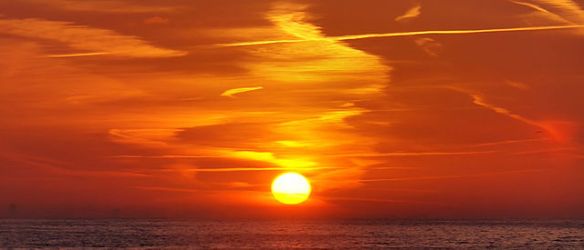
Dawn over Oostende, Belgium, 2007.  Photo by Hans Hillewaert, CC-BY-SA-3.0

Dawn over Oostende, Belgium, 2007. Photo by Hans Hillewaert, CC-BY-SA-3.0

Such words are a fitting conclusion to the lifework of a man who lived in defense of Anima Mundi, the World Soul and who taught that animals, trees, and rivers are intelligent and alive, and that at some deep level of the psyche, we can hear their voices.  In Hillman’s life work, observation of the modern psyche led to conclusions that mesh with the myths of the ancestors.

A thousand years from now, people will read of our times and shudder, as we do in contemplating the rigors of life in the middle ages.  A few visionaries stood out from the rest, those like Saint Francis, Dante, and Leonardo, who pointed toward a more benevolent and expansive future.

We cannot write our own history, but we can wonder how it will look to those in the future.  I am convinced that James Hillman will be remembered when most of what passes for news on TV is blessedly forgotten.