Those who follow this blog will know the high regard in which I hold historian Andrew Bacevich. In a 2012 review of his book, The Limits of Power: The End of American Exceptionalism, I mentioned a few of Bacevich’s credentials:
Bacevich, a Viet Nam veteran, retired as a colonel after 23 years in the army. He holds a PhD in American Diplomatic History from Princeton and taught at West Point and Johns Hopkins before joining the faculty at Boston University in 1998. In March, 2007, he described the US doctrine of “preventative warfare” as “immoral, illicit, and imprudent.” Two months later, his son died in Iraq.”
On February 14, Bacevich posted a brief article on Moyers & Company that I’d love to see more widely read. He likens the current administration’s middle-eastern initiative to Nixon’s 1970 “incursion” into Cambodia and says:
“How did we arrive at this predicament? Where exactly are we headed? What is the overall aim? How will we know when we have succeeded? What further costs will the perpetuation of the enterprise entail?
Back in 1970, when the predicament was the Vietnam War, those questions demanded urgent attention. Today, the enterprise once known as the Global War on Terrorism, now informally referred to as the Long War or the Forever War or (my personal preference) America’s War for the Greater Middle East, defines our predicament. But the questions remain the same as they were when Cambodia rather than the Islamic State represented the issue of the moment.
So President Obama’s requested Authorization for the Use of Military Force (AUMF) could not have come at a more propitious moment. The proposed AUMF presents the Congress with an extraordinary opportunity — not to rubber stamp actions already taken, but to take stock of an undertaking that already exceeds the Vietnam War in length while showing not the slightest sign of ending in success.”
When the year turns, I tend to watch for events, private or public, that set a tone for the days ahead. I witnessed something on January 6 that I can’t forget, that seems important, like something I need to remember and pass on.
We took our dogs to the local park for a walk in the late afternoon, a beautiful clear winter’s day. Soon after we started, two bedraggled and pitiful looking stray dogs began to follow us. They were small, of no breed I can name, but clearly siblings, and clearly they had been dumped in the park. No tags, and they were shaggy, dirty, smelly, and seemingly desperate for the company of our dogs.
We kept ours moving – not wanting this pair to come too near – fleas and/or disease came to mind. We circled the park and dropped our own dogs back in the car. One of the strays fell behind, but the other kept up the pace, though it must have been painful, for its nails were overgrown, and walking was difficult. I planned to go to the Arby’s at the edge of the park to get a couple of sandwiches for the dogs, but this little bedraggled one shied away from humans and wouldn’t even come near enough to pick up our doggie treats. It turned back toward it’s companion somewhere behind on the trail.
Words can’t convey how forlorn these two little dogs appeared. How their abandonment evoked the thought of all abandoned, discarded, and unloved beings. How their plight aroused such a strong desire to do something, to relieve their suffering, but what?
Call animal control? They’d be warm and well fed, at least for a while. But who could predict their odds of being adopted or being put down?
In the end, we left them in the park. Once before, I encountered a similar stray, who followed our dogs back to the car and even managed to jump in. Later I learned he’d been adopted by a friend who works in the Parks and Recreation Department. I can only hope someone who wants a dog will find them before cold and hunger or coyotes do them in.
The feeling of compassion never guarantees the wisdom to do the right thing. In the end, all we can do is take our best guess and do our best. As I think of these dogs, as well as the human strays I see from time to time in the park, I think of these U2 lyrics:
Every sailor knows that the sea Is a friend made enemy And every shipwrecked soul, knows what it is To live without intimacy.
The dogs, at least for a while, had each other, but plenty of others do not. Haven’t we all been there at times? And it’s not always people who visibly live at the margins, for margins are not always visible. To watch for a chance to reach out with kind words or a helping hand – is there anything more important to consider at the start of the year?
I’ve read about this, but it never happened to me before.
Late yesterday afternoon I was driving home from the bay area. I’d been up at 6:30 to attend a second day of Dharma teachings. The weather was fine, traffic was moving, I was listening to a decent audio book, but a wave of fatigue overtook me, and all I could think of was stopping for a stretch and caffeine at a Starbucks up the road.
I pulled up behind a small truck and half a dozen cars at the Benicia Bridge tollbooth. The truck seemed to take forever getting through, as if there was an argument about the toll. With some mixture of fatigue and (hopefully) the wisdom I had absorbed from the teachings, I waited patiently, and finally reached the window. I handed a five dollar bill to the cashier.
“No need, sir,” she said. “The lady ahead of you paid your toll.”
As I said, previously, this was something I had only read about before. I was suddenly wide awake, wondering how I could pass the gift on. Carry $10 next time I came to that bridge and pay for the stranger behind me, yes, but what about day to day actions? I don’t cross toll bridges often, and as I felt the effect of that small gesture ripple through me, all I could think of was how to pass it on.
“Don’t bother trying to save the world,” one of the lamas had said. “What right choice is in front of you now?”
What a powerful question, and how worthwhile it is to keep it in mind!
This morning, I attended the funeral of a friend’s mother. She lived to be 92, had 14 great-grandchildren, was happily married for 49 years, and was lucid and even cracking jokes with those at her bedside until almost the end.
Almost everyone I talked or listened to commented on her outlook – positive, even when facing adversity. How central that seems to have been to this life well lived!
I’ve been thinking a lot about attitudes recently – actually almost daily, without coming to any clear conclusions. Through the course of the year, documented in various posts, I’ve been looking at views and outlooks, my own and others, from the perspective of which are helpful and which are not.
It’s easier to see in others. My mother lost her father when she was in grade school, as the result of a freak accident. I remember my mom in adulthood with a certain wariness, a backward glance over the shoulder, as if wondering when or how the next blow would fall. Be it nature or nurture, I’m coming to see how I carry the same trait, without even any such clear reason why. The good news is that when such things come to consciousness, we can look at them, and in observing they begin to change.
Along these lines, I remember an irreverent joke my father used to tell:
“Once there was a study to determine which children were optimistic and which were pessimists,” my father would begin. “One day a group of observers came through for a tour. In the first room they visited, a boy was crying his eyes out, even though the room was a virtual toy store, with shiny new bikes and every kind of playing you could imagine.
‘What’s wrong?’ one of the observers asked.
‘Everything’s so nice,’ the boy said. ‘I’m afraid I might break something.’
The group moved on to the next room, where they came upon another boy who smiled and sang as he shoveled his way through a mountain of horse manure.
‘How can you be so happy in all of this mess?’ an observer asked.
‘Easy,’ the boy said. ‘With all this shit, there’s gotta be a pony in here somewhere!'”
I know which boy I have been for most of my life. I also know which one I aspire to be!
Sometime during the first semester of graduate work in psychology, our clinical practice professor made an interesting observation. “The funniest people I know,” she said, “have all deeply experienced sorrow.” Her words came back when I heard we had lost Robin Williams.
They say he suffered from alcoholism and depression, both progressive, fatal diseases that can be arrested. Interestingly, the media has done much to remove the stigma from both conditions. Ted Danson, as bartender, Sam Malone on Cheers, helped normalize an alcoholic abstaining and going to meetings. And the constant din of TV antidepressant commercials has probably primed millions to “Ask their doctor” about this oh so modern affliction.
Untreated depression, like untreated alcoholism, puts a person at risk for suicide, accidents, and poor health choices that end too many lives far too early. It’s futile to speculate on why some people reach out for help and others do not, but no individual, not you nor I, is a statistic. We are not bound by any kind of odds.
In this world where information is so easy to come by, it is my hope than anyone who sees in themselves the conditions that took Robin Williams from us may hit google and check out the mountains of information on what they may have and what can be done about it.
“Right now, bookstores, libraries, authors, and books themselves are caught in the cross fire of an economic war. If this is the new American way, then maybe it has to be changed — by law, if necessary — immediately, if not sooner.” – James Patterson
I haven’t blogged about ebooks and independent publishing lately. Over the last few years, it’s become clear they are here to stay. Success breeds acceptance, and the “vanity press” stigma is gone. In olden days (ca. 2011), I found a kind of “blows against the empire” satisfaction in promoting ebooks, writing reviews, and encouraging Indie authors. The evil empire was big publishing. This was the time of the little guy.
I still like Indie authors, though the “righteous cause” fantasy is gone. Now suddenly, at least to a casual observer like me, the situation appears reversed, with Amazon in the role of bully-boy, and those same publishers (perhaps) fighting for their existence, and with them (maybe) hangs the fate of a lot of remaining brick and mortar stores.
I first learned of the Amazon-Hachette duel from Michael Koryta, a favorite action-adventure writer I follow on Facebook. On May 19, Koryta reported serious problems pre-ordering his new book, due out June 3, from Amazon. He said the situation goes far beyond the interests of one author, and provided some of the links posted below.
On May 29, USA Today quoted James Patterson as saying “the future of our literature is in danger.” Patterson says that “Amazon wants to control book buying, book selling and even book publishing,” and laments that federal anti-trust laws no longer have teeth.
And if I was only going to read one account of this dispute, I’d chose this one by Mark Coker, founder of Smashwords and early champion of ebooks, who believes in the vitality of a diverse writing and publishing world: Amazon’s Hachette Dispute Foreshadows What’s Next for Indie Authors
I’ve heard Coker speak on several occasions, and he’s a keen observer of a complicated landscape and future. His predictions on publishing tend to be right. In this post, he explains that the conflict centers on “agency pricing,” and who gets what profit margin for ebooks. Amazon is demanding a greater share. Here is what is at stake, says Coker:
“Books represent only one of hundreds of layers of icing on the cake of Amazon. Amazon can lose money on books while still operating a profitable business. Pure-play book retailers – Kobo and Barnes & Noble for example, must earn money from book sales. Unlike Amazon, they don’t have the financial resources to sell books at a loss forever…If Amazon can abolish agency pricing it will have the power to put its largest pure-play book retailing competitors out of business. This will make the publishers even more dependent upon Amazon, which further weakens their power.”
That’s the bad news. The really bad news, according to Coker, is that next they’ll come after Indie authors, just as they have in their audio book division, Audible. Gone are the 70% margins for authors that the agency model protects. Instead, exclusive Audible authors get 40% while the non-exclusive rate is 25%.
Coker winds up with with advice for independent authors, who, he says, are “the future of publishing.” It’s well worth reading the details in his article, but here are his main suggestions:
Choose your partners carefully.
Favor retail partners that support the agency model.
Avoid exclusivity.
Support a vibrant ecosystem of multiple competing retailers.
Remember the vibrant ecosystem of multiple competing book retailers? Though it is on the ropes, it’s not yet extinct. That’s worth thinking about and will be the subject of my next post.
medley (med-lē) n., 1a mixture of things not usually placed together; heterogeneous collection; hodgepodge.
A quiet week, with many ideas wandering through my mind without quite attaining blog post velocity. Sitting here, with a cup of coffee and the windows open to a fine spring morning, I decided to scoop up some of these notions, not necessarily in order of importance, and present them to you as a medley, or hodgepodge as the case may be.
On Mickey Rooney: I wish I had known that last Sunday, all day, Turner Classic Movies was hosting a day of Mickey Rooney movies. I tuned in late, but did get to see Boy’s Town (1938) and The Human Comedy (1943), both notable for their idealistic and almost too sentimental presentation of American life. Boys Town tells the story of Father Edward Flanagan (Spencer Tracy), who founded a home for abused and delinquent boys in Nebraska. Rooney plays Henry Hull, the tough kid who tests Flanagan’s belief that there is “no such thing as a bad boy.”
Tracy and Rooney in “Boys Town,” 1938
In addition to the real life humanity of Flanagan, whose Boys Town still exists in the Midwest, the film reflects 1930s progressive ideals, as well as an older, deeper, American romanticism, the belief that by nature, we are noble beings, corrupted only by cultural dysfunction. Watching Boys Town, I thought of the next great eruption of that ideal in the ’60s and remembered a line from Crosby, Stills & Nash that almost stands as an epitaph for that era: “It’s been a long time coming / it’s gonna be a long time gone.” The album came out in 1969, the year Charles Manson called optimism like Father Flanagan’s into serious question.
Mother Nature on the run: Now that I’m thinking of Crosby, Stills & Nash, that phrase popped to mind as title for this subsection, though it’s really about animals on the run. An editorial in yesterday morning’s paper, The case for banning wildlife-killing contests by Camillia H. Fox, outlines the common practice of for profit, recreational predator hunting contests.
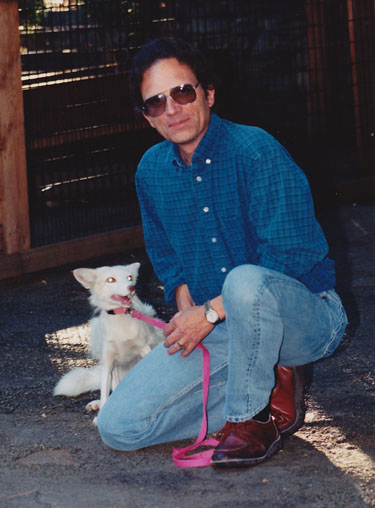
Exercising Vixen the fox while a volunteer at the Folsom City Zoo, ca. 1996. She was a sweetheart, though a bit of a drama queen. Is this the enemy?
“The greatness of a nation and its moral progress can be judged by the way its animals are treated,” said Mahatma Gandhi. It is heartening to learn that pushback is growing, both from citizens and state Fish and Game Commissions. In California, commission president, Michael Sutton said:
“I’ve been concerned about these killing contests for some time. They seem inconsistent both with ethical standards of hunting and our current understanding of the important role predators play in ecosystems.”
The way we treat the animals seems increasingly to be like the way we treat each other. Witness the case cited in the article, of the organizer of one of these killing contests, who (allegedly) pushed a 73 year old man to the ground for trying to photograph the event. We have to say, “allegedly” because, although the older man’s spine was fractured, the perpetrator has yet to be charged. This is not what our founding fathers meant when they spoke of a “well ordered militia.”
Of Jungians and Tibetans: I’ve recently started, with keen interest, The Psychology of Buddhist Tantra (2012) by Rob Preece, an in depth practitioner of both Jungian psychology and Tibetan Buddhism. Tibetan iconography is striking and vivid, almost begging for Jungian analysis, but most western commentators, including Jung himself, have written about it as outsiders looking in.
Not Preece, who studied with Lama Thubten Yeshe, one of the greatest 20th century Tibetan teachers to come to America. Lama Yeshe understood Jung and understood that Buddhist practice has always undergone change when crossing geographic and cultural boundaries.
Preece writes of Col. Francis Younghusband, who visited Tibet in 1904. Seeing pictures of wrathful deities, Younghusband concluded that this was a culture that worshiped demons. Jungians may pounce on the concept of shadow, but that too, will often be wide of the mark. Although Tibetans and Jungians both understand such imagery as depicting internal qualities, in this case, it is wrathful energy in the service of compassion. It’s the energy of, “This shit’s gotta stop!” The energy that led Camilla Fox to start a foundation to stop the slaughter of animals.
Two large gatherings: Over the last two weekends, I took part in two separate events which drew hundreds of people. Both were immensely satisfying days of harmonious groups, drawn together by shared interest, working cooperatively and having a lot of fun doing so. It’s almost enough to make you believe in no such thing as a bad boy or girl, in Mickey Rooney’s America.
That fundamental goodness is precisely what the Tibetans and Buddhists in general believe, even with their finely honed awareness of both relative truth, here in the trenches, and ultimate truth. Our ultimate nature, they say, the ground of our being is pure, unstained by any event, the way the sky is unstained by pollution. The bad news is, it can take eons for us to figure this out; a weekend at Woodstock is clearly not enough.
Still, I always feel energized after such gatherings, even as that wrathful energy rises at the thought of all the artificial barriers that divide us in our day to day lives. That’s something everyone has to work out for themselves. Meanwhile, I felt like listening again to Crosby, Stills & Nash. I hope they’re right in this song: that it’s always darkest before the dawn.
I find most alliterative titles, like “Media musings,” to be about 40% cute and 60% annoying, but in this case, it’s a good match for the headline that inspired this post: “Ellen’s Oscar ‘selfie’ a landmark media moment.”
“A what moment?” I mused. “A landmark media what?”
Because the media is falling over itself to celebrate Ellen’s tweet, and because nature abhors a vacuum, it has fallen to me to be the curmudgeonly voice of this “event.” One of the first things a curmudgeon does is reach for the dictionary. A “landmark event” is “an event, discovery, etc. considered as a high point or turning point in the history or development of something.”
At first I thought it must be the high point of product placement. The picture in question was taken with a Samsung phone, Samsung was a big Oscar sponsor, and the Academy Awards are the biggest post-Super Bowl marketing event. But that’s not really new news. Reading on, I realized the article referred to a landmark social media event. Since tweeting about TV isn’t new, an expert, in this case an Oscar co-producer, had to explain it to the likes of me:
“What it’s all about right now is creating a conversation, and social media allows for the conversation as it’s happening.”
Oh thanks, now I understand.
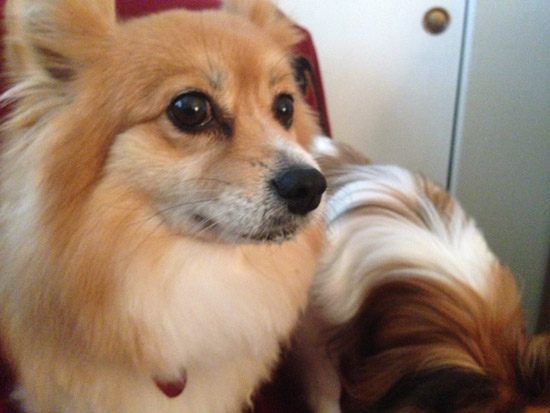
The dogs don’t like me being a curmudgeon, so while I was writing this post, Kit grabbed my (non-Samsung) phone and snapped a selfie, hoping to create a new conversation.
Kit snaps a selfie
“It’s all about what’s happening now,” she says, explaining why she wants to establish a social media presence.
So the price I pay for being a curmudgeon is having to ask all you loyal readers to give my dog a tweet (she accepts treats as well). After all, she is cuter than Ellen’s crew, and she hasn’t been real annoying since puppy days when she chewed up my wife’s phone. That really happened, but it’s a story for another day, and right now I need to let you log onto your twitter accounts. Don’t forget – it’s all about right now.



 The First Gates