Three Requirements of a Book Review (?)

In a post entitled, “How Not to Write a Book Review,” Robert Pinsky, who has been writing reviews since typewriter days, discusses a famous and venomous book review a critic leveled at John Keats in 1818. http://www.slate.com/id/2299346/pagenum/all/#p2.  The review, by Irishman, John Wilson Croker, founder of modern political conservatism, became known as “the review that killed Keats.”  Croker really is nasty, but by himself,would not inspire me to write a blog post.

What I found noteworthy in the article are the basic principles Pinsky has used for decades to write his reviews.  In the 1970’s, when he wrote freelance for newspapers, one of them gave him a mimeographed style sheet with three rules  for every book review:

1. The review must tell what the book is about.
2. The review must tell what the book’s author says about that thing the book is about.
3. The review must tell what the reviewer thinks about what the book’s author says about that thing the book is about.

At first reading, the list seems to apply to non-fiction more than fiction.  Novelists don’t really say things about what their books are about except during interviews, but if we are less literal, do these criteria work?  As an experiment, let’s consider Harry Potter and the Sorcerer’s Stone, which I’m choosing because it’s pretty well known.

Criterion #1 is really the synopsis:  A lonely orphan discovers he is a wizard and finds allies as well as a deadly enemy at Hogwarts School of Witchcraft and Wizardry.  I like to set a story in context with (relatively) objective information.  For the first Potter, I might discuss characteristics of middle-grade fantasy – a magical world must be internally consistent, but does not require a detailed explanation:  some people are wizards and some are muggles, and that’s how it is.  This is common in middle grade, while adult fantasy needs more – a theory of mutant genes or something like that.  This first criterion, a summary of what the book is about, is essential for any review.

Criterion #2, is phrased in a strange manner.  An author writing a history of the Third Reich will have things to “say about that thing that the book is about,” but J.K. Rowling doesn’t.  For fiction, I interpret this as detailing what the author does to flesh out the plot and make it dynamic.  Rowling’s main characters, for instance, are so well drawn that they feel like people we’ve known.  You feel like you’ve met Hermione, Snape, and Hagrid, whether or not you have.  In addition, this is where I would speak of the richness of the world of Hogwarts, and maybe research a brief history of academies of magic in fiction and legend.

Criterion #3 is a tongue twister that boils down to my take on #1 and #2.  For Potter, I might talk about how it evokes the longing for connection; how sometimes we all feel like orphans longing for a virtual family  of kindred spirits like Ron, Harry, and Hermione.  How Hogwarts is an endless world our imaginations want to explore.  In other words, if I can find words for my deepest reactions, presumably – hopefully, others will know or echo what I am talking about.

I enjoy reading and writing book review as do a lot of bloggers I follow.  The exact phrasing of Pinsky’s rules seem a little too cutesy, but they got me thinking and I can come up with lots of ways to conceptualize the same thing. Here is one, off the top of my head:

1.  What is the story about?
2. How does the author make it uniquely their own?
3. Does it work for me?

Can you write an effective review with less than these basic criteria?  Are there others that will make it more effective?  Is it possible to do all of this and still wind up in left field?

After Potter

Of course it is happening in your head, Harry, but why on earth should that mean it isn’t real?  –   Albus Dumbledore

The fact that everyone is weighing in on Harry Potter stands as a tribute to the impact the saga has had on us all.  There’s no doubt the release of the final movie is most poignant for those who grew up with the series; a span of 13 years for the books or 10 for the movies is huge when you are young.  Some of those who picked up The Sorcerer’s Stone in grade school have finished college.

Annie Ropeik, an intern at NPR suggests three adult fantasies for the “Hogwarts Grad.”  She calls one of them, The Magicians by Lev Grossman, a cathartic examination of the nature of magic and our relationship to the stories we wanted to live in as kids — required reading for anyone trying to recover from a lifelong love affair with a fictional world.  http://www.npr.org/2011/07/14/137802346/3-grown-up-books-for-the-hogwarts-grad

Note the language Ropeik uses, especially the word, “recover,” which suggests that a love affair with a fictional world is something we should fight the way someone “in recovery” uses the 12 steps to fight for freedom from an addiction.

I’ve been sensitive to this kind of nuance ever since one of my psychology professors, a colleague of James Hillman and Joseph Campbell, recommended The Neverending Story by Michael Ende with the comment that, “It’s about our culture’s war on imagination.”  Can we graduate from the fictional worlds we have loved and lived in?  Should we even want to?  According to Hillman, our greatest danger is literalism, the mind that is closed to fantasy, or rather, refuses to see the fantasy in all our realities and the reality of our fantasies.

Today may be a day to mourn the end of an era, but it is also a day to celebrate the gifts we have received from Rowling, the young actors, and everyone who worked on the movies.  They have given us an unforgettable world of imagination and dreams where courage and friendship matter, even when the odds are bad, in the struggle of good against evil.

Harry Potter Fan Fiction

Harry, Ron, and Hermione in The Sorcerer's Stone, 2001

Fan fiction did not begin with Harry Potter or the internet.  According to Lev Grossman’s article, “The Boy Who Lived Forever,” in the July 18, issue of Time, xeroxed fanzines appeared after the premier of “The Man from U.N.C.L.E.” in 1964, and really took off with “Star Trek.”

In the broader sense, telling original stories with borrowed settings and characters is nothing new at all.  Homer did not create the Trojan War, Achilles, or Odysseus.  Shakespeare did not make up either King Lear or Henry V.  But with the internet and Harry Potter, fan fiction has exploded.  There are more than 2 million pieces on fanfiction.net and more than a quarter of these are based on Potter – everything from short stories to full length novels.

The final movie will not be the end of original Potter creations

Grossman explodes most of the stereotypes of those who write and read these tales.  One 38 year old writer and actress says it’s like character improvisation.  A best selling fantasy writer whose novels have been optioned by Peter Jackson says, “Fanfic writing isn’t work, it’s joyful play.”  This raises the key question of why writer’s of fiction write.  Joyful play, a platform, and an appreciative audience are there – and it’s not like many creators of “original” stories get to leave their day-jobs.

Well known authors fall on both sides of the unanswered copyright issue.  J.K. Rowling and Stephanie Meyer encourage new fiction based on their characters and worlds.  Orson Scott Card, Anne Rice, and George R.R. Marin, author of A Game of Thrones do not, and threaten lawsuits.  It may or may not be coincidence that the authors Lev Grossman names as supporting fanfic are more recent and write for a younger audience than those who are in opposition and write for adults.  So far, all cease and desist requests have been honored, so there are no legal precedents in the world of fiction, though court cases involving music have been liberal in their interpretation of what constitutes “fair use.”

This begs the interesting question of who a character or world belongs to.  Groosman says that until recently:

Writers weren’t the originators of the stories they told; they were just the temporary curators of them.  Real creation was something the gods did…Today the way we think of creativity is dominated by Romantic notions of individual genius and originality and late-capitalist concepts of intellectual property, under which artists are businesspeople whose creations are commodities they have for sale.

Personally, I have always loved the poet’s invocation at the start of The Odyssey:  Sing in me, muse, and through me tell the story… 

In my experience, the “I” does not invent worlds or characters.  Whether you call it the muse, the gods, or the collective unconscious, fictional worlds and imaginal people come from somewhere else.  With a bit of luck and humility, the “I” may get to witness what happens, and may even get adept at finding new rabbit holes.  To me, the idea of “owning” a “product” of imagination smacks of hubris.

There is no real data on whether fanfic hurts an author economically.  Intuitively, I can only imagine it benefits Rowling and Meyer.  I hope so.  Creativity is creativity, regardless of what spark ignites it.  I’m thinking of dropping by some of the sites to see what these authors are up to.  For those who write for the joy of it, I wish them a lot more.

The Emerald Atlas by John Stephens: A Book Review

I have said before, I often read middle grade fantasy for the sheer fun of it, and I recently picked up The Emerald Atlas, published in April by John Stephens.   Stephens comes from the world of television production where he wrote for “The Gilmore Girls” and “The O.C..”  He also produced and sometimes directed and wrote for, “Gossip Girls.”  Most interestingly, he says what he really wanted to do all along was write novels, but when he finished grad school, “I was pretty bad at it.  I really kinda stunk.”  Stephens learned his craft in Hollywood:

“Writing for Hollywood turns out to be a great training ground. You learn how to work on a schedule, tell a satisfying story, build character, construct scenes, you develop a feel for dramatic momentum…and you get to tool around the Warner Bros lot on a golf cart, which is kind of awesome.” 

He says working for television was so much fun he forgot about writing until he read Phillip Pullman’s, The Golden Compass and realized that “all” he wanted to do was write fantasy novels for children.  (thought he still misses the golf carts).

The Emerald Atlas is the story of three very special children whose parents mysteriously vanish when they are young.  One night when she is four, Kate’s mother slips into her room and insists that she promise to care for her younger siblings, Michael, two, and Emma, one. The three children are hustled to a waiting car driven by an elderly man who barely eludes magical pursuers in a chase reminiscent of Harry Potter.  After ten year of ever more awful orphanages where they never seem to fit in, the children are sent to an apparent “last stop,” facility in Cambridge Falls, New York, run by the mysterious Dr. Pym.

Dr. Pym, it turns out, is the wizard who had taken the children for safekeeping ten years earlier, to keep them from the grasp of the beautiful but evil witch who calls herself, the Countess.  The forces of both good and evil are interested in Kate, Michael, and Emma for they each have a magical bond with one of the three Books of Beginning, where the great wizards of old in Alexandria encoded their lore when the worlds of magic and humans began to seperate.

Kate’s affinity lies with the first book, The Emerald Atlas, which enables one to travel in time and space.  When they stumble upon the volume in Dr. Pym’s basement, Kate, Michael, and Emma are whisked into the past before they understand the powers they have awakened.  They become separated and fall under the power of the Countess and her minions.

There’s a lot to like in The Emerald Atlas.  The characters are nicely fleshed out.  Fourteen-year-old Emma, clever, brave, with intuitive understanding of magic, suffers under the burden of keeping her brother and sister safe, as well as the other children of Cambridge Falls.  Twelve-year-old Michael, who sometimes drives his sisters nuts with his camera, notebook, and bent for scientific experiment, has the thrill of his life when he meets real dwarves, the people he admires more than any other.  Eleven-year-old Emma is the feisty one – part of the reason they’ve been shuffled from orphanage t0 orphanage is Emma’s habit of mouthing off to prospective adoptive parents.  The three are desperate to locate their real parents and and learn who they really are.  The value of loyalty and family runs like a constant thread through the book, even through Michael’s betrayal and forgiveness, which is reminiscent of Edmund in The Lion, the Witch and the Wardrobe.

Something else I liked in the story was the complexity of the time-travel plot.  Traveling into the past creates alternative pasts and futures and things can get very complicated, but there is no simplification or condescension for young readers.  Humor that will appeal to all ages pervades the story as well:  “How was [Emma] supposed to know how to defuse a mine?  No one had ever taught her that in school.  Her classes had always been about useless things, like math or geography.”

This is the sort of book, like the Narnia tales or Harry Potter, that will appeal to readers of all ages.  With the cinematic sense of its author, I won’t be the least bit surprised to see it made into a movie.  Stephens said, in his Amazon interview, that none of the studios have contacted him yet, but I suspect it is only a matter of time.  I will certainly buy a ticket, just as I expect to read and enjoy the next two books of the trilogy.

A Job From Hell by Jayde Scott: A Book Review

Several weeks ago, a young author from London, Jayde Scott, emailed and asked me to review her ebook, A Job From Hell.  She sent the link to her Smashwords page, which can serve as a model of how to present an ebook; the cover, description, and the montage of images and music in the trailer are very professional and lend a clear sense of what the book is about.  Have a look:  http://www.smashwords.com/books/view/56864

A Job From Hell is a paranormal romance featuring vampires, but what separates it from similar stories is the tongue in cheek tone set by the protagonist, seventeen-year-old, Amber, who takes a summer housekeeping job on a  remote estate in Scotland where the cab driver will not take her after dark – not a promising omen, but Amber needs the money for college.  Amber is a teenage Bridget Jones and a refreshing change from so many breathlessly serious YA heroines who are princess material and/or destined to save the world.

Amber stumbles all over herself when she meets her new boss, the hunky Aidan, who never appears by day, but before she can puzzle out what that means, she accidentally wins a competition for otherworld creatures, held only once every five-hundred years.  The prize, five hundred years of second sight and the ability to see the dead, is nothing she wants but also proves to be nothing she can give back, even when legions of other supernatural creatures take an unwanted interest in her.  It is shocking enough when Aidan, leader of the local vampire clan, informs Amber that she is destined to be his mate for eternity, and only gets worse when the Shadows, sworn enemies of vampires, spirit Amber away to their hidden lair and tell her she will have to stay there.

More than the various thrills and chills, it was the cast of characters who kept me turning the pages.  In addition to Amber, we have Kieran, who is Aidan’s snarky brother and drives his SUV like a maniac.  There is Angel, a lonely Shadow who wants to be Ambers BFF, and my favorite, the delightfully irreverent  Cassandra, who is Lucifer’s daughter and notorious for her hellishly bad fashion sense.

The one major character who didn’t quite fit the Buffy-like tone of the story was Aidan.  Although he was “turned” into a vampire at 18, he’s had five hundred years of living experience, and I found myself wanting a bit more reserve or wisdom from him, something to set him a little apart from “the gang.”  Even so, it was the gang that made A Job From Hell appealing, and now that I’m done, I find I miss them.  No fear on that score, however, as this is just the first title in Ms. Scott’s Ancient Legends, series.  A Smashwords reviewer says the next book is due out June 1, and at a cost of $0.99, you can hardly go wrong.

The Inklings and Stuff

The Inklings was the name of an informal literary group at Oxford that met for nearly two decades, between the early 1930’s and 1949.  Fans of fantasy literature know that regular members included authors J.R.R. Tolkien, C.S Lewis, Owen Barfield, Charles Williams, Neville Coghill, a Chaucer specialist, and Hugo Dyson who had been a member of the club that spawned the Inklings, “The Coalbiters,” a group founded by Tolkien to discuss Icelandic myth.

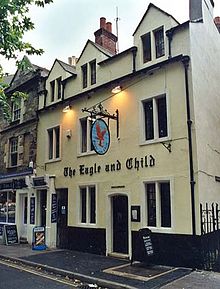
The Inklings discussed, among other things, myth, religion, and what we now call fantasy “world-building.”  Tolkien read chapters of Lord of the Rings and Lewis read his Narnia books.  They met on Thursday evenings in Lewis’s college rooms, and often shared lunch on Tuesdays at the Eagle and Child pub, commonly called, “The Bird and the Baby.”

The Eagle and Child Pub, Oxford

Nowadays we call such literary clubs, critique groups.  You often hear fans of fantasy literature say, “Oh, to have been a member of that group!”

Lately I’ve been thinking of the downside of such associations.  If you were C.S. Lewis, what would you have done when Tolkien told you not to publish Narnia?  “You will embarrass yourself,” he said.

I also think about the first Harry Potter book, which would never have been blessed by any critique group.  J.K. Rowling broke too many rules.  For starters, she mixed elements of middle-grade fantasy with young-adult fantasy, and by all conventional rules, that is a no-no.  The problem is, conventional rules lead to conventional books.  Check out some book-jacket blurbs at the local Barnes & Noble to see for yourself if that’s true.

I can clearly remember when it wasn’t like this.  In the eighties I used to hang out at a quirky fantasy bookstore.  I could go in with a theme in mind like, “spirit guides in contemporary urban fantasy,” and walk away with a couple of titles the owner pointed out to me.  Try that at the Barnes & Noble!

Learning and practicing conventional wisdom is a part of mastering any craft.  I went through it in art school.  It was necessary, but eventually became like wearing mental blinders that prevented me from appreciating or producing work that ventured beyond certain boundaries.  The problem was, I could not see past the filters even when I started wanting to, because I had spent so much effort learning the rules.  Only with the passage of time – a lot of time – did my rigid ideas relax and dissolve.

Is there any way to speed up the process now?  Because now I know what is really at stake:  it’s about recapturing a spirit of freshness and play as a reader and a writer.

***

This morning I found myself rereading notes I had taken in March when I attended a retreat with Edward Espe Brown, an event I posted about at the time.  No wonder!  Brown is one of the least doctrinaire people I have ever met.  Here is the story that really stuck with me:  Brown was leading a meditation session, and as leader, his role was rather formal.  One day he sat down and reviewed his inventory of meditation techniques – which was extensive – to choose one to practice that day.  A sudden inspiration arose in his mind – Why don’t you just touch what is inside with warmth and kindness?

That is a very revealing exercise.  One of the first things that comes up for me you could call the “inner achiever.”  I bet most of us learned early in life to be virtuous and hard working.  Play only after you get your work done, and so on.

It’s easier to see the dynamic in meditation where nothing else is going on.  I tend to procrastinate more in attempting such a strange (warmth and kindness?) exercise in writing.  Yet a timed period of freewriting in the morning, before the daylight mind is fully awake, can lead to a startling result – it can open a doorway into play and an unexpected abundance of ideas.

I do this freehand in spiral notebooks and tell the inner achiever these are “warm up exercises.”  And after repeating this for a few days, I’ve witnessed ideas pouring onto the page, in such a profusion that it’s sometimes hard to keep up.  Try it and see.  For me it was something of a revelation.  I’ve done free writing before without experiencing this, but I suspect I was secretly harboring agendas along the lines of self-improvement or self-discovery or something like that.

Where are all these ideas going?  I really don’t know, and I am determined not to ask.  It’s too adult a question – “Are you engaged in an educational form of play?  Is this leading toward a measurable goal?  I have no idea.  I don’t even know if these ideas are “mine” or if “me” and “mine” have any meaning while this is going on.

Here are some other notes I jotted down when Edward Brown was here:

  • What is precious in us doesn’t come and doesn’t go.  It is not dependent on performance.
  • You can’t figure it out.
  • Focus on what is beyond thinking – and that means what is in the heart.

Finally, he posed a stunningly simple question:  Are you going to be a rule follower or are you going to be you?

You can’t just make a simple decision on that one and then do some warm up exercises.  What was it that C.S. Lewis knew about himself and his work that kept him going when Tolkien told him Narnia wasn’t fit to publish?

That is a very important question for any writer who wants to listen to others without losing his or her own inner center of gravity.

Hollowland by Amanda Hocking – A Book Review

If you are a writer, unless you’ve been living with wolves, chances are you have heard of Amanda Hocking, the twenty-something Minnesota author of young adult fantasies who spun the publishing industry in an unexpected direction.

One year ago this month, after a string of rejections from agents and editors, Hocking uploaded two novels in Kindle format.  She thought $43 for her first two weeks of sales was “pretty good.”  By the start of this year, she was selling half a million eb00ks a month, and in March she signed a reported $2 million dollar contract with St. Martin’s Press.

Amanda Hocking’s story has been told in the New York Times, the Wall Street journal, and on dozens if not hundreds of blogs, but one key question is seldom directly addressed:  are her books any good?  I just finished my first Hocking novel, and the short answer is, yes, it was lively, original, and I liked it a lot.

Hollowland starts with a bang and the action does not let up.  How is this for an opening sentence?

“This is the way the world ends – not with a bang or a whimper, but with zombies breaking down the back door.”

These are not your old-school, reanimated corpse type zombies.  No stiff, slow, shambling, mumbling, B-Grade movie zombies.  A mutation of the rabies virus has infected most of the population, causing them to become really angry, really psychotic, and ravenously hungry.  After her quarantine station near Las Vegas is breached by a coordinated zombie attack, 19 year old, Remy, and her friend, Harlow, set off across the desert, determined to find Remy’s brother.  Their first traveling companion is an African lion – animals are immune to this kind of rabies, and all the big cats from Circus Circus are loose.  That night they meet a rock star whose fame doesn’t mean so much in a post-apocalyptic world.  They pick up an SUV and a couple of refugees from a fundamentalist cult, whose leader has the habit of “cleansing” his female followers in his bedroom.  And so it goes.

It says a lot about Remy that she names the lion, Ripley, after Sigourney Weaver’s character in the Alien movies  That is the mojo you need when the zombies are winning.  Remy also has a charming irreverence, the kind of simple, eyes-open, speak-your-mind nature that you see in Amanda Hocking’s online interviews.

I can really see, though I have not found the words to express it, why the literary establishment would not cut Hocking a break.  There’s a hint of piety about the stories and characters you see in the YA fantasy section of Barnes&Noble.  The word “homogenized,” comes to mind.  And “processed food.”  And “inbred.”

This story was fresh, a little bit raw, a bit unpolished, but shaped by a writer whose imagination has not, and hopefully will not, be poured into the grooves shaped by others.  Hocking reminds me of Stephen King and not for the obvious horror licks that they share.  Both authors seem to gravitate to horror not just for its own sake, but to explore what ordinary people will do in impossible situations.

Hollowland is a available in both self-published text version, and Kindle format for $0.99, and in case anyone does not know, a Kindle device (though I love mine) is not required to read a book in that format.  Amazon has free Kindle apps for pc, mac, iPads and smart-phones.

Enjoy.

The Hunger Games by Suzanne Collins

What if there was a trend and I wasn’t paying attention?

I actually did notice The Hunger Games when it came out in 2008, but I did not read it then for two reasons.  First, though I love the genre, I am wary of reviews of fantasy literature, with words like “Breathtaking,” or “Original,” because I’ve been burned too many times.  In addition, when I read the synopsis, although The Hunger Games did sound original, but we had just had a round of serious layoffs at work, and I wasn’t in the mood for a story of hard times in the not-so-distant-future.

Last weekend, at the SCBWI conference, I heard repeated praise of The Hunger Games from sources I trust.  Later, one of the speakers cautioned the audience not to write a story just because it is trendy.  He cited a current mass of “dystopian fiction” as an example.

Looking again at reviews, and watching the the trailer of the movie that is “Coming Soon,” I realized The Hunger Games must have sparked the trend.  I downloaded the ebook and to my surprise and delight, could not put it down.  I devoured it this week.  It seems strange that in the fantasy genre, real originality is so rare, but this book has it.  It isn’t perfect.  I thought that at a key moment, Suzanne Collins held true greatness in her hand and let it slip away.  Still, The Hunger Games is one of the very best reads I recall in YA fantasy.

Katniss

I didn’t just read this book for pleasure.  It is one of a half-dozen new books I plan to read once for pleasure, and again with an eye to look under the hood and try to see how the author creates the magic.  Observation one – Suzanne Collins takes all the time she needs to introduce us to Katniss Everdeen, 16, and let us bond with her.  We rise with Katniss, learn that she loves her 12 year old sister Prim but despises her cat.  Very human stuff like that.  We learn that times are hard.  We learn that to get into the woods to hunt for squirrels to eat or trade on the black market, she has to pass through an electrified fence, which isn’t really that dangerous, because the power is seldom on.  We aren’t in Kansas anymore!  We meet Katniss’ best friend and hunting partner, Gale, who despises The Capitol, which runs things, and we learn he could be killed by the Peacekeepers if such talk is overheard.  We learn this is the day of “The Reaping” and that does not sound good.

Panem

Panem rose from the ruins of America.  Katniss’ District 12 used to be called Appalachia.  The Capitol is totalitarian, and attempts to flee result in death or slavery.  Earlier worlds of this sort, like 1984, reflected the cold war mentality, while Panem is firmly lodged in 21st century fears.  Large chunks of the coastline are gone.  There have been famines and other ecological disasters.  The Peacekeepers bring to mind Homeland Security, and the iffy electricity has an eerie resonance to what is happening right now in Japan.

But all that is nothing compared to the Hunger Games and what happens if you are selected as a “Tribute” at the “Reaping.”

As punishment and a warning to the 12 surviving Districts that unsuccessfully tried to revolt, the Capitol demands a boy and a girl between the ages of 12 and 18, to be chosen by lottery once a year.  The are trained and pitted against one another in a huge outdoor arena as gladiators.  One victor will be set up for life.  Twenty-three others will die for the amusement and “instruction” of the population, which is forced to watch – there is always enough electricity to televise the Hunger Games.

The Games

When her baby sister, Prim, is chosen, Katniss rushes forward to volunteer to take her place.  We had come to like her before, and now we love her.  Her chances do not seem very good.  Her fellow District 12 tribute, Peeta, is a baker’s boy, who doesn’t seem much of a warrior.  To make things worse, Peeta once saved her life with the gift of a loaf of bread, and both know they will eventually have to fight to the death to survive.

By now, of course, we are really into the story, and incredibly, as their training unfolds, we begin to think Katniss and Peeta may stand a chance.  As a strategy to deceive the others, they feign love for one another – except Peeta may not be pretending.  Katniss wins the affection of the crowds and the all-important sponsors.  The odds-makers give her good marks for her skill with a bow.  Their trainer, a past winner and a drunk goes on the wagon and dedicates himself to their survival.

Then the games begin and all hell breaks loose – literally.

Rue

Lets face it, we know Katniss will survive, but to her credit, Collins keeps up the nail-biting doubt.  The most poignant moment comes when Katniss teams up with Rue, a twelve year-old slip of a girl, who reminds Katniss of her sister.  They bond in a hurry, and Katniss briefly basks in the luxury of not feeling alone – never mind that they will have to fight each other later.  But after a daring raid on another team’s food supply, Rue is mortally wounded.  Katniss sings her a lullaby as she dies, for her greatest love had been music.  And then, as the greatest protest she dares, Katniss covers her friend’s body with wildflowers as the hidden camera’s broadcast the image all through the land.  Gladiators are not supposed to care for each other – it is the closest thing to open defiance Katniss can imagine.

At this moment, The Hunger Games transcends genre and reaches the level of tragedy – that which is grave and constant in human affairs.  In particular, it reminded me of that heartrending day, Dec. 25, 1914, that we now call the Christmas Truce.  Two armies of young men defied the old men who sent them to kill each other, by celebrating the birth of Christ with friendship.  The generals promised a firing squad to any who tried it again.

How It Ends

Things tapered off from there, perhaps inevitably so, for how could such a moment be sustained?  Still, the genetically mutated zombie-werewolves who end the contest were over the top – they seemed like an add-on, a patch to ramp up adrenalin by borrowing from the horror genre.  For me, it had the opposite effect.

The book also ends with romantic teasers.  Katniss went out of her way to save the badly injured Peeta, but until now, she had been a hard-luck tomboy, fond of him and grateful, but not in love.  Her last moment inner conflict does not seem to grow “organically” from her earlier thoughts about her friendship with two young men – maybe I am too cynical, but I took it as a carrot to get the masses of Twilight readers to buy the next book of the trilogy.  Club Peeta or Club Gale?

Still, I plan to read and enjoy the final two books of the trilogy.  Even if the series comes off as an “ordinary” romance and battle of good guys against an evil empire, if that’s the worst thing we can say of The Hunger Games, it is still in very good company.  Suzanne Collins has given us a vividly imagined and wonderfully crafted story.