Harry Potter Fan Fiction

Harry, Ron, and Hermione in The Sorcerer's Stone, 2001

Fan fiction did not begin with Harry Potter or the internet.  According to Lev Grossman’s article, “The Boy Who Lived Forever,” in the July 18, issue of Time, xeroxed fanzines appeared after the premier of “The Man from U.N.C.L.E.” in 1964, and really took off with “Star Trek.”

In the broader sense, telling original stories with borrowed settings and characters is nothing new at all.  Homer did not create the Trojan War, Achilles, or Odysseus.  Shakespeare did not make up either King Lear or Henry V.  But with the internet and Harry Potter, fan fiction has exploded.  There are more than 2 million pieces on fanfiction.net and more than a quarter of these are based on Potter – everything from short stories to full length novels.

The final movie will not be the end of original Potter creations

Grossman explodes most of the stereotypes of those who write and read these tales.  One 38 year old writer and actress says it’s like character improvisation.  A best selling fantasy writer whose novels have been optioned by Peter Jackson says, “Fanfic writing isn’t work, it’s joyful play.”  This raises the key question of why writer’s of fiction write.  Joyful play, a platform, and an appreciative audience are there – and it’s not like many creators of “original” stories get to leave their day-jobs.

Well known authors fall on both sides of the unanswered copyright issue.  J.K. Rowling and Stephanie Meyer encourage new fiction based on their characters and worlds.  Orson Scott Card, Anne Rice, and George R.R. Marin, author of A Game of Thrones do not, and threaten lawsuits.  It may or may not be coincidence that the authors Lev Grossman names as supporting fanfic are more recent and write for a younger audience than those who are in opposition and write for adults.  So far, all cease and desist requests have been honored, so there are no legal precedents in the world of fiction, though court cases involving music have been liberal in their interpretation of what constitutes “fair use.”

This begs the interesting question of who a character or world belongs to.  Groosman says that until recently:

Writers weren’t the originators of the stories they told; they were just the temporary curators of them.  Real creation was something the gods did…Today the way we think of creativity is dominated by Romantic notions of individual genius and originality and late-capitalist concepts of intellectual property, under which artists are businesspeople whose creations are commodities they have for sale.

Personally, I have always loved the poet’s invocation at the start of The Odyssey:  Sing in me, muse, and through me tell the story… 

In my experience, the “I” does not invent worlds or characters.  Whether you call it the muse, the gods, or the collective unconscious, fictional worlds and imaginal people come from somewhere else.  With a bit of luck and humility, the “I” may get to witness what happens, and may even get adept at finding new rabbit holes.  To me, the idea of “owning” a “product” of imagination smacks of hubris.

There is no real data on whether fanfic hurts an author economically.  Intuitively, I can only imagine it benefits Rowling and Meyer.  I hope so.  Creativity is creativity, regardless of what spark ignites it.  I’m thinking of dropping by some of the sites to see what these authors are up to.  For those who write for the joy of it, I wish them a lot more.

Dreaming Up Ideas

I have been busy working on several blog posts, but they are for later this summer.  Meanwhile, I found myself less than excited by any of my other topic ideas, so I drifted over to a blog filled with a wealth of advice and inspiration, “Writing On The Wall” (you can find it in my blogroll).  Out of all the tags, I chose a section called, “Getting Ideas.”  http://writingonthewallblog.blogspot.com/search/label/getting%20ideas

Most of the posts were by a contributor named Annette Lyon, who shares a number strategies for jump-starting the creative process in fiction, as well as some interesting facts, like Orson Scott Card’s moment of inspiration for Ender’s Game, and this great quote from Tom Clancy:  “The difference between fiction and reality?  Fiction has to make sense.”

I especially liked Ms. Lyon’s account of wrestling with the infamous cliche that she heard from a college creative writing teacher – the famously stupid advice to “Write what you know.”  I suspect that most fantasy authors have never believing that nugget.  Write what you can imagine is more accurate for writers and poets from Homer to H.G. Wells, to J.K. Rowling, but Lyon’s misguided professor actually forced his students to compile a list of 100 things they knew, and were thus qualified to write about.

Lyon, who had wanted to be an author since the second-grade, was initially paralyzed by the realization that she didn’t know anything on her list well enough to write about it.  Fortunately for her and for us, she round-filed the list as soon as she could and rephrased the motto as, Write what you are willing to learn about.  

Any writer who has ever researched anything will agree with her, and reading her post, I realized that learning new things is one of my greatest pleasures in blogging.  And speaking of learning, check out “Writing on the Wall.”  Scroll through the tags and you’re bound to learn something new and find this sort of inspiration.

Gone For Good by Harlan Coben

A few posts ago I said I was going to read six books straight through for pleasure, and then cycle back and analyze the ones with plot features I admire.  Book number two on my list was Harlan Coben’s Gone For Good, 2003.  Donald Maass had good things to say about this title in his Writing the Breakout Novel Workbook.  He said it takes a mystery cliche – a detective haunted by the murder of his wife or girlfriend – and turns it inside out by layering the plot and adding twists and turns.  I cannot recall a thriller with more surprising twists packed into its pages.

Will Klein’s mother tells him a few days before her death that his beloved older brother Ken is still alive. Ken disappeared eleven years earlier, wanted for the murder of Will’s former girlfriend. The family believes Ken is innocent but assumes he is dead – could he really be alive and in hiding? The day after his mother’s funeral, Will’s girlfriend, Sheila disappears. The next day at work, two FBI agents ask for Sheila’s whereabouts, and inform Will that her fingerprints were found at the scene of a double homicide in New Mexico. Meanwhile we meet two former classmate’s of Will’s older brother, one a gangster and one a sociopathic master-assassain known as “The Ghost,” and both have a keen interest in Will.

Got all that?  You need to, since this is just the basic setup of Gone For Good.  When Will sets out with his friend, Squares, to try to discover what is really going on, Squares warns him he may not like the answers.  “The ugliest truth, in the end, was still better than the prettiest of lies,” Will says, a sentiment that will be tested as the story progresses.

Perhaps the greatest take-away for me as a writer is the way questions can keep us turning pages as effectively as tension.  From the initial, “What’s going on?”, “Is my brother alive?”, “Where is my girlfriend?” mysteries, Will must face issues that cut deeper and deeper into the basic assumptions of his life and the people he loves.

This is not a perfect book.  During the second half, I found my attention wandering.  In part, the plot twists were coming with such frequency they felt expected and lost a little of their power to shock.  So I think when I review Gone For Good in greater detail, I am going to discover that for a large section of Act II, the stakes and the pacing of the revelations stayed somewhat constant.

Also, the most menacing character, The Ghost, was not fleshed out until the end of the book.  It is hard to write a convincing, three-dimensional, psychopathic killer.  It is the humanizing details that make them come alive.  Hannibal Lektor valued good manners and hated rude people.  The killer in No Country for Old Men had certain personal values – keeping his promises, for one.  Such quirks make them more believable than an apparently flawless killing machine.  The Ghost, we learn at the end of the book, is driven by a complex and unexpected sense of loyalty and fair play, but I think we would have found him more “real” and more frightening if we had known some of the details earlier.

As I now understand it, the whole point of this exercise – reading and then rereading six books to try to look under the hood – is to look deeply into what works in six unique approaches.  Having just finished a complex novel like this, I have several other opinions and hunches but I need to review them further.

I was reminded though, of the very first post I made on this blog at the end of last June.  I quoted Neil Gaiman’s comment as editor of Stories, that the measure of a storyteller’s success are the four words we all want to hear – “And then what happened?”  By that measure, Harlan Coben deserves the acclaim Gone For Good has won.

A Conference and a Resolution

“If we had more stories as children, we would need fewer psychiatrists as adults.” – James Hillman

On Saturday, I attended the Spring Spirit Conference of the North/Central region of the SCBWI – Society of Children’s Book Writers and Illustrators.  This all day event took place in Rocklin, just 20 minutes from home.  It featured seminars and critiques by writers, editors and agents, aimed at people who write for children and young adults.  I had registered at the end of December, but as the day rolled around, I wasn’t that anxious to go.

Part of it was simple fatigue, the after-effect of this spring’s flu.  Part of it was a kind of burnout.  Earlier this week, as I was reviewing a manuscript for one of my critique groups, I caught myself writing a comment out of habit – a knee jerk response I was not even sure was true.  I’ve found myself doing that several times recently, and as a result, I was feeling an impulse to step away and sort out some ideas that didn’t feel like mine.  I wasn’t sure I needed a professional gathering where I was likely to pick up more.

I was pleasantly surprised by the keynote speaker, author and teacher, Bruce Coville.  “Take everything the presenters say with a grain of salt,” he said.  “Your job is to find your own truth.”  Those words turned my day around.  They set the tone of the day, as did his later seminar on writing fantasy, a genre he notes is snubbed by some literati as less than properly serious.  “Tell that to Homer, to Dante, Milton, and Shakespeare,” Coville said.

Sometimes I write fairytales because it’s the best way to tell the truth.” – C.S. Lewis

As I went through they day, an ongoing problem that is really mine came into focus.  I’ve been stalling out on my current book because several key plot elements need to be re-imagined.  Slogging away is not going to do it this time.  I’ve known I need to take a break, take a step back, but that isn’t easy for an A-Type, yankee-ingenuity, roll-up-your-sleeves mentality.  I needed some kind of plan to make it okay to take a break.  And I found one.

When in doubt, read, read, read.  That in itself is a great idea, but I find it hard to study really compelling books when the great ones sweep me into the story from the start – I’ll do the objective stuff later, and later never comes.  I happened to flip through the first book I ever bought specifically to help with plot and structure, called (would you believe) “Plot and Structure,” by James Scott Bell.

Toward the back of the book, Bell addresses that whole issue in a section called, “How to Improve Your Plotting Exponentially.”  It involves getting half a dozen novels, ones you have read or new ones.  Read them first for pleasure, then read them again with a stack of 3×5 cards and note the events, characters and purpose of every single scene.  Review them when done (like “forming a movie in your head,” says Bell).  Finally, lay out the cards and see how the scenes fit into the traditional three-act structure.  Where are the key plot points?  Where is “the door of no return?”  Where is the final battle joined?

This will take eight to twelve weeks, Bell estimates, but because of all that I earlier learned from him, I’m willing to test his estimation that during those weeks “you will jump ahead of 99 percent of all the other aspiring writer out there, most of whom try to find out how to plot by trial and error.” Trial and error has always been iffy for me.

So I’m giving myself permission to take a reading break.  I’ve already downloaded three books to my Kindle:

1)  The Hunger Games by Suzanne Collins, an acclaimed, post-apocolyptic story for young adults.   I started it yesterday and found to my delight, a YA story I can’t put down – I haven’t come upon too many of those recently.

2)  Gone For Good, by Harlan Coben.  This violates Bell’s instructions to stick with the type of book I want to write, but I’ve meant to read this ever since I saw Donald Maass praise the story in his Breakout Novel Workbook.  Besides, I really enjoy action/adventure and believe the genre contains elements that can improve any sort of writing.

3)  Hollowland by Amanda Hocking.  About time I read something by her!

From time to time I will report back on how this goes and probably review at least some of the titles, but right now, I have to get back to  The Hunger Games!

Annual “Bad Sex in Fiction” Prize Winner Announced

And now for something completely different:

British author, Rowan Somerville, has been awarded the annual “Bad Sex in Fiction Prize,” for his stunning use of animal and insect imagery in his novel, The Shape of Her.  Judges said they were especially impressed by a passage comparing lovemaking to “a lepidopterist mounting a tough-skinned insect.”

http://www.usatoday.com/life/books/news/2010-11-29-bad-sex-in-fiction-prize_N.htm

Somerville, who beat out such luminaries as Jonathan Franzen, noted during the award ceremony that, “There is nothing more English than bad sex.”   The Shape of Her is not yet available in this country, although I suspect Amazon.UK could ship in time for a holidays.

Rowan Somerville joins an select group of past winners, which includes Tom Wolfe, Norman Mailer, and the late John Updike, who was awarded a “lifetime achievement bad sex prize in 2008.”

Last year’s winner was Jonathan Littell for his novel, The Kindly Ones, in which he described the sex act as “a jolt that emptied my head like a spoon scraping the inside of a soft-boiled egg.”

Show, don’t tell in action…

Hint Fiction Contest Winners – and Two More Competitions

I almost missed the email, but here is a link to the winner and some of the runner-up entries from the Gotham Writer’s Workshop 25 word story contest that I mentioned here earlier.

In addition to enjoying the stories, scroll down to the bottom of the page for links to two more competitions.   There is a 30 word (that is 30 words exactly) story contest that is underway – entry deadline is Nov. 30.   There is also a “YA Discovery Novel Contest” with a deadline of Nov. 30.  For $15 you can submit the first 250 words of a YA novel for prizes including an invitation to submit the full manuscript to a YA agent in New York, a free writing workshop, and critiques by editors at Candlewick, Scholastic, Harlequin, MacMillan, Viking, Roaring Brook Press, and Sourcebooks, who will judge the finalists.

Why not give it a shot?

http://www.writingclasses.com/InformationPages/index.php/PageID/720?utm_source=streamsend&utm_medium=email&utm_content=12936417&utm_campaign=An%20Editor%27s%20Advice%20to%20Writers%20+%202011%20Guide%20to%20Literary%20Agents

Of Words and Wolves: Thoughts on Jack London

By the end of grade school, I knew, or sensed, that vast forces – parents, teachers, and church – were arrayed against me in a vast conspiracy to civilize me. My relationship with them had become one of wariness and secrets. I had friends of course, but after changing schools fairly often, I regarded friendship as a tenuous thing, subject to disruption at any time. I tended not to get too close to anyone.

My one constant companion was Ranger, the German Shepherd I had grown up with since the age of six. Once, alone in the woods in my coonskin hat, something exploded out of the brush at my back – a buck, with Ranger at his heels. The twentieth century vanished. We were back in the era when Daniel Boone would pack up and move when things got so crowded he could see the smoke of a neighbor’s chimney.

By the sixth grade, there weren’t any woods. We had moved from rural New York to the San Jose suburbs, where you had to look hard to find a decent tree to climb. Ranger hadn’t fared well either – he grew listless in our little fenced in yard, and within a year, developed a tumor. We put him down when he was six.  I was on my own and largely clueless.  And then, something wonderful happened.

They used to bring carts of inexpensive books into the sixth grade class, and one day I spent my lunch money on a paperback because the dog on the cover looked like Ranger. I hadn’t heard of Jack London or Call of the Wild, and though I loved to read, I didn’t yet know how deeply an author could speak to your soul.

For several years I followed Jack London through his dreams of silent forests, solitary men, dogs, and wolves.  I read everything of his I could find, but especially his tales of the Klondike – Call of the Wild, White Fang, and the collected of stories.  This past week I finally got to visit Jack London State Park and learn much I didn’t know about this author.  I didn’t realize what a toll his various adventures took on his health.  During his year in the Klondike, he:

” developed scurvy. His gums became swollen, leading to the loss of his four front teeth. A constant gnawing pain affected his hip and leg muscles, and his face was stricken with marks that always reminded him of the struggles he faced.” http://en.wikipedia.org/wiki/Jack_London

London tried to live out the dream of sailing to tropical islands.  He built a ship, the “Snark,” to carry him and his second wife, Charmian, on a seven year, round the world voyage.  Instead, plagued by mechanical problems with the ship, and health problems of his own, London sold the “Snark” after 27 months.  That was one of his heartbreaks.  http://www.parks.sonoma.net/JLStory.html Another was the miscarriages that prevented him and Charmian from having children.   A third was the fire that destroyed “Wolf House,” the 27 room, rustic mansion he and Charmain were building, at a cost of $80,000 pre-WWI dollars.  The house was nearly complete, and London remained severely depressed after its destruction.


Wolf House Ruins


In addition to these travels, London was constantly on the go. He’d been a war correspondent twice, had an active social life, tried unsuccessfully to make his ranch profitable, and wrote more than 50 books. For long stretches, he slept only 4 or 5 hours a night. His flesh could not keep up with his spirit, and he died in November, 1916, at the age of 40. The certificate lists the cause of death as uremic poisoning, complicated by hepatitis and kidney problems. The morphine he took for the pain of his other conditions apparently played a part, and though there was talk of suicide at the time, most historians now agree that if there was an overdose, it was accidental.  His correspondence and papers were always full of plans and projects for the future – his dreams were far bigger than his human capacity.


OF JACK LONDON’S WOLVES.


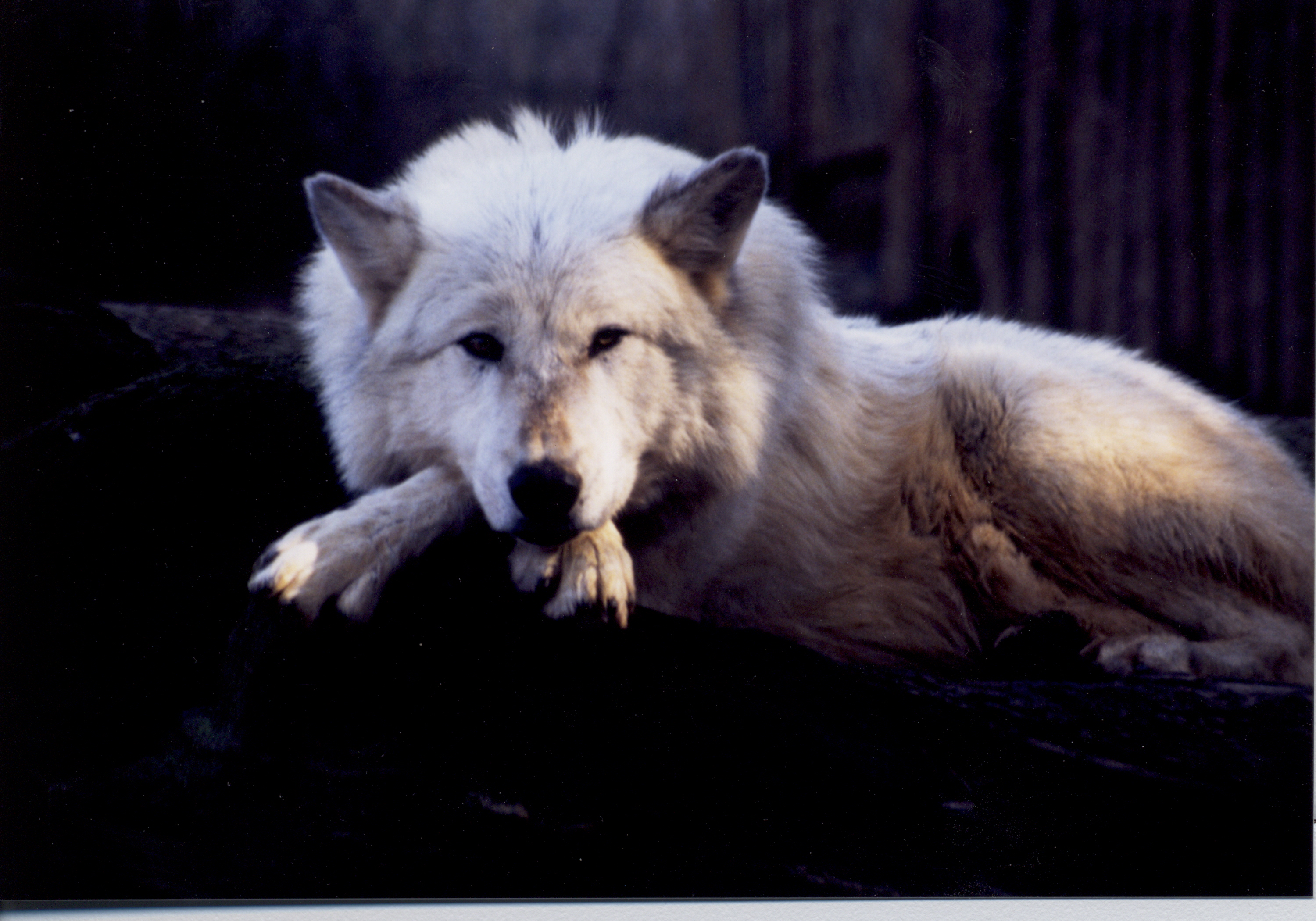
Sage at the Folsom City Zoo, ca. 1994


His best friend called him “Wolf.”  He named his dream home, “Wolf House.”  James Dickey notes how closely London identified with his totem animal, and says:

The reader should willingly…conjure up the animal in the guise of the mysterious, shadowy, and dangerous figment that London imagines it to be. We should encounter the Londonian wolf as we would a spirit symbolic of the deepest forest, the most extremely high and forbidding mountain range, the most desolate snowfield: in short, as the ultimate wild creature, supreme in savagery, mystery, and beauty.” – (Dickey’s intro to the Penguin edition of The Call of the Wild, White Fang, and Other Stories_

The “reality” of wolves as observed by biologists is very different, and Dickey says:

The mythic wolf that London “found” in his single winter spent…in the Klondike Gold Rush…bears in fact little resemblance to any true wolf ever observed. In studies…the wolf emerges as a shy and likable animal with a strong aversion to fighting. There is no evidence that any wild wolf has ever killed a human being in North America.

Reality and Truth can appear in different places depending on where and how we look for them. I don’t think I would have stayed up late as a kid – the old flashlight under the blanket trick – to read stories of lost trappers whose fires burn low while packs of shy, likable, creatures pace the perimeter.

Besides, it is the fact that wolves, like dogs, can accept humans as members of their pack, that allowed me to bond with several wolves when I was a volunteer at the Folsom City Zoo Sanctuary.  This was a marvelous opportunity I stumbled into – right place at the right time – and I often thought of Jack London, and imagined it as an inoculation of wildness – I got my fix without having to risk scurvy on the tundra.


A kiss from Redbud, a wolf pup, ca. 1996


OF JACK LONDON’S WORDS

Sometimes a degree of sophistication is a real pain in the ass.  I’d long lost my copies of Jack London’s books, so I picked up a collection on our visit.  I sat back that evening and looked at some of the stories, and noticed things I never saw as a kid:  in George Orwell’s words, “the texture of the writing is poor, the phrases are worn and obvious, and the dialog is erratic.” Yep – the agents at any writing conference would hammer him today.  And yet…

“The key to London’s effectiveness is to be found in his complete absorption in the world he evokes.  The author is in and committed to his creations to a degree very nearly unparalleled in the composition of fiction.  The resulting go-for-broke, event-intoxicated, headlong wild-Irish prose-fury completely overrides a great many stylistic lapses and crudities that would ordinarily cause readers to smile….Once caught in London’s swirling, desperate, life-and-death violence, the reader has no escape.” – James Dickey.

Fifty of Jack London’s stories and books have been made into movies. I’m not sure that can be said of any other author, let alone one whose youth was spent in abject poverty, and whose life was over at 40. And even those facts pale when the sight of a cold winter moon, or the scent of a pine, or the yip of a coyote in the distance sends shivers down the spine and spins you off, just for a moment, into arctic dreams.


Grave of Jack and Charmian London
 

September Writing Contests

Zoetrope:  All-Story Short Fiction Contest: http://www.all-story.com/contests.cgi

Prizes: $1,000, $500, and $250 and seven honorable mentions. Deadline October 1. 5000 words or less.

The announcement says: We accept all genres of literary fiction.   If the juxtaposition of “genre” and “literary fiction” has you scratching your head, you can purchase an online issue to get an idea of what that means.

They also say:  There are no formatting restrictions; please ensure only that the story is legible. That puts me in mind of colored inks and napkins, but that’s just because I do not knowingly write literary fiction.

Delacorte Press Contest for a First Young Adult Novel: http://www.randomhouse.com/kids/writingcontests/

This contest is in its 29th year. First prize is a book contract from Random House, $1,500 cash, and a $7,500 cash advance against royalties. This is for fiction in a contemporary setting, between the ages of 12 and 18, with manuscript length between 100 and 224 pages.

Fairly standard formatting requirements (no napkins) and entries must be postmarked between October 1 and December 31. The judges reserve the right to not award a prize and looking at the list of past winners it is clear that sometimes they have not.

Hint Fiction Writing Contest: http://www.writingclasses.com/ContestPages/hintfiction.php

This is the 25 word short story contest I talked about in another post here.   There are still five weeks left.  I initially set out to write a story a day…so far I have done five, so I need to get busy.

I find it a fun way to play with images, especially with “other” genres, imagining things like an innocent person kneeling beside a corpse.  It isn’t hard to write good 25 word stories, but I am finding it is maddeningly hard to do great ones.

I’m sure there are many other contests coming up, and one of these days I will have to go looking for them.