The churchyard horror

Tis the season for chills up the spine, and this is great tale for a windy October night – another wonderful story from Freaky Folktales.

Freaky Folk Tales's avatarfreaky folk tales

vampire

I have studied all manner of ghost and demon in my quest to better understand this realm betwixt Heaven and Hell but there is little in this study that has proved more intriguing — and downright flesh-creeping — than that of the Croglin vampire. On a dark autumnal day such as this, having struggled against sheets of rain and the swirl of stray leaves in the lonely path across the cemetery, my mind creeps towards that of a real churchyard horror, set upon the Lancashire moorlands.

It happened in the last century. Croglin Low Hall was a low, one-storeyed house on a slope looking down its gardens and cross a small park to the churchyard two hundred yards away. Along the front of the house ran a wooden verandah, like an African stoep. Two brothers and a sister took the house for the summer. I will not give their names…

View original post 739 more words

Dreaming with animals

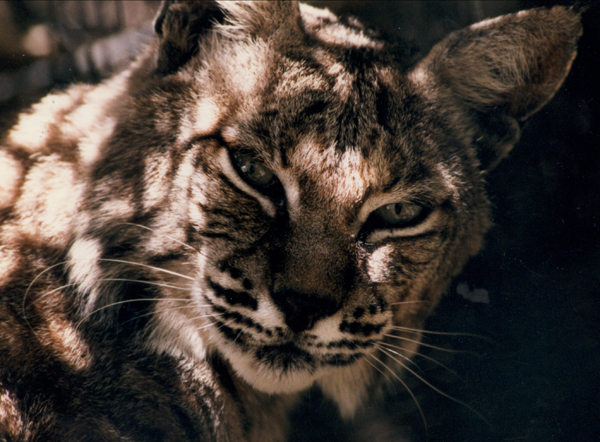
Bobcat, Folsom City Zoo Sanctuary - M.Mussell

Bobcat, Folsom City Zoo Sanctuary – M. Mussell

“What is the single greatest predictor of a hero’s success in folktales around the world?”

A professor who had studied the subject at length once posed that question in a psychology class. The answer, he said, was finding an animal helper. More than any other human or supernatural guide, an animal ally can lead the hero or heroine through trials and dangers to the end of their quest.

The professor was a friend and colleague of James Hillman (1926-2011) who loved animals and began collecting animal dreams in 1956.  Toward the end of his life, Hillman helped compile and update five decades of essays and lecture transcripts for a ten volume collection of his work.  Five volumes have been published to date, including Animal Presences, 2012, which I am currently reading.

Vixen the fox, Folsom City Zoo Sanctuary - M. Mussell

Vixen the fox, Folsom City Zoo Sanctuary – M. Mussell

After serving in the US Navy, Hillman studied at the Sorbonne, at Trinity College, Dublin, and in Zurich, where he received a PhD from the University of Zurich and an analyst’s diploma from the C.G. Jung Institute where he served as Director of Studies until 1969.  Versed in Jungian psychology, he charted his own path which he named “Archetypal Psychology.”  His first major work, Revisioning Psychology, 1975, was nominated for a Pulitzer Prize.

With 18 volumes in Jung’s Collected Works, and 10 in Hillman’s, it is clearly beyond the scope of a blog post to compare and contrast these two complex approaches to the depth psychology.  That said, several broad generalizations are possible:

Jung’s psychology can be characterized as “monotheistic,” aiming at a realization of the “Self,” as the supreme archetypal principle.  Jung understood the Self as “the God image within.”  Hillman, by contrast, called the psyche “polytheistic,” and considered the Self as simply one of many psychic centers within us.  Our nature, as we experience it moment by moment, is more like a pantheon of many gods than the kingdom of single inner supreme being.

As a corollary to these differing models of the psyche, development for Jung was often imagined as an ascent, a kind of upward climb toward spiritual clarity.  For Hillman, growth was often a descent, leading to contact with the “Soul,” which for him was more like the “soul” of a blues musician or an artist than the “immortal soul” of organized religion.

Hillman was also concerned with anima mundi, the soul of the world.  How can people be healthy when the world is ailing?  Hillman had little patience with ego psychologies that pretend human health is possible when our cities are blighted and we work in sterile, windowless offices bathed in florescent light?  As a result, his method of approaching dream and fantasy was unique.  He shunned methodologies that seek to aggrandize ego by asking what the figures of dream mean.  He insisted we treat the beings who visit us nightly with the same courtesy we would show to a guest in the waking world.

“the animals are right here. You have to be careful you don’t say something stupid because the animals are listening. You can’t interpret them; you can’t symbolize them; you can’t do something that is only human about them.”

Sage the wolf, Folsom City Zoo Sanctuary - M. Mussell

Sage the wolf, Folsom City Zoo Sanctuary – M. Mussell

“the image is the teacher. We have to endure a laboriously slow method of dreamwork…A dream brings with it a terrible urge for understanding. We want dreams decoded for their meanings. But the dream, like the animal in it, is a living phenomenon. It goes on displaying itself, pointing beyond itself to ever further interiority if we can hold back the hermeneutical desire so that the image can elaborate itself.”

“I am suggesting that the dream animal can be amplified as much by a visit to the zoo as by a symbol dictionary.”

Something within us mourns the animals missing from our lives.  We wear their pictures on t-shirts and sometimes collect little animal figurines.  We cherish domestic pets in ways that might seem bizarre to earlier generations who weren’t as estranged from the natural world.  We thrill at the sight of Coyote or Deer moving through twilight woods at the edge of the housing tract, and we mourn them dead on the road as we drive to work.

Sly the Fox, Folsom City Zoo Sanctuary - M. Mussell

Sly the Fox, Folsom City Zoo Sanctuary – M. Mussell

We are energized when animals visit our dreams – sometimes.  We’d rather they weren’t fierce, threatening, or slimy.  We prefer majestic and noble: an eagle, a dolphin, or wolf will do nicely. We’re not so fond of ants or mice, pigs or slugs, skunks or rats.

With the natural world in tatters, however, anima mundi is not dreaming of Disney creatures and love and light.  That’s all right.  Black Elk said the Lakota people knew every being has it’s place in the medicine wheel.  And if we don’t know what’s broken in ourselves and in the world, said Hillman, we don’t have the slightest idea of who and what and where we are.

Aiko the bobcat, Folsom City Zoo Sanctuary - M. Mussell

Aiko the bobcat, Folsom City Zoo Sanctuary – M. Mussell

What animals have recently come to your dreams?  What did they seem to want? Don’t remember any animal dreams? Just ask. If you mean it, if you are truly interested and repeat the suggestion until it brings results; if you prime the pump by leaving a notebook and pen you your bed stand, the creatures will visit.

They want to be heard and are looking for those who will listen.

Two views of the hero myth

In a recent post, I discussed heroes and anti-heroes in spy movies and westerns.  This is the followup post I promised, but I’m going to leave the realm of popular heroes – those of fiction, entertainment, sports, and all who wear masks and tights.  I’m going to discuss the heroes of myth, especially the “monomyth” as Joseph Campbell summarized it in The Hero With a Thousand Faces:

“A hero ventures forth from the world of common day into a region of supernatural wonder: fabulous forces are there encountered and a decisive victory is won: the hero comes back from this mysterious adventure with the power to bestow boons on his fellow man.”

Here is a graphic that makes the elements of this type of story clearer:

Heroesjourney

I can’t think of heroes without remembering James Hillman, (1926-2011), the father of archetypal psychology and one of the most creative thinkers of our time.  The two differing views of the mythic hero announced in the title of this post are Hillman’s own.  He never shied away from ambiguity; “I don’t have answers, I have questions,” he said.

James Hillman

James Hillman

Hillman often railed at the negative effects he saw flowing from the hero archetype, which he saw as ego enshrined as narrow self-interest, both individually and collectively.  For Hillman, the “heroic ego” was often a source of evil and mischief.  Noting that heroes slay dragons, and earlier generations of Jungians wrote of dragons as “the mother,” Hillman claimed that heroes like Hercules in Greek mythology were emblematic of the modern world’s subjugation of women, “the feminine,” and “mother nature.”  On another occasion he said, “Killing the dragon in the hero myth is nothing less than killing the imagination.”

Yet a recently published collection of Hillman’s work (Mythic Figures, 2012) includes a chapter on Joseph Campbell, compiled from talks he gave in 2004 in which he spoke at length of the positive hero.  He put his earlier negative comments in context:

“A mistake in my attacks on the hero has been to locate this archetypal figure within our secular history after the gods had all been banished.  When the gods have fled or were declared dead, the hero serves only the secular ego.  The force that prompts action, kills dragons, and leads progress becomes the Western ‘strong ego’ – capitalist entrepreneur, colonial ruler, property developer, a tough guy with heroic ambitions on the road to success.”

When Hillman used terms like “soul” and “the gods,” his concern was religious, but not in the way of the literal truths of most organized religions.  For Hillman, such literalism was the enemy of soul.  He spoke only and always of the truth of the psyche because it precedes every other kind of truth:  “Every notion in our minds, each perception of the world and sensation in ourselves must go through a psychic organization in order to ‘happen’ at all.” (Revisioning Psychology, 1977).

This understanding of the true hero in service to a Power greater ego prompted Hillman to revise his understanding of the “Father/Dragon/Ogre/King” the hero slays:

“A civilization requires the Ogre to be slain.  Who is the Ogre?  The reactionary aspect of the senex who promotes fear, poverty, and imprisonment; who tempts the young and devours them to increase his own importance.  The Ogre is the paranoid King who must have an enemy.  He is the deceitful, suspicious, illegitimate King whose Nobles of the Court [have] committed themselves to the enclosed asylum of security where they nourish their world-devouring megalomania.”

St. George and the Dragon by Paolo Uccello, ca. 1458

St. George and the Dragon by Paolo Uccello, ca. 1458

I think we know what he meant in 2004 by speaking of “paranoid kings” whose nobles live in “the enclosed asylum of security.”  It has only gotten worse. How desperate the Ogre is to quash any budding heroes was revealed in a piece on August 19 on Time.com, “School Has Become too Hostile to Boys,” by Christina Hoff Summers.  Three seven year old boys, in Virginia, Maryland, and Colorado, were recently suspended from school for the following acts:

  1. Using a pencil to “shoot” a “bad guy.”
  2. Nibbling a pop-tart into the shape of a gun.
  3. Throwing an imaginary hand grenade at “bad guys” in order to “save the world.”

The rationale for these suspensions were “zero tolerance for firearms” policies.  Punishing pop-tart weapons in a culture that went on a gun buying binge in the wake of the Sandy Hook shootings seems too ludicrous to believe unless you see it from Hillman’s perspective – another step in the dragon’s war on imagination, in this case, the male imagination, the perspective from which most of our current hero myths derive.  Along with banning snack food guns, such schools have renamed “tug of war” games as “tug of peace,” and halted dodge ball as too violent.

Fortunately, as Christina Hoff notes, such efforts to “re-engineer imagination” are doomed to fail – all they will do is “send a clear and unmistakable message to millions of schoolboys: You are not welcome in school.”

In We’ve Had a Hundred Years of Psychotherapy and the World is Getting Worse, 1993, Hillman made clear his belief that pathology lies in cultures as well as individuals, and we deprive the world of something when we take our rage and our grief exclusively to the therapist.  Hillman never shied away from critiques of the world at large.  Depression is “an appropriate response” to the world we live in, he said.

Yet stronger than the Ogre, said Hillman, is the myth of the Hero – not this or that particular hero, but the heroic pattern itself that Joseph Campbell restored for our times, which renews culture “by revivifying the archetypal imagination displayed by peoples the world over…The panoply of materials that Campbell catalogued shows that the hero wears a thousand faces and cannot be reduced to the modern ego.  Especially important in recognizing him is recognizing the heroic liberating function of myth – that it speaks truth to power, even the Ogre’s power.”

We know from history and the nightly news how much suffering the decay of empires involve as paranoid kings strive desperately to hold on to power.  We also have the examples of James Hillman and Joseph Campbell, who spent their lives pointing toward soul, psyche, and the language of myth and imagination.  That is where we must look to find the larger truth – the hero brings the gift of renewal as surely as spring returns after the darkest time of the year.

Face Rock, Bandon, Oregon

face rock

From this perspective, it’s easy to see how Face Rock, got it’s name.  Legend says that long ago, Chief Siskiyou from the mountains came to the sea to trade with the four tribes that lived in this region.  Warriors stood on the bluffs above the ocean fearing that the evil sea-spirit, Seatka might cause trouble.

Siskiyou’s daugher, Princess Ewauna, was not afraid of the spirit, and one night, when the moon was full, she slipped away from camp with her faithful dog and a basket with her cat and kittens nestled inside.  She went swimming, farther and farther from shore, ignoring the warning barks of her dog.  Seatka captured the princess.

Carrying the basket of cats, the dog swam out to Ewauna and bit the evil Seatka.  Howling, he shook off the dog and threw the cats into the sea.  Seatka tried to make Ewauna look into his eyes, but she refused and kept her gaze on the moon.  The dog ran on the beach howling, but in time, he, the cats, and Ewauna, still gazing up at the moon, were frozen into stone where they remain to this very day.

I first passed through Bandon, Oregon back in college days, and it’s one of those places that has drawn me back ever since.  I took the current blog header photo two years ago at a spot about half a mile up the beach overlook trail.

With the wind off the sea and afternoon fog, it is downright chilly.  I had almost forgotten what chilly is like, but I remembered this afternoon, rolling into town in cutoffs and t-shirt.  It’s hard to pack for cold weather when it’s 100+ degrees outside, so tomorrow will likely involve shopping for a sweatshirt.

This will probably be a quiet week on thefirstgates, as we wander the shore, listen to the ocean, and eat cranberry oatmeal cookies.

Photo by Casey Fleser, CC-by-3.0

Photo by Casey Fleser, CC-by-3.0

See you then, with more stories and photographs.

Your Own Damn Life: an interview with Michael Meade in The Sun

Michael Meade is an author, storyteller, and a passionate advocate of soul values in a world that increasingly ignores them; I’ve written about Meade or mentioned him in half a dozen posts.

In The Water of Life (revised, 2006) he shares his discovery that stories can be a matter of life and death.  As a teen in New York, when confronted by gang members from a rival neighborhood, Meade didn’t just lie his way out of serious injury or worse – he storied his way out, with an elaborate made-up tale that won over the assailants long enough for him to make his escape.  Readers of my recent posts will recognize a thriving trickster in Meade when he was just a kid!

I recently found an interview between Michael Meade and John Malkin in the The Sun that is as timely today, or more so, than in November, 2011, when it was published.  In the interview, “Your Own Damn Life,” Meade quotes an African proverb, “When death finds you, may it find you alive.”  Alive, he goes on to say, “means living your own damn life, not the life that your parents wanted, or the life some cultural group or political party wanted, but the life that your own soul wants to live.”

In the past, meaningful stories could guide soul evolution, but now, with the culture and the natural world both in crisis, Meade points to our lack of coherent, guiding tales.  A culture falls apart, he says, when youthful imagination and energy are stunted and when the traditional wisdom of elders is forgotten.  At one extreme, “You’re not supposed to be worrying about the end of the world as a teenager; you’re supposed to be bringing your dream to it. The world seems old and troubled now, and the young are no longer allowed to be as young as they should be.”  At the other extreme, we have a lot of “olders” but not many wise “elders.”

When traditional stories collapse, Meade says, the guiding and healing stories must come from within.  “That means going to the core of your own life and finding the story seeded within.”  Meade has tried to facilitate such explorations through his writings and talks, which first became known in the 80’s when he, James Hillman, and Robert Bly hosted a series of men’s conferences.

Meade continues to teach, write, and offer a variety of community services through the non-profit Mosaic Foundation he founded in Seattle where he lives.  If you’ve read this far, you will find Meade’s interview in The Sun and the Mosaic page hightly rewarding and likely sources for new ideas.


The North Wind’s Gift: a trickster tale from Italy

If you haven’t already done so, I suggest you read the preceding post, Notes on Trickster stories, which provides a background and context for this article.  Both posts were inspired by “The North Wind’s Gift,” a tale from Italo Calvino’s Italian Folktales, 1956.  The story came to my attention in Allan Chinen’s discussion of tricksters and appealed because of its relative simplicity and relevance to our own times.
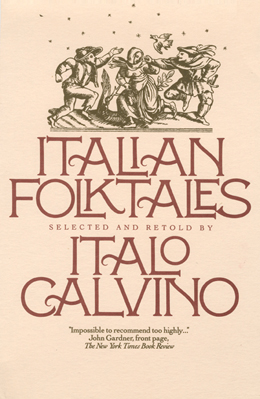
Italian Folktales

Here’s a synopsis of the story:

Once there was a farmer named Geppone who toiled in his fields every day of the year but could barely feed his wife and three children.  The North Wind blew at harvest time and ruined his crops.  Finally Geppone had enough and set out to find the North Wind and demand justice.  He reached the North Wind’s castle.  “Every year you ruin my crops,” he said.  “Because of you, my family is starving to death.”

“What can I do?” the North Wind asked.

“I leave that up to you,” Geppone replied.

The North Wind’s heart went out to the little farmer.  He brought out a box.  “This is a magical box which will give you food when you open it, but tell no one else about the magic or you’ll lose it.”

Geppone thanked the Wind and set out for home.  On the way, he opened the box.  Instantly a table appeared, piled with food.  When he got home, Geppone opened the box again and treated his family to a feast.  He told his wife not to tell anyone, and especially to say nothing to the priest, who was their landlord and a greedy man.

The next day, the priest spoke to Geppone’s wife and wrung the story out of her.  He summoned Geppone and  demanded the box on pain of eviction, offering seeds in return, which proved to be worthless.  As bad off as he was before, the farmer returned to the North Wind’s castle to ask for another boon.

At first, the North Wind refused, saying, “You ignored my warning.  Why should I help you again?”  Geppone pleaded, and reminded the Wind that he was still the cause of the family’s ruin.

“Very well,” said the North Wind at last.  He gave Geppone a magnificent gold box, but said, “Open this only when you are starving.”

On his way home, Geppone stopped and opened the new box.  This time a ruffian with a club jumped out and began to beat the farmer, who struggled to close the lid.  When he did, the ruffian vanished.  Geppone limped home, sore and bruised.  When his wife and children clamored to try the golden box, Geppone left the room.  This time two ruffians jumped out and began to beat the family.  Geppone slipped back into the room, closed the box, and the assailants vanished.

“This is what you must do,” he said to his wife.  “Tell the priest I brought home an even finer box, but say nothing else.”

Geppone’s wife understood and did as her husband instructed.  When the priest called the farmer and demanded the golden box, Geppone feigned reluctance, but at last agreed to trade it for the original box.  The priest rubbed his hands.  The bishop was due to join him for Mass the next day; a feast would be just the thing to win the approval of his superior.

The next day, after Mass, the priest, the bishop, and their retinue gathered for supper.  When the priest opened the box, six ruffians jumped out and beat the clerics.  Geppone, who was waiting at the window, took his time in closing the box to save them.

No one objected when he carried this second box home.  The priest never bothered Geppone again.  The farmer was careful to guard the North Wind’s gifts, and his family lived in ease and comfort for the rest of their days.

You can read the story as it appears in Italian Folktales here:  The North Wind’s Gift

***

It’s clear at the start of the story that we’re in a post-heroic fairytale world.  Geppone is not out to slay a dragon, rescue a princess, or win a kingdom – he just wants to survive.

Allan Chinen speaks of the different life stages that different fairytales address.  While the majority center on young people venturing into the world,  “middle-tales” like this have older protagonists with different kinds of problems.  From a Jungian perspective, Chinen notes that tricksters usually don’t show up in our dreams when we’re 18 and planning to take the world by storm – they visit us when we’re 40, with a mortgage, a couple of kids, and a car that needs an engine overhaul.

Geppone works from dawn until dark but can barely make ends meet.  His wife doesn’t listen to him, and the landlord threatens eviction.  This setup makes his story seem contemporary – if we’re not in this situation ourselves, one of our neighbors probably is.

We get the feeling Geppone has been down on his luck and taking it on the chin for a while.  Something finally awakens within him and spurs him to action.  As a result, he meets the North Wind, a wild spirit who will become his guardian and mentor and teach him the wiles of the trickster.

The North Wind is invoked in the Song of Solomon, in Aesop, and in Greek and Norwegian folklore.  He shows up in George McDonald’s novel, On the Back of the North Wind, in the stories of Hans Christian Anderson, and in Pokemon.  The North Wind is also associated with thunder gods like Zeus and Odin.  It’s not surprising that he is a shadowy trickster in Italy, where invaders and winter both arrive from the north.

Almost every successful fairytale character wins the help of a guiding spirit, and the North Wind’s help is just what Geppone needs.  It prompts him first to stand up for himself and ask for what he needs and then to learn enough strategy to overcome his oppressive priest and landlord.  To Jungians, fairytale allies like helpful animals, fairy godmothers, and nature spirits represent parts of the unconscious mind that are older and wiser than ego, which gets us into trouble in the first place.

What this means in practical terms is a vast subject, beyond the scope of a few blog posts.  Jung would suggest to patients who were comfortable in a religious tradition to return to it for guidance.  Much of Jung’s work aimed at helping people estranged from existing traditions who still needed to tap inner sources of wisdom.

In the “Power of Myth,” Bill Moyers asked Joseph Campbell where ordinary (i.e., busy) people might look to experience the wisdom of myth.  Campbell suggested we take 30 minutes or an hour a day in a quiet place where we can read what inspires us and perhaps keep a journal.

Just like this story, the psyche is home to ruffians and riches, and the old stories are not to be taken literally.  James Hillman, a prominent Jungian thinker, always insisted that literalism is the greatest enemy of inner wisdom.  So how does trickster wisdom manifest  in our world right now?  I don’t think we have to look very far.

A world that’s increasingly dysfunctional serves as a magnet for trickster energy, for good as well as for ill.  A Facebook friend mentioned that he once loaned out a book on trickster mythology and never got it back.  That fits the myths of trickster gods like Hermes who are also patrons of thieves.  Hermes may be the supreme image of the trickster.  As fluid as the metal which bears his Roman name, Mercury, he was the messenger between gods and humans who also conducted souls to the afterlife.  Patron of travelers, herdsmen, poets, orators, athletes, and inventors, his herald’s staff, the caduceus, is the symbol of healing to this day.

I find myself watching for positive manifestations of trickster energy, which usually turn up under the radar of corporate and government organizations which carry a vested interest in the status quo.  When you look, quite a few individuals and groups are trying out new solutions.  I’ll post at least one example in the near future.

In the meantime I would love to hear where you find trickster energy in yourself and in those around you.

Notes on Trickster stories

Many of you will have heard the old Chinese curse, “May you live in interesting times.”  We do, beyond any question.  With a longstanding interest in folklore, I often find myself wondering which, if any, of the old tales can speak to us now and illumine our situation?  I always come back to the trickster stories.

Br’er Rabbit, an Americanized African trickster, from an 1881 book cover by Frederick S. Church. Public domain

Trickster tales are told around the world and may be among our earliest stories; in some traditions, tricksters create the world and bring fire to humans.  Sometimes benefactors and sometimes criminals, tricksters are contrarians, rule breakers, restless beings who disrupt and disturb, who keep creation moving, dealing out life and death in turn.

Groucho Marx, Loki, all of Shakespeare’s fools, and many animals, from Coyote, to Spider, to Br’er Rabbit are tricksters.  We named our first rescue dog Kit, short for Kitsune, which is Japanese for “Fox,” another famous trickster.  The reason should be obvious in this picture:

Kit

Kit

We have to lock the windows when driving with Kit because she knows how to hit the window button with her paw to roll it down so she can hang her head out, bark at other dogs, and catch the breeze. If Kit had thumbs, we’d be in serious trouble!

Establishments have little use for tricksters, and it’s easy to see why.  We may like them in the movies, but no one wants the Three Stooges to work on their plumbing. Schools are ruthless in their suppression of tricksters.  And yet, in times when the norms break down and the culture looses its rudder, trickster energy may be what we need.  Free of cultural norms and concern for what is polite or even legal, tricksters focus on what will work in the here and now.

After interviews with twin tower survivors, researchers discovered that people waited an average of ten minutes before deciding to exit the buildings.  “Do you think we should leave?”  “Will we have to use vacation time if we go?”  “What about the report I have to finish?”  Once they decided to exit, survivors spent several more precious minutes logging out of their systems and locking their desks and file cabinets.

Researchers concluded from this and other studies, that the human brain is often dangerously slow in reacting to radically different events or disasters.  These are the times when we need trickster energy.  Unbound by convention, the trickster jumps on a desk and yells, “The sky is falling – get the f**k out!”

Allan Chinen, M.D., a psychiatrist and professor of psychiatry, wrote about tricksters from the Jungian perspective.  In 2012, I discussed his Once Upon a Midlife, an analysis of folklore aimed at that stage of life.  In 1993, Chinen published Beyond the Hero:  Classic Stories of Men in Search of Soul.

beyond the hero

Chinen argues that despite popular concepts and movies like Man of Steel, The Hero is not the core masculine archetype – the Shaman/Trickster is an older, wiser, and more primal energy.

Like most Jungian’s I have read, Chinen regards tricksters as primarily masculine archetypes.  I’m not sure how opinion stands in currently folklore studies; much work has been done with women’s tales in the last 20 years.  It is Gretel, after all, who uses trickery to kill the witch and save her brother.  Only by wiles can Bluebeard be defeated or brothers saved from various enchantments.

I suspect the difference is that full-time tricksters like Coyote are usually male.  You see it in children at play too, and sadly, it is overwhelmingly boys who get dosed with ritalin when they’re not docile enough for the modern classroom.  As Jung and Hillman both observed, what a culture defines as pathology may say more about the culture than the people it labels as defective.

Guardians of the status quo are wary of tricksters and with good reason.  They are almost always subversive – the Stooges only throw pies in the homes of the 1%, and Charlie Chaplin was no friend of the captains of industry.

Charlie Chaplin in "Modern Times."  CC-by-SA-2.0

Charlie Chaplin in “Modern Times.” CC-by-SA-2.0

To personify self-preservation; to point out the shadow of a dominant culture; to keep the flame of hope and spirit alive; to demonstrate the power to wit to those who are disenfranchised.  Scholars now believe the Br’er Rabbit tales performed such functions for slaves as the Coyote stories did for Native Americans on the reservations.  In all likelihood, these are the gifts tricksters have given for untold millennia.

Next time I’ll look at a classic trickster story that Allan Chinen told, with an eye to it’s relevance for the 21st century.

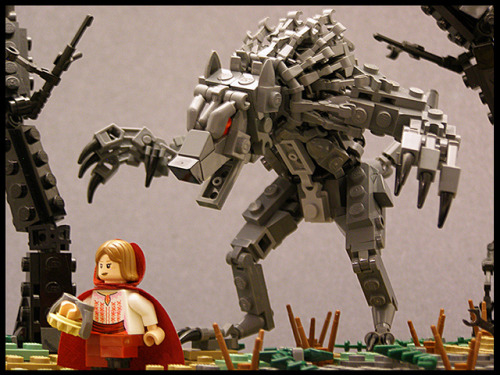
Lego Fairy Tales

Once again I’m pleased to feature a post by the amazing Lily Wight, who found some fairytale illustrations I doubt that you’ve seen before. I wonder what the career path is – Lego engineer has always seemed like a dream job!

Lily Wight's avatarLily Wight

     This month’s Lego fix features Little Red Riding Hood, Beauty & The Beast and a rather startled Little Mermaid.

     Just hover over the images for extra information…

View original post