The Gettysburg Battlefield

I spent the spring and summer of 1973 working at IBM and living with my parents in the western New York factory town they had moved to a year before.  I had just gotten a VW van and while I was there, I offered to take each of them camping to the place of their choice.  My father chose the Jersey shore.  My mother wanted to tour Gettysburg, so that’s where she and I went.

My mother was born in Richmond and remembered seeing old gray-bearded veterans rocking on porches in nursing homes when she was a girl.  Her Uncle Bob was an avid Civil War historian and inspired the same passion in her, which she in turn passed on to me.  I think she first took me to see Gone With the Wind when I was six.  On a summer visit to Richmond, Uncle Bob toured us around local battlefields and bought me a minnie ball.  He had a civil war musket over his fireplace and gave my mother a first edition of General Sherman’s Memoirs.

It was natural then, for us to set out for Gettysburg, but it turned out to be far more than either of us expected.  Growing up on the east coast, I had visited other battlefields, but Gettysburg is about something more than history.  Everyone I have ever met who who has been there has the same thing to say:  Gettysburg is sacred ground.  These are the exact words people use.

Little Round Top, courtesy of TripAdvisor.com

First of all, the battlefield is incredibly beautiful.  In early June, 1973 everything was in bloom.  At the Devil’s Den, my mother said it looked like a team of Japanese gardeners had been working the land for a hundred years.  There was a distinct oriental feel to the granite boulders, the blooming dogwood, and the surrounding fields of wildflowers.

But our nation is filled with natural wonders, and the feeling at Gettysburg is not about beauty alone.  It is like the feeling of peace you sometimes experience in old cemeteries, especially the old ones on the east coast, with statues of sad angels silently keeping watch.  At the start of July, 1863, 150,000 men fought on this ground.  In the next three days, they suffered 50,000 casualties; one out of every three men was killed, wounded, or captured.

In a place of so much horror, you would expect a negative vibe, but Gettysburg is the opposite.  In some places, you lower your voice, as if you were standing in church.  Lincoln got it right in his address:  in some inexplicable way, the blood of so many young men forever hallowed this ground.

***

I think of Gettysburg and often watch the movie again at this time of the year.  Gettysburg was released in 1993 and was based on the best historical novel I’ve ever read, The Killer Angels, 1974 by Michael Shaara.  The book won a Pulitzer prize, and I believe it is still required reading in military academies.  Over the next few days, I am going to post about what happened there.  This was the turning point of the war.  At moments, the outcome depended on just a few men who did the right or the wrong thing under fire.  Some of these stories are better than fiction.

***

The soldiers of both armies showed incredible courage, but the south had dominated the battlefields for the first two years of the war.  They had brilliant generals, while the north put the wrong men in leadership roles at precisely the wrong times.  By the summer of 1863, Lee was convinced that a victory on northern soil would finish the north’s already flagging will to fight.

It was just at this pivotal moment that Lee’s own judgement and that of some of his key commanders failed.  At the same time, several Union field commanders made precisely the right moves, and all these actions combined to tip the outcome.  Part of Lee’s problem was beyond anyone’s control – he had lost Stonewall Jackson, the general he called his “right arm,” at the battle of Chancellorsville in May.  The new commanders of the Stonewall brigade did not have Jackson’s uncanny instinct for always doing the right thing.

What was avoidable was the serious lapse in judgement of Lee’s cavalry commander, J.E.B. Stuart.  Cavalry was the eyes and ears of the army, but Stuart had gone “joyriding,” as some of the other commanders put it – tearing through Pennsylvania, trying to sow confusion and panic in the population.  He succeeded, but left Lee without knowledge of the Union army’s location and strength.

On July 29, 1863, Lee’s army was stretched over miles of Pennsylvania roads, vulnerable to attack.  Late that night, an actor-turned-spy named Harrison reported to Generals Longstreet and Lee that elements of a stronger Union force were no more than four hours away.  Lee send word to all his commanders to assemble at a sleepy little town called Gettysburg where all the highways happened to meet.

To be continued.

Finding Your Civil War Ancestors

For a number of reasons, which I will discuss here later, my thoughts at this time of year turn toward the battle Gettysburg, an event in our history that has long haunted and fascinated me, especially since I toured the battlefield one June many years ago.

The campaign began at this time of year, on June 15, 1863.  Bolstered by six months of stunning victories against superior numbers, Robert E. Lee led 70,000 men of the Army of Northern Virginia across the Potomac to invade Pennsylvania.  He planned to strike as far north as the capitol in Harrisburg, or even Philadelphia.  Anti-war sentiment in the north was so strong he believed that one more victory on northern soil would force Abraham Lincoln to negotiate for peace.  He was probably right.

On the battlefield’s web site, I found a fascinating page for locating civil war ancestors:  http://www.nps.gov/gett/historyculture/ancestor-search.htm,  If you click the top button on the right, called the “Civil War Soldiers and Sailors System,” you can plug in names and states to search the National Archives data base.

I started by trying my name, because it’s unusual, and discovered eight soldiers named Mussell, seven who fought for the Union, and one Confederate from Georgia.  I doubt that any were direct ancestors, since my paternal great-grandfather didn’t arrive on these shores until 1870.

I searched on my mother’s maiden name, which is more common, but that carried its own difficulty:  she was born in Virginia, her father came from Michigan, her grandfather from New Jersey, and all three states had soldiers with her name.  Out in a trunk in the garage I have an old hand-drawn genealogy, and such tools are likely to be necessary.

The soldiers’s names are matched with regiments, and if you click those, you can see where they were formed, where they fought, and where they were disbanded.  Tragically, in every regiment I checked, the number who died of disease was greater than the number who killed in battle, a statistic that holds for both armies as a whole.

It’s pretty amazing to have this kind of information at our fingertips, and one thing we can be sure of:  everyone who lived in this country 150 years ago was affected.  There were almost a million casualties at a time when the population was only 31 million.  If you are lucky enough to have some letters, a family Bible, an aging relative, or family legends, who knows what you can find with this database.

The Ballad of Jesse James

It’s easy to see why I was drawn to the Ballad of Jesse James as a kid; the song paints Jesse as an American Robin Hood:

Jesse James was a lad, he killed many a man,
He robbed the Glendale train.
He stole from the rich and he gave to the poor,
He’d a hand, and a heart, and a brain.

Jesse James

Not surprisingly, singers who have covered this ballad include Woodie Guthrie, Pete Seeger, and Bruce Springsteen.  The song also has those elements of mystery I believe are central to stories that take up permanent residence in imagination:

Oh, Jesse had a wife who mourned for his life,
Three children they were brave,
But that dirty little coward, that shot Mr. Howard,
Has laid Jesse James in his grave.

The notes in the book of ballads I found as a kid explained that “Howard” was the alias Jesse James used when he married, settled down, and tried to leave his life of crime behind.  The dirty little coward was Robert Ford a friend of Jesse, who shot him as he straightened a picture on the wall of his home.  Something in us recoils at that and wants to know how Ford could do it.  We know in our bones why Dante assigned traitors to the lowest circle of Hell.  I am not the only one who wonders, for the story has been dramatized several times, most recently in 2007, when Brad Pitt played Jesse in The Assassination of Jesse James by the Coward Robert Ford.

With Jesse James we get to witness a legend in formation, for unlike the Child ballads, this story is just over a hundred years old.  We can see how imagination shapes facts the way the ocean smooths pebbles, and something in us prefers the legend – we want to know who the heroes and villains are and we want them larger than life.  If you are like me, you’ll be disappointed to learn that no historical record shows the James gang ever using its loot to benefit anyone but themselves.

Jesse James, (1847-1882), and his older brother Frank, came of age during an especially bloody phase of the Civil War – the guerilla conflicts that raged across the border state of Missouri.  The James brothers rode with William Quantrill, one of the most notorious guerillas; we would call him a terrorist now.  Sixteen year old Jesse joined Quantrill in 1864, and supposedly took part in the Centralia massacre, where the band killed 22 unarmed Union troops then scalped and dismembered them.

After the war, Missouri freed its slaves, but forbade ex-Confederate soldiers from voting, serving on juries or even preaching from pulpits; it was a fertile ground for outlaws.  The James brothers joined with Cole, John, Jim, and Bob Younger, and went on decade long spree of robberies that spread from Iowa to Texas, and from Kansas to West Virginia.  John Newman Edwards, an editor of the Kansas City Times, published Jesse’s letters and presented him as a symbol of Confederate resistance to Reconstruction.  The James-Younger gang was adept at publicity, often hamming it up before crowds during escapes from stagecoach and bank robberies.  Because they took safes and strongboxes and did not rob passengers, Edwards’s editorials painted Jesse as Robin Hood.

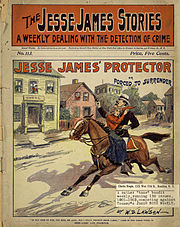
Jesse James dime novel cover

The Pinkerton Detective Agency was hired in 1874 to stop the James-Younger gang, and after numerous setbacks, Allan Pinkerton took on the case as a personal vendetta.  In 1875 he staged a raid on the James homestead and threw an incendiary device into the home.  It exploded, killing Jesse’s half-brother, and blowing off one of his mother’s arms.  This, more than any editorial, won public sympathy for Jesse James.  A bill granting the James and Younger brothers complete amnesty was narrowly defeated in the Missouri legislature.

Jesse married his cousin Zee in 1874, and two of their children survived to adulthood.  The downfall of the gang came in 1876, when they raided the First National Bank in Northfield, Minnesota.  All of the Younger brothers were killed or captured.  Only Frank and Jesse escaped.

Jesse tried to live quietly with his wife after that, in a home near St. Joseph, but he invited Charley Ford, a former gang member, to move in with the family for protection, and Charley brought in his younger brother Bob.  Both Ford brothers had been in contact with the governor of Missouri about his reward for Jesse, dead or alive.    One day, in 1882, as the three men were getting ready to leave for a robbery, as Jesse stopped to clean dust from a picture on the wall, Bob Ford shot him twice in the back of the head.

***

Memory, both individual and collective, is always mixed with imagination, increasingly so with the passage of time.  And if ours is not an era that treats the reputation of heroes well, at least we grasp human complexity.  Could Jesse James have been a loving father and a cold blooded killer and sympathetic to the poor?  Of course.  What was he really like?  We are never going to know, and besides, if there was a simple answer, I would not still be researching the legend and listening to the song.  Here is Pete Seeger’s version:

Memorial Day, 2011

I had a friend at work who was rather vocal about his support for liberal social issues and his disdain for the political landscape during the Bush administration.  In 2007 or 2008, he spent three weeks in Shanghai on business.  On the last morning he was there, the television showed a stadium full of people who had gathered to witness an execution.  Three young men were shot by a firing squad for first time possession of marijuana; no appeals, no clemency.  My work friend said he wanted to kiss the ground when his plane touched down again on American soil.

Memorial Day always pulls me up short like that.  We have 364 other days each year to debate our past and present military engagements.  This is a day when people’s  thoughts turn to the courage and sacrifice of men and women in uniform who have done their best to defend a culture that gives us trial by jury, a constitution that says the punishment must fit the crime, and countless other benefits it is easy to take for granted until they are threatened.

This is a day when I think of my grandfather, Morgan.  At 17, he lied about his age so he could enlist for the war to end all wars.  To his great disappointment, it was over before he made it “over there.”

I think of my father, Howard, who served as a radar technician in WWII.  His old navy manuals fueled my own interest in ham radio, and ultimately led me down my career path.  As a non-combatant, my father avoided the worst physical and emotional scars, and yet even though he looked so young at 23, he and most of his generation always seemed older than their years.

My father in uniform, ca. 1943

Time paints the conflicts of the past with the sepia tones of memory.  The poppies grow in Flanders field, and the last World War I veteran died on May 5 of this year.  At 14 he lied about his age to join the Royal Navy and then lived to be 110.  This is the stuff of historical novels.  Present realities are never as tidy.  Yet this is a day to be thankful for all those who find the courage to serve, even if for the “wrong” reason – like a friend of mine who enlisted for Viet Nam in an alcoholic blackout.

Not long ago, while walking the dogs one Saturday morning, we passed a military honor guard waiting outside a local church.  I thought of the solemn dignity of the honor guard that folded the flag and handed it to me at my father’s memorial service.  Such rituals are very important.  By whatever means we have, these are things we have to remember.

California Indians and their Dogs

Three-thousand archeologists are on the loose in Sacramento, gathered for the 76th annual meeting of the Society for American Archaeology, which runs through sunday.  According to the local paper, members of this tribe are avid researchers one of humankind’s oldest recreational beverages.  The Bee reports that in 1993, they drank all the beer in the conference hotel, and this in St. Louis, hometown of Anheuser-Busch.

When they are not partying like ancient Egyptians (one theory holds that pyramid-builders were paid in beer), the Society’s members will hear numerous research papers.  One of them, by Paul Langenwalter, professor of archaeology and antropology at Biola University in La Mirada, contradicts a popular prevailing view, and asserts that California Indians had close personal relationships with their dogs. http://www.sacbee.com/2011/03/29/3510650/indians-dogs-were-companions-in.html
 

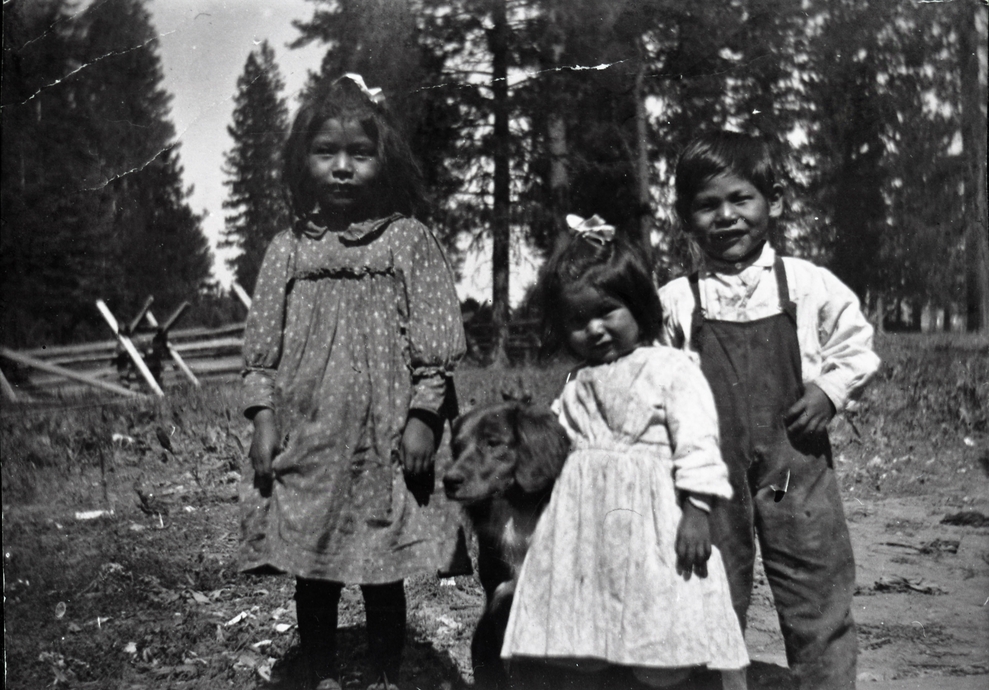
Native American Children and Dog, near Susanville, ca 1900 - From Sacramento Bee

This is good news for those who have wondered if we are the only culture in the historyof the world that buys our dogs presents at Christmas and Jackalope horns at Halloween.  Actually, we probably are.  Langenwalter, who has studied Indian burial sites dating to 1700 has not recovered any Jackalope horns, but he has found many other things of interest.  Native people and their dogs were often buried side by side, curled up in a sleeping position.  Dog graves were also marked with stone cairns. 

Early European observers noted the close relationship between native Californians and their dogs, and this is confirmed by Debra Grimes, a Miwok Indian, and cultural preservation specialist for her tribe.  Grimes agrees that dogs were historically buried as a member of the family, because they were.

I am reminded of a story I heard so long ago that I cannot even remember its source.  My best guess is that it is either a plains Indian legend or that it comes from the Pacific Northwest.

When the earth was young, humans and animals were natural allies, and the friendship of the animal tribes made us very powerful.  So powerful, in fact, that gods were worried.  (Even then we had a tendency to get too big for our britches).   The gods decided to separate the human and animal nations, so they opened a chasm between us in the earth.  From a small crack it grew deeper and wider, the animals on one side, people on the other.  At the very last possible moment, Dog jumped across the gap to stand with humans, and that is why dogs have been our special friend ever since.

Enjoy the article and wish the archaeologists well.  Who knows, they could find the Jackalope horns any day!

Deja-vue all over Again

Hydrogen bomb drill during the Cuban Missile Crisis

The Cuban Missile Crisis was one of the defining events of my generation’s childhood. On October 15, 1962, US spy-plane photos revealed installation of medium range Soviet nuclear missiles in Cuba.  President Kennedy ordered a naval blockade of the island – something very close to an act of war – and announced that any missile launched by Cuba would be regarded as an attack by the Soviet Union and would trigger full retaliation.  The world stood closer to the brink than it has before or after.

In grade schools all over the country, we had almost daily hydrogen bomb drills.  I was in the 5th or 6th grade, and there wasn’t one of my classmates who did not fully comprehend the absurdity of the exercise – be sure to cover your head with your hands in the event of a thermo-nuclear blast.  There was a lot of gallows humor.  The guy on the corner who dug a fallout shelter was branded a “f**king moron,” by the guy in our crowd who knew more exotic words than the rest.

I had already formulated my plan.  The papers said we’d have 20 minutes from the time the sirens went off until the first missiles struck.  I had timed myself, and knew I could run home in 8-10 minutes.  When the real alarm went off, I was going to bolt so I could die with my family and my dog.  I found additional consolation in an unlikely place.  I had a powerful transistor radio I would listen to under the covers.  Sometimes I could tune in a fundamentalist preacher in Bakersfield.  One night, quoting scripture to prove his point, he assured everyone that God had promised not to destroy humanity with a nuclear war.  I don’t remember his logic, but I do remember sleeping like a baby that night.

All this came to mind while reading of west coast fears of radiation from Japan.

I found myself wishing that preacher was still around.  I found myself also recalling my parents’ generation.  Maybe because the second world war was so close for them, they never pretended death was something you could avoid if you just managed things well enough.  Another thing that helped was all the scientific information that was published during the missile crisis.  Rather than seeming grisly, it was a comfort to know precisely what we’d be dealing with 10 or 20 or 50 miles from the blast.  Among other things, I learned that there wasn’t even the ghost of a chance that that kind of radiation could travel across an ocean.

Still, lack of credible information on what, precisely, we are dealing with, is sorely lacking now; critics of the government are right about that.

I was recalling something else I got from that preacher in Bakersfield – something I later heard other preachers confirm – that the most often repeated phrase in the New Testament is, “Fear not.”  Same thing in eastern religions; there is a hand gesture you see in pictures of Hindu and Tibetan deities that means, “Fear not.”  It looks like the Vulcan salute, (“Live long and prosper”).

It’s hard not to fear in the face of a scary unknown.  The tactics we used to cope when they ordered us to “duck and cover” under our desks won’t work anymore.  Still, when you listen to heroes they all seem to say the same thing:  they are “nobody special,” but at the critical moment, they were thinking of someone other than themselves and trying to do what they could.  That, in a seemingly small way – that maybe is a big way after all – is available to all of us.  We can give a few dollars and say a prayer for those who are suffering.  Feel free to click on the Red Cross link in the right column of this page or go to the organization of your choice.  It’s a far better use of money than buying Iodide pills.

The King’s Speech

I confess that despite the academy award nominations and four-star reviews, I wasn’t really looking forward to The King’s Speech.  In the back of my mind was the thought – “Come on – a full length movie about stuttering?”  The first two minutes of the film changed all that as the genius of Colin Firth and Helena Bonham-Carter pulled me into the pain this affliction brings to sufferers.  There are certain expressions you never forget in the movies, but I cannot recall such expressiveness, such anguish conveyed with so much restraint.  For an actor of the calibre of Firth, a glance or a momentary twist of the mouth can speak volumes.

Firth plays Prince Albert, the Duke of York, second son of King George V, and father of the current Queen Elizabeth.  As the film unfolds we glimpse the life-long pain “Bertie” has experienced – the badgering of his father and brother, and the failure he experiences at every “minor” address he cannot avoid.

Out of sheer desperation, Bertie seeks the help of Australian speech therapist, Lionel Logue (Geoffrey Rush) – and none too soon, for history is about to raise the stakes to a higher level than most of us ever have to experience.  His father’s death and his brother’s abdication leave Albert no choice but to ascend to the throne as King George IV.

“I am not a king, I am not a king,” Bertie cries again and again in the most moving scene of the film.  “I’m just a naval officer!”  But a king he must become in a hurry.  In the climactic scene of the film, he has to address his subjects all over the world when war breaks out with Germany.

Bertie and Logue on their long walk to the radio room made me think of Frodo and Sam on their final ascent to Mt. Doom, and why not?  Both are stories of people who feel completely inadequate to the demands of their fate, but who find the strength to act for their own salvation and that of their nation.  The difference, of course, is that these events really happened.

Indian Grinding Rocks State Park

Every year about this time, when the days are mostly rainy or foggy, I find myself drawn to Indian Grinding Rocks Park, a gem of a state historical park in the foothills, east of Sacramento, and about eight miles east of Jackson.  At 2400′,  the skies are often blue in January, and green shoots poking up through the brown grasses hint at spring.

Grinding Rock Mortar Holes

The Miwok people called the place Chaw’se, meaning “grinding rock,” and camped here in the fall to gather and process acorns.  There are 1185 mortar holes on soft slabs of limestone where year after year the women pounded acorns into flour and meal while the men hunted, to lay in supplies for winter.  Petroglyphs are carved on the mortar slab, though some of them, estimated at 2000-3000 years old, are becoming faint.

An excellent museum displays arts, crafts, tools, and California tribal history.  Native American teachers demonstrate crafts like basket weaving and flint knapping on the second saturday of most months.  Native people use the reconstructed roundhouse for ceremonies at various times of the year, with the largest, the Big Time, at the end of September.  For several days, acorn harvest time is celebrated with native food, crafts, storytelling, and public dances during the day.  Tribal members hold privae ceremonies at night.

Chaw’se Roundhouse Entrance

Going in January is a great way to shake off cabin fever and simply enjoy the little valley, although it’s too early to get the full benefit of one of my favorite parts of the park, a self-guided trail along the creek and up a hillside, with markers for 18 plants the Miwok used for medicinal and other purposes.  Nothing is in yet in bloom, so aside from tree-based medicines like willow bark, there is no chance for real recognition.

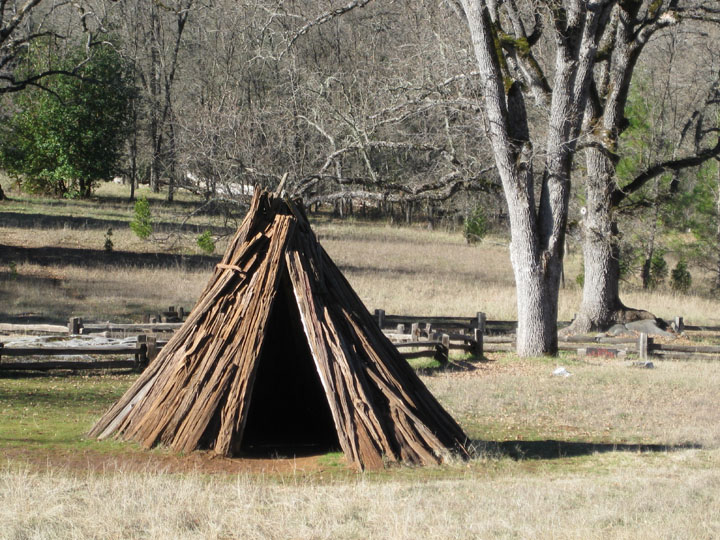
The park service has reconstructed the temporary bark structures the Miwok used during the acorn harvest.  A friend camped in one in the fall with a group of boy scouts and said the nights were really cold!

The elephant in the living room for all  California parks at this time is the impact of budget cuts in the wake of our fiscal crisis.  Hopefully Grinding Rocks, a living monument, will be spared from a dire  reduction of services, but anyone planning a visit, especially from far away, should call or check the website:   http://www.parks.ca.gov/default.asp?page_id=553

There are nice picnic facilities, but no concessions so you need to bring snacks at a minimum; the nearest town is three windy miles away.  A “primitive” campsite with 27 spaces overlooks the park; I’ve had friends drive up at the start of holiday weekends with no reservations and find room.

***

I have always found something compelling about winter in the California foothills, something plain or basic about the simplicity of sky, tree, and grass.  The abundance of foliage, humming insects – and crowds at a place like Chaw’se – will come later.  Now there is just the growing warmth of the winter sun, the voice of the wind, and a feeling of home that people have shared in this spot for thousands of years.