An Interlude with Mutant Chickens

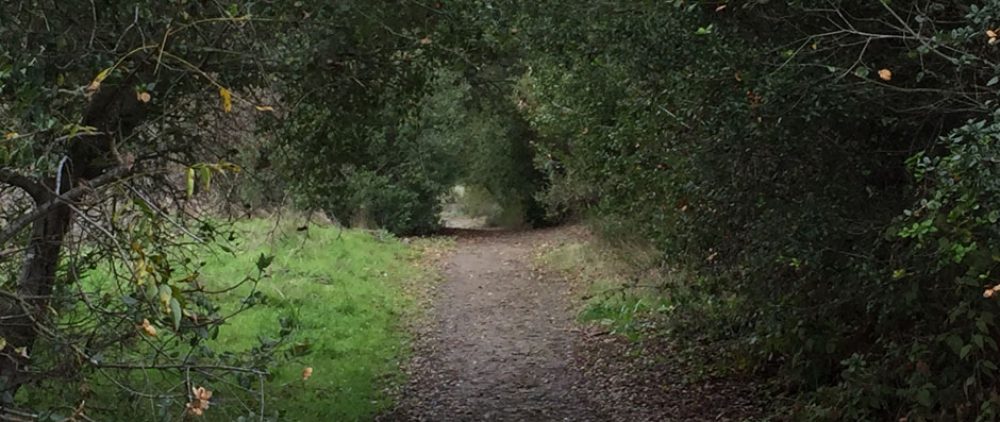
The other day, I took a break from literary activities to meet a friend in Fair Oaks Village for coffee.  Once upon a time, Fair Oaks was a farming community, separated by miles of fields and orchards from Sacramento.  Those days are gone, but there’s still something inviting about the town.  It’s slower than the boulevards and mini-malls that surround it, but not yet gentrified.  That may have something to do with the chickens, but I will get to that.

Fair Oaks Coffee Shop and Deli

So my friend were I are sitting at a table outside, having coffee and waxing eloquent on matters of great import, when I spotted a mutant chicken pecking at the pretzel I’d dropped on the sidewalk.  If you really pay attention, even normal chickens are sort of scary; you can understand the theory that they descend from dinosaurs.  Watch them run around, and you think of mini-velociraptors.  Yet chickens are the official Fair Oaks bird.  Herds of them run loose in town, and they are even featured on the town sign.

Once, when our dog, Holly, was younger, she jerked her leash out of my hand and took off after a chicken. By the time I caught her, thinking I was about to burst a lung, an irate citizen informed me that chickens are protected.  I believe I said something along the lines of, “Come on, Holly, we’ll hunt for dinner elsewhere.”

Fair Oaks is famous for chickens, and I have it on good authority that people throughout the region come here to dump their excess fowl.  What you have is a group of birds that interbreed, and every now and then you see a really demented one, who could play in a monster movie.  Such was the one who pecked at my feet the other day.  It had some kind of growth, like the extra head on the alien in Men In Black II.  I was so busy thinking of tetanus shots and keeping my feet out of its way, that I forgot the camera phone in my pocket and didn’t document the monster.   Today I went back with a real camera, and naturally all the chickens looked normal – or as normal as chickens can look.

Here’s the Fair Oaks chicken ideal:

Mural on the Fair Oaks, open air theater

And here’s the reality – chickens invading the public men’s room:

Employees must wash their hands before returning to work

The ideal – an idyllic shot in the town square
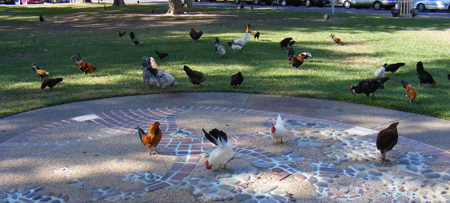
Don’t be fooled! Think of Alfred Hitchcock.

The real – high noon in roosterville.
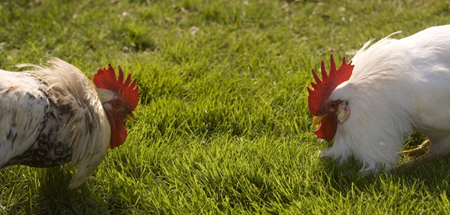
Go ahead – make my day.

And finally, here is the biggest Ideal Chicken of all – at the 2010, Fair Oaks Chicken Festival:

Has everyone had a chance to go, “Awwww?”  If you can make it, this year’s Chicken Festival will be held on September 17.  Feel free to bring the munchkins, but be ready to change the subject if they ask, “What’s for lunch?”  Last year, the featured item was barbecued chicken.  (I’m serious).

Have fun if you go.  I would never dream of saying anything on my blog about eating Big Bird, but I will be home that day eating tofu.  Probably with the shades drawn too, in case the mutant chicken knows where I live.

The Freedom Index

Actually, there is no Freedom Index, except in my possibly fevered imagination.  The idea came from reading the WordPress Daily Post, “What Does Freedom Mean?”  That’s a good question to think about.  It is very hard to answer, which makes it interesting.

All of the obvious answers lead you in circles.  Millions of people in these troubled times long for the freedom that work brings, but that reminds me of all the five dollar bills I tossed into lottery pools at work.  I’m guessing that nearly all working stiffs sometimes dream of winning the lottery and achieving that sort of freedom – even though lots of studies show that a year later, most winners are no higher on the Happiness Index (which really exists).

News reports are always full of threats to our freedom, often couched in words of blame for someone else.  Still, on a hypothetical Public Freedom Index, things could be a lot worse.    We can watch fireworks if we choose – or not, since we don’t have mandated public celebrations.  The explosions tonight will be for fun; we live free of the threat of real bombs.  We can can blog and tweet to our heart’s content, and Google on a staggering array of topics.

Personal Freedom is always a little more dicey.  We are still guaranteed “the pursuit of happiness,” but you have to wonder how most people would answer the Dr. Phil question:  “How’s that working for you?”

The Dalai Lama says all of us desire happiness and an end to suffering, but we really don’t know how to go about it.  Many of our choices lead to the opposite result.  Perhaps the freedom to ask – really ask – where our real happiness lies, is one of the greatest freedoms of all.  That and Freedom of Information which allows us to follow the trail where ever it leads.

Here is Buddhist blessing/prayer, known as The Four Immeasurables:

May all beings have happiness and the causes of happiness.
May all beings be free from suffering and the causes of suffering.
May all beings know the supreme happiness that is beyond suffering.
May all beings rest in equanimity, free from attachment and free from aversion.

Happy Fourth of July!

Father’s Day Musings

About ten years ago, a woman from the U.K. told me that in a British poll, Homer Simpson had been voted “the most influential living American.”  One thing hasn’t changed much over the last decade:  men don’t get a lot of respect in the popular media.  Best case, they come off as lovable though horny goofballs like Joey and Chandler on Friends.  Worst case they are portrayed as liars and nincompoops who couldn’t survive a day without the steadying hand of a woman.  Without Carl’s Jr. bacon cheeseburgers, some guys would starve.

If you believe the marketing experts who layout the Father’s Day advertising supplements, the male imagination is limited to Docker’s shorts, socket-wrench sets, wide-screen TV’s, and golf balls.

When I was in the first grade, my bus used to stop to drop off a boy at a corner then turn uphill toward my house a mile away.  One day that boy’s father shot himself; it was clearly accidental.  He was a WWII veteran who brought home a German luger, and as he was cleaning the gun, he forgot the round in the chamber.  The details were discussed all over the schoolyard and the kitchen table at home; how the man had tried to reach the telephone before he died.  I lay awake quite a few nights with this reminder of my father’s mortality.  I think of that boy every Father’s Day and wonder what thoughts he has.  It may be that no one appreciates a father as much as those who have lost or never had one.

Father’s Day is a nice time to celebrate the expressions of men’s generosity as they have appeared in our lives.  It’s a time to celebrate every man who ever told us, “You can do it,” and made us believe we could.

Missy’s Homecoming Day, aka, Valentine’s Day

I’ve always been something of a Valentine’s Day Scrooge – “Humbug!”  Always, even in fifth grade, while trying to decipher the nuances of the text on candy kisses enclosed in the envelopes during the school Valentine swap.

I’m not doctrinaire about it.  I always bring Mary a card and some little treat.  And it is marvelous to stop to be mindful of the love and friendships we enjoy.  I’m just not a fan of Hallmark holidays.  It’s hard not to be a bit cynical when the hearts come out the last week of December, during the Christmas closeout sales.

Much of that cynicism ended two years ago, on Saturday, February 14, 2009, at noon.  Mary had spent the morning at Saint Francis Episcopal church.  Like their namesake, the good people there have a serious ministry with animals.  They rescue dogs and train them as companion and service animals for vets coming home from our wars.

Mary called to tell me an eight month old papillon had washed out of the program.  The little thing been mistreated or neglected, for she was much too hyper and skittish to make any kind of service training feasible.  “She is really sweet,” Mary said.  My wife later confessed that she was counting on me to be the voice of reason, and tell her to get real.  Didn’t happen!

Instead, I leashed up our other two dogs and took them over to meet Missy.  It was instant bonding, all around.  Humans and canines instantly warmed up to the little one, and she to us.  Thankfully, neither Mary nor I had any clue how much harder three dogs are to care for than two!  Missy was part of the family and we took her home within the hour.

Now Valentine’s day will forever have a face, one far more appealing than any stupid, rosy-cheeked cupid.  The hearts of people and animals do not seem to have any limits for how much love they can hold.  At this very moment I’m gazing at Missy curled up at my feet – one of the biggest hearts in one of the smallest beings I have ever had the joy of including in my life.

Missy

Happy Imbolc, St. Brigid’s Day, Candlemas, Groundhog Day.

Our Celtic ancestors marked the changing seasons not by solstice and equinox days, which divide the year into quarters, but with the “cross-quarter days” which fall between the astronomical events.  Seasons figured in this way more closely match our experience in the northern temperate zones.  Winter begins at Samhaim (Halloween) and ends on Imbolc, the first day of spring, February 2.  Imbolc or Oimelc are Gaelic words that refer to the lactation of ewes.  Through most of the British Isles, February was bitterly cold, yet it was also the time when lambs were born and shoots of green grass appeared, events that were heralds of new life and a new year.   http://www.chalicecentre.net/imbolc.htm

This time of year was celebrated in the British isles for at least 3,000 years, the age of several megalithic stone circles in Ireland oriented toward the positions of the sun on Samhain and Imbolc http://en.wikipedia.org/wiki/Imbolc.  The people who raised the standing stones were as remote from the Celts as the Celts are from us:  we can only speculate on their motives and the meaning the day had for them.  And even though the word, Imbolc was used in the middle ages in Ireland and Scotland, who and what the Celts celebrated isn’t certain.  The earliest written records of Celtic cosmology come from Julius Ceasar’s commentary on the Gallic War, 51-52 BCE, in which Celtic beliefs are filtered through the Roman perspective.

Even so – even if our stock of “Celtic lore” dates from the 19th century on, when a revival of interest began (think of pre-Raphealite painting and William Morris’ craft movement), that does not mean it is not “authentic.”  When Yeats tramped around Ireland at the turn of the century gathering fairy lore, some of his informants lived such remote lives that they only spoke Gaelic.  How far back can such an oral tradition go?  Pretty far according to most folklorists.

At Imbolc, the maiden goddess, Brigid or Bride supplants the Cailleach, the hag of winter.  Brigid is the goddess of healing, poetry, and smithcraft.  And fire and divination and wisdom and childbirth.  As patron of healing she presides over numerous sacred wells in Ireland and in Britain (where they were renamed for Minerva by the Romans).  To this day, people extinguish old fires and light new ones for the coming year in her honor.

Brigid the goddess was supplanted by Brigid the saint in the Christain era, where she was revered as, “the Mary of the Gaels.”  Numerous miracle stories surround her life.  When just an infant, neighbors saw a fire burning at her house that rose to the heavens.  http://www.brighid.org.uk/saint.html.   Though a beautiful woman, Brigid renounced marriage to found dual monastic communities at Cill Dara, now Kildaire, in Ireland.  The nuns tended a sacred flame that burned continuously until the reformation, except for a brief 13th century inteval where a bishop had it extinguished for being too pagan.

Brigid and children, Kildaire, Ireland, copyright, brigid.org.uk

February 2 has long been celebrated by Christians as Candlemas.  The early church was not the least bit shy about superimposing new festivals over earlier pagan rites.  This day celebrates the Presentation of Jesus at the temple and the purification of the Virgin Mary.  The association of the day with candles comes from the passage where Simeon, an aged seer, recognizes Jesus and proclaims him as “a light for revelation.”  (Luke 2:21).  One website that explores correspondences between Christian and pagan festivals notes that the association of fire or light with this date is widespread through Europe.  In ancient Armenia, Feb. 2 was sacred to Mihr, the god of fire.  http://www.schooloftheseasons.com/candlemas.html

Of course no discussion of February 2 would be complete without a reference to Groundhog day, although locally, the staff at the Folsom City Zoo Sanctuary points out that groundhogs are not native to the American west.  Here we celebrate Prairie Dog Day.

"Don't drive angry!"

There is also an old Celtic tale involving the Cailleach that explains the importance of weather on Feb. 2.

Legend has it that if she intends to make the winter last a good while longer, she will make sure the weather on Imbolc is bright and sunny, so she can gather plenty of firewood. Therefore, people are generally relieved if Imbolc is a day of foul weather, as it means the Cailleach is asleep and winter is almost over. (see the Wikipedia link above.)

***

I don’t keep sheep, but the signs of spring are everywhere. It’s light out at 5:00pm. The sap from the liquid amber tree takes a nightly dump on my car and I swear every year at this time to dig out our car-cover. The buds on the apple tree are a bit late but I expect them any day now. Strangely, pruning the apple tree is one of those rituals of super-bowl sunday I always enjoy.  The super-bowl itself is like the closing rite of winter – after this I won’t want to spend an entire sunday afternoon indoors. In two weeks the almond and walnut trees will be covered with blooms that look like snow when they fall.  Our brown hills will turn emerald green for a month or so.

May everyone have a happy Imbolc and bask in the promise of the return of light and warmth to the earth.

They Say It’s Your Birthday

That’s right. January 22. Just over the cusp of Aquarius.  Old enough to know who Eddie Haskel was (see previous post).  Old enough to take the title for this post from a Beatles song.  Old enough that I was in Jr. High (they didn’t call it middle school then) when the Beatles played Ed Sullivan.

I am interested in Tibetan astrology and discovered there is some disagreement about where January birthdays fall in the scheme of the zodiacal year; the Tibetan new year is in February, but half the web sites and a friend who is a dedicated student of all things Tibetan say the astrological year begins at the winter solstice. That would make me an Iron Tiger. The prognosis for 2011 is not encouraging: one online site says, if you survive 2011, you will enter a run of good fortune. How’s that for good news/bad news? The same site suggests taking a retreat for the rest of the year, and urges caution around sharp tools.  Let’s just say we’re running low on firewood because I haven’t hauled out the chain saw in the last few weeks.

But in the forward looking department, I just put an official tag on this blog for the WordPress Post-a-week 2011 challenge. I saw this way back at the start of January, and figured, “Oh yeah, I’m gonna do that anyway, so I don’t need to be formal about it.”  Rereading the challenge, I realized there is a real stand-up-and-be-counted aspect to being formal about it, so I’m in.

So here’s to a year of surviving and thriving, and at least a post a week to document it!

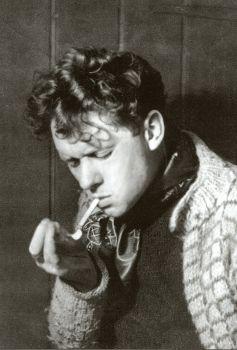
A Child’s Christmas in Wales by Dylan Thomas

My best friend gave me Dylan Thomas’ incredible prose poem back in high school. In whatever form – which now include recordings and at least one TV adaptation – it has been a part of every Christmas since then. I pass it on now, with best wishes for the holiday:

One Christmas was so much like another, in those years around the sea-town corner now and out of all sound except the distant speaking of the voices I sometimes hear a moment before sleep, that I can never remember whether it snowed for six days and six nights when I was twelve or whether it snowed for twelve days and twelve nights when I was six……

http://www.bfsmedia.com/MAS/Dylan/Christmas.html

Dylan Thomas

…Always on Christmas night there was music. An uncle played the fiddle, a cousin sang “Cherry Ripe,” and another uncle sang “Drake’s Drum.” It was very warm in the little house. Auntie Hannah, who had got on to the parsnip wine, sang a song about Bleeding Hearts and Death, and then another in which she said her heart was like a Bird’s Nest; and then everybody laughed again; and then I went to bed. Looking through my bedroom window, out into the moonlight and the unending smoke-colored snow, I could see the lights in the windows of all the other houses on our hill and hear the music rising from them up the long, steady falling night. I turned the gas down, I got into bed. I said some words to the close and holy darkness, and then I slept.


The King is Dead; Long Live the King!

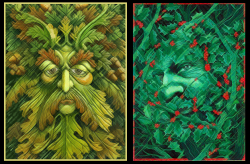
The Oak King and the Holly King

As predicted by Las Vegas odds-makers, the Oak King scored a narrow victory today over his twin brother, the Holly King. The Winter Queen is reportedly in mourning, though she is expected to emerge – as she has since time began – in her guise as the Spring Maiden, on or about February 2, (aka, Imbolc, Candlemas, St. Brighid’s Day) to take her place beside the new reigning monarch. At least that is the story the old Britons told to explain how the darkest day of the year hides the seed of summer, and why the Winter King is likely to win the scheduled rematch on June 21.

Winter Solstice: the default explanation

Though I cannot prove it, I’ve always believed this tale of eternally battling twins must have gone into the making of the black-on-the-left vs. black-on-the-right episode of Star Trek.

Is this a real legend – one the Celts and Saxons actually told?   Robert Graves said as much in The White Goddess, suggesting that Balin and Balan, as well as Gawain and the Green Knight represent the eternally dueling pair in Arthurian legend.  Sir James Frazer’s earlier Golden Bough had a similar section entitled “The Battle of Summer and Winter,” although he told the story with only one eternally dying and reborn Divine King.

The Oak and Holly kings battle at a 2005 Winter Solstice ritual. Photo by Anderida Gorsedds.

Whatever you may think of the story, now that the solstice has arrived, may you stay warm and dry, and bask in the confidence that summer is coming around again.