What is your quest?

Monty Python fans will recognize my title as a reference to Monty Python and the Holy Grail, a hilarious movie which is available on Netflix. Hero tales sometimes include riddles that must be solved or questions that must be answered in order to proceed. In Monty Python’s take on the Arthurian legend, the questions are: “What is your name? What is your quest? What is the airspeed velocity of an unladen swallow?”

On a more serious note…

The idea I want to discuss is that each soul comes into this world with with a purpose which is forgotten at birth and must be remembered for that life to be successful. This is an ancient notion that has appeared in written and oral form for millennia. We find the theme, with variations, in such places as “The Myth of Er” in Plato’s Republic, in The Silver Chair, one of C.S. Lewis’s Narnia Tales, and in James Hillman’s The Soul’s Code, the only one of his many books that became a bestseller.

The idea of such personal destinies came to mind recently as I watched a video by Michael Meade, a storyteller, mythologist, and former colleague of Hillman. He retold an African tale about souls in the Otherworld watching events on earth. When they are drawn to a particular place, situation, or family, they travel with a personal spirit guide to the place of birth. The guide is born with them, as an inner guardian, who will help that soul remember why it chose to be born, as it always forgets when it enters a womb.

In The Soul’s Code, Hillman proposes an “acorn theory” of human development, which he explains is more like a myth than a psychological axiom. As an acorn contains the pattern for the oak tree it will become if circumstances permit, so a child comes into this world with a destiny or “sense of fate.”

It’s important to note that in the first chapter of The Soul’s Code, Hillman explicitly says the book is not addressing questions of “the meaning of life…or a philosophy of religious faith…But it does speak to the feelings that there is a reason my unique person is here and that there are things I must attend to beyond the daily round.”

In an interview first published in 1998 and republished after his death in 2011, Hillman said of his acorn theory, “The same myth can be found in the kabbalah. The Mormons have it. The West Africans have it. The Hindus and the Buddhists have it in different ways — they tie it more to reincarnation and karma, but you still come into the world with a particular destiny. Native Americans have it very strongly. So all these cultures all over the world have this basic understanding of human existence. Only American psychology doesn’t have it.”

Hillman gives several examples of the difference between his “acorn theory” and the psychological theory of “compensation.” He mentions Manolete (1917-1947), a famous Spanish bullfighter who, as a child, was frail, shy, and “clung so tightly to his mothers apron strings” that even his sisters teased him. Traditional psychological theory would posit that he chose a macho profession to compensate for being a mama’s boy. Hillman turns that argument around. What if a dim awareness of his destiny was present during Manolete’s childhood (his acorn years)? No little boy could handle the intimation of facing charging, thousand pound bulls, so of course he stayed close to his mother!

Hillman never pretends to have a complete set of answers, especially to troubling questions like the origin of “bad seeds,” like Hitler, Manson, or serial killers. Hillman is also cautious of any formulation that would single out kids who are “troublemakers,” noting that Truman Capote was viewed as an “impossible child.”

Meade and Hillman are both concerned with how “ordinary” people find their inner calling, those of us who don’t begin to play the piano or chess at the age of four. Hillman said the “first step is to realize that each of us has such a thing [as a calling]. He then suggests we review our lives, looking especially at “coincidences” or “some of the accidents and curiosities and oddities and troubles and sicknesses and begin to see more in those things than we saw before. It raises questions, so that when peculiar little accidents happen, you ask whether there is something else at work in your life.”

One lifelong thread for me began in childhood, though I would only begin to understand its import years later.

I spent my first nine years in a semi-rural area, with trees to climb, woods to explore, and apples to snitch from the orchard of a farmer who lived over the hill. When my family moved to a quarter acre lot in a suburban California, it often felt claustrophobic. One late afternoon, after everyone had gone home, some impulse led me back to the schoolyard. I lay on my back in the grass of a baseball field and gazed into the clear sky. I don’t know how long I was there, but I didn’t want to get up. When I did, I experienced a refreshing sense of spaciousness and peace.

Several times over the years, at critical moments, I found that same peace and renewal in gazing into the sky, but it was only during the last decade that I learned from a Tibetan lama that sky gazing is a classic meditation practice, often used to teach students “the nature of mind” (clear, like the sky, and unaffected by passing “mental events,” just as the sky is not affected by clouds, rain, or smoke). Such practices became central during the second half of my life.

For both Hillman and Meade, the royal road to understanding and finding our deeper purpose is imagination, and with it, the willingness to listen to the “small” thoughts or impulses we often ignore. Like Joseph Campbell and the first generation Jungians before them, they both look to traditional stories, legends, and myths as means to unlock clues that are hidden within.

Finding our authentic selves, for our own good and the good of a world in transition is a key theme on Michael Meade’s website, Mosaic Voices, where he regularly presents writings, online workshops and podcasts that discuss this and related topics. (He’s presenting a free talk tomorrow, July 13, with a video available afterward – I have no personal stake in this, other than interest).

The consequences of ignoring inner promptings to discover our own authenticity can be devastating. In 1998 Hillman said:

“I think our entire civilization exemplifies that danger. People are itchy and lost and bored and quick to jump at any fix…They have been deprived of the sense that there is something else in life, some purpose that has come with them into the world.”

If this observation, made 25 years ago was relevant then, how much more it is now!!

Reflections on Soul and Soul Loss

Down the Rabbit Hole by Kbetart, CC BY NC-ND 2.0

One morning in the fall of 2021, as Mary and I walked the dogs in a nearby park, we turned a corner, and at the other end of a parking lot, saw several police cruisers pulled up next to a pickup truck with a camper shell. The area was cordoned off with caution tape. The pickup was there almost every morning, so although we had never seen or spoken to the owner, we assumed it was one of the homeless men who spend their nights in the park. We chose another path to continue our walk, and I remember thinking that it seemed like a lot of police to bust a guy for sleeping in his car.

The next day we learned the man had hanged himself from the tree next to his truck.

It’s impossible to grasp the full extent of suffering and the death toll of the pandemic years, and just as the world did after the 1918-19 pandemic, we seem hell bent on trying to act like things are back to normal, but out of all the statistical and personal losses, this man’s death continues to haunt me. Potentially, there was help nearby if he had been able to reach out. There’s a megachurch, with various outreach programs, visible from the place where he died. A twelve-step group met several days a week that year in the park near the spot where he parked. Other homeless people sometimes gathered in the evenings for company or to share a pizza, but this man he never seemed to have joined them.

Most of us know what it’s like to get stuck in a dark place, where there doesn’t seem to be any way out. Most of us might also agree that the culture, the nation, the world are in a parallel state. In earlier times, in shamanic cultures, “soul loss” was the diagnosis for conditions we now call Anxiety Disorders, Dissociative Disorders, PTSD, and in general, the feeling of being “outside oneself,” “beside oneself,” or “not all there.”

But what kind of soul is it that can be lost and found? This has been a world-wide concern of shamans, spiritual seekers, and poets for millennia and has resurfaced for modern psychotherapists like Carl Jung and James Hillman.

Soul eludes precise definition, though I suspect everyone has a sense of it. Somehow it relates to depth, to intensity, to vibrant experience. Contact with soul, for an individual or a group, involves a sense of connection to an inner wisdom, an inner compass, like touching “the still point in the turning world,” to borrow Eliot’s phrase. To be out of contact with soul was reflected in a line from Yeats, “Things fall apart; the centre cannot hold.”

At the end of 2016, a lot of people in the Bay Area were upset by the election of Donald Trump. I was invited to a two day soul-retrieval ceremony in the Bon Tradition of Tibet, which dates back thousands of years and has shamanic roots. Tenzin Wangyal Rinpoche, a contemporary Bon meditation master, wrote that “In the context of the Bon soul-retrieval practice, the soul…is understood as the balance of the subtle energies and related qualities of the five elements: earth, water, fire, air, and space.”

At the end of the second day, the presiding lama performed a traditional test of this ceremony’s success. The result was about 50% effective, and that’s what it felt like subjectively – nothing had really changed. I found the result disappointing though not surprising. The ceremony grew from indigenous roots, among a people who shared the same consensus reality, a condition that no longer exists in America, where it feels like our 20th worldview is gone and the future is not yet in sight. Also, regardless of our conscious beliefs, at deeper levels, we are steeped in the imagery of our native culture, and other iconography, no matter how attractive, remains more distant. As Garrison Keeler once quipped, “In Minnesota, even the atheists are Lutherans because it’s a Lutheran God they don’t believe in.”

Joseph Campbell wrote extensively of the Grail Legends, which became popular in Europe during the liminal time between the dissolution of the medieval world and the emergence of the Renaissance. The mysterious Grail, which could heal individuals, the kingdom, and the land, was something mystical, sometimes imagined as the cup of the last supper, and at other times, as a stone, like the philosopher’s stone of alchemy. A key feature for Campbell was that every seeker of the Grail had to enter the wilderness alone.

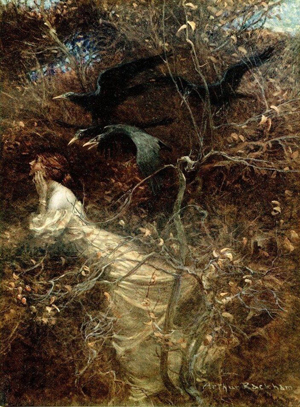
“Haunted Wood” by Arthur Rackham. Public Domain

In the Grail stories, a single hero (in some versions, Galahad, in others, Parsifal) finds the sacred object which redeems the kingdom and the king. No single hero or culture or nation can solve the issues as complex as those which confront the entire planet during our time of cultural dissolution. Solutions that seemed to work in the past are the very source of the problems that face us now.

Like it or not, every individual now living has the choice of clinging to nostalgic fantasies of an imagined idillic past, or of looking within to see what our individual soul and the soul of the world need from us now. The time of the winter solstice and the New Year is conducive to such reflections. “Peace and an hour’s time” are needed for creativity, according to photographer, Edward Weston, though he admitted that neither are easy to attain. How to get there is worth reflection as the new year dawns, and worth considering in the new year at greater length here.

Meanwhile I wish you all Happy New Year, with peace and time to enjoy it.

The Mendocino Coast Botanical Gardens

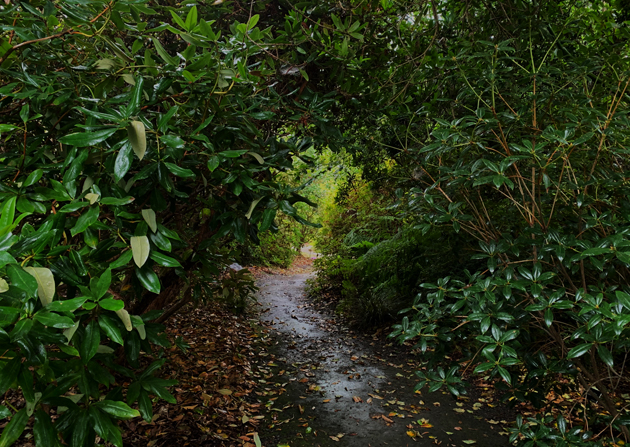
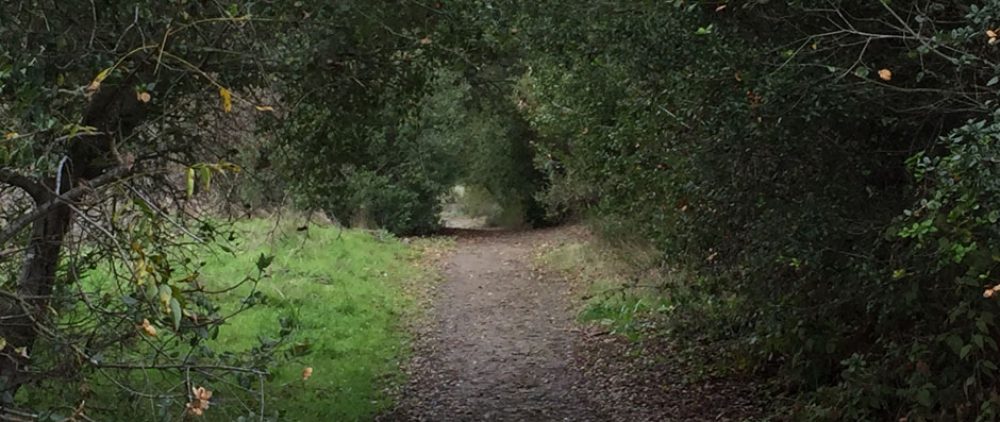
Path through the Woodland Garden

“For me beauty is the primary proof of the existence of God. Beauty is sublime, transcendent, and fulfilling. It takes us to the very edge of our capacity for knowledge…The world considered without its beauty is a world perceived without its God.” – Thomas Moore

“You must protest, you must protest, it is your diamond duty; ah but in such an ugly time, the true protest is beauty.” – Phil Ochs

James Hillman often railed against psychology’s “medicinal complex.” He looked to Greece and the Renaissance for inspiration as he championed a psychology of soul, image, and eros, in which “the primary value is beauty,” (A Blue Fire). A lack of beauty is pathological, he said, both in the lives of individuals and cultures. I thought of this often during this seemingly unending summer, with its record heat, smoke from another disastrous fire season, and a resurgent pandemic, set against a backdrop of too much traffic, too many angry drivers, and too many miles of billboards and decaying strip malls. For those, and other reasons, in mid-September, we set out for the coast, which we hadn’t visited since 2018.

Begonia Pavillion

Two days before we left, the temperature hit 106, so the 60 degree days alone would have made the trip worthwhile, but there was more than just a preview of fall in Fort Bragg, where we hadn’t stayed before. There were independent restaurants, coffee shops, a marine museum and the Skunk Train terminal, in the “downtown” area along the coastal highway. A few blocks away, wide streets and and quiet neighborhoods invited evening walks in glow of the coastal evening light. But the real surprise and most inspiring feature of the trip was the Mendocino County Botanical Gardens, just a few miles south of Fort Bragg www.gardenbythe sea.org.

We spent portions of two days at the gardens, which was only enough time to begin to explore, but that didn’t really matter. When a place mirrors the landscape of the soul, feeling like home on a deep level, it’s enough to just be there, and rest, and pay attention, letting the sense of presence arise.

“The flowers had the look of flowers that are looked at.” – T.S. Eliot

In the Dahlia Garden

Multiple paths meander through multiple groves, gardens, and open spaces, opening onto new vistas a every turn. Huge old trees bend and twist as if synchronized to the smaller plants that surround the trunks.

I’ve always enjoyed Japanese gardens, which blend the natural world with design and draw us into stillness. Here, there’s a wildness at the center of the garden designs, like an echo of the wildness of the ocean. The result is to draw us into wonder.

Memorial benches border the paths, with small plaques given by families of people who loved or supported or worked on these gardens. What a wonderful tribute that seems as one sits, surrounded by the beauty of the place they helped to create!

“The soul is born in beauty and feeds on beauty, requires beauty for its life.” – James Hillman

It rained the second day we went to the gardens, but everyone there seemed to enjoy it, both those who live on the coast and those, like us, visiting from inland. The clouds and rain added an extra shimmer to the foliage.

These gardens are an inspiring place to visit if you get a chance to visit the Mendocino coast. They brought to mind at least one similar feature near home that I haven’t explored in some time, and must get back to. Tt was also rewarding to pot several of the succulents we brought home. Just a small thing, but nothing that feeds the soul is ever too small.

At Year’s End

Winter sun and shadow on the back fence

A week or so ago, at noon, I was sitting on the back porch, gazing at the sky. I was dressed warmly for it was 50 degrees and windy, which is cold if you live in a hot climate. Suddenly – and this made no sense – I heard the distinctive jingle of an ice cream truck. Stephen King came to mind, and I imagined a truck full of killer clowns. It has been that kind of year.

King himself has tweeted that nothing he’s written is as scary as 2020 has been. To be precise, he said nothing he’s written “is as frightening as the current administration,” which is to state more clearly what has made America the epicenter of many of the horrors the world has endured this year.

My father was born exactly 100 years ago, on December 31, 1920. As I sat on the porch this afternoon, on another chilly day, I was thankful that he didn’t live to see this year. Then a pleasant memory came to mind. Continue reading

The Social Dilemma: A Movie Review.

The Social Dilemma, released on Netflix on September 9, is a comprehensive evaluation of the dark side of social media, by some of the senior engineers who designed the underpinnings of these systems:

What is your history with social media?

I started this blog in the summer of 2010, after attending a seminar presented by the California Writer’s Club. I learned about “clickbait” from the blogger who led the session, who made his living managing eight blogs, and drew 50,000 – 80,000 hits a month. He used Twitter and Facebook to extend the reach of his blogs.

Fortunately, I didn’t have to hustle a profit from blogging, but I did take to social media to further publicize each post. For five years, I used it for little else.That changed in 2015, during the presidential election season and has only accelerated during our nation’s and the world’s accelerating disasters.

When I worked in the tech industry, we constantly had to think in terms of “cost vs. benefit.” By the start of this year, the benefit I received from social media was maybe ten percent – about the percentage of non-political and non-end-is-near posts my newsfeed provides. Continue reading

A Contemplation of Heroes, Toilet Paper, John Wayne, and John Ford.

Paramahansa Yogananda told a story of two families, one Hindu and one Muslim, who were neighbors during the violence that preceded Indian independence in the late 1940’s. Food was scarce due to rioting, but the mother of the Hindu family got hold of a bag of rice. When she realized her neighbors had nothing to eat, she took half the rice to the Muslim family before lighting her own stove. When we were young, many of us aspired to that kind of heroism. Now we hoard toilet paper.

In all fairness, this is a manufactured crisis, driven by our online yellow press with so many pictures of empty paper good shelves that anyone paying attention might conclude that they better get some extra. But the TP story brings up one of our culture’s major living room elephants – our worship of individualism. Me first. I gotta be me. Do your own thing.

When I studied counseling psychology, we had a unit on “cross-cultural differences,” to learn not to project our biases onto people from other cultures or sub-cultures where identity rests as much on family and community membership as it does on our northern European focus on individuation. Without such training, we would have been ready to put labels like “enmeshed” and “codependent” on anyone who didn’t regard “self-development” as the pinnacle of psychological development.

Fun Fact: The Diagnostic and Statistical Manual of Mental Disorders, the DSM, the bible of mental health or its lack in our culture grew out of a study commissioned by the Marine Corps after WWI. They sought a personality test to filter out those who were most at risk of shell shock. In other words, our mental health norms in this country  are based on the attributes of a good combat soldier. Think about that for a while… Continue reading

James Hillman – on Changing the Object of our Desire

Watching this video in which Hillman so clearly shines a light on the core issues of so many of our current crises, it is hard to realize he left us 2011. It makes what so often passes for journalism and analysis of events seem trivial…

Soul Notes 5: From a Nobel Laureate in Literature

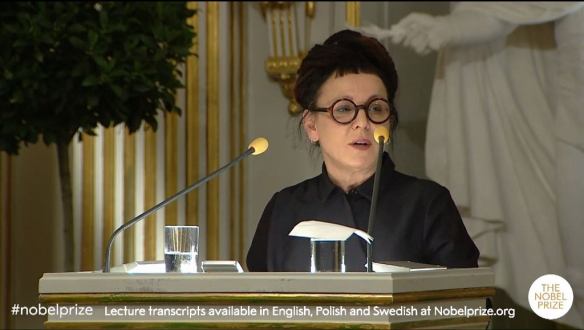
Olga Tokarczuk Nobel Prize Lecture, Dec. 7, 2019

Olga Tokarczuk, born January 29, 1962 in Sulechów, Poland, won the 2018 Nobel Prize in Literature. She received her prize this year, and yesterday, delivered her Nobel Lecture in Stockholm.

All who have been following these Soul Notes will appreciate what she has to say, for her eye and heart register mysteries in places and situations we often take for granted. In tuning the radio in her childhood home, she says, “I believed that through this radio different solar systems and galaxies were speaking to me, crackling and warbling and sending me important information, and yet I was unable to decipher it.”

She tells how an old photograph of her mother led her to find find within herself, “something once known as a soul, thereby furnishing me with the world’s greatest tender narrator.” Later she she says more about what she means by tenderness. “Tenderness is spontaneous and disinterested; it goes far beyond empathetic fellow feeling. Instead it is the conscious, though perhaps slightly melancholy, common sharing of fate. Tenderness is deep emotional concern about another being, its fragility, its unique nature, and its lack of immunity to suffering and the effects of time.”

I was especially struck by this passage in which she captures the difficulty of trying to describe today’s world and possible futures with an earlier era’s language and imagery, which are proving inadequate to the task:

“Today our problem lies—it seems—in the fact that we do not yet have ready narratives not only for the future, but even for a concrete now, for the ultra-rapid transformations of today’s world. We lack the language, we lack the points of view, the metaphors, the myths and new fables. Yet we do see frequent attempts to harness rusty, anachronistic narratives that cannot fit the future to imaginaries of the future, no doubt on the assumption that an old something is better than a new nothing, or trying in this way to deal with the limitations of our own horizons. In a word, we lack new ways of telling the story of the world.”

Phrased in that manner, the simple effort to imagine and speak of where we find ourselves today becomes a soul issue. As her mother told her, just as we often miss things that are gone, it’s possible to miss things that haven’t arrived yet.

This is a dense lecture, filled with wise observation and speculation, that I expect to read again and again.