A Fake World

“All that we see or seem is but a dream within a dream.” – Edgar Allen Poe

The world’s spiritual traditions tend to agree with these words Poe wrote in 1849, the year of his death. To Hindus, this world is “maya,” meaning “a magic show, an illusion where things appear to be present but are not what they seem.” (1)

Buddhists call it “samsara,” a Sanskrit word for “wandering through, flowing on, aimless and directionless wandering,” signifying the involuntary cycle of death and rebirth that continues until we grasp the true nature of appearances (2).

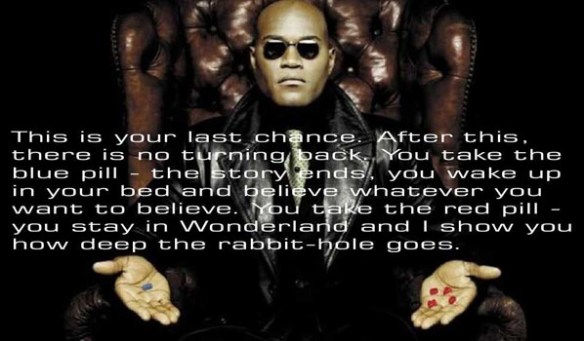
Jesus warned his followers that this is not the place to store up riches. In 1999, the Matrix reframed the appearance/reality question for the twenty-first century.

Being spiritual, doesn’t give anyone a pass on consensus reality. As Ram Dass put it, “We have to remember our Buddha nature and our social security number.” 

Navigating samsara has never been easy. Truth is hard enough to discover when we are sincere, let alone when we are not. That’s one reason why Buddha placed a special emphasis on truth as a core value. Not lying was one of his Five Precepts. He said, “When anyone feels no shame in telling a deliberate lie, there is no evil, I tell you, they will not do” (3). Continue reading

Notes from 2017 – The Hollow Crown

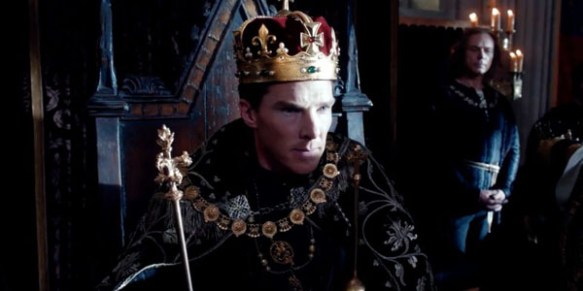
Benedict Cumberbatch as Richard III in PBS series, "The Hollow Crown."

Benedict Cumberbatch as Richard III in PBS series, “The Hollow Crown.”

I invite everyone to look at the magnificent productions of three of Shakespeare’s histories on PBS, on a series entitled, The Hollow Crown: The Wars of the Roses.

I’ll have more of to say on this in days ahead, for it bears directly on the stuff of our current and recent headlines – people who desperately quest for temporal power, but that can wait, because right now, and only for a while, you can watch the full movies online!

Watch these – they are great productions with star-studded casts!.

Henry VI, Part 1 – expires Jan 3, 2017.

Henry VI, Part 2 – expires Jan 10, 2017

Richard III – expires Jan 17, 2017

Enjoy, and make a contribution to PBS if you do!

Hell or High Water: a movie review

Ben Foster and Chris Pine in “Hell or High Water’

Hell or High Water came out last summer. It ran only briefly in one local theater, so I finally caught it on iTunes yesterday.  I’d planed to see it since reading an editorial that claimed Hell or High Water captured the mood of the country – at least the country between the coasts – better than any of the volumes of election year analyses.

Watching it, I remembered another great movie of hard times, Tender Mercies, 1983, but that was a film of redemption. There’s no redemption in Hell or High Water, just dry laughter at desperate measures aimed at overcoming desperate circumstance. “There’ll be no peace,” Jeff Bridges tells Pine in the closing scene. “This will  haunt you all the rest of your days. And me too.”

Two brothers, Toby (Chris Pine), a divorced father, and Tanner (Ben Foster), an ex-convict, begin robbing branches of the Texas Midland Bank. Their mother died owing the bank $32,000 and back taxes after taking out a reverse-mortgage to save her failing cattle ranch. When oil is discovered on the land, the bank issues a foreclosure notice. Toby and Tanner set out to steal money from the bank to redeem the mortgage it holds.

The robberies are too small to interest the FBI, so Texas Rangers, Marcus (Jeff Bridges)  and Alberto (Gil Birmingham) are assigned to the case. On the trail of the brothers, Alberto tells Marcus, “A hundred and fifty years ago, your great grandparents stole this country from my people. Now the banks are stealing it from you.”

Alberto’s ambivalence is mirrored by other people the rangers and the brothers encounter on their way to the inevitable showdown. Toby leaves a cafe waitress a $200 tip with stolen money. When the rangers arrive and demand the bills to check for fingerprints, the waitress says, “Get a damn warrant. This is half of a month’s mortgage. All I care about is keeping a roof over my daughter’s head.”

This is a country where hope for anything more than survival is missing. Thirty years ago, Tender Mercies showed Robert Duvall’s redemption from alchohol through the power of love and faith. In Hell or High Water, the only love is fast sex after a winning night at an Indian casino. The only reference to faith is Bridges’ comments on a TV evangelist – “He wouldn’t know God if God crawled up his pant leg and bit his pecker.”

Hell or High Water is not a depressing movie; it’s a sad movie. There’s a difference. The lonesome beauty of the land mirrors the towns that are falling apart, while the soundtrack, with songs from artists like Townes Van Zandt and Ray Wiley Hubbard, echoes the mood. Bridges’ world weary humor, and the brothers’ awareness of the irony of robbing the bank to pay the bank give us humor and moments of laughter even as a darker story unfolds.

Movies set in rural Texas have long depicted dying towns and troubled times. Think of The Last Picture Show, 1971, or No Country for Old Men, 2007. This one is filled with more topical references than any of the others. In one scene, the rangers stop as a couple of cowboys drive a small herd of cattle across the blacktop, fleeing a prairie fire that paints the sky an ugly black behind them. “It’s the 21st century,” one of the cowboys tells Bridges, “No wonder my kid doesn’t wanna do this shit!”

I’m not sure a single a single political pundit has captured as accurately the reasons this country voted the way it did in the recent election. At the same time, there’s a power in this movie I think will endure beyond any socio-economic circumstance. As Jeff Bridges character puts it, I think it will haunt the viewer for a long time.
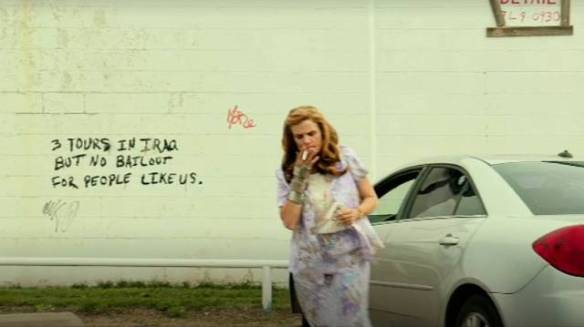
hell-or-high-water-graffiti

R.I.P. Professor Snape

Alan Rickman as Severus Snape. Creative Commons

Alan Rickman as Severus Snape. Creative Commons

We’ve lost another British luminary to cancer at the too-young age of 69.

Alan Rickman, whom Harry Potter fans remember as the tortured and acerbic Professor of Potions, is gone.  Tributes have poured into social media sites from those who knew and worked with him.

Daniel Radcliffe, who played Harry, wrote “As an actor he was one of the first of the adults on Potter to treat me like a peer rather than a child.”

J.K. Rowling offered a tribute, and Emma Watson, who played Hermione said,“I’m very sad to hear about Alan today. I feel so lucky to have worked and spent time with such a special man and actor. I’ll really miss our conversations. RIP Alan. We love you.”

That about says it all.

Star Wars VII: The Force Awakens

Star-Wars-Force-Awakens

It’s like coming home 30 years later.

Minor spoilers – nothing you won’t see in other reviews.

The Empire is gone, but the First Order has risen to menace those who would live free. A young woman named Rey lives as a scavenger on a barren planet, waiting for her family, taken by First Order when she was a child, to return.  She has little else to live for until a mysterious droid, bearing a critical message for the Resistance, appears in the desert, followed closely by Finn, a First Order defector, with storm troopers hot on his heels. The pair make a narrow escape on the Millennial Falcon, which had been sold for scrap.

Sound familiar?  It is, down to such elements as a bad-ass intergalactic bar and a woman of Yoda’s race, but it works, for the faces and circumstances are fresh, and the story of young people waking up to their courage never grows old.

And there is plenty for those old enough to have seen the original Star Wars in theaters. Leia and Han have split up, and the latter is back with Chewie in his familiar role as a rogue, sought by intergalactic bad guys for non-payment of funds. Necessity calls him back to the aid of the Resistance, however.

The Death Star is gone but a new, bigger and badder planet-killing weapon threatens all that is good.  Vader is gone, but Kylo Ren, son of a pair we know and love, has gone to the dark side and wears a mask.  The battle is joined. Rey and Finn team up to battle Kylo, but this is only the start of their fight.

In the end it is Rey who finds Luke, last of the Jedi, in exile and brings him the message, “You are needed.”

To be continued:  serious cheers for that!

Inside Inside Out, a review of sorts

In a culture that imagines a sharp mind-body split, it isn’t surprising to see images of a smart inner being controlling our physical “machinery.” Inside Out gives us a committee at the helm. Among feature length movies, it is unique in this respect, as far as I know.

Inside-Out-Meet-your-emotions-2

There are many points to ponder during the film’s 90 spectacular minutes of Pixar 3D animation, but given my background, I was especially caught by the movie’s alignment with a key post-Jungian view of the structure of the psyche.

Michael Ventura, a journalist who has written at length upon archetypal themes, and who co-authored We’ve Had 100 Years of Psychotherapy and the World is Getting Worse (1993) with James Hillman, said “There may be no more important project for our time than displacing the…fiction of monopersonality.” 

In Jung’s theory of archetypes, pre-eminent place goes to “The Self,” at once, the center of the psyche and it’s totality. The Self, for Jung, was the god image within us. The problem, according to both Ventura and Hillman, is that none of us ever experience ourselves this way. The idea of a unified, “monotheistic” Self is a longing rather than day to day reality, in Ventura’s words, “the longing of all the selves within the psyche that are starving because they are not recognized.”

Buddha came to a similar conclusion 2600 years ago, but Hillman, chose to rely on western models, and drew from Greek mythology to illustrate his conclusion that the psyche is “polytheistic,” with many archetypal centers.  A contemporary of Jung named these centers, “sub-personalities,” a term I have heard at least one Zen teacher use to illustrate the concept.

The Greek pantheon

The Greek pantheon

Thirty years ago, Michael Ventura wrote,  “It is crucial to every form of human effort that we forge a model of the psyche that is closer to our hour-to-hour experience, because, in the long run, as a society, we can share only what we can express.” (published in Shadow Dancing in the USA, 1985, now out of print but available used).

In the interim, nothing was actually forged – rather, a growing awareness of our “hour-to-hour” experience has emerged. How often do we say or hear others say, “Part of me wants to go left, but another part wants to go right?”

This awareness is now pervasive enough that it’s central to a summer blockbuster, aimed at a PG audience. Even if we don’t spend time studying differing models of the psyche, we understand Ventura perfectly when he says, “If you are alone in the room, it is still a crowded room.”

Thomas Hardy – take two

Let’s try this again…last time I pulled a classic not-paying-attention trick – I hit “Publish” instead of “Save,” and then trashed the previous draft.

So as I was I was saying….

A movie trailer for a new version of Far From the Madding Crowd got me thinking of Thomas Hardy. This is the fourth movie based on Hardy’s fourth novel and the first one that brought him critical acclaim and commercial success. The 1967 film version, starring Julie Christie, Alan Bates, and Terrance Stamp, launched me on a long Thomas Hardy reading jag.

This version of Far From the Madding Crowd is the movie I most clearly remember from my teenage years. Not only did Hardy’s melancholia mesh with my teenage angst, but I’m sure I wasn’t the only teenage boy to fall in love with Julie Christie.  Observe her gaping audience as she sings “Bushes and Briars:”

https://www.youtube.com/watch?v=5b6AmD9tePw

You can’t read Thomas Hardy without noting his stark vision of tragic fate in human affairs. The simplest act or coincidence can trigger chains of events that lead to disastrous outcomes. In Far From the Madding Crowd, an anonymous valentine, sent as a joke, leads to heartbreak, murder, and a hanging.

In Tess of the D’Urbervilles, also made into four movies, a snatch of conversation overheard at a crossroads by Tess’s drunken father leads to heartbreak, murder, and a hanging.

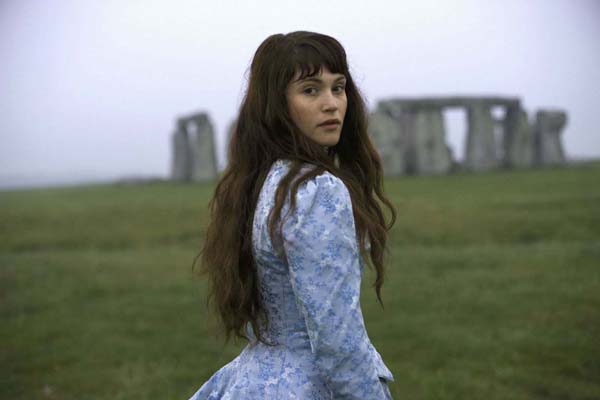
Gemma Arterton as the doomed Tess, 2008.

Gemma Arterton as the doomed Tess, 2008.

In Return of the Native, Hardy’s sixth novel, the beautiful Eustacia Vye, who longs for greater life than she can find on a remote heath, suffers the fate of a Greek tragic heroine. Her moves to escape her fate bring it upon her. Eustacia and her husband’s mother drown. In grief and despair, the husband becomes a preacher.

Catherine Zeta-Jones as Eustachian Vye in "Return of the Native," 1994

Catherine Zeta-Jones as Eustachian Vye in “Return of the Native,” 1994

With recurrent themes of the conflicting demands of culture versus nature for the individual, as well as liberal doses of illicit sexuality, Hardy’s 19th century works were popular with 20th century readers. Seeming to contrast with that is a tragic vision more purely classical than any other novelist I can think of.

And let’s face it, we Yanks love good British period dramas whenever we can get them, whether set in Camelot or on Egdon Heath. So you better believe I’ll be in line to see the new Far From the Madding Crowd when it’s released. It might even prompt me to take another foray into 19th century literature, something I thought I had long left behind. We never know where imagination will turn…

Thoughts on Maleficent and retelling folktales

maleficent

Maleficent opens in a world of beauty, threatened by a greedy human king. The visual contrast between human actors and fantasy animation was great enough to take a few minutes for suspension of disbelief to kick in. After that, I was in for the ride, through an ambitiously re-crafted tale of the Disney arch villainess who gave kids of my generation nightmares in Sleeping Beauty (1959). As the poster implies, this movie belongs to Angelina Jolie, whose performance is gripping.

The Sleeping Beauty themes of love and betrayal remain but they manifest very differently in the two Disney versions of the story. Men betray and women love; implicit in Disney’s previous blockbuster, Frozen, the theme is explicit in Maleficent. For now at least, it’s Disney’s key to box office success.

Retelling fairytales with a modern twist is nothing new. Fantasy authors like Nancy Kress, Jane Yolen, Steven Brust, and Roger Zelazny, to say nothing of Neil Gaiman and George R.R. Martin have been doing this for decades. I’m currently reading a 1994 collection of short retold fairytales, Black Thorn, White Rose, edited by fantasy writers, Ellen Datlow and Terry Windling. There are two different versions of Sleeping Beauty. In both, it is the prince who needs to be rescued.

I take this as an inevitable pendulum swing from earlier Disney movies where princesses mostly sat around singing, “Someday my prince will come.” We have to remember that no Disney movie, then or now, is “real” folklore, nor is any work fantasy fiction. By “real” folklore, I mean stories shaped by the collective imagination of generations of members of a culture, region, or tribe. Strictly speaking, any talk of folktales now must be in the past tense. Nowadays the events that might spawn new fairytales, over a generation or two, become headlines or tweets, “details at 6:00,” to be forgotten in a day or an hour.

Among other things, the old fairytales were full of hints on wise living for those who knew how to listen. Here is one simple list of some of the lessons they taught:

  • Sorrow is real, and so is joy
  • Joy is freely available to all, just as sorrow comes freely to all, whether rich or poor, and without regard to changes in material fortune
  • The world is fraught with danger, including life-threatening danger, but by being clever (always), honest (as a rule, but with common-sense exceptions), courteous (especially to the elderly, no matter their apparent social station), and kind (to anyone who has obvious need), even a child can succeed where those who seem more qualified have failed.

Much as I love them, I don’t find that fantasy movies and novels teach lessons like these in a visceral or unforgettable manner, which leaves us sadly impoverished. Dragons have not gone away – any glance at the headlines makes that clear. What is gone is the wisdom to know how to deal with them.