Notes from 2017 – Stille Nacht

“Stille Nacht” is Silent Night in German. On this night, 102 years ago, millions of young men in Europe lay shivering in trenches in northern France. The finest summer anyone could remember had erupted into the most violent war the world had seen. Longing for home, the German troops began singing Stille Nacht. British soldiers joined in with Silent Night. Before long, soldiers on both sides rose from their trenches to shake hands with “the enemy” and share cigarettes, cookies from home, bottles of wine, and song.

British and German soldiers together, Dec. 25, 1914

British and German soldiers together, Dec. 25, 1914

This is the most moving modern story of Christmas Eve I know. But my subject this evening is not the song but Silence itself. At Solstice time, the earth itself pauses. Religious people of many faiths celebrate different holidays.The external busy-ness of the season stops, at least for a day, but I’ve learned from wise meditation teachers that the inner noise will continue unless we turn toward inner silence with intention.

Awareness of inner stillness and silence is the source of renewal and healing says Tenzin Wangyal Rinpoche, a Tibetan Bon Buddhist master. “Silence has it’s own language.”

Anam Thubten Rinpoche, of the Tibetan Nyingma tradition tells students who come to him for advice to “Go back home and be quiet. Silence is wiser than our discursive minds.” Tibetan Buddhist practice can be extremely complex, but Anam Thubten gives this simple instruction:

“Meditation is the art of simply sitting in silence. Sitting means just sit, just rest, just let be. Let everything be as it is. When we know how to let everything be as it is, we then we don’t have to try and be some kind of divine terminator attempting to destroy the world of delusion and sorrow. The world of delusion and sorrow is already falling apart and disappearing on its own. It sounds simple but it is also subtle. We just let everything be just as it is. Once we know that, we know everything. We have unlocked the secret to enlightenment. To sit actually means just let everything be as it is, and let the world of ideas, concepts, and sorrow dissolve on its own, which always happens. This is the highest technique.”The Magic of Awareness.

Naturally the hardest part of that instruction is letting myself be as I am – abandoning all the self-improvement projecst, the “Oh, maybe I can blog about this” mentality, and all of that. “Rest,” says Tenzin Wangyal, is nothing less than “the doorway to our true nature.”

More of that in coming episodes. Meanwhile, as a Christmas Eve gift, here is a wonderful rendition of a beautiful Shaker song, by Yo yo Ma and Allison Kraus, a song the places our true nature at the center of this holiday, and all our days…


Notes from 2017 – The daily deception!

Cyberspace is atwitter – literally – with news of Mr. Trump’s call for renewed stockpiling of nuclear weapons.

DON’T FALL FOR THE SLIGHT OF HAND!

We’ve been down this road before. How often, in the face of scandal, has this TV star and drama queen shifted our attention to something outrageous, to get us all shouting, “That’s outrageous,” while we loose focus on the real issue?

He knows media, he knows propaganda, he knows misdirection. He’s a very good stage magician and master of what is false

What matters is the Russian hacking, and what knowledge Mr. Trump and his cronies may have had of this. He never let go of Hillary’s emails. We must not let go of demanding disclosure of CIA information, and a bipartisan investigation to get to the truth.

A renewed arms race would demand congressional budget approval, something not likely to be forthcoming when generals and every representative and senator involved in military planning understands that American 21st century warfare is likely to center on cyber attacks and countering lone wolf terrorists.

Mr. Trump is like a drug dealer, tweeting our daily adrenaline fix. Enough! It’s time to let go of the drama and keep focus as the miasma clears and we see what he’d rather we didn’t.

Note: I won’t use pictures in posts on this man, nor say the name of the office he won, an office that bears an honor of which Mr. Trump is not worthy.

Notes from 2017 – The war on what???

Intruder Alert! St. Nicholas, by Thomas Nast

Intruder Alert! St. Nicholas, by Thomas Nast

Piety and commercialism, two unlovely attributes, are rampant at this time of year, so it’s time for my annual Christmas history post. If you search on “Christmas” here, you’ll find some interesting info on things like the Ghostly Christmas tree ship (Christmas Tree Facts and Legends), my grinchly rant on “Holiday music,” and most poignantly, the Christmas Truce, when to the chagrin of the generals, peace broke out on the western front on Dec. 25, 1914.

One thing you won’t find are notes on a “war on Christmas,” since there isn’t one. No one out here in the world cares whether you say “Merry Christmas,” or “Happy Holidays.” But if you look back in history, you’ll find a number of instances of Christians waging war on Christmas. Consider that:

–Early Christians did not celebrate Christmas. Origen of Alexandria, a third century theologian, wrote that “only sinners like Herod and Pharaoh celebrate their birthdays.”

–Christians didn’t celebrate Christmas until the ninth century reign of Charlemagne.

–During the middle ages, the Feast of Epiphany was more important than Christmas, which didn’t really emerge as a feast until 1377, when Richard II held a months long blowout with his nobles. Twenty-eight oxen and 300 sheep were slaughtered for the event, which according to chroniclers, featured “drunkenness, promiscuity, and gambling.” Early Christmas carols were sung, but they were bawdy.

–In 1645, Oliver Cromwell banned Christmas in England, and the Mayflower pilgrims outlawed it in Boston from 1658-1681.

–The New York City Police Department was formed after a Christmas riot in 1828. We read on History.com that “The early 19th century was a period of class conflict and turmoil. During this time, unemployment was high and gang rioting by the disenchanted classes often occurred during the Christmas season.”

–The “one percent” of the day responded with a campaign to transform a holiday long known for outlandish behavior into a commercial, family centered time, drafting the work of Thomas Nast, Charles Dickens, Washington Irving and others for the task.

–Victorian sensibilities focused on family and children, and it was only then, in 1870 that Christmas become a legal holiday in America. We’ve been led to believe we celebrate this day as it has been done for centuries, but that simply isn’t so (Humbug Revisited: A Brief History of Christmas).

I have no complaints about Christmas as a spiritual holiday, and it’s a great time to remember family and friends, but I do my best to ignore the cultural trappings. I boycott stores that force employees to work on Thanksgiving. I celebrate “Buy Nothing Day,” instead of Black Friday.

I will end with an observation I once heard an Art History professor share on the iconography of Santa Claus.

Glance at the Thomas Nast illustration at the start of this post. If you saw this guy in your living room, you’d either unlock your gun safe or call 911. He’s looking for your liquor cabinet and fridge, as he carries a sack of loot boosted from the neighbors!

Now look at the “Jolly Old Elf” in this modern representation below – white hair and beard but a child’s nose! This is an infantilized Santa Claus! It may help to get parents of very young children out to Toys R Us, but I don’t think it does much good for the maturity level of the culture…

Happy Solstice everyone!

Santa with puppies, kittens, and the facial features of a child.

Santa with puppies, kittens, and the facial features of a child.

Notes from 2017 – William Stafford

William Stafford, from the announcement of the centennial celebration of his birth, 2014, at Lewis and Clark College

William Stafford, from the announcement of the centennial celebration of his birth, 2014, at Lewis and Clark College

Some poems are prophetic, though readers and the poet alike discover this only after the passage of time. William Stafford (1914-1993) wrote poems like this. Of his process, he said, “It’s like fishing,” and “A writer is not so much someone who has something to say as he is someone who has found a process that will bring about new things he would not have thought of if he had not started to say them.” (1)

Stafford was born and raised in Kansas. During WWII, as a contentious objector, he served in Civilian Public Service camps from 1942 t0 1946 for $2.50 a month. In 1947, he moved to Oregon to teach at Lewis and Clark College, a post he held for 30 years. He was a late bloomer, who did not publish the first of his 57 volumes of poetry until he was 46.

William Stafford was named “Consultant in Poetry to the Library of Congress” in 1970, a position now called Poet Laureate of the US. He was Poet Laureate of Oregon from 1975-1990. James Dickey said William Stafford was one of those poets”who pour out rivers of ink, all on good poems.” He wrote 22,000 of these in his lifetime, and published 3,000 of those.

He left an unfinished poem, “Are You Mr. William Stafford?” on August 28, 1993, the day he died of a heart attack, containing these lines:

“You can’t tell when strange things with meaning
will happen. I’m [still] here writing it down
just the way it was. “You don’t have to
prove anything,” my mother said. “Just be ready
for what God sends.” I listened and put my hand
out in the sun again. It was all easy.”

In an article in the New York Times Review of Books, Ralph J. Mills Jr. said, “Stafford’s work and attitudes say a good deal indirectly about contemporary modes of living that have lost touch with the earth and what it has to teach. He uncovers and keeps alive strata of experience and knowledge that his readers are in grave danger of losing, and without which, Stafford keeps saying, they will forget how ‘To walk anywhere in the world, to live / now, to speak, to breathe a harmless / breath.'”(1)

All these are reasons why Stafford’s work remains fresh, and seems even more timely as time goes on. One of my favorite poems, “A Ritual to Read to Each Other,” was published in 1962. It seems to me that out of time, he is speaking to us directly, urgently, pointedly at this solstice season of 2016:

A Ritual to Read to Each Other

If you don’t know the kind of person I am
and I don’t know the kind of person you are
a pattern that others made may prevail in the world
and following the wrong god home we may miss our star.

For there is many a small betrayal in the mind,
a shrug that lets the fragile sequence break
sending with shouts the horrible errors of childhood
storming out to play through the broken dyke.

And as elephants parade holding each elephant’s tail,
but if one wanders the circus won’t find the park,
I call it cruel and maybe the root of all cruelty
to know what occurs but not recognize the fact.

And so I appeal to a voice, to something shadowy,
a remote important region in all who talk:
though we could fool each other, we should consider–
lest the parade of our mutual life get lost in the dark.

For it is important that awake people be awake,
or a breaking line may discourage them back to sleep;
the signals we give–yes or no, or maybe–
should be clear: the darkness around us is deep.

–William Stafford, (from The Way It Is: New & Selected Poems)

Notes from 2017, part 1

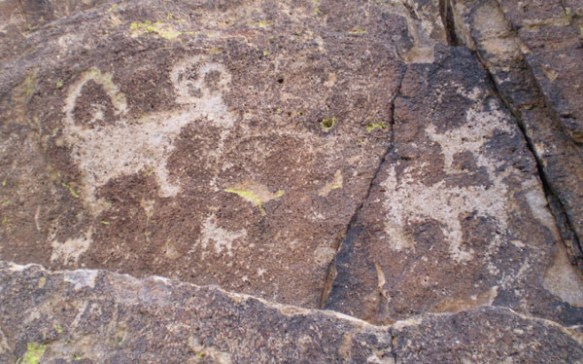
Petroglyphs, Saguaro National Park, Arizona

Petroglyphs, Saguaro National Park, Arizona

This morning, at 2:44 am local time, the still point of the turning world became even more still. Like the gap between the end of an outbreath and the next inbreath, the earth paused.  From the depth of our longest night, her axis tilted back toward summer.

Darkness is metaphorical as well as physical. By many measures, our nation is in its darkest hour since the civil war. The inspiration for what will become a series of posts through the coming year was an article by Summer Brennan, called Notes From the Resistance: A Column on Language and Power. Ms Brennan begins by saying:

“In George Orwell’s 1984, the first act of rebellion undertaken by Winston, the protagonist, is to acquire a blank book and begin to write down his thoughts and memories.”

As Big Brother watches, Winston begins to reclaim words and celebrate truth. Big Brother is not yet as pervasive here, although security experts warn I should put a piece of tape over the camera on my laptop – just in case. In my estimation, I’m hiding in plain sight, betting that no one much cares about pics of an unshaven man in his 60’s, sitting in his bathrobe before dawn, swilling coffee and searching for words.

Although if Ken Bones could go viral…

But I digress. A minority of those Americans who voted chose a petty tyrant and reality TV star to become the most powerful man on earth. Lies are his currency. I will not repeat the lies here, but rather, use these posts to document my reality, and as much as I can sense it, the national reality, over the coming year.

Rather adding my saliva to the spitting contest between supporters and detractors, I will use this space, through the coming year, to ask the Dr. Phil question: “How’s this working for you?”

Here we will celebrate truth and truth-tellers.

Here I begin by celebrating Pope Francis, who so follows so beautifully in the footsteps of the apostle of peace for whom he is named. Yesterday, he declared that evolution and the Big Bang theory are correct. That God is not a magician who pulled the universe out of a hat 5000 years ago. That science can be a mode of truly appreciating the handiwork of the Creator.

Happy Solstice to all!