Anatomy of the Deep State by Mike Lofgren

Be warned, this post has disturbing content.  If it was a movie, I’d rate it “R,” not because of sex or violence, but because it concerns a penetrating essay on the current state of the US government.  Change the channel now if you’re squeamish.

If you’re still here, good, because disturbing or not, I think everyone ought to read Anatomy of the Deep State, by Mike Lofgren, a former GOP Congressional aide who retired after 28 years as a staff member for Congress and the Senate.  This article is a distillation of ideas he explored in his recent book, The Party is Over: How Republicans Went Crazy, Democrats Became Useless, and the Middle Class Got Shafted.

party is over

Lofgren says what many of us have long suspected, that our visible political landscape is merely the tip of a much bigger iceberg – that our various issues, debates, and elections often have little to do with the real trajectory of power in this country.  Much of this “real” trajectory is hidden in plain sight.  With almost three decades inside the belly of the beast, Lofgren can show us where to look.

He cites many examples.  During the political circus surrounding the 2011 debt ceiling “crisis,” our leaders had no problem finding money to topple Gaddafi.  A few months later, during the government “shutdown”, while debates raged over canceling meat inspections and air traffic control, we gave $112 million to Syrian rebels, to keep that conflict going.  And since 2007, as our bridges collapse, schools fail, and cities go bankrupt, we’ve spent $1.7 billion on an NSA building in Utah the size of 17 football fields.  Its purpose is to house a yottabyte of data.  A yottabyte, the largest number computer scientists have so far coined, equals 500 quintillion pages of text.  “They need that much storage to archive every single trace of your electronic life,” Lofgren says.

The best news, according to Lofgren, is that what he calls the Deep State is far from invincible.  He notes how sufficient ineptitude draws pushback even from allies, citing our two failed wars and the Snowdon revelations among other things.  Past elites have often reacted to challenges in one of two ways.

Some have tried to “stay the course,” and Lofgren observes that,“The dusty road of empire is strewn with the bones of former great powers that exhausted themselves in like manner.”  Others have followed reformers, as diverse as Franklin D. Roosevelt, Charles de Gaulle, and Deng Xiaoping.  What each of these men developed in common was a deep understanding that their cultural stories and myths were ossified and that survival depended upon renewing both vision and action.

Mike Lofgren, a self-described “former proud Republican” now says, “there is…a deep but as yet inchoate hunger for change. What America lacks is a figure with the serene self-confidence to tell us that the twin idols of national security and corporate power are outworn dogmas that have nothing more to offer us. Thus disenthralled, the people themselves will unravel the Deep State with surprising speed.”

The first step in dealing with any problem is understanding its nature.  In this time of deliberate political and economic obfuscation, I highly recommend Anatomy of the Deep State as one of the best and most succinct diagnoses I’ve yet seen of what ails us.

Final notes on the Grail and the Wasteland

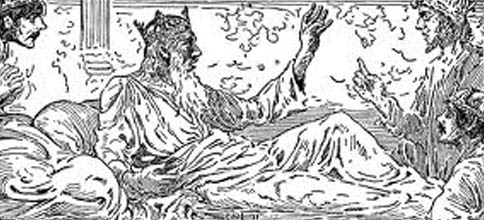
An ailing king lives at the heart of the Wasteland. We often find this figure in fairy tales, such as “The Water of Life,” where efforts to heal him launch the story.  Jungians interpret the king as the “dominant ruling attitude” of a culture or individual, which grows atrophied unless it is periodically renewed.

water of life king

In seeking a simple description of our own collective attitude, I thought of an often misquoted phrase spoken by President Calvin Coolidge in 1925: “The chief business of the American people is business.”  This attitude swept the world in the years since then and sheds much light on our current Wasteland with an ecosystem in crisis.  Sadly, few people know what else Coolidge said in that speech:  

“Of course, the accumulation of wealth cannot be justified as the chief end of existence…So long as wealth is made the means and not the end, we need not greatly fear it…But it calls for additional effort to avoid even the appearance of the evil of selfishness. In every worthy profession, of course, there will always be a minority who will appeal to the baser instinct. There always have been, probably always will be, some who will feel that their own temporary interest may be furthered by betraying the interest of others.” (1)

***

In the earliest versions of the legend, the king is healed when the hero asks this question:  “Who does the Grail serve?”  In these tellings, the Grail is a stone or a large platter that nourishes each person according to their heart’s desire.  This suggests a cornucopia, a potential earthly and spiritual abundance.  There have always been cycles of growth and cycles of famine, cultural florescence and decay.  In the legend, that question, “Who does the Grail serve?” appears to lie near the heart of these cycles.  Somehow we intuit that what Campbell termed “Greed for more  than one’s share” on a large scale is a formula for disaster.

***

In my two previous posts, I mentioned hearing many accounts of people seeking new ways of doing most everything.  I’ve collected so many stories it took several days figure out how to present them.  Simplicity won out in the end; here is one brief account, with more to follow in the future.

I’ve listened to Jill Stein on several occasions, most recently on BillMoyers.com in November, 2013.  Stein, a Harvard Medical School graduate, “became so outraged by how politics adversely affected her patients” that she ran as the Green Party candidate for president in 2012.

Naturally, she was not allowed to participate in the presidential “debates,” which don’t really deserve the name, but in 2012 she and Green vice-presidential candidate, Cheri Honkala, were arrested for simply trying to enter the debate hall.  “We were arrested, taken to a secret detention facility, and handcuffed to metal chairs for eight or nine hours until the debate was long over.”  

Jill Stein, 2012 Green Party candidate for president

Jill Stein, 2012 Green Party candidate for president

You’d expect her to be discouraged after this blatant violation of civil liberties, as well as a host of other abuses she cited during the interview, but she was not, saying instead that,

“America is ready to move. And when we start moving together…all we have to do is realize how numerous, strong and inspired we are. And then we are unstoppable. You know, in the words of Alice Walker, the biggest way people give up power is by not knowing we have it to start with. It’s by flicking that switch and rejecting the disempowerment that’s beaten into us every waking moment by every media source that surrounds us.”

I encourage everyone to watch the interview or read the transcript.  There much that was frightening but even more that was hopeful in this discussion of our current situation.  As time goes on, I’ll feature other optimistic stories I have collected, featuring “ordinary” people searching for those Grails that can transform and renew the world and the lives we are living.

Delisting the Wolf – Your Help is Needed!

If wolves are removed from Endangered Species protection, the day may soon return when there are none in the lower 48. I’ve worked with these magnificent creatures as a volunteer at the Folsom City Zoo Sanctuary, and in my opinion, that would be a tragedy. Please read this article and make your comment on the Federal website.
Update: As of November 6 at 5:00pm, the website is up again and I was able to comment.

Mungai and the Goa Constrictor's avatarMungai and the Goa Constrictor

The U.S. Fish and Wildlife Service is in its comment period on their proposal to remove the wolf from the Endangered Species Act in the lower 48.  Hearings are being held throughout the country.  If you can go, please do.  If that’s not possible, please write or call.  They need to hear from people who want the wolf protected, not only from those who don’t.

AMENDMENT
Many thanks to my good friend, Carmen Mandel, for providing a DIRECT LINK to add your comments. Please add yours. There are almost 32,000 signatures, as I write this, but this figure falls a long way short of previous opportunities.
This is so important
Please add your comment now
Your Voice in Federal Decision-Making

ALTERNATIVE WAYS TO COMMENT
Please click here for details

Click here for more details:
The U.S. Fish and Wildlife Service

Related links:
Defenders of Wildlife
Grey Wolves Left Out…

View original post 59 more words

James Hillman on world change and political polarization

James Hillman, 1926-2011

James Hillman, 1926-2011

For decades, James Hillman brought us unique observations on modern life from the perspective of a depth psychology that embraced soul as its highest value.  Recently, I’ve wished I could hear his take on our current climate of political divisiveness, but Hillman, who died two years ago at the age of 85, wasn’t here to watch our most recent shenanigans.  Happily, I recently stumbled upon a pair of interviews in which Hillman discussed this very subject and set it in a context of massive cultural change.

Author and journalist Pythia Peay published the first interview on The Huffington Post in February, 2011 (Jungian Analyst Explains the Psychology of Political Polarization).  The occasion for their talk was the mass shooting in Tucson, which had happened a month earlier.  The most prominent victim was Representative Gabrielle Giffords.

Tragically, memory of that event, just two and a half years ago, has been lost in the wake of more recent carnage, including the Nevada school shooting earlier this week.  Though Hillman’s comments focused on the role of political divisiveness in the attempt to kill a congresswoman, his additional statements now seem eerily relevant to the 12 year old in Sparks who was so alienated that he ended his life with murder and suicide.

Hillman began with a general discussion of polarized thinking.  “Polarity,” he reminds us, is an electrical engineering term.  Batteries have poles; the psyche is far more nuanced than that, dwelling in shades of gray rather than black or white.  Ideological extremes subvert our ability to judge individual issues on their merit.

When asked if violently polarized politics caused the shootings, Hillman changed the focus to another kind of cultural rigidity and its effect on the Tucson shooter:

“I think that this kid was made a loner by an American educational system in which there is no room for the weird or the odd…We need to have an educational system that’s able to embrace all sorts of minds, and where a student doesn’t have to fit into a certain mold of learning. Our educational system has become so narrowed to a certain formula, that if you go through a weird phase, you’re dropped out — often at the age of schizophrenia, 19-23 — and that’s the danger.”

Arguments in the wake of gun violence bog down in specifics, like background checks and how many bullets a magazine should hold – we don’t ask why and how we’re producing more and more people prone to mass violence.  In the end, says Hillman, for a culture that pays so much lip service to “the individual,” we are terrified of real individuality, and attempt to stamp it out.

In the second interview, America and the Shift in Ages, Hillman suggests that much of that rigidity has to do with futile attempts to shore up outmoded systems and institutions during a period of massive change.  Not just one but “three or four” myths that are central to our culture are collapsing.

Everything we fear has already happened said Hillman:  “The fragility of capitalism, which we don’t want to admit; the loss of the empire of the United States; and American exceptionalism. In fact, American exceptionalism is that we are exceptionally backward in about fifteen different categories, from education to infrastructure. But we’re in a stage of denial.”  Other beliefs and structures are crumbling as well, he said.  White supremacy, male supremacy, the influence of monotheistic religions, and the belief that we are “the good people.”

If such institutions do not appear to be in decay, it’s because they are so staunchly defended, and that, Hillman says, is a sign of their lack of vitality — “If they were vital they wouldn’t need to be defended. And the fanaticism we’re witnessing goes along with the deterioration of the vitality of these myths.”

Many of our fundamental beliefs are under scrutiny and need to be.  Hillman mentions the meaning of “freedom.”  For many, freedom means, “I can do any goddamn thing I want on my property; that I am my own boss and don’t want government interference; that I don’t want anybody telling me what I can and can’t do.”  This, he says, is the freedom of an adolescent boy.  What of the different kinds of freedom, such as “freedom from the compulsions to have and to own and to be someone?”  What of the freedom Nelson Mandela found in prison?

Hillman cites economic assumptions that need to be questioned as well.  Falling demand needs to be stimulated, according to current assumptions, but from an ecological point of view, that’s exactly what the world needs at this time.  Sustainability models, which may be our hope for the future, terrify those in positions of power.

Many of our current fears, says Hillman – from fear of immigrants crossing our borders, to fear of failing education, to fear of cancer, to economic insecurity, terrorists, and of course fear of “the other” political party, results from the lack of a wider framework in which to understand the massive shifts that are already underway.

There is no going back, but as obsolete structures crumble, we can glimpse, if we look, new forms emerging.  Hillman gave the example of a “Bioneers” conference he attended where Paul Hawken showed a film that was simply the names of individuals and organizations involved in trying to innovate ways of building communities, economic systems, and ways of dealing with the natural world.  Hawken said there were thousands of names, and the film could roll for weeks.

Hillman said it’s important not to try to fit emerging structures into the patterns of the past.  For our peace of mind, a new kind of faith is required:   “I think it’s a matter of being free-wheeling, and trusting that the emerging cosmos will come out on its own, and shape itself as it comes. That means living in a certain open space — and that’s freedom.”

Dawn over Oostende, Belgium, 2007.  Photo by Hans Hillewaert, CC-BY-SA-3.0

Dawn over Oostende, Belgium, 2007. Photo by Hans Hillewaert, CC-BY-SA-3.0

Such words are a fitting conclusion to the lifework of a man who lived in defense of Anima Mundi, the World Soul and who taught that animals, trees, and rivers are intelligent and alive, and that at some deep level of the psyche, we can hear their voices.  In Hillman’s life work, observation of the modern psyche led to conclusions that mesh with the myths of the ancestors.

A thousand years from now, people will read of our times and shudder, as we do in contemplating the rigors of life in the middle ages.  A few visionaries stood out from the rest, those like Saint Francis, Dante, and Leonardo, who pointed toward a more benevolent and expansive future.

We cannot write our own history, but we can wonder how it will look to those in the future.  I am convinced that James Hillman will be remembered when most of what passes for news on TV is blessedly forgotten.
Full Faith and Credit: a personal story and parable.

My wife and I got married in Santa Fe in 1976.  We didn’t have a lot of money, but our mothers were gone and our families and friends were on the coasts, so there would only be eight in the wedding party.  We arranged to have the reception and put everyone up at the lodge in a nearby national monument.

I worked in a printshop that had been one of the finest in town.  We still did brochures for the Santa Fe Opera, but signs were clear that the glory days were over.  A husband and wife team had started the shop, but they divorced, and with only one of them running the business, glitches appeared in the billing system, the revenues, and the payroll.  About the time we booked the rooms and locked in arrangements, my paychecks started to bounce.

The pressmen and I started cashing our checks at grocery stores and the boss’s bank, since our own banks charged fees for deposits that bounced.  The day before the wedding, a teller said, “I’m sorry, I can’t cash this check.  Your employer’s account is $1000 in arrears.”

“Please,”  I said.  “We’re getting married tomorrow, and we have to pay the caterers.  If they’re $1000 in the hole, what does another $150 matter?”

She bit her lip and scrunched up her eyebrows, then smiled, and handed me the cash.  “Congratulations!” she said.  “Have wonderful wedding day.”

Crisis narrowly averted.  But

Do you think I ever put my faith in that employer again?

Do you think other nations will put their faith in United States credit again?

I’ll answer the first question.  We set about saving money to move back to California where economic prospects were better.

I don’t know the answer to question number two, but I do know that trust takes time to build and is easy to squander…

Ship of Fools

Ship of Fools.  German woodcut, 1549

Ship of Fools. German woodcut, 1549

I’m sure it won’t surprise anyone to learn that this is my second post of this title in two years.

“The ship of fools is an allegory that has long been a fixture in Western literature and art. The allegory depicts a vessel populated by human inhabitants who are deranged, frivolous, or oblivious passengers aboard a ship without a pilot, and seemingly ignorant of their own direction.“Wikipedia

The Wikipedia entry documents the origin of this image in a method that Renaissance people developed to rid themselves of their mentally challenged fellows.  As Michel Foucault put it in Madness and Civilization, “they were put on a ship and entrusted to mariners because folly, water, and sea, as everyone then ‘knew’, had an affinity for each other.”

OK, I gotta say it – don’t you wish we could send all members of the Federal government off on a Carnival cruise and hope the engine stalls at sea?

“Ship of Fools” has been a recurrent image in literature, art, and music for 500 years.  Somehow it’s comforting to to know that folly and madness are nothing new, even – or perhaps especially – at the helm of the Ship of State.

Informed Citizen Disorder

Words can sometimes illuminate.  Bill Moyers’ recent interview with Marty Kaplan, Professor of Entertainment, Media, and Society at USC, gave me a phrase that crystalizes the sense of despair that increasingly follows attending to current events.  “Our spirits have been sickened by the toxins baked into our political system,” Kaplan says.  That’s one definition of what he calls, “Informed Citizen Disorder.”

Marty Kaplan by adamrog, CC-by-SA-3.0

Marty Kaplan by adamrog, CC-by-SA-3.0

Kaplan has an impressive and varied resume; a degree in Microbiology from Harvard; a Ph.D in Modern Thought and Literature from Stanford; twelve years as a Vice President at Walt Disney Studios.  Kaplan wrote speeches for Walter Mondale and co-authored the screenplay for The Distinguished Gentleman (1992) starring Eddie Murphy.  He was the founding Director of the Norman Lear Center at USC, which studies “the social, political, economic and cultural impact of entertainment on the world.”

In the interview with Moyers, called Weapons of Mass Distraction, Kaplan spoke of the weeks he recently spent in Brazil, watching the widespread protests against “political corruption, economic injustice, poor health care, inadequate schools, lousy mass transit, [and] a crumbling infrastructure” while the government spends billions to host the 2014 World Cup and the 2016 Summer Olympics.

One of the obvious questions Kaplan asks is where are the protests in our country?  With ills so blatant and parallel to Brazil, where is our outrage?

“Sickened spirits,” is one of his answers.  Another is misdirection; what passes for journalism often has us asking the wrong questions as it feeds us “the infotainment narrative of life in America.”  Learned helplessness is another factor that Kaplan often cites.

Learned helplessness entered the language of psychology in a now-famous experiment conducted by Martin Seligman in 1967.  Dogs were subjected to electro-shocks with no means to avoid them.  Eventually, they stopped looking for an escape and entered a passive and “hopeless” mode.  In the experiment’s final phase, when means of avoidance were introduced, the dogs did not discover them, because the helplessness had been so thoroughly learned they no longer even tried.  Researchers had to retrain them to manipulate their surroundings again.

The analogies to our situation are obvious.  Citing incidents like the lack of change after Sandy Hook, Kaplan wonders how many times can we stand to have our hearts broken?  Answering a question from Moyers on “Informed Citizen Disorder,” he adds:  

“Ever since I was in junior high school, I was taught that to be a good citizen meant you needed to know what was going on in your country and in your world. You should read the paper, you should pay attention to the news, that’s part of your responsibility of being an American.

And the problem, especially in recent years, is the more informed I am, the more despondent I am, because day after day, there is news which drives me crazy and I want to see the public rise up in outrage and say, no, you can’t do that, banks. You can’t do that, corporations. You can’t do that polluters, you have to stop and pay attention to the laws, or we’re going to change the laws.

…every time that doesn’t happen…something bad happened and nothing was done about it…the sadder one is when you consume all that news…all the incentives are perverse. The way to be happy, to avoid this despondency is to be oblivious to it all, to live in Aldous Huxley’s ‘Brave New World.'”

Despite everything, Kaplan remains an optimist.  “I have kids,” he says, “I have to be.  The world has kids, we have to be.”  The alternative to optimism, Kaplan warns, is to “medicate yourself with the latest blockbuster and some sugar, salt, and fat that’s being marketed to you.  The only responsible thing that you can do is say that individuals can make a difference and I will try…”

Not the happy-happy answer we’d get from the “infotainment” world, but though Kaplan is an optimist, he’s not going to feed us bullshit.  I urge everyone to listen to the interview or read the transcript.  A key finding with learned helplessness that researchers discovered and Kaplan cites, is that since it is based on perception rather than fact, it can be quickly reversed.  We’re not there yet, he thinks, but maybe as people become more and more unhappy with the state of affairs around them, a critical mass is building that will lead ordinary citizens to demand change as we have done in the past.

The Unwinding: An Inner History of the New America, by George Packer

In the first sentence of The Unwinding, George Packer tells us what his title means:  “No one can say when the unwinding began – when the coil that held Americans together in its secure and sometimes stifling grip first gave way.”

Packer is a staff writer for The New Yorker, the author of an award winning book on American involvement in Iraq, two novels, and a play.  You could almost guess it would take someone with Packer’s chops to weave together the disparate threads of change that have irreversibly altered the country we thought we lived in.

It began in 1973, when the mid-east oil embargo coincided with models showing American had reached peak oil production.  And in 1977 when the steel mills in Youngstown, Ohio, that once stretched side-by-side for 25 miles, shut down.  When an idealistic young man named Jeff Connaughton, got an MBA and then decided to go to Wall Street, because by the early 80’s, getting a business degree and going to work for a company “that actually made things,” was viewed as failure.  When, according to Packer, concern over exported jobs prompted Wal-Mart to hang “Made in the U.S.A” signs over racks of clothing from Bangladesh.  When Connaughton became a Washington lobbyist and one of his colleagues told him, “Four-hundred thousand a year just doesn’t go as far as it used to.”

Poets see things before the rest of us, and Packer quotes Bruce Springsteen, who put it like this in 1984:  “Don’t you feel like you’re a rider on a downbound train?”

Now, almost 30 years later, when we all know we’re on a downbound train, Packer turns a light on some of the hydra-headed influences that led us collectively down this road.  He also shows us where positive change is likely to come from.  And where it is not.  It won’t come from the power elites, though it may come from disaffected refugees from those elites.

Jeff Connaughton, who made it into the outer circles of the inner circle, as a legal council for the Clinton White House, left Washington after being “radicalized by a stunning realization that our government has been taken over by a financial elite that runs the government for the plutocracy.”  Connaughton is now writing a book called The Payoff:  Why Wall Street Always Wins.

Packer also profiles Peter Thiel, a Silicon Valley entrepreneur who co-founded Paypal and helped bankroll Facebook as a startup.  Thiel put it like this:  “…the deep secret is there’s nobody at the steering wheel at all…People pretend to be in control, but the deep secret is there is no one.”  Thiel now looks for unusual entrepreneurial projects to fund.  Claiming that education is “the latest U.S. economic bubble,” he compares university administrators to sub-prime mortgage lenders.  In response, he began awarding Thiel Fellowships, two year grants of $100,000 each, to 20 people a year under the age of 20, willing to leave school to work on projects that “could make the world a better place.”

Packer doesn’t just profile movers and shakers in the post-unwinding world.  He details the story of Dean Price, son of generations of tobacco farmers, who overcomes multiple obstacles, including personal bankruptcy, to establish a working and profitable biodiesel refinery after learning about peak oil and taking the message to heart.

George Packer

author George Packer

In writing the book, Packer spent a lot of time with Tammy Thomas, an African-American woman who was 11 when the mills closed in Youngstown.  A few years later, she found herself an unwed mother of three, with a fierce determination, which she attributed to her grandmother, to get off welfare, even as jobs evaporated and gangs took over the neighborhoods.  She succeeded in doing so, and is now a community organizer and advocate, but her story makes clear that the odds were stacked against her.  She survived for 19 years in a car parts factory but is scornful of politicians who attach the label of “good jobs” to such work.  “Mitt Romney would be dead in week,” she said.

Packer interweaves the individual stories in a way that keeps you turning pages, like a novel with a large cast of characters that you care about.  Not all the stories have happy endings, and the suffering of individuals, cities, and regions is palpable.  By giving so many seemingly separate events the name, Unwinding, Packer helps clarify connections I had been sensing but unable to articulate.

“Alone on a landscape without solid structures, Americans have to improvise their own destinies, plot their own stories of success and salvation.”

A problem has to be named and described before we can begin to imagine solutions, and for this reason The Unwinding is a profoundly important book.