On Shapechangers: Proteus in John Barth’s, The Menelaiad

I’ve been thinking a lot about shapechangers over the last few months.  I’m trying to refine the villain in my current novel, and I really want to give him shapechanging powers, but he needs some restrictions.  Presumably, a villain with an unlimited ability to change his form instantly and at will could never be caught.  That would be a different story than the one I am writing.

The figure of  “The Shapechanger” has fascinated me since I heard John Barth read his story, “The Menelaiad” four decades ago.  I have never forgotten that tale or several related stories which I will discuss in future posts.  “The Menelaiad,” was published in Barth’s collection of short fiction, Lost in the Funhouse, in 1968. English majors love it as “metafiction,” writing about writing, but what really caught me is the “simple” image of a man who wrestles a shapechanger and can never again be certain if his life is really unfolding as it appears, or if he is still engaged in the wrestling match.

Barth was fascinated with “frame tales,” stories within stories.  A classic example is The Arabian Nights.  Scheherazade  tells stories with multiple characters who each tell their own stories, often with people within those stories telling stories.  Barth claimed that in his search of world literature, he never found a story that went deeper than five levels, so he decided to write one with seven.  He began with an episode from the Odyssey, which has plenty of shapechanging and frame tales as it is.

Barth chose the episode where Menelaus, husband of Helen (who launched a thousand ships) relates how he was blown off course, to the Nile delta, after the fall of Troy.  (He tells the tale to Telemachus, son of Odysseus, who was urged by the goddess Athena in the shape of Mentor, an elderly advisor, to seek for news of his missing father – clear enough?)

Luckily for Menelaus, Eidothea, the daughter of Proteus, the Old Man of the Sea, falls in love with him, and relates how he may win sure and certain advice from her father who does not like to dispense such information.

Proteus is herdsman of Poseidon’s seals, so Menelaus must hide himself in a smelly sealskin, jump Proteus when he comes into his cave at noon, and hang on for dear life, for Proteus:  “can foretell the future, but, in a mytheme familiar from several cultures, will change his shape to avoid having to; he will answer only to someone who is capable of capturing him. From this feature of Proteus comes the adjective protean, with the general meaning of “versatile”, “mutable”, “capable of assuming many forms”.  http://en.wikipedia.org/wiki/Proteus
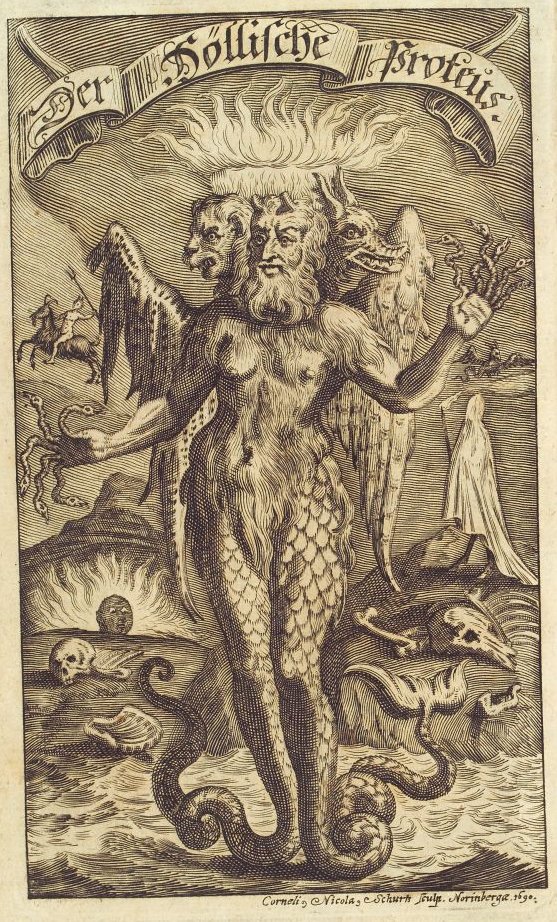
Proteus, The Old Man of the Sea

Barth has a field day letting Menelaus tell the tale of conversations with different people at different times – when someone related what someone else related about what someone else related, he relates.

And yet, for all the tour de force writing, the central image of the tale is like a koan that stays with you.  While holding on to Proteus, Menelaus realizes he can never again be sure that Proteus has not changed into Menelaus holding Proteus, and if so, what or who is he?  All he can know for sure is that he is a voice asking who or what he is.

***

There is a classic Zen story of a man who dreams he is a butterfly.  When he wakes, he wonders if he is a man who dreamed he was a butterfly, or a butterfly dreaming he is a man.

It’s easy to flip the page and forget about that particular story.  It is harder or even impossible to forget Barth’s “Menelaiad,” once you make the effort to wade through some of his bizarre invented ways to use quotes in ways they were never designed to be used.  “”””This is frustrating!”””” he said, she recounted, he told me, I say.

I’ve always suspected that Proteus predates the Olympian pantheon of classical Greece, for what could be more antithetical to the ideals of clarity, order, and rational philosophy than a shapechanger?  There really is no character in mythology more dangerous to any kind of fixed worldview than one who can plant the seed of doubt at the core of awareness.  “Is this really true?”  “Are things really as they appear to be?”  The moment consciousness really and truly begins to entertain questions like these, the wrestling match has begun.

NEXT:  A ShapeChanger in Faerie.

The Cypress House by Michael Koryta

Arlen Wagner, son of a West Virginia undertaker, knows about death, but nothing prepares him for that midnight in the Belleau Wood when he sees a squadron of skeletons marching toward his position and understands that every one of those men is going to die. In the years after the first world war, Arlen relies on whisky and manual labor to try to live with his unwanted “talent” for seeing death before it strikes.

In the summer of 1935, as Arlen and 19 year old Paul Brickhill, travel to a CCC camp in the Florida Keys, everyone on the train suddenly appears as a dead man. At the next stop, only Paul heeds Arlen’s warning to wait for the next train, and only Paul survives.

After that, things get strange…

That comment is not just meant to be facetious but points to one of the tactics Koryta uses to weave supernatural elements into his tale in a seamless fashion that is too often missing from the “urban fantasy” sub-genre that I once enjoyed but which soon became predictable.  Koryta is a master of mood who plants the vision of dead men on a train among a wealth of ordinary details:  the ever present heat, the smell of unwashed bodies, the cigarette smoke, the card games, and Arlen’s surreptitious sips from his flask.  In the next moment, he can make a simple walk down an empty road in the dark of the tropical night burst with menace.

He delivers on the promise of menace – and secrets.  Everyone has secrets – layers of them.

Arlen and Paul catch a ride with a man who takes them to The Cypress House, a roadhouse in the middle of nowhere, owned by a stunningly beautiful woman.  A few minutes after their arrival, the man who gave them a ride tries to slip away, but is incinerated when a bomb explodes in his car.  Why?  Why are Arlen and Paul arrested for the crime?  What secrets hide in the Cypress House – cypress house – another name for a coffin, Arlen remembers his father saying.  The very best kind of coffin, the coffin of choice for ancient kings and for popes.  Arlen’s father, who claimed he could talk to the dead.  He was insane – wasn’t he?

Michael Koryta, author of five mystery novels, charted a new direction by introducing supernatural elements into So Cold the River, which I praised on this blog last summer.  The Cypress House just came out.  Like its predecessor, this is one of those rare books I could not put down.

Happy Imbolc, St. Brigid’s Day, Candlemas, Groundhog Day.

Our Celtic ancestors marked the changing seasons not by solstice and equinox days, which divide the year into quarters, but with the “cross-quarter days” which fall between the astronomical events.  Seasons figured in this way more closely match our experience in the northern temperate zones.  Winter begins at Samhaim (Halloween) and ends on Imbolc, the first day of spring, February 2.  Imbolc or Oimelc are Gaelic words that refer to the lactation of ewes.  Through most of the British Isles, February was bitterly cold, yet it was also the time when lambs were born and shoots of green grass appeared, events that were heralds of new life and a new year.   http://www.chalicecentre.net/imbolc.htm

This time of year was celebrated in the British isles for at least 3,000 years, the age of several megalithic stone circles in Ireland oriented toward the positions of the sun on Samhain and Imbolc http://en.wikipedia.org/wiki/Imbolc.  The people who raised the standing stones were as remote from the Celts as the Celts are from us:  we can only speculate on their motives and the meaning the day had for them.  And even though the word, Imbolc was used in the middle ages in Ireland and Scotland, who and what the Celts celebrated isn’t certain.  The earliest written records of Celtic cosmology come from Julius Ceasar’s commentary on the Gallic War, 51-52 BCE, in which Celtic beliefs are filtered through the Roman perspective.

Even so – even if our stock of “Celtic lore” dates from the 19th century on, when a revival of interest began (think of pre-Raphealite painting and William Morris’ craft movement), that does not mean it is not “authentic.”  When Yeats tramped around Ireland at the turn of the century gathering fairy lore, some of his informants lived such remote lives that they only spoke Gaelic.  How far back can such an oral tradition go?  Pretty far according to most folklorists.

At Imbolc, the maiden goddess, Brigid or Bride supplants the Cailleach, the hag of winter.  Brigid is the goddess of healing, poetry, and smithcraft.  And fire and divination and wisdom and childbirth.  As patron of healing she presides over numerous sacred wells in Ireland and in Britain (where they were renamed for Minerva by the Romans).  To this day, people extinguish old fires and light new ones for the coming year in her honor.

Brigid the goddess was supplanted by Brigid the saint in the Christain era, where she was revered as, “the Mary of the Gaels.”  Numerous miracle stories surround her life.  When just an infant, neighbors saw a fire burning at her house that rose to the heavens.  http://www.brighid.org.uk/saint.html.   Though a beautiful woman, Brigid renounced marriage to found dual monastic communities at Cill Dara, now Kildaire, in Ireland.  The nuns tended a sacred flame that burned continuously until the reformation, except for a brief 13th century inteval where a bishop had it extinguished for being too pagan.

Brigid and children, Kildaire, Ireland, copyright, brigid.org.uk

February 2 has long been celebrated by Christians as Candlemas.  The early church was not the least bit shy about superimposing new festivals over earlier pagan rites.  This day celebrates the Presentation of Jesus at the temple and the purification of the Virgin Mary.  The association of the day with candles comes from the passage where Simeon, an aged seer, recognizes Jesus and proclaims him as “a light for revelation.”  (Luke 2:21).  One website that explores correspondences between Christian and pagan festivals notes that the association of fire or light with this date is widespread through Europe.  In ancient Armenia, Feb. 2 was sacred to Mihr, the god of fire.  http://www.schooloftheseasons.com/candlemas.html

Of course no discussion of February 2 would be complete without a reference to Groundhog day, although locally, the staff at the Folsom City Zoo Sanctuary points out that groundhogs are not native to the American west.  Here we celebrate Prairie Dog Day.

"Don't drive angry!"

There is also an old Celtic tale involving the Cailleach that explains the importance of weather on Feb. 2.

Legend has it that if she intends to make the winter last a good while longer, she will make sure the weather on Imbolc is bright and sunny, so she can gather plenty of firewood. Therefore, people are generally relieved if Imbolc is a day of foul weather, as it means the Cailleach is asleep and winter is almost over. (see the Wikipedia link above.)

***

I don’t keep sheep, but the signs of spring are everywhere. It’s light out at 5:00pm. The sap from the liquid amber tree takes a nightly dump on my car and I swear every year at this time to dig out our car-cover. The buds on the apple tree are a bit late but I expect them any day now. Strangely, pruning the apple tree is one of those rituals of super-bowl sunday I always enjoy.  The super-bowl itself is like the closing rite of winter – after this I won’t want to spend an entire sunday afternoon indoors. In two weeks the almond and walnut trees will be covered with blooms that look like snow when they fall.  Our brown hills will turn emerald green for a month or so.

May everyone have a happy Imbolc and bask in the promise of the return of light and warmth to the earth.

True Grit, Pothos, and Westerns that Stick With You

Not just Americans, but people around the world understand that some westerns completely transcend genre. Their stories stay with you; like the greatest drama (to paraphrase Joyce) they arrest the mind in the presence of what is grave and constant in human suffering and unite the mind with the sufferer.

Rooster and Maddie in True Grit 2010

I think the stunning remake of True Grit may prove to be one of these.  It has the two elements I believe are at the core of unforgettable westerns – great unrequited longing and an open-eyed view of the nearness of death.

The westerns I cannot forget – and I’m going to discuss three of them – have in common, a longing that goes beyond anything specific, but is best described by the wonderful Greek word, Pothos:  an insatiable longing for what lies over the horizon, for what is ever out of reach.  Pothos means desire, longing for, regret, want….It is [a] painful restlesness. That quote comes from a website, pothos.org,  devoted to Alexander the Great, the man who conquered the world but was never satisfied.  http://www.pothos.org/content/index.php?page=pothos-2

Like any good story, True Grit begins with an appealing character, Maddie Ross, who has a compelling need:  she is determined to bring the man who killed her father to justice.  The initial motive is overshadowed as Maddie’s relationship with federal marshal, Rooster Cogburn, develops.  My friend and writing buddy, Rosi Hollinbeck nails it on her blog:  it’s a love story   http://rosihollinbeckthewritestuff.blogspot.com/2011/01/book-for-readers-and-writers.html

The key thing is, you sort of know the nature of the love between them, but can’t quite say what it is, and the characters don’t quite know what it is either, so they inevitably drift apart, though the final scene suggests this may have been the most important connection in both of their lives.

The nearness of life and death is the constant minor chord that opens the movie and is present under the stormy sky at the close.   The best westerns are not about special effects and high body counts for their own sake, and they are not about the cavalry charges of childhood saturday matinees.  To some degree, they are meditations that remind us that a life with all its hopes and dreams is a very fragile thing; it can end in an instant.

The one other thing my favorite westerns have in common are haunting soundtracks.  I downloaded Carter Burwell’s soundtack as soon as I got home from the theater.  It’s a solemn and stately musical play with the melody of a great old hymn, “Leaning on the Everlasting Arms,” here captured by Iris Dement, whose voice itself resonates with the pothos evoked by the words.

TO BE CONTINUED:  In my next post, considerations of Pat Garrett and Billy the Kid, and McCabe and Mrs. Miller.

Dwight Swain’s Motivation-Reaction Units

A recent discussion in one of my critique groups sent me back to my reference-of-choice for writing fiction, the book I would probably pick if I could have only one book on writing.  This is the writing book I’ve read cover to cover twice and dipped into many other times.  It was written in 1965 and updated in 1982 by Dwight Swain, a long-time professor at the University of Oklahoma, who gave it the slightly embarrassing title, Techniques of the Selling Writer.  I’m sure he did it on purpose.  There’s a no-nonsense, let’s-get-real quality to the book; show me a writer who wouldn’t like to get paid for prose.

I went back to the text to look up one of Swain’s most valuable concepts, and hands down, the one with the silliest name: the Motivation-Reaction Unit, aka, (you guessed it) the MRU.  I think this name is deliberate too; once you get it, you never forget it.  You can look up another take on MRU’s on Randy Intermanson’s AdvancedFictionWriting.com, the site where I first heard of Dwight Swain: http://www.advancedfictionwriting.com/art/scene.php

***

Motivation-Reaction Unit is the fundamental building block of an action sequence (it’s important to stress that it does not apply do description, exposition, or reverie).  It’s pretty simple:  something happens, the hero reacts to it, the situation changes, and something else happens.  How characters react to events will largely determine their plausibility and how closely we bond with them.

There’s a lot more to it than that, of course, but this is an introduction.

The Motivation part is the easiest:  something external happens, something apprehended by the senses.  The house catches fire, a car almost hits me, the boss says, “You’re fired,” I pass a bakery and smell bread like my grandmother used to bake.  The key point here is to chose events that are meaningful to the character or the story:  a flight of Canadian geese overhead might change the life of a man in a dead-end job and a loveless marriage, who has always equated birds with freedom, but if the same man only worries about getting pooped on, why include it at all?

The Reaction component is harder:  it includes three events that Swain calls Feeling, Action, and Speech.  Ingermanson calls them Feeling, Reflex, and Speech.  I call them “Involuntary Response, Reflex, and Speech/Decision.  In real life they can be virtually simultaneous, but in fiction we need to write them sequentially.

Feeling, as Swain uses it, refers to an immediate, involuntary response –  what do you do when a horn blares behind you?  That is why I prefer “involuntary response.”  It may be physiological – you jump out of your skin at the horn, but depending on the stimulus, it could be a memory – what does the smell of the bread bring up?

Reflex or Action is a response I have some control over, and as such, will reveal more of my character than being startled by a loud noise.  I may spin in the direction of the horn with clenched fists.  Or grasp a parking meter to steady myself.  Or count to ten.  Or pull the gun from my shoulder holster.

Speech/Decision is where response is most rational.  It’s going to involve rational thought/feeling, expressed as speech or as inner dialog, and maybe a decision.  Maybe the horn-blower is Eddie Haskel, an old high school adversary.  Maybe I say, “Jeeper’s Eddie, I’ve asked you before to quit doing that,” then I slink away with bent shoulders, berating myself once again for not standing up to him.  Maybe I aim my 38 at his head and say, “This time you’ve gone too far, dirt bag!”  Maybe, if I’ve smelled grandmother’s bread, I think “There’s a poker game tonight.  If I’m lucky, I could win bus fare to get back home.”

The key point Swain makes is that we don’t need all three responses to every stimulus; two or even one will do, but, the responses must come in this order, from least-to-most “rational” to avoid confusion.  It makes no sense to say, “When I spotted Eddie Haskell, I drew my 38 and aimed at his head.  I nearly jumped out of my skin when he blared the horn.”  You get the idea.

SO WHAT???

We want readers to feel what we want them to feel, and our greatest chance is usually through the protagonist.  If the audience bond’s with our lead character, and the character’s responses to events are plausible, the audience will deeply experience what they experience.  Huck Finn, Ebenezer Scrooge, Frodo Baggins.  Swain has presented a template.  Constraining?   Yes, but like the constraints of a three act structure, or pigment on a rectangular canvas, I think there’s a lot of room for creativity within the MRU structure.

I caught myself not long ago, relying too heavily on just the immediate and largely inarticulate visceral responses of my character to convey emotional states; it wasn’t working.  When I came back to Swain I realized I had a pattern.  I realized my approach wasn’t wrong, so much as it was insufficient.  I had more work to do.  We always have more work to do – it helps when we know what it is.

Welcome to the New World Order

The title of this post is actually a lyric from one of the Springsteen songs I posted, but also fits what I want to talk about today.

One afternoon twenty years ago, as I sat in my cubicle watching the clock inch toward 5:00, two friends from the IT department came over and asked if they could install something interesting called, “Mosaic” on my computer.  Ready for any diversion, I said, “Sure.

For those who do not remember, Mosaic was the first publically available internet browser. I spent the next three hours transfixed, only logging off when hunger drove me from the building. I didn’t realize I had witnessed something as significant as the steam engine – the world had started to change.

The other half of this equation manifested within the year – NAFTA – although us techies were slow to see what was happening as we continued to rake in the bonuses, at least for a while, for enabling the change.

It’s old news now:  the twin engines of the internet and globalization have changed the landscape of work forever, for everyone.  According to two significant articles I came upon recently, too few of our leaders are acknowledging what everyone in the trenches knows.

I glossed over the articles in my Springsteen post, which does not do them justice; both are worth reading.  The gist is that no amount of stimulus money, or politicians “plans,” or “business friendly environments” are going to bring back many jobs that a changing world has made obsolete.  In this country, economic recovery will not restore opportunities for elevator operators, gas station attendants, most travel agents, most manufacturing workers, or the tens of thousands of software engineers whose work is now done overseas.  New “efficiencies” have allowed occupations in all industries to be “right-sized.”

Here are the articles:

“Where the Jobs Aren’t:  Grappling With Structural Unemployment,” by Zachary Karabell, Time, January 17, 1011.
http://www.time.com/time/business/article/0,8599,2040966,00.html/

“Many Jobs Gone Forever Despite Onset of Recovery,” by Darry Sragow, The Sacramento Bee, Jan. 8, 2011,
http://www.sacbee.com/2011/01/08/3308378/many-jobs-gone-forever-despite.html/


In my opinion, all this was well underway ten years ago, but masked by a decade-long economic sugar-rush comprised of a housing bubble and military spending.  Quite a few people saw it for what it was.  In 2005, someone on a financial bulletin board quipped that soon Americans would earn their living selling each other beanie babies on eBay.

The grand irony as a tech worker over the last decade has been seeing so many positions eliminated as a direct result of our success.  Young yang always becomes old yang, according to the I Ching.

***

I have been thinking about how this affects writers.   On one hand, as Dylan said, “When you got nothin’ you got nothin’ to loose.”  I know published authors, but none who make their living solely from writing.   A while ago, someone asked Gary Snyder what he would do if he was just starting out as a poet.  Snyder, who has written poems about fixing old pickups, said he’d probably get a day-job as an auto mechanic.  For most of us, with vocations different from our avocation, not too much has changed.

This may be Pollyanna-ish, but I tend to think the internet represents mostly upside for us.  I do not mean just opportunities for exposure, though these are important, and I am certain new avenues will continue to emerge.

I am talking of information or services that one may fairly ask and receive payment for.  One example is Randy Ingermanson, whose AdvancedFictionWriting.com is listed on my Blogroll.  He charges a nominal fee for some of his online classes, and if they are as worthwhile as his free discussion of the “Snowflake Method” (for working out plot and structure), they are probably worth the cost.

The internet holds more information and services than any of us could use in ten lifteimes.  How does any one site rise above the crowd?  By specializing, somehow aligning with personal passion, I suspect.  Beyond Google I probably visit no more than a dozen sites on a regular basis, all of them very focused on topics of interest to me.

Sometimes over coffee I fantasize different internet ventures the way I fantasize story plots.  It recently struck me that it’s probably harder to write even a bad novel than to dream up an online venture that could generate income, if one was so moved and motivated.

What does it take after all, at a minimum, to write a novel?

  • A high degree of desire and determination.
  • In depth knowlege of fiction in general and one’s genre in particular.
  • Imagination to dream up story ideas, pick one, and continuously refine it.
  • The company of like minded people for advice and support.
  • Several years worth of evenings and weekends.

Isn’t it likely that if someone focused this kind of effort on an online endeavor, something worthwhile would come of it?  And if it happened to mesh with one’s passion…well, that is worth pondering over a cup of coffee.   Hmmm, now what features would you want in a beanie baby exchange?

The Forgotten Garden by Kate Morton

I choose new books in a variety of ways. Over the last year, I drove frequent round trips to the bay area and became a big fan of audiobooks. Earlier this month, while roaming iTunes, I came across this description of  The Forgotten Garden:

A foundling, an old book of dark fairy tales, a secret garden, a maze, an aristocratic family, a love denied, a mystery – The Forgotten Garden is a captivating, atmospheric, and a compulsive listen about the past, ghosts, family, and memories…

Ghosts, memories, identity – these are hot-buttton themes for me lately, and I did the download. As I got into the story, I wanted to study certain passages in detail, so being a newly-equipped Kindle wonk, I downloaded the eBook.

In 1913 London, a mysterious woman, “the authoress,” leaves a four-year-old girl aboard a ship bound for Australia, with strict instructions to wait for her on the deck.  The authoress never returns.  The child, who hits her head during the voyage, lands with no idea who she is.

A dockmaster takes her home, and he and his wife name her Nell.  On her twenty-first birthday, the dockmaster tells Nell the story, plunging her into a search to learn who she truly is:

Pa’s secret had changed everything.  His words had tossed the book that was her life into the air and the pages had been blown into disarray, and could never be put back together to tell the same story…This person she was, or thought she was, did not really exist.  There was no Nell O’Connor.

Nell never quite unravels the mystery, but when she dies in 2005, with “The authoress…I was supposed to wait,” on her lips, her granddaughter, Cassandra takes up the search.

The book spans over a century, largely focusing on the years 1913, 1975 when Nell travels to England to search for her past, 2005 when Cassandra does the same, and the turn of the century, when we meet the authoress, the mysterious Eliza Makepeace, as an impoverished child in the London of Jack the Ripper.  Eliza lives with her brother Sammy, a changeling….

A what???  A changeling – one of the strange creatures the fairies leave behind when they take a human child.

Some reviewers fault The Forgotten Garden for it’s slow buildup, its rambling style, its sheer length and focus on detail, but I think those very elements may add to the subtle strength of a story that can smoothly fuse what we think is real with what we think is not.  This is not your typical urban fantasy, in the way that Buffy is urban fantasy.  There are still places in Britain where you can walk outside on a moonless night and understand why people believe in other worlds.  Cornwall, where Nell lived as a child, is one of them, and Morton brings this into her story.

It is often the custom these days, for books and movies to open with white-knuckle action.  Perhaps that’s why I like audiobooks so much.  Something about the speaking voice, its rhythms and pauses, slows us down enough to allow the teller to weave the tale.  The point is magic, after all, and there are many ways to get there, some of them in danger of being forgotten.

Kate Morton - Authoress

Kate Morton’s website:  http://www.katemorton.com/