All quiet on the holiday front

The chief of security at one of the largest area malls reported that this year’s Black Friday was the smoothest in 13 years.  He didn’t speculate on why that was true, so here’s a poll.  Pick whichever explanation(s) seem most plausible:

  1. The population has grown more civil.
  2. More people are shopping online.
  3. After all that’s happened this year, including the election, we’re too numb to respond to the usual holiday trappings.

Yesterday, I thanked the waitress at a local waffle place for the lack of “holiday” music.  “I know,” she said.  “Isn’t it great?  I’m hoping management keeps it up.”

I distinguish between Christmas music, which I enjoy at this time of year, and Holiday music.

People reading this blog in other countries may not be clear on the distinction.  Because of our nation’s diversity, in the public sphere, both at work and in stores, we say “Happy Holiday’s” instead of “Merry Christmas.”  The intent is not to offend people of other faiths.  The result is largely to trivialize the whole thing.  If you’ve ever gotten a song like “Little Saint Nick,” or “Rockin’ Around the Christmas Tree,” stuck in your mind, you know what I mean.

For helping spark the trend toward silence or simply generic music in stores, I present my 2012 Corporate Hero award to Shoppers Drug Mart, a popular Canadian pharmacy chain.  They started playing Holiday music the day after Halloween, but received so many complaints that they pulled the plug “until further notice.”

One comment on their Facebook page read, “Starting this music so early takes the sacredness and meaning out of what should be such a beautiful season.”  That sums up “the Holidays” in their entirety.

Luke’s gospel tells us that after the shepherds saw the baby Jesus, they ran off to Bethlehem to tell everyone, “But Mary treasured up all these things and pondered them in her heart”  Lk 2:19.

Pondering things in our heart is how an event becomes an experience.  It’s how we come to appreciate things, even simple acts like buying a gift or having waffles with a friend.

I never begrudge our merchants the chance to make a living at this time of year, and I appreciate them even more for pulling the plug on noxious music so I can treasure more of these things in my heart.

The end of the world as we know it

Having slept through Black Friday, the next big event on my calendar is the Mayan apocalypse, scheduled for December 21.

I had no intention of blogging about this until I received the Winter 2012 issue of the University of Oregon Quarterly, where an article by Alice Tallmadge, “Doomsday or Deliverance?” discusses this prophecy in the context of end-of-the-world folklore.

Associate professor Dan Wojcik, director of the UO folklore program, plans to travel to Chichen Itza, one of a huge number of visitors expected for the event, which for some heralds the shift to a higher world age, in the same spirit as the Harmonic Convergence of 1987.  The main organizer of that event, as well as the biggest publicist of 12/21/12, was Jose Arguelles (1939-2011).  In his obituary, the New York Times described his philosophy as “an eclectic amalgm of Mayan and Aztec cosmology, the I Ching, the Book of Revelation, ancient-astronaut narratives, and more.”

On the other end of the spectrum, Alice Tallmadge reports that sales of survivalist goods have spiked in recent months.  A recent Reuters poll found that 15% of people worldwide, and 22% of Americans believe the world will end during their lifetime.  The apocalypse has been a feature of Christian theology from the start, but professor Wojcik notes a recent uptick in secular end-time beliefs:  pandemics, overpopulation, and climate change are seen as threats to the planet without any hope of spiritual redemption.

Things that have a beginning have an end, from gnats, to humans, to stars, and all of creation in the western view of time as linear.  When the world survives a predicted ending date, the error is put down to miscalculation; the expectation persists.  What is it about end-time predictions that continue to fascinate most of us and motivate many believers?  The old saying, “Fool me once, shame on you, fool me twice, shame on me” doesn’t hold in this realm.

I wonder if it parallels our continuing love for disaster film?  Stories of terrible struggle and danger where we get to imagine ourselves among the survivors or among the happily raptured, coming through the ordeal to enjoy “a new heaven and earth.”  The ultimate do-over.

They don’t get any better than one of my all time favorite “disaster films,” made decades before the phrase was coined:  San Francisco (1936), with Clark Gable, Spencer Tracy, and Jeanette MacDonald surviving the 1906 earthquake.

Here’s hoping all our December disasters turn out as well!

And finally, for extra credit, here’s a different kind of celebration, with REM performing “It’s the End of the World As We Know It (and I Feel Fine).  Enjoy!

A life lived for others

This has been a season of losses.  A friend recently died of something that should not have been fatal, and after the special treatments stopped working, we had to let go of our dog, Holly, who I wrote about in June.  That’s partly what motivated my recent reflections on what matters most in our lives.  The question comes up as well in the experience of a great friend and teacher who recovered from a serious illness this year.

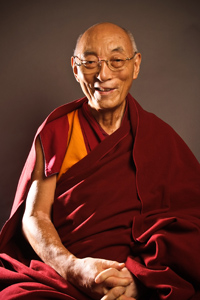
Lama Kunga Thartse Rinpoche was born in Tibet in 1935.  At the age of eight, he entered Ngor monastery where he was ordained as a monk at 16.  In 1972, Rinpoche emigrated to the United States and later founded Ewam Choden Tibetan Buddhist Center in Kensington, CA (see the link on my blogroll).

Early this year, he was diagnosed with lymphoma.  He underwent chemotherapy while his nearby friends and students saw to his diet and daily needs.  Friends the world over offered prayers and traditional healing ceremonies.  His cancer is now in remission and he just returned to a full teaching schedule seeming more vigorus than ever.

Lama Kunga Thartse Rinpoche

A week ago Sunday, I joined some of Lama Kunga’s students and friends in the bay area to celebrate his birthday and his return to health.  This is a man who had lots of help in his time of need because he lives his life as everyone’s friend.  In Buddhism, compassion for all sentient beings is the most important attribute we can cultivate.  The Dalai Lama has said, “We can live without religion and meditation, but we cannot survive without human affection.”

Buddha gave different teachings for different kinds of practitioners.  The first was Hinayana, the “lesser vehicle,” which aims at enlightenment to end suffering for the individual.  Of far greater importance today is Mahayana, the “greater vehicle,” where the goal is to reach enlightenment for the benefit of all sentient beings.  People are naturally drawn to those who fully embody such an ideal.

His Holiness, the Dalai Lama

Though not nearly as well known as the Dalai Lama, Lama Kunga also has the magnetic personality of one who sincerely tries to benefit all other beings.  I hadn’t seen him in almost a year, but at his birthday party, we fell into conversation as if it had been just a week.  We talked about things like Tibetan ways of cooking  potatoes, but I found myself as uplifted as I have been after hearing him speak about subtle points of philosophy.

Some instructors teach with their whole being and not just their words, yet remain very human too.  Lama Kunga is an avid golfer.  In a 2002 interview in Golf Digest he said, “I would like to be reincarnated as a better golfer someday.”  One of his golfing buddies reports that he sometimes uses “colorful sounding phrases in Tibetan” on the course.

When I was a junior in high school, one of my teachers said, “I really think life is only satisfying when we live for something greater than ourselves.”  In the decades since then, the people I’ve most admired lived that ideal.  “Rinpoche” is an honorific that means “precious one,” a title that friends of Lama Kunga know he richly deserves.

The music of Iris Dement

Last Sunday I caught an NPR interview with one of today’s finest country and folk music artists, Iris Dement.  Her music is not as well known as it should be, though it has been featured on several notable TV shows and movies.

I first heard Dement’s music in the final scene of the final episode of my favorite TV show of the 90’s, Northern Exposure.  The song, “Our Town,” from her first album Infamous Angel 1992, illustrates one constant in her work, an unflinching look at the losses and longings that permeate our lives.

And you know the sun’s settin’ fast,
And just like they say, nothing good ever lasts.
Well, go on now and kiss it goodbye,
But hold on to your lover,
‘Cause your heart’s bound to die.
Go on now and say goodbye to our town, to our town.
Can’t you see the sun’s settin’ down on our town, on our town,
Goodnight.

In the NPR interview, Dement said that for her, singing is prayer, and two other songs on Infamous Angel reflect the range of her spirituality.  The album’s title song is about redemption, imagined from the perspective of her evangelical upbringing, while “Let the Mystery Be” opened the soundtrack of Little Buddha 1993.

Everybody’s wonderin’ what and where they all came from.
Everybody’s worryin’ ’bout where they’re gonna go when the whole thing’s done.
But no one knows for certain and so it’s all the same to me.
I think I’ll just let the mystery be.

Dement’s second album, My Life, 1994, won a grammy nomination in the Best Contemporary Folk Album category.  The liner notes explain why it’s dedicated to her father who had been a fiddler but stopped playing after he was “saved.”  Young Iris was fascinated by the dusty violin case in the back of the closet and one day mustered the courage to ask her father to play a song.  He looked at her and at at the violin for a very long long time before picking the instrument up.  The few bars he played gave his daughter permission.  “No Time to Cry,” is her song about his passing.

Also notable on My Life is “Sweet is the Melody,” a beautiful song and fine expression of the nature of the creative process:

Sweet is the melody, so hard to come by
It’s so hard to make every note bend just right
You lay down the hours and leave not one trace
But a tune for the dancing is there in it’s place

Dement appears in Songcatcher 2000, a movie about an early 20th century musicologist collecting Scots-Irish ballads in the Appalachians.  She sings “Pretty Saro,” an expression of American roots music that parallels her own search for musical authenticity. Her most recent film credit is True Grit, 2010, where her version of the classic hymn, “Leaning on the Everlasting Arms” plays at the end of the movie.  You can watch a clip in my review of the movie: http://wp.me/pYql4-up

The recent NPR interview follows the release of Dement’s fourth album, Sing the Delta, a reference to the Arkansas Delta where she was born. http://www.npr.org/2012/10/28/163560263/singing-is-praying-for-iris-dement.  She discusses the importance of her Pentecostal upbringing.  As the youngest of 14 children, she sang in the church choir and took her faith seriously as an adolescent.  Losing that faith as an adult is reflected in her new song, “The night I learned how not to pray,” yet Dement emphasizes her gratitude for what she was taught as a child, saying it gave her a message “about what’s going on underneath the waters of life.  My parents just gave me a gift I can’t even put a figure on.”

Though she left the beliefs that sustained her youth, Dement relates a lesson she learned from her mother, “My mom, who sang straight up until the day she died, told me one day: ‘You know, Iris, singing is praying and praying is singing. There ain’t no difference.’ So I think, even though I’ve left the church and moved away from a lot of the things that didn’t do me any good, I continued to pray — and that is singing for me.”

You won’t find music more sincere or heartfelt than this.

This is post #17 in a series of reflections on spirituality and living that fellow blogger, Jason, has been posting every Monday. Each post relates to a letter of the alphabet. Who knew that “Q” could generate such a useful series of thoughts that are both timely and timeless? – Morgan

Jason E. Marshall's avatarLiving In The Now

This is my seventeenth post in a series, where each Monday (if possible) I will post about a point of reflection or insight that I will use to reflect and meditate on during the week. In order to make it a bit more focused and interesting, I will attempt to do this with topics beginning with letters from A to Z. I have often found that having a specific topic to reflect and/or meditate on during the week really lends itself to interesting insights and growth, because you not only have several days to reflect and meditate on the topic, but you have several days to put any lessons and insights that you discover to work in your every day life. For those that follow me on Twitter (@JasonLivingNow) I will try to write updates as the weekly topics come up during meditations, moments of reflection, or just during everyday…

View original post 862 more words

Lost, a poem by David Wagoner

David Wagoner, a prolific poet and novelist, was born in the midwest in 1926.  In 1954, he moved to the Pacific northwest and said that crossing the Cascades and coming down into a Pacific rainforest “was a big event for me, it was a real crossing of a threshold, a real change of consciousness. Nothing was ever the same again.”  He has taught at the University of Washington since that time.

He based his marvelous poem, “Lost” on teachings the northwest coast Indians gave their children on what to do if they ever got lost in the forest.

Lost

Stand still.  The trees ahead and bushes beside you
Are not lost.  Wherever you are is called Here,
And you must treat it as a powerful stranger,
Must ask permission to know it and be known.
The forest breathes.  Listen.  It answers,
I have made this place around you,
If you leave it you may come back again, saying Here.
No two trees are the same to Raven,
No two branches are the same to Wren.
If what a tree or a bush does is lost on you,
You are surely lost.  Stand still.  The forest knows
Where you are.  You must let it find you.

From, Travelling Light, Collected and New Poems, 1999

Up to each one of us

Last weekend, I attend a teaching by Lama Pema Wangdak, a Tibetan Buddhist who was sent by the head of his order to teach in this country in 1982.  I invite you to read about his many humanitarian activities, which include founding schools in three countries and inventing a Tibetan brail alphabet. http://www.ewamchoden.org/?p=2093

Lama Pema

Lama Pema represents the next generation of the Tibetan diaspora, educated by traditional Tibetan masters, but fully acclimated to western culture.  He illustrates points of philosophy with current movies or ancient stories with equal ease.  He has a great sense of humor too.

Many traditional teachings are presented in simple phrases, called “pith instructions,” that are easy grasp with the intellect, but not so easy to grasp in depth.  For instance, we all understand the truth that “everything changes,” but it takes reflection to real-ize in the gut what that means in personal terms.

Because of this election season, some of Lama Pema’s comments ventured into the realm of politics.  He threw out some of his own deceptively simple concepts, which I’m still pondering and want to pass on.

One of his constant themes is individual responsibility, moment by moment, in trying to create the kind of world we want to live in.  “The peace of the world hinges on you and me,” he said.  I jotted down some of his other comments.

“We expect the world to be ‘right’ and to make us feel good.  In fact, we are in the midst of chaos and it’s up to us to make it right.”

“There are some people who can improve situations by their very presence, by their inner nature.  There are others for whom it’s not quite right, and when they are done, it’s much worse.  Both capacities live within each of us.” 

“We have to stand up for what we believe in, be decisive about what we are aiming for…To belittle oneself, undermine oneself is a real sin…To take risks, even at the risk of being wrong, is far better than not taking risks.”

“A great part of our humanity is sustained by legends, imagination, and hope.  It’s all imagination.  To take life as a dream helps lower our blood pressure.”

Deceptively simple ideas.  The kind it’s easy to jot down in a notebook and forget about a day or two later.

One classic exercise with this kind of teaching is to take one of these points and focus on it for a day or a week or longer.  Mull it over, bring it to mind when we wake, while walking in from the parking lot, while waiting at red lights.  “What do I believe in, what do I need to stand up for?” for instance.

As if to underscore the idea, Lama Pema gave the example of Gandhi.  Even though we know it happened, it’s hard to believe one skinny little man could push the British out of India.  The core of all his action was knowing what he believed in, what he stood for, with unswerving certainty.

There was no suggestion that we are called to change the world in such a dramatic manner.  The suggestion was that at every moment, our thoughts and actions always change the world, either for good or ill.  The suggestion was to bring mindfulness to bear on our “simple” actions and see what kind of difference they can make.

This summer I met a hero

It’s so easy to get caught up in negativity.  Sometimes all it takes is a quick scan of the paper or a click on a topical websites to make the world seem full of scallawags and scoundrels.  This summer, however, I was privileged to meet a towering figure of moral courage.

His Eminence Choden Rinpoche was born in eastern Tibet in 1933.  At the age of three, he was recognized as the reincarnation of a previous master, and he took novice ordination vows at seven.  He chose not to flee Tibet after the Chinese takeover, and beginning in 1965, during the cultural revolution, Rinpoche spent 19 years in seclusion, living in a windowless basement room at a cousin’s house in Lhasa.

During the cultural revolution, thousands of monasteries were destroyed and more than a million people, especially lamas, monks, and nuns were imprisoned.  When the Chinese burst into his room unannounced at various times of the day or night, they never found any incriminating evidence of religious activity – no texts or even prayer beads.  He was able to hide in plain sight because they thought him an invalid.

Like other spiritual giants – Gandhi, Nelson Mandela, and Martin Luther King – Choden Rinpoche used his time in what amounted to a cell to deepen his practice.  From memory and imagination, he recited texts and performed rituals he had learned, internalizing Buddhist philosophy.

“From the point of view of spiritual practice, there was great accomplishment in living as I did…If I had gone with the Chinese, I would have received a house, a car and high rank, but I would have had to harm people and cause much suffering…I didn’t have to experience any of this.  These were the advantages of living as I did.”  – from a pamphlet published by Ananda Dharma Center, San Jose, CA, 2012. 

In 1985, Rinpoche was able to leave for India, and he has been teaching around the world since then.  I was a beneficiary this summer and attended a very special series of teachings he gave at his US home, the Ananda Dharma Center in San Jose.  http://anandadharma.org

On July 28, I went to the final event of the summer, a long-life puja for Rinpoche.  It’s a beautiful ceremony in which students, friends, and other lamas essentially ask him to stick around in his present incarnation as long as possible.  Choden Rinpoche is a Tulku, a word for those believed to be able to chose the time and place of their next birth.  For the rest of us, the puja is a way of saying, “Hang on – don’t leave yet!”

Rinpoche has had trouble with his knee.  On Thursday, he flew to Taiwan where some of his students are doctors.  Today he undergoes knee replacement surgery.  Friends and students around the world are sending prayers and good wishes in his direction.  With that in mind, I decided to write that post, knowing even as I did so, that I am really the one it benefits.

Like his friend, the Dalai Lama, Choden Rinpoche’s mind is always fixed on what’s beneficial.  Some of the rest of us (meaning me) have to rely on the inspiration of people like this to bring unruly thoughts back to what really matters.