Getting rid of those pesky memories

In my previous post, I wrote of advances in the field of virtual reality, and posted a video clip that brought to mind the dystopian landscape of Aldous Huxley’s Brave New Word (1932).  Huxley imagined life in “The World State” in 2540, where children are born in “hatcheries.”  They are raised in “conditioning centers” and learn to be avid consumers and abhor the thought of solitude.

Happy face thumbs up

One of the World State’s tools for keeping people docile are “the feelies,” multi-sensory movies, most often centered on sex.  The connection to virtual reality should be obvious.  Another conditioning tool was “soma,” a side-effect free hallucinogenic drug that World State citizens used to go on “holidays.”  Soma relates to the subject of this post – a potential advance in the technology of feeling happy, happy.

In “Unwanted Memories Erased in Experiment,” an article in The Wall Street Journal (12/23/13, p. A1), Gautam Naik writes that scientists used electrical currents to erase memories they had implanted earlier.  Someday doctors may be able to zap painful memories and leave the rest in tact.  Assuming the technology becomes (relatively) safe, would this be a wise thing to do?

In a few cases it might be – the 39 patients who volunteered for the experiment were already undergoing electroshock therapy for severe clinical depression after all other treatments had failed.  But the article’s assertion that memory erasing might be useful to remove “associations linked to smoking, drug-taking, or emotional trauma” suggests the kind of social engineering Huxley wrote about.

Last year at a Buddhist teaching, I met an elderly woman who had spent her youth in a Soviet gulag.  As difficult as the hardship was, she had written a memoir for her family to read, “So they’ll know who I really am.”  Her core identity, as well as her later practice of Buddhism were direct results of those years of suffering.

In my late 20’s, I knew a woman who lost her closest male friends over a short period of time; they died of cancers related to Agent Orange exposure in Vietnam.  After surviving a deep depression, my friend enrolled for training to work in a hospice.  Without the pain of loss, she wouldn’t have found her calling.

The poet, Rilke, declined Jung’s offer of therapy work saying, “If you take away my devils, I fear my angels might flee.”  

The disowned parts of ourselves are especially important in scripture.  When Jesus offers living water (Jn 4:10-13), only those who know they are thirsty will hear him.  When Buddha teaches a path beyond suffering, we won’t listen if we’ve deadened ourselves with soma or reality TV.

A tour of America 80 years ago sparked Huxley’s vision of an economic and political culture at war with soul values.  Now that another “holiday season” has run its course, as the media waits for the next distraction, I am reminded once again of the cautionary words in this wonderful poem that William Stafford published in 1960:

A Ritual to Read to Each Other

If you don’t know the kind of person I am
and I don’t know the kind of person you are
a pattern that others made may prevail in the world
and following the wrong god home we may miss our star.

For there is many a small betrayal in the mind,
a shrug that lets the fragile sequence break
sending with shouts the horrible errors of childhood
storming out to play through the broken dyke.

And as elephants parade holding each elephant’s tail,
but if one wanders the circus won’t find the park,
I call it cruel and maybe the root of all cruelty
to know what occurs but not recognize the fact.

And so I appeal to a voice, to something shadowy,
a remote important region in all who talk:
though we could fool each other, we should consider–
lest the parade of our mutual life get lost in the dark.

For it is important that awake people be awake,
or a breaking line may discourage them back to sleep;
the signals we give–yes or no, or maybe–
should be clear: the darkness around us is deep.


About Rejoicing

Rejoicing is an abrupt theme change from the last two posts I’ve worked on, both of which have ground to a halt.  They seemed important at the time, but they were full of bad news, and there’s plenty of that to go around.

Recently I attended two teachings by a Tibetan lama visiting from the east coast, the Venerable Khensur Lobsang Jampa.  I’d heard him on a previous visit and on both occasions his teachings were all I expected and more.  I purchased a book he published this year and started to read it when I got home.

Ven. Khensur Lobsang Jampa Rinpoche.

Ven. Khensur Lobsang Jampa Rinpoche.

In the early pages, he gave an account of a king called Prasenajit who sought the Buddha’s advice.  King Prasenajit wanted to study the Dharma, and asked how he could do so when so much of his time was devoted to running his kingdom.  Like us, he was insanely busy, and didn’t have much time for spiritual practice.

Buddha gave him just three things to do, which he could practice in the midst of other activities:  generate bodhicitta, rejoice, and dedicate.

Bodhicitta is the core of Mahayana Buddhist practice.  It’s the desire and determination to seek spiritual awakening for the benefit of all living beings.  It parallels St. Paul’s first letter to the Corinthians, where he says no amount of spiritual prowess is worth anything without love.

Dedication means mentally giving the positive energy of spiritual practice, the good karma, for the benefit of all sentient beings.  The secret is that by giving it away, we do not lose anything, for like Jesus’ loaves and fishes, there’s always enough to go around.

Buddha’s final instruction, rejoicing, took on a special meaning this week.  Lama Khensur wrote:  “Rejoicing is simply cultivating happiness in the positive actions of others and in the good things that happen to others, thinking ‘How wonderful for them!'” He explained that rejoicing means celebrating the lives of spiritual masters, prophets and saints, as well as the positive actions of “ordinary” people.

Consider the world-wide rejoicing we saw this week for the life of Nelson Mandela.  How uplifting it was to reflect on the positive transformation he brought to his own nation and  to the lives and dreams of people everywhere.  The Buddha said that such uplift is ours anytime we deeply reflect on the good that people have done and can do.

Yesterday I attended the wedding of a long time friend.  I’m not ordinarily a fan of occasions like weddings, where I have to be on my best behavior for several hours at a time, but this was different.  Some 30 friends and family members gathered to witness the union of a couple who are such a good match that it was pure celebration and I didn’t look at my watch until after the cake.  It was easy to think, “How wonderful for them!”

The smallest event can spark this kind of rejoicing when we watch for such occasions.  Last week, when I stepped out of the rain and cold and into a local bagel shop, the young man who brought me a bagel and coffee with a genuine smile passed on something very valuable.  Many such moments are ours when we pay attention.

The clouds above us join and separate,
The breeze in the courtyard leaves and returns
Live is like that so why not relax?
Who can stop us from celebrating?
– Lu Yu

Creative Commons

Creative Commons

Remembering George

George Harrison in the Oval Office at the invitation of President Ford, 1974.  Public Domain

George Harrison in the Oval Office at the invitation of President Ford, 1974. Public Domain

I didn’t call the Beatles by their first names – or even clearly know their names – when they first came to America.  Although the media wouldn’t let you forget Beatlemania, I was more of the Beach Boys persuasion at the time, and later got caught up in the San Francisco sound.  Then, in 1968, the Beatles did something amazing to me – they went to India to study with a guru.  They opened a door I had only vaguely known was there.

George was the Beatle whose life and work were forever altered by eastern religion, as was my own.  He learned to play the sitar with a master, while I learned the harmonium, (a wonderfully simple instrument that allows even a novice to produce a credible melody).  For a time he belonged to an organization I did, dedicated to meditation and the study of eastern philosophy.

In Vrindavan, India, 1996.  Public Domain.

In Vrindavan, India, 1996. Public Domain.

In early November, 2001 at the age of 58, he underwent a last ditch treatment in New York for lung cancer that had metastasized to his brain.  When that failed, he travelled to Los Angeles, where he died on November 29, surrounded by family and friends.  Deepak Chopra wrote:

“He always would say that when I die I want to be fully conscious of God, I want to be totally at peace, and I don’t want to have any fear of death. And believe me, being close to him, I know that he died very conscious of God and in peace and not afraid of death.”

Blood line ancestors pass on their physical substance to us.  Ancestors of the heart pass on their spirit, encourage us by example, and show us what a life well lived can look like.  For inspiration, I still listen to Harrison’s last album, Brainwashed, released posthumously in 2002.  His son, Dhani helped finish it and included this quote from the Bhagavad Gita in the liner notes:

“There never was a time when you or I did not exist. Nor will there be any future when we shall cease to be.”

Here is a very nice clip on one of my favorite George Harrison songs from the Concert for Bangladesh, 1971.

On this day, when I listen to his music, I remember a man I truly admire, who was genuine, who found his own path and followed it to the best of his ability.  “You got to walk that lonesome valley by yourself,” as the old song says, but we do not do so alone.  Somehow the spirits of those who went before are there to inspire us.

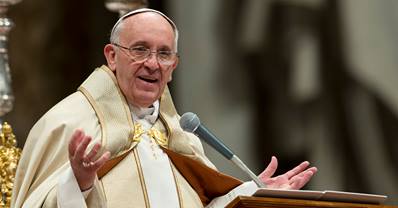
Pope Francis on Economic Justice

Pope Francis

“How can it be that it is not a news item when an elderly homeless person dies of exposure, but it is news when the stock market loses 2 points?” – Pope Francis (1)

On Tuesday, Pope Francis delivered a sharp rebuke of unfettered capitalism as “idolatry of money” that will lead to “a new tyranny.” (2)  His language was specifically directed at those in the United States who continue to defend “trickle-down economics,” which he said “has never been confirmed by the facts, [and] expresses a crude and naive trust in the goodness of those wielding economic power.”

“Meanwhile,” he said, “the excluded are still waiting.”

President Obama said he was “hugely impressed with the pope’s pronouncements.”  Nevertheless, on Wednesday, the US announced it will close its Vatican embassy as a “cost saving measure.” (3)  The seven embassy staffers will be retained, just moved beyond the borders of Vatican City, which is the world’s smallest sovereign nation.

Republican senators, many of whom still advocate the trickle-down policies the pope condemned, were quick to denounce the administration’s move as “a slap in the face to Catholic Americans around the country.”

Though I’m not a Catholic, I find myself deeply grateful on this day of thanks, for the current Vicar of Christ.  When politicians of all persuasions spend most of their time defending an increasingly dysfunctional status quo, it is refreshing and marvelous to find a world leader willing to speak the truth.


The Legend of Bagger Vance: a movie review

Bagger_Vance_9176

One of my favorite movies of all time centers on the game of golf, which has never interested me.  It is not about golf, however.  As Roger Ebert said in his review, “It is the first zen movie about golf.”  The Legend of Bagger Vance (2000) was directed by Robert Redford and stars Will Smith in the title role, Matt Damon, and Charlize Theron.

Rannulph Junuh (Damon) is a promising golfer whose girlfriend, Adele (Theron) is the daughter of a wealthy and prominent family in Savannah, Georgia.  Junah, the golden boy, has everything going for him until, as a captain in the first world war, his entire company dies in battle.  Though he wins the medal of honor, when Junah returns home, he lives in the shadows for a decade, as a drunk, abandoning everything from his former life.

In 1930, in an effort to recover the family fortune, Adele organizes an exhibition tournament between Bobby Jones and Walter Hagen, the most famous golfers of the era, at an extravagant golf resort her father built just as the depression struck.  To try to generate local interest, she asks her estranged boyfriend, Junuh, to play.  Junuh can barely hit a straight shot when the mysterious Bagger Vance (Smith) literally steps out of the night and announces he will be Junuh’s caddy.

Vance and Junuh

Vance and Junuh

Bagger Vance becomes a mentor in every sense of the word, helping Junuh recover his “own authentic swing,” a metaphor for recovering an authentic life.

The movie did not do well at the box office, and critical opinion was mixed.  Though Roger Ebert gave it 3 1/2 stars, George Perry of the BBC called it “pretentious piffle,” and Dana Stevens, writing in the New York Times said, “it’s central premises are so banal and dubious as to border on offensiveness.”  Such a reading results from failing to understand that the movie’s genre is mythological, and Bagger Vance is a spiritual guide.

When the movie was released, director, Robert Redford, spoke of the “spiritual journey.” In one interview said he believed in “mythology as a foundational storyline,” and in Bagger Vance, the image of losing and finding one’s “authentic swing,” meant losing and recovering one’s soul.

The theme was close to my own heart.  Nine years earlier, I’d finished a psychology masters thesis on “Imaginal Guides,” but when the movie came out, I felt my corporate work milieu threatened my own soul.  Part of the problem, I think, confronts us all, as the mythical/imaginal dimension of our collective psyche has collapsed.  Events, which once were woven into stories and ballads, become the stuff of headlines and clips on Entertainment Tonight, which are no more nourishing to the soul than yesterday’s tweets.

Redford came “from a big family of storytellers,” which led him to “place value…on mythological story lines because they’re the most solid and they usually have moral and rich characters and a simply told story. And [Bagger Vance] had that…a wonderful, simple, mythological story. A classic hero’s journey.”  

The fact that the movie didn’t have more success may say more about our “entertainment culture” than about the film itself.  Watch this clip, and if it resonates, you are sure to enjoy the movie.

James Hillman on world change and political polarization

James Hillman, 1926-2011

James Hillman, 1926-2011

For decades, James Hillman brought us unique observations on modern life from the perspective of a depth psychology that embraced soul as its highest value.  Recently, I’ve wished I could hear his take on our current climate of political divisiveness, but Hillman, who died two years ago at the age of 85, wasn’t here to watch our most recent shenanigans.  Happily, I recently stumbled upon a pair of interviews in which Hillman discussed this very subject and set it in a context of massive cultural change.

Author and journalist Pythia Peay published the first interview on The Huffington Post in February, 2011 (Jungian Analyst Explains the Psychology of Political Polarization).  The occasion for their talk was the mass shooting in Tucson, which had happened a month earlier.  The most prominent victim was Representative Gabrielle Giffords.

Tragically, memory of that event, just two and a half years ago, has been lost in the wake of more recent carnage, including the Nevada school shooting earlier this week.  Though Hillman’s comments focused on the role of political divisiveness in the attempt to kill a congresswoman, his additional statements now seem eerily relevant to the 12 year old in Sparks who was so alienated that he ended his life with murder and suicide.

Hillman began with a general discussion of polarized thinking.  “Polarity,” he reminds us, is an electrical engineering term.  Batteries have poles; the psyche is far more nuanced than that, dwelling in shades of gray rather than black or white.  Ideological extremes subvert our ability to judge individual issues on their merit.

When asked if violently polarized politics caused the shootings, Hillman changed the focus to another kind of cultural rigidity and its effect on the Tucson shooter:

“I think that this kid was made a loner by an American educational system in which there is no room for the weird or the odd…We need to have an educational system that’s able to embrace all sorts of minds, and where a student doesn’t have to fit into a certain mold of learning. Our educational system has become so narrowed to a certain formula, that if you go through a weird phase, you’re dropped out — often at the age of schizophrenia, 19-23 — and that’s the danger.”

Arguments in the wake of gun violence bog down in specifics, like background checks and how many bullets a magazine should hold – we don’t ask why and how we’re producing more and more people prone to mass violence.  In the end, says Hillman, for a culture that pays so much lip service to “the individual,” we are terrified of real individuality, and attempt to stamp it out.

In the second interview, America and the Shift in Ages, Hillman suggests that much of that rigidity has to do with futile attempts to shore up outmoded systems and institutions during a period of massive change.  Not just one but “three or four” myths that are central to our culture are collapsing.

Everything we fear has already happened said Hillman:  “The fragility of capitalism, which we don’t want to admit; the loss of the empire of the United States; and American exceptionalism. In fact, American exceptionalism is that we are exceptionally backward in about fifteen different categories, from education to infrastructure. But we’re in a stage of denial.”  Other beliefs and structures are crumbling as well, he said.  White supremacy, male supremacy, the influence of monotheistic religions, and the belief that we are “the good people.”

If such institutions do not appear to be in decay, it’s because they are so staunchly defended, and that, Hillman says, is a sign of their lack of vitality — “If they were vital they wouldn’t need to be defended. And the fanaticism we’re witnessing goes along with the deterioration of the vitality of these myths.”

Many of our fundamental beliefs are under scrutiny and need to be.  Hillman mentions the meaning of “freedom.”  For many, freedom means, “I can do any goddamn thing I want on my property; that I am my own boss and don’t want government interference; that I don’t want anybody telling me what I can and can’t do.”  This, he says, is the freedom of an adolescent boy.  What of the different kinds of freedom, such as “freedom from the compulsions to have and to own and to be someone?”  What of the freedom Nelson Mandela found in prison?

Hillman cites economic assumptions that need to be questioned as well.  Falling demand needs to be stimulated, according to current assumptions, but from an ecological point of view, that’s exactly what the world needs at this time.  Sustainability models, which may be our hope for the future, terrify those in positions of power.

Many of our current fears, says Hillman – from fear of immigrants crossing our borders, to fear of failing education, to fear of cancer, to economic insecurity, terrorists, and of course fear of “the other” political party, results from the lack of a wider framework in which to understand the massive shifts that are already underway.

There is no going back, but as obsolete structures crumble, we can glimpse, if we look, new forms emerging.  Hillman gave the example of a “Bioneers” conference he attended where Paul Hawken showed a film that was simply the names of individuals and organizations involved in trying to innovate ways of building communities, economic systems, and ways of dealing with the natural world.  Hawken said there were thousands of names, and the film could roll for weeks.

Hillman said it’s important not to try to fit emerging structures into the patterns of the past.  For our peace of mind, a new kind of faith is required:   “I think it’s a matter of being free-wheeling, and trusting that the emerging cosmos will come out on its own, and shape itself as it comes. That means living in a certain open space — and that’s freedom.”

Dawn over Oostende, Belgium, 2007.  Photo by Hans Hillewaert, CC-BY-SA-3.0

Dawn over Oostende, Belgium, 2007. Photo by Hans Hillewaert, CC-BY-SA-3.0

Such words are a fitting conclusion to the lifework of a man who lived in defense of Anima Mundi, the World Soul and who taught that animals, trees, and rivers are intelligent and alive, and that at some deep level of the psyche, we can hear their voices.  In Hillman’s life work, observation of the modern psyche led to conclusions that mesh with the myths of the ancestors.

A thousand years from now, people will read of our times and shudder, as we do in contemplating the rigors of life in the middle ages.  A few visionaries stood out from the rest, those like Saint Francis, Dante, and Leonardo, who pointed toward a more benevolent and expansive future.

We cannot write our own history, but we can wonder how it will look to those in the future.  I am convinced that James Hillman will be remembered when most of what passes for news on TV is blessedly forgotten.

Stories that make the world

Photo by Manel, 2011, CC BY-ND 2.0

Photo by Manel, 2011, CC BY-ND 2.0

 On saturday, an acquaintance and I met at a local park to discuss some things of mutual interest.  It was a stunning fall day, with temperature in the low 80’s, so we sat for several hours at a picnic bench surrounded by tall oaks.

I met this man just a few months ago, and during the conversation, it became clear that his political views and mine are polar opposites.  We mentioned them but didn’t argue, for we had other things to discuss.  Besides, by then some people nearby had a birthday barbecue going, and we were both distracted from politics by the smells.  When someone said, “Anyone else want a burger?” I was sorely tempted to raise my hand.

Later though, I reflected on how the two of us could hold such different narratives of the same recent events.  The poet, Muriel Rukeyser’s phrase, “The universe is made of stories” came to mind, as it often does, for it summarizes a key observation of two disciplines that have deeply shaped my world view, eastern philosophy and depth psychology:

  • “The Buddhist does not inquire into the essence of matter, but only into the essence of the sense perceptions and experiences which create in us the idea of matter.” – Lama Angarika Govinda, 1969.
  • “Every notion in our minds, each perception of the world and sensation in ourselves must go through a psychic organization in order to “happen” at all.” – James Hillman, 1975. 

Such statements may seem too lofty for a number of common experiences, especially things like physical pain, even the sliver I have in a finger from hauling firewood onto the back porch.  Not long ago, however, I came upon a concrete example of how the mind creates reality.

A contemporary Tibetan lama spoke of an experience we all went through in learning to read.  One day when we were young, a teacher drew three marks on the board (or our parents did, or we saw it on Sesame Street).  That teacher then said something that changed our world forever:  “This is the letter A.”

a-elmo-alphabet 200

From that moment on, the letter “A” existed for us, and it always appears to exist “out there,” in the world, when in fact, all that’s “out there” are three lines in a specific pattern.  “A” exists only in the minds of those who have learned certain alphabets – a person who doesn’t read or only reads Chinese would not be able to find it.

This small story about the letter “A” parallels the complex stories we create, borrow, and use to make the sense of the world.  Sometimes, like this past saturday, when it seems like the person you’re talking to comes from an alternate universe, it’s because they do – not a universe we could travel to with  warp drive, but one that is simply constructed of very different stories.

Friday is World Animal Day

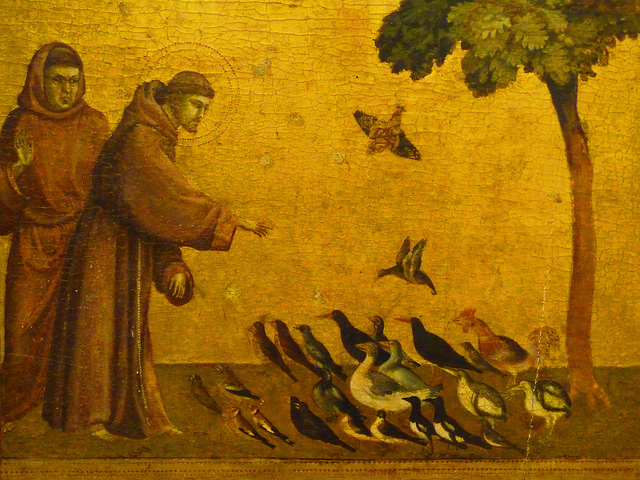
Saint Francis and the birds, by Giotto.  CC BY-NC-ND 2.0

Saint Francis and the birds, by Giotto. CC BY-NC-ND 2.0

“The greatness of a nation and its moral progress can be judged by the way its animals are treated.” – Mahatma Gandhi

October 4 is the Feast Day of Saint Francis, renowned for his love of animals. In 1931, a group of ecologists meeting in Florence, Italy, chose this date as World Animal Day to highlight the plight of endangered species.  Since then it has grown to a world wide day of celebration of animals by people who love them in all nations and religious traditions.

The Singapore SPCA held a three day celebration in September, with a theme of “Friends for Life.”  The Moscow Zoo is holding its celebration of Saturday.  World Animal Day celebrations are scheduled in Pakistan, India, Indonesia, Jordan, Dubai, France, Britain, Sweden, Bosnia and Herzegovina, the US, Canada, Serbia, Greece, Bolivia, Chile, Australia, the Ukraine, Palestine, Gambia – and these were just locations listed on a single website.

A revered Tibetan Buddhist teacher, Lama Zopa Rinpoche, urges his students to pray for the wellbeing of animals on October 4, and recite mantras to bring them auspicious rebirths.  If one is looking for a pet, he says, it’s a perfect day to visit a shelter and adopt, or adopt an animal via a contribution to an organization that benefits them.

Friday is a wonderful day to notice and appreciate the birdsong in the morning, the hawk in the noontime sky, and the creatures who bring so much to our lives.  What would our world be like without them?

Kit and Missy smiling