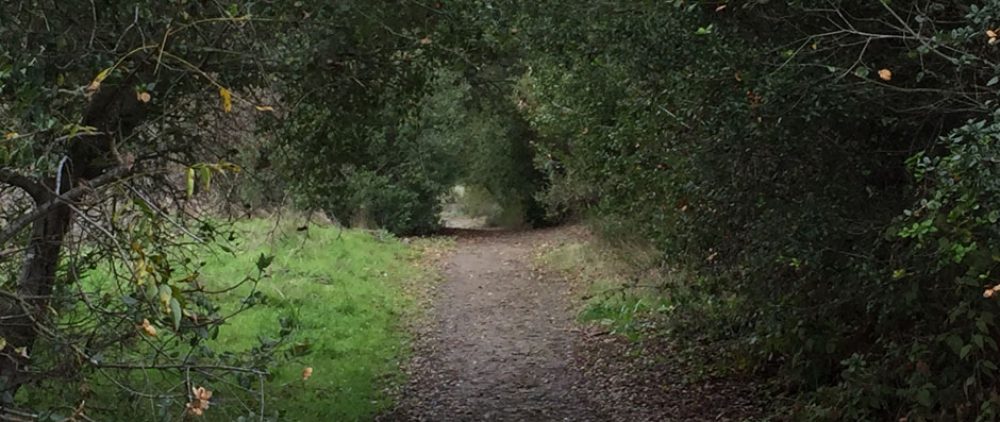
Shangri-La in Books, Movies, and Legend

I recently wrote a short story about a group of people trying to find Shangri-La. For decades, the name has stood for an earthly paradise, difficult to attain. The name was so popular in the 30’s and 40’s that before it was renamed Camp David, Franklin D. Roosevelt named the presidential retreat ground, Shangri-La. After my story was finished, I began to research this mythical place about which I realized I knew very little.

The name, “Shangri-La” entered public awareness through a novel and a movie, which I will discuss today. In my next post, I will explore the Tibetan legend of Shambhala from which core elements of the story may derive.

In David Hilton’s 1933 novel, Lost Horizon, Hugh Conway, a world-weary British diplomat and WWI veteran, along with three others refuges from an uprising in India, board a plane that is hijacked to the remote mountains of Tibet. They crash land in the snows and find their pilot dead. The group is rescued by a postulant lama named, Chang, who leads them to the hidden lamasery of Shangri-La, high above a fertile and temperate valley. Here Conway finds peace, the stirrings of love, and a sense of purpose when the High Lama tells him he has been chosen to oversee the mission of Shangri-La – to preserve the best of modern civilization during a world war the lama, (who is 300 years old), has seen in vision.

Did Hilton foresee WWII when he wrote his book in the early 30’s? Perhaps, but he also studied a 1931 National Geographic account of an expedition to the borders Tibet. Unexpectedly temperate valleys lie along the Nepalese border, and Hilton may also have read of the legend of Shambhala, with a similar prophesy of a world war. This prophesy is part of the Kalachakra teaching cycle the Dalai Lama presents, most recently in Washington, DC, last summer.

Lost Horizon won public notice only after Hilton published, Goodbye Mr. Chips, the following year. Because it was later published as Pocketbook #1, Lost Horizon has been mistakenly called the first American paperback.

Frank Capra read Hilton’s book and immediately decided to make the movie version. Production began in 1936, with a budget of $1.25 million, the largest for any film at the time. After a $777,000 cost overrun, Lost Horizon, was released in 1937 to critical acclaim. A New York Times reviewer called it, “a grand adventure film, magnificently staged, beautifully photographed, and capitally played.” It won Oscars for Art Direction and Film Editing, and was nominated for Best Picture.

Both the book and the movie seem dated now. The romantic vision of humans-as-noble-savage will not appeal to our modern sensibility. The idea that people will be good if freed from want echoes both the pacifism that flourished after the first world war and the socialism that grew in response to the hard times of the ’30’s. I believe in the “higher vibration” of certain places, yet when Chang tells Conway the healing properties of Shangri-La have even eliminated human jealousy, it breaks my “suspension of disbelief.”

Even with this kind of flaw, I enjoyed the book and the movie. The specifics of the Lost Horizon’s 75 year old vision may be dated, but the archetypal longing for a golden age and heaven on earth is not. The book and movie tap into this, and the tale of paradise found then lost evokes our longing for the Garden of Eden, Atlantis, Avalon, and Shangri-La. “We are stardust / We are golden / and we’ve got to get ourselves back to the Garden,” sang Joni Mitchell in her song about Woodstock, another manifestation of longing for a world of peace and joy.

This longing will not go away because it expresses our true nature, according to the view that gave birth to the legend of Shangri-La. Next time we’ll look at the legend of Shambhala, which carries predictions that will echo some we have seen in Lost Horizon.

How Much is Too Much?

I have to thank Ceinwenn for this topic.  He or she (I can’t be sure, since the link takes me to a password protected forum) commented on my previous post, Three Requirements of a Book Review (?).  Ceinwenn felt I had given away too much plot info in my review of  David Baldacci’s First Family.  It’s entirely possible.  Several comments mentioned avoiding spoilers, something I have not considered as much as I will now.

In my own defense, I would cite the similarities of a synopsis, which you use as a design and advertising tool with your own fiction, and the plot exposition section of a book review.  In a synopsis, you must reveal what happens; you can’t leave an agent or editor guessing.  In a book review you must not.  Got it.  Thanks.

But that wasn’t what I really wanted to talk about here.  Ceinwenn’s comment spun me off thinking of several recent things I’ve said about blogging, and specifically my discovery that the public act of blogging is far more stimulating than the private act of writing in a journal.  The public nature of blogging makes it challenging in terms of deciding how much self-revelation is right.

My wife has commented on my tendency to get too academic and boring, which is an easy path for me to take.  On the other hand, I remember a psych teacher who was Mr. Sensitive-Self-Revelation, and it wasn’t a pretty sight!  A remember a very calm and poised young woman walking out of the class, shaking her head and making barfing noises.

You get what I’m saying.  As a blogger I want to be real and I enjoy the same quality in others, but I’ve used the delete key on posts that went to far.  I might write about an embarrassing moment, especially if there is humor involved, but I’m probably not going to post my most mortifying-ever experience.  You know the one – you’re driving along and it comes to mind and you slink down in your seat in case the nearby drivers can read your mind.

Some topics rouse caution immediately, notably politics and religion.  Mary and I have a couple of long-term friends that are long-term because we learned early on to stay off these topics.  Here on this blog I circle both politics and religion, but I keep more of a distance than I would personally like to.  Still, because I really dislike door to door religion or candidate salespeople, I don’t want to risk using this space to invade anyone’s right to decide for themselves.  Fortunately, tonight I get to quote someone brilliant on a political topic.

I’m traveling.  As a matter of fact, I’m attending a two day intensive teaching session let by a Tibetan Buddhist teacher of international renown (forbidden topic #1).  I got back to my room and flipped on the news just in time to see the President’s message that a compromise is in the works. (forbidden topic #2).  Whew!  No one with their head screwed on right could wish to see our country in default, and yet, the whole situation is icky!  Have you ever gone for a swim in a lake or river that was too full of alge?  You come out feeling slimy.

It’s far to easy to blame someone else, but none of us are innocent in this mess.  We elected these clowns, most of whom are doing what they think we want them to do in order to get re-elected.  It cuts a lot deeper than that, and once I get home, I may quote from an article I found that has a lot to say about this dance of the public and the politicians.

Meanwhile, here is the brilliant comment I promised, from Walt Kelly, creator of the wonderful comic strip, “Pogo.”  This particular panel was printed in 1971, on the occasion of the first Earth Day, but its message took on a life of its own that goes beyond any single issue.  If we could learn one thing from this latest crisis, this would be my vote.  We, as a nation, will not be destroyed from without, goes the common wisdom, often repeated over the last decade – but clearly we can do it to ourselves.

Kalachakra For World Peace: In Washington, DC and in Sacramento

Did you know that the Dalai Lama is currently engaged in an 11 day ceremony in Washington DC, called  “The Kalachakra for World Peace?” Did you know that a Sacramento organization, the Lion’s Roar Dharma Center is giving a parallel ceremony from July 23, to July 30?  Please read on for the details.

Kalachakra Sand Mandala

Kalachakra, meaning Wheel of Time, is philosophy and set of practices that “revolve around the concept of cycles and time from the cycles of the planets, to the cycles of human breathing.  It teaches the practice of working with the most subtle energies within one’s body on the path to enlightenment.”  Kalachakra also refers to a Tibetan Yidam or meditational deity, who represents a Buddha.  http://en.wikipedia.org/wiki/Kalachakra

Yidam practice is complex and widely misunderstood, but here is a quick analogy: a kid who pretends to be Luke or Leah or Yoda is doing something similar – invoking a figure who represents and inspires bravery and wisdom.  Perhaps the child experiences an inflow of those qualities – except it is not really an inflow because it is already there, in seed form, inside all of us.  Imagination can awaken these latent potentials in a child and in a practitioner of Tibetan Buddhism.

I used to pretend to be Davy Crockett for the same reason.  There was never any real confusion, although my mother looked at me strangely the day I asked her to pick up some bear meat the next time she went shopping – but I digress.

Kalachakra is one of the most advanced Tibetan practices, but because of his perception of the urgent need for non-violence in the world, the Dalai Lama opened this series of teachings to anyone who was interested.  A Tibetan Sangha in Sacramento, the Lion’s Roar Dharma Center, is offering a similar series of classes, beginning with an introductory lecture, July 23, from 7:00-9:00pm, followed by classes and empowerments from July 24-July 30. http://events.r20.constantcontact.com/register/event?llr=rnxs8gcab&oeidk=a07e3puot1u6e5e5f26

Finally, here is a description of the ceremony by , a Tibetan nun who has been working in Washington since May, 2010 to prepare for the Dalai Lama’s performance of this ritual, which is now in progress.

http://www.npr.org/2011/07/14/137848121/in-washington-a-ritual-for-world-peace?ft=1&f=1003

They Say It’s Your Birthday

That’s right. January 22. Just over the cusp of Aquarius.  Old enough to know who Eddie Haskel was (see previous post).  Old enough to take the title for this post from a Beatles song.  Old enough that I was in Jr. High (they didn’t call it middle school then) when the Beatles played Ed Sullivan.

I am interested in Tibetan astrology and discovered there is some disagreement about where January birthdays fall in the scheme of the zodiacal year; the Tibetan new year is in February, but half the web sites and a friend who is a dedicated student of all things Tibetan say the astrological year begins at the winter solstice. That would make me an Iron Tiger. The prognosis for 2011 is not encouraging: one online site says, if you survive 2011, you will enter a run of good fortune. How’s that for good news/bad news? The same site suggests taking a retreat for the rest of the year, and urges caution around sharp tools.  Let’s just say we’re running low on firewood because I haven’t hauled out the chain saw in the last few weeks.

But in the forward looking department, I just put an official tag on this blog for the WordPress Post-a-week 2011 challenge. I saw this way back at the start of January, and figured, “Oh yeah, I’m gonna do that anyway, so I don’t need to be formal about it.”  Rereading the challenge, I realized there is a real stand-up-and-be-counted aspect to being formal about it, so I’m in.

So here’s to a year of surviving and thriving, and at least a post a week to document it!

Murder, Magic, and Redemption – the Story of Milarepa

This rather dramatic lead-in comes from a movie teaser: “Milarepa is a tale of greed and vengeance – demons, magic, murder and redemption. It is the story of the man who became Tibet’s greatest mystic.” http://www.imdb.com/title/tt0499238/
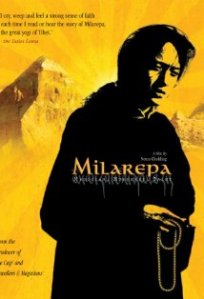
Milarepa film poster

“Milarepa is one of the most powerful and moving stories of love and transformation in world literature” – Richard Gere

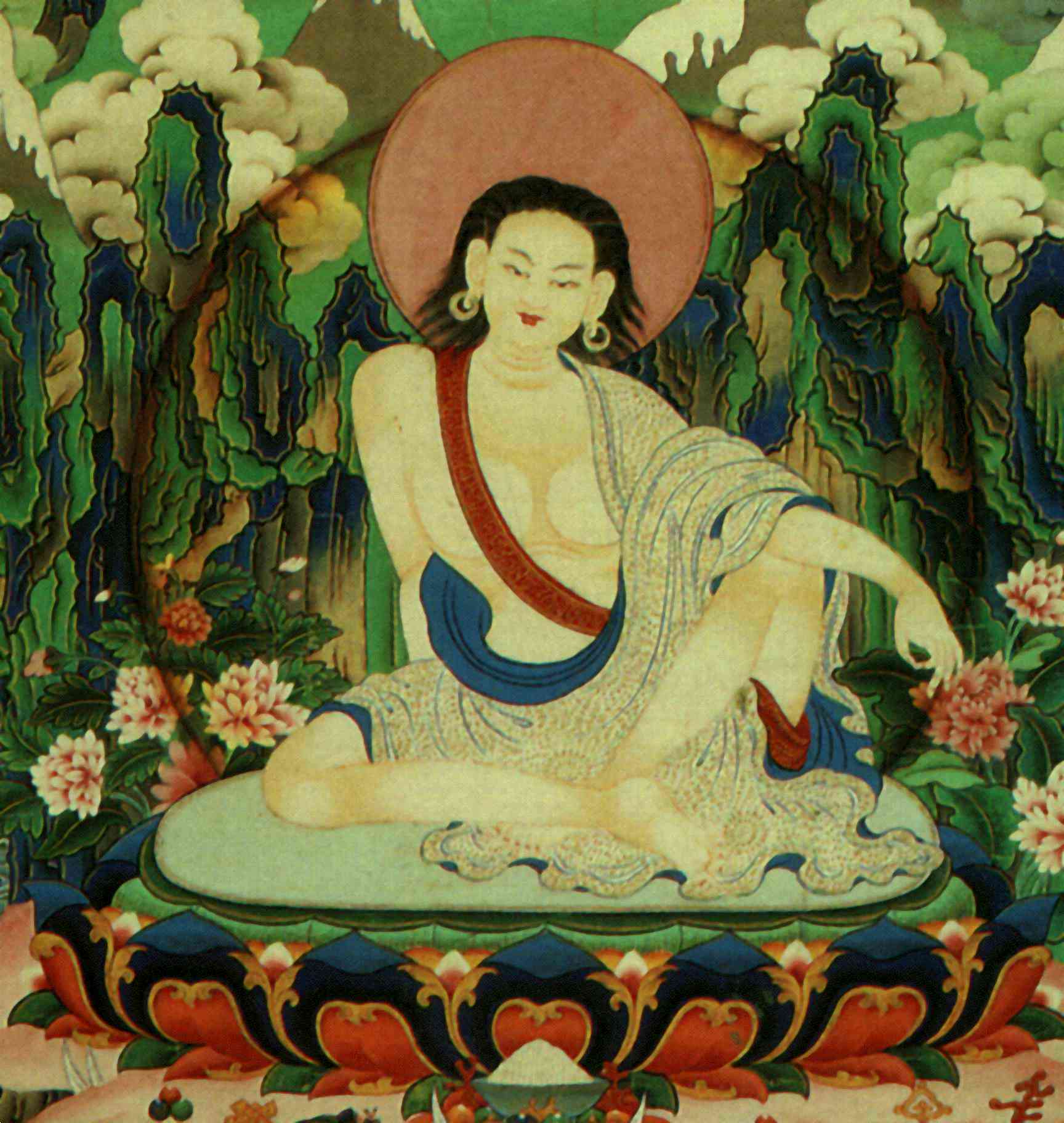
To borrow a term from the previous post, the stories of mystics and prophets are almost always strange attractors. History, shaped by our collective imagination of ultimate things, is guaranteed to be larger than life. Milarepa’s (1052-1135 CE) own teachings are found in the songs and poems he wrote, while the magical legends are from a biography written several centuries later.  The Dalai Lama said, “I cry, weep, and feel a strong sense of faith each time I read or hear the story of Milarepa, the greatest yogi of Tibet.”

Here is a one sentence synopsis: A young man in ancient Tibet commits mass-murder to save his mother, undertakes rigorous spiritual practice to expiate his sin, and becomes a saint whose teachings are still alive nine-hundred years later.

This is the story in greater detail:  Milarepa was born into a prosperous family, but his father died when he was seven, and the house and property went to a greedy aunt and uncle, who treated the family like slaves; they lived in a hovel, ate swill, and toiled in the fields all day.  When he was 15, Milarepa’s mother demanded that he visit a certain sorcerer and learn black magic to extract revenge.  If he didn’t do her bidding, she threatened to kill herself in front of him.

In our culture, where obeying your parents is optional, it’s easy to think the mother was just a whack job, and why didn’t someone think to call CPS?  To understand Milarepa’s story at all, we have to imagine a culture where family honor was more important than life itself.  Where a human incarnation was held to be infinitely precious, and your mother was revered as the chief giver of this gift.  Where allowing harm to come to your mother if you had the power to prevent it was an unimaginable sin.

We speak casually of choosing the lesser of two evils, and for most of us, the dilemma will be over once election day is past.  Not so for Milarepa.  The closest I can come to imagining him wrestling with his choice is to recall the scene of Gary Cooper on the mountain in Sergeant York, a Bible in one hand and the Constitution in another, trying hear the voice of his own conscience.
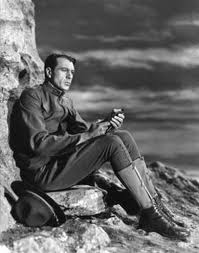
Gary Cooper as Sergeant York

Milarepa chose to obey his mother.  He went to the sorcerer and learned a complex practice that allowed him to invoke spirts who pulled down the stone house where his uncle’s family was celebrating a wedding.  Thirty-five people were in the house.  Ironically, only the aunt and uncle survived.

All hell broke loose.  The relatives of the dead were furious and gave chase.  Milarepa barely escaped pursuit, but he couldn’t escape his own conscience or the negative karma for 33 murders that was sure to land him in Buddhist hells for quite a few incarnations.  His sorcerer contact advised him to seek out a famous guru named Marpa.  When he heard the name, a thrill went through Milarepa, as if a glimpse of his destiny had just opened up.  The night before he arrived, the guru dreamed of someone very special coming into his life.  Though he instantly recognized Milarepa’s potential, he also saw the dark karma and knew the boy would have to work it out before anything else could take place.

Milarepa asked for initiation into spiritual practice, but Marpa refused, saying such treasures were not for someone as “worthless” as he.  Instead, he told Milarepa to move a stone tower to another location three miles away.  It took Milarepa three years to carry the rocks on his back.  Marpa looked at his work, scratched his chin, and said, “You know what?  I think I liked it better at the first location.  Move it back.”

At that point, most of us would be on the phone to our therapist, but Milarepa did what he was told.  In those days, spiritual seekers sometimes endured great hardships and life-threatening journeys for spiritual instruction.  It was all right;  Marpa never wound up on the 6:00 news with charges of fraud or scandal.

Milarepa toiled for for twelve years before receiving spiritual initiation.  After that, he undertook an eleven month retreat in a sealed cave with only a butter lamp for light, and a little slot where someone passed him one meal a day.  Later he moved to another remote cave where he lived on nothing but nettles and local vegetation.  He looked like a living skeleton, but there he attained final awakening.  Just like the parable of the Prodigal Son and related stories from India, Milarepa’s tale asserts that no one is beyond redemption once they sincerely turn in that direction.
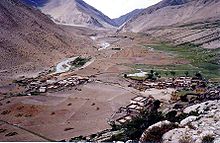
View from Milarepa's cave

Naturally, there are miracle stories about Milarepa.  One of them tells that he pressed his hand into the rock wall of his cave where it still holds the impression.  Here is an online account of someone who visited the site:  http://www.dreammanifesto.com/milarepa-miracle-set-stone.html

During a group pilgrimage to Tibet in the spring of 1998, I chose a route that would lead us into directly to Milarepa’s cave…To demonstrate his mastery over the limits of the physical world, Milarepa had placed his open hand against the cave’s wall at about shoulder level . . . and then continued to push his hand farther into the rock in front of him, as if the wall did not exist! When he did so, the stone beneath his palms became soft and malleable, leaving the deep impression of his hand for all to see…

In anticipation of my questions, our Tibetan translator…answered before I even asked them. “He has belief,” he stated in a matter-of-fact voice. “The geshe [great teacher] believes that he and the rock are not separate.” I was fascinated by the way our 20th-century guide spoke of the 900-year-old yogi in the present tense, as if he were in the room with us. “His meditation teaches him that he is part of the rock. The rock cannot contain him.”
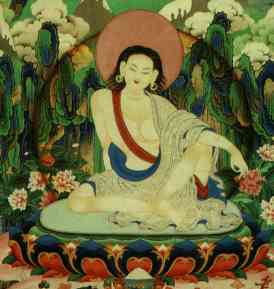
Milarepa

“In my youth I committed black deeds. In maturity I practiced innocence. Now, released from both good and evil, I have destroyed the root of karmic action and shall have no reason for action in the future. To say more than this would only cause weeping and laughter. What good would it do to tell you? I am an old man. Leave me in peace.” – Milarepa http://en.wikipedia.org/wiki/Milarepa

I’m all for stories of solitary heroes going against the crowd.  For stories of finding your life’s purpose and for tales of redemption and spiritual mastery.  My fiction always seems to circle around such themes, but for me, there is even more to the tale of Milarepa.  I’ve been fortunate enough to experience the living nature of his teachings in the person of Lama Kunga Thartse Rinpoche.

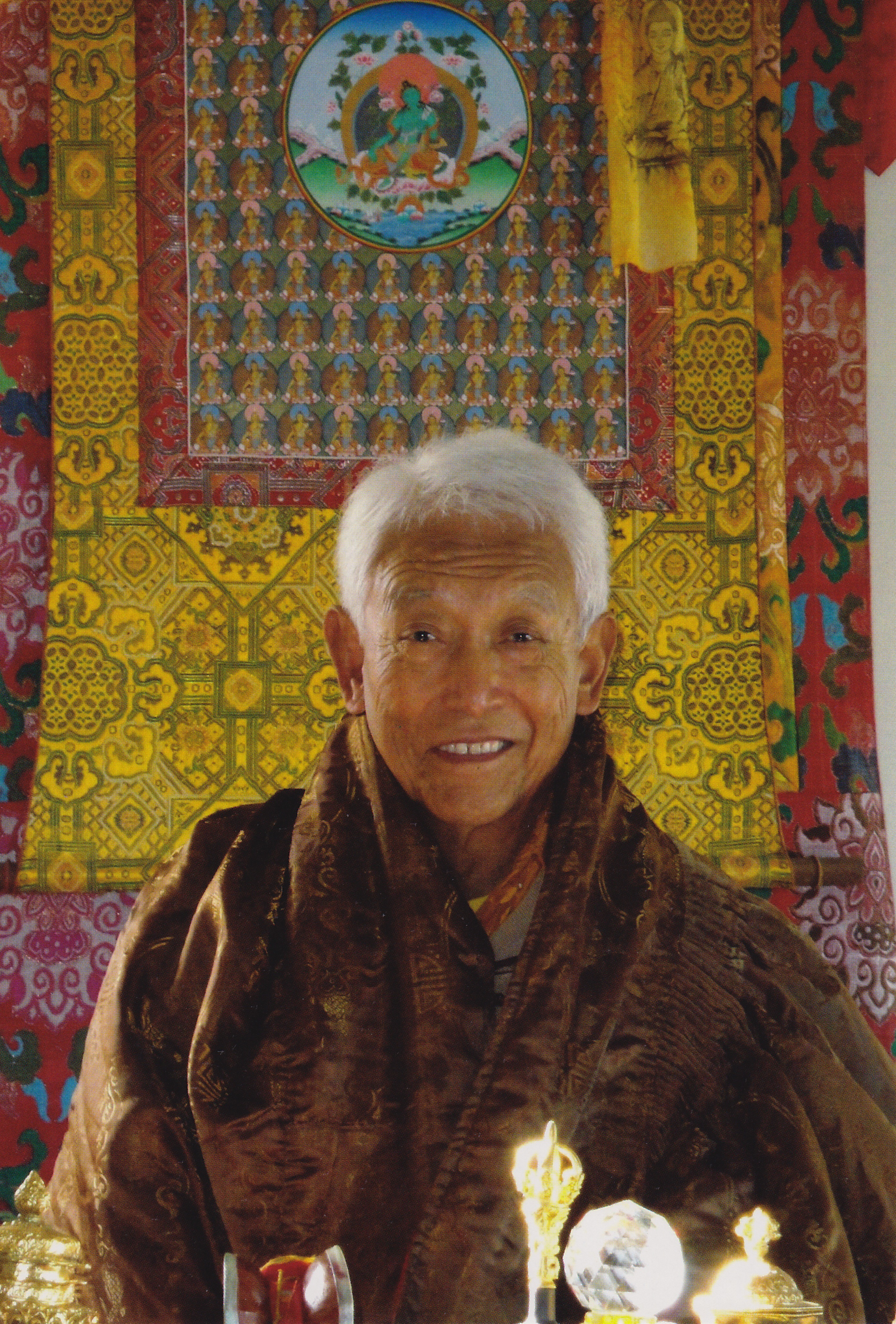
Born in Lhasa in 1935, he was recognized at the age of 7 as a reincarnation of Sevan Repa, one of Milarepa’s closest disciples.  He entered a monastery at 8, was ordained as a monk at 16, and became a Vice-Abbot at 24.  Lama Kunga fled from Tibet in 1959, and in 1972, he founded Ewam Choden Tibetan Buddhist Center in the hills just north of Berkeley (there’s a permanent link to the website on this blog).
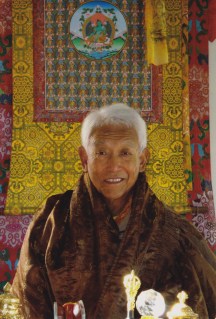
Lama Kunga Thartse Rinpoche

I met Lama Kunga two years ago while searching online for a particular Tibetan ceremony. I knew there was a place in Tucson and had calculated the cost of plane tickets when I found the ceremony was being offered at Ewam Choden, in two days time. I left a phone message, afraid there would be some barrier or pre-requisite, but when Rinpoche returned my call a little while later, he said, “Just come!” I asked if he was sure, and he said once more, “Just come, you are very welcome.”

Ewam Choden is just 90 minutes away, and I’ve been back many times.  On several occasions, I’ve sat through all day teaching sessions that end with the 75 year old lama more energetic than the students who are – at least speaking personally – desperate for a cup of coffee.

No rocks on the back or towers to move.  Lama Kunga is not that sort of teacher at all, as one can gather from the story written about him in the November, 2002 issue of Golf Digest, where he told the interviewer that good golf demands getting past the ego, but then said, “I would like to be reincarnated as a better golfer someday.” http://www.ewamchoden.org/?page_id=46

And finally, if the story of Milarepa seems like a pretty decent fantasy tale and nothing more, that’s fine. It would be fine with Milarepa and with the Buddha before him, who told a group of seekers, “Don’t take my word for anything.”

“Do not go by oral tradition, by lineage of teaching, by hearsay, by a collection of scriptures, by logical reasoning, by inferential reasoning, by a reflection on reasons, by the acceptance of a view after pondering it, by the seeming competence of a speaker, or because you think: ‘The ascetic is our teacher.’ But when you know for yourselves, ‘These things are wholesome, these things are blameless; these things are praised by the wise; these things, if undertaken and practiced lead to welfare and happiness’, then you should engage in them. (Numerical Discourses of the Buddha, p. 66)