
Changes

2x2 Matrix: possible futures, by Gaurau Mishra. CC-BY-2.0

2×2 Matrix: possible futures, by Gaurau Mishra. CC-BY-2.0

Almost four years ago, I posted Change is the Only Constant, a discussion of the December, 2012 report of the National Intelligence Council, a consortium of the 16 major U.S. intelligence agencies. Since 1997, they have issued comprehensive reports on future trends after each presidential election and posted the reports online. We can expect the next installment this winter.

The 2012 edition, which predicts alternate futures for the year 2030, outlines some things that are certain, like aging populations in the developed world; some which are possible, and some “black swans” – potential surprises for good or ill. Here are two key predictions.

  • The rate of change in all areas of life will continue to accelerate and will be faster than anything anyone living has seen.
  • World population will grow from 7.1 billion (in 2012) to 8.3 billion in 2030. Demand for food will increase 35% and for water by 40%.

Keep this in mind as we look at a some current events.  I should preface these comments by saying I’ve long had a rule of thumb: never trust a politician who says, “I have a plan to create jobs.” Both presidential candidates have said those exact words this year.

The fantasy is that by pulling the right levers – cutting or raising taxes, threatening or cajoling China, building a wall at our southern border, and so on, we can restore whatever American golden age our imagination conjures. Maybe the 50’s, when we were the only industrial nation not ravaged by WWII. Maybe the 90’s dot com boom, when even your Starbucks barista had stock tips to share.

We all know that’s not going to happen. The truth is even harder to face than any elected or would-be elected American official has yet been willing to share.

On May 16, the BBC reported that China’s Foxconn, the largest electronics manufacturer in the world, where Apple and Samsung smart phones are made, replaced 60,000 workers with robots.  Chinese manufacturers are investing heavily in robotics. So much for bringing jobs back from China.

For an article in the August 1 issue of Time, (“What to do about jobs that are never coming back”), Rana Foroohar spoke to Andy Stern, a former head of the Service Employees International Union:  “Stern tells a persuasive story about a rapidly emerging economic order in which automation and ever smarter artificial intelligence will make even cheap foreign labor obsolete and give rise to a society that will be highly productive–except at creating new jobs. Today’s persistently stagnant wages and rageful political populism are early signs of the trouble this could generate.”

In a Common Dreams article published last week,  You Can’t Handle the Truth,  Richard Heinberg, steps back for a much longer view of our situation and says:

“We have overshot human population levels that are supportable long-term. Yet we have come to rely on continual expansion of population and consumption in order to generate economic growth—which we see as the solution to all problems. Our medicine is our poison.

“And most recently, as a way of keeping the party roaring, we have run up history’s biggest debt bubble—and we doubled down on it in response to the 2008 global financial crisis.

“All past civilizations have gone through similar patterns of over-growth and decline. But ours is the first global, fossil-fueled civilization, and its collapse will therefore correspondingly be more devastating (the bigger the boom, the bigger the bust).

“All of this constitutes a fairly simple and obvious truth. But evidently our leaders believe that most people simply can’t handle this truth. Either that or our leaders are, themselves, clueless. (I’m not sure which is worse.)”

“…any intention to “Make America Great Again”—if that means restoring a global empire that always gets its way, and whose economy is always growing, offering glittery gadgets for all—is utterly futile, but at least it acknowledges what so many sense in their gut: America isn’t what it used to be, and things are unraveling fast. Troublingly, when empires rot the result is sometimes a huge increase in violence—war and revolution.” (emphasis added)

The last major decline of empires, he notes, resulted in World War I. The US and the rest of the world are, in Heinberg’s words, “sleepwalking into history’s greatest shitstorm.”

“…Regardless how we address the challenges of climate change, resource depletion, overpopulation, debt deflation, species extinctions, ocean death, and on and on, we’re in for one hell of a century. It’s simply too late for a soft landing.

“I’d certainly prefer that we head into the grinder holding hands and singing “kumbaya” rather than with knives at each other’s throats. But better still would be avoiding the worst of the worst. Doing so would require our leaders to publicly acknowledge that a prolonged shrinkage of the economy is a done deal. From that initial recognition might follow a train of possible goals and strategies, including planned population decline, economic localization, the formation of cooperatives to replace corporations, and the abandonment of consumerism. Global efforts at resource conservation and climate mitigation could avert pointless wars.

“But none of that was discussed at the conventions. No, America won’t be “Great” again, in the way Republicans are being encouraged to envision greatness. And no, we can’t have a future in which everyone is guaranteed a life that, in material respects, echoes TV situation comedies of the 1960s, regardless of race, religion, or sexual orientation…”

Heinberg’s conclusions aren’t easy to digest, and are tempting to deny. Keeping attention on even a few of the significant points in the articles referenced here leads to disturbing conclusions.

If 16 US Intelligence agencies are anywhere near correct in their numbers, in 14 years, 8.3 billion people will be competing for 40% less water and 35% less food (in this case, living up to their name, the intelligence agencies don’t waste anyone’s time denying the effects of climate change).

Can we imagine “global efforts at resource conservation” in which nations co-operate, and at least try to send relief where it’s needed?  Like after tsunamis or the earthquake in Nepal? Or are we headed toward a survivalist wet dream?  Futures aren’t set in stone, said the NIA. It all depends on how we behave (sinking feeling in the gut…).

I can see it both ways. Speaking of our current election, someone recently said to me, “I haven’t felt this bad about things since 9/11. Maybe it’s even worse.”  Maybe so. In the immediate aftermath of 9/11, we were a nation and a world largely united in awareness of our fragile humanity and revulsion at senseless suffering.

It strikes me that communities often pull together in the face of disaster when our leaders and governments won’t. That is Heinberg’s conclusion as well. Given our lack of competent leadership at the top, how can we build “local community resilience?”

I wish I knew. But since Iceland has more sense than to open it’s doors to American refugees, I’ll have time to think it over!  Meanwhile this quote from the Dalai Lama comes to mind:

“We can live without rituals. And we can live without religion. But we cannot live without kindness to each other.”

Changes are certain but futures aren’t set in stone…

100 Years Ago – The Battle of the Somme

Cemetery at Poziers, France, in the Somme River Valley

Cemetery at Poziers, France, in the Somme River Valley

“I’ve never met a grandson of someone who fought on the Somme, or a granddaughter, who hasn’t said to me, ‘My grandfather never recovered.'” – Sir Martin Gilbert, historian.

One hundred years ago this morning, at 7:30am in northern France, 150,000 British, Canadian, Australian, and French troops went “over the top” to attack German trenches along a 40 km. front in the Somme river valley. Six months in planning, the assault was designed to break through the German lines and end the war in the west.

When the battle ended four and a half months later, more than a million men on both sides lay dead or wounded. British and French troops had gained just six miles of mud, strewn with corpses, many of which had lain unburied for months.

“The most gigantic, tenacious, grim, futile and bloody fight ever waged in the history of war.” – Lloyd George, on the Battle of the Somme.

When the first day’s casualty reports – 19,240 dead and 38,230 wounded – reached British headquarters, the high command assumed the figures to be mistaken; the battle plans, in the making for six months, were foolproof – they couldn’t go that wrong! The generals ordered the attacks to continue.

British Field Marshal Douglas Haig had launched a massive artillery barrage through the week before the assault to destroy the German trenches, not realizing that during the months of stalemate, the Kaiser’s troops had worked tirelessly on their fortifications. Some trenches were 30 feet deep in the chalky ground, reinforced with concrete and steel, with electric lighting, running water, and ventilation. An estimated third of the British shells fired were duds, and many that did explode were the wrong kind of shell – shrapnel rather than high explosive charges, which failed to damage the trenches or cut the barbed wire as planned. Quality control had suffered during the British effort to ramp up production of war material.

A few minutes before the attack began, the British detonated a series of mines that engineers had tunneled to place near the German lines. The effects were limited and not worth the clear signal they sent that the attack was about to begin. The craters soon became killing fields as the British troops struggled to cross them, with no cover, under fire from German machine guns placed along the eastern rims.

Many of the British troops were new volunteers and draftees.  On the assumption that to keep order, the inexperienced troops needed to march in close formation – and assuming the artillery barrage had cleared the barbed wire and dispatched the German defenders – the infantry was ordered to walk, not run, in close, shoulder-to-shoulder formations, carrying 70 pound packs which made dodging and weaving impossible anyway. Nine out of every ten men in a Newfoundland battalion were cut down in the first 40 minutes of the assault.

The units that fared best were those with young commanders, who ordered their troops to drop the packs, duck, and run forward.  Before the day was over, German gunners in the center of the lines, where the carnage was the worst, shut down their guns, unable to keep firing. They simply watched in silence as the British retreated with as many wounded as they could carry.

“When we started to fire we just had to load and reload. They went down in their hundreds. We didn’t have to aim, we just fired into them. – German machine gunner.

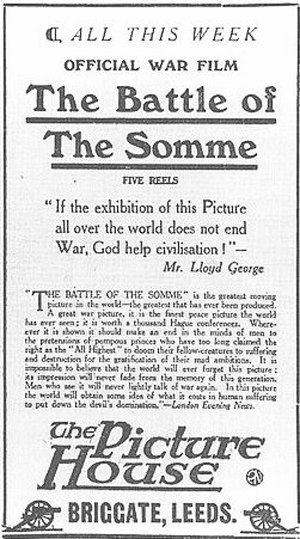
Somme-film-ad

July 1, 1916, was and remains, the worst day in British military history. A generation later, during the Normandy invasion, it was a full 20 days before the combined British and American casualties would equal those of the first day of the Somme offensive.

One of the inexperienced members of “Kitchener’s army,” at the Somme was a young second lieutenant named J.R.R. Tolkien. Fortunately for millions of book lovers, his unit was held in reserve for the first week of the battle. Although he saw action and served to the best of his ability, he survived, unlike most of his school and university friends.

In October, Tolkien was struck down with Trench Fever, a serious illness related to Rocky Mountain Spotted Fever, and also carried by ticks, fleas, and lice. This was likely a godsend. He was evacuated to Britain weeks before Haig broke off the offensive. While recuperating in a hospital in Birmingham, Tolkien began a story about three mystic gems called the silmarilli in the first age of a place called Middle Earth.

While celebrating Tolkien’s survival, we can only wonder how many other gifts we have never seen because those who might have given them died in France.

The first American casualty of the first world war was Alan Seeger, a 28 year old poet. Seeger graduated Harvard in 1910, spent two years in Greenwich Village, and then moved to Paris, where he thrived in the bohemian atmosphere of the Left Bank. When war broke out, he joined the French Foreign Legion to defend the land he loved so much.

In his last letter, dated June 28, 1916 Seeger said:

“We go up to the attack tomorrow. This will probably be the biggest thing yet. We are to have the honor of marching in the first wave.  I will write you soon if I get through all right. If not, my only earthly care is for my poems.”

Seeger did not advance with the first wave; his regiment was held in reserve until 4:00 pm on July 1, then ordered to advance on the village of Belloy-en-Santerre.  His friend, John Keegan, wrote in his diary:  “How pale he was! His tall silhouette stood out on the green of the cornfield. He was the tallest man in his section. His head erect, and pride in his eye, I saw him running forward, with bayonet fixed. Soon he disappeared and that was the last time I saw my friend. . . .”

These prophetic lines are from one of Seeger’s last poems, “I Have a Rendezvous with Death.”

Alan Seeger

Alan Seeger

God knows ’twere better to be deep
Pillowed in silk and scented down,
Where love throbs out in blissful sleep,
Pulse nigh to pulse, and breath to breath,
Where hushed awakenings are dear…
But I’ve a rendezvous with Death
At midnight in some flaming town,
When Spring trips north again this year,
And I to my pledged word am true,
I shall not fail that rendezvous.

From “I Have A Rendezvous with Death” by Alan Seeger


Between July 1 and November 18, 1916, there were 420,000 British, 200,000 French, and 500,000 German casualties along the Somme. Though we only know and can tell a few of those stories, it is good to do so at the time of this centennial.  Lest we forget their sacrifice. And lest we again entertain the delusion that a war can end all wars…

Happy 100th Anniversary to the Schwarzschild Radius

Imagined image of black hole - public domain

Imagined image of black hole – public domain

There aren’t many things to celebrate about 1916, which set a new record as the bloodiest year in the history of human warfare, but an exception to that rule was discussed on a fascinating segment on Science Friday today, Tracing Light to Map the Cosmic Darkness.

German astronomer, Karl Schwarzschild, who was serving in the trenches, used his free time to solve the gravitational field equations of Einstein’s general theory of relativity. He communicated his findings to Einstein on a postcard. The great scientist didn’t like his solution, but recognizing its validity, he presented it to the Prussian Academy of Sciences in 1916. Ever since then, the Schwarzschild radius has defined a black hole.

Karl Schwertschild, 1873-1916, Wikimedia Commons.

Karl Schwertschild, 1873-1916, Wikimedia Commons.

And why is this important to anyone other than diehard Trekies?  Given that dark matter comprises 96% of the total matter in our universe – the stars, our earth, ourselves make up only 4% – it’s a rather interesting topic. Something to contemplate next time you’re under a sky full of stars.

One of Ira Plato’s guests, Sheperd Doeleman, Director of the Event Horizon Telescope project, hopes to soon have photographs of these objects that can’t be photographed. His other guest, Priyamvada Natarajan, Professor of Astrophysics at Yale and author of Mapping the Heavens, creates maps of dark matter, this mysterious background in which we and our universe dance.

This is a fascinating segment, so grab a cup of coffee, put you communicators on vibrate, and tune in for a wonderful glimpse at all we don’t know about our world.

Of Kids and Legos

Studies in the psychology of happiness list the factors that contribute to wellbeing. Not surprisingly, good health is most important, followed closely by a satisfying social network. Having money for necessities and simple comforts is important, though the curve flattens out once we have “enough.”

Statistically, having children is a wash; those with kids and those without have the same chances of feeling satisfied in life. Two parents in China experienced the downside of little ones, when their four year old son, unable to read a “Do Not Touch,” sign, destroyed a $15,000 lego critter that had taken three days and 10,000 legos to create.  Oops!!!

The creator, who identifies himself as Zhao, said he feels “frustrated and depressed,” though he understands the act was not intentional. I am reminded of Tibetan sand mandalas, especially as China is warming up to Buddhist practice again. The sand mandalas are ritually destroyed after use to demonstrate the impermanence of all created things.

Still, I certainly sympathize with Zhao. I managed to screw up or set back painstaking projects at work from time to time, even without a four year old to help. The end result was that I became very careful…

Here’s hoping Zhao gets back in his groove!

Farewell to a Truth Teller: Morley Safer

If you’re old enough, you will remember a time when reporters and news media aimed for the truth.  We just lost one of the greats of that era, Morley Safer.

Here’s what truth-telling looked like during that time when the corporate media and the government allowed it, and we would not have settled for reality TV.

RIP Morley, after a life lived with courage and integrity.

Welcome to 1984!

This post from Ipledgeafallegiance is a tragic but pertinent summary of the fruits of a foreign “policy” that Jimmy Carter cautioned against 37 years ago. Saying we had a choice between national self-restraint and dependence on foreign oil, Carter said:

“In a nation that was proud of hard work, strong families, close-knit communities and our faith in God…too many of us now tend to worship self-indulgence and consumption. Human identity is no longer defined by what one does, but by what one owns. But we’ve…learned that piling up material goods cannot fill the emptiness of lives which have no confidence or purpose.”

To continue on this course, he said, was “a road to certain failure.” Read it and weep.

gpicone's avataripledgeafallegiance

I think that President Obama has done a good job as President of the United States. I know that not everyone agrees with me and even though I don’t agree with everything that President O. has done, our 44th elected President is about to do something that no other president in the history of the United States has ever accomplished.

He is about to become the only president who has been at war during all 8 years of his presidency! And when you consider that President G.W. Bush had the nation at war for the last 6 years of his presidency then the United States has been at war for the past 14 years, non stop…with no stopping in sight.

Hillary Clinton, should she become our next president, is well known in Washington for being a “war hawk” herself… and Donald trump, should he become our next Commander in Chief…

View original post 398 more words

Land of the Free, Home of the Brave…

You mean Belgium, right?  That is, after all, the home of Anheuser-Busch InBev, parent company of Anheuser-Busch, maker of Budweiser, which shall henceforth be known as America beer. Until the election is over, that is.

America beer

And who among us, cannot wait for that day?

Ad Age, which announced the change noted that the motto, “King of Beers” will become, “E Pluribus Unum,” and the bottom of the can will feature this text: “From the Redwood Forest to the Gulf Stream Waters this land was made for you and me.”

Yep, let’s hoist one for good old Woody Guthrie. I’d love to hear the songs he’d be writing this year!

The Devil’s Sooty Brothers

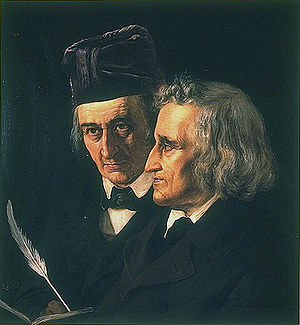
Wilhelm and Jacob Grimm, 1855. Painting by Elisabeth Jerichau-Baumann

Wilhelm and Jacob Grimm, 1855. Painting by Elisabeth Jerichau-Baumann

“People think stories are shaped by people. In fact, it’s the other way round.” – Terry Pratchett

“The Devil’s Sooty Brother” is the catchiest name among a group of tales from the Brothers Grimm about career soldiers who are discharged when they are wounded, or peace breaks out, or for no given reason. They find themselves on the road, with a loaf of bread and a few coins if they’re lucky, and no clear path to making their way in the world.

Most of the best known Grimm tales feature young people – a lad or a maiden, just starting out in the world. In contrast, we imagine these soldiers as middle aged career men, whose services are no longer needed. I thought of these stories when I heard that Oreo, “America’s favorite cookie,” will now be produced in Mexico, where Nabisco expects to save $130 million a year. Six hundred people join the hundreds of thousands before them whose working lives have been disrupted by technical, financial, and social changes that continue to accelerate in speed.

Do the old stories have anything practical to say to 21st century people when the world turns upside down?  Maybe…

These stories have elements in common:

  1. The protagonists are combat veterans. They’ve been around the block.
  2. They take up with shady, trickster-like characters, who take them underground, into the darkness, or other trials.
  3. They either are, or must learn to be, trickier than their tricky benefactors. In modern terms, they need to think outside the box, and there, if anywhere, is the relevance for us now. Circumstances may change, but the value of seeing the world afresh, free from habit and preconception, is probably even more vital now than in the “simpler” times when these tales emerged.

I will consider two of the tales of discharged soldiers that depend on wit. I’ll skip several others that hinge more on religious piety and luck. Piety and luck may pay off in real life, but they aren’t satisfying story elements.

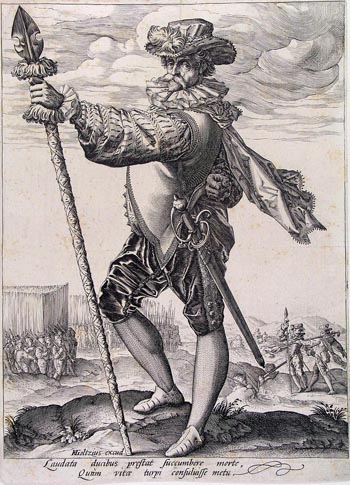
German mercenary pikeman. Wikimedia Commons

German mercenary pikeman. Wikimedia Commons

In our title story, The Devil’s Sooty Brother, (Grimm Tale #100), Hans, a hungry and penniless out of work soldier, meets the Devil in the woods. This Devil is a dark trickster and initiator rather than a personification of evil. If the soldier agrees to the terms of a seven-year contract, he’ll be set for life.  If he violates the terms, he will die, and presumably, be stuck in hell. Continue reading →