It’s In His Kiss by Vickie Lester: a book review

IIHKCover5x8final291p copy

Death is a sidewinder. It strikes from a place concealed and unthinkable, triggering a reality completely unexpected. – Vickie Lester

Anne Brown, a New York teacher and author of literary novels is on her way to Palm Springs in the middle of winter. Movie studio bigwigs are flying her out to renew the option on her first novel, a decade out of print. Why do the rich and beautiful people welcome her with open arms? Is it because she’s the out of wedlock daughter of a retired movie mogul?

No, it’s a bit more sinister than that, Cliff, the most beautiful person there, tells Anne. An acting agent, he fills her in and offers to help her navigate the proverbial shark infested waters. And draws her into a whirlwind affair that is hardly the norm for Anne, a confirmed bachelorette, who thinks of herself as the girl that guys just want to be friends with.

It seems too good to be true, but it is, until the following morning, when Cliff is found dead by the side of the road in his Ferrari. It looks like a tragic heart attack until the coroner finds he overdosed on the kind of drug cocktail used to enhance pleasure at the gay sex club up the road. Cliff hardly seemed gay to Anne, and everyone who knew him swears he was straight in every sense of the word.

Filled with grief, anger, and curiosity, Anne begins to ask questions. It soon becomes apparent that everyone at the Palm Springs house that weekend was hiding something. “Was there not one single normal person in all of L.A.?” she wonders. And then a black Escalade tries to chase her down on the freeway…

Vickie Lester, who blogs at Beguiling Hollywood, used to write screenplays, “Horrid, arty, little things,” she says, “that were…optioned again and again, but never made into movies. Perhaps, because they were neither commercial or cinematic?”

Now she has turned her considerable talent and insider’s knowledge of Hollywood into a gripping mystery, with an ending I never saw coming.  It’s In His Kiss is funny and smart and offers an insider’s view of a world of illusion that still fascinates.

The City of Angels was named for beings most often seen by children, visionaries, and the insane. The best novels out of LA are woven with a noir tone – all that sun and all those palm trees have to cast a shadow. Anne Brown and Phillip Marlowe are very different characters, and yet I imagine the spirit of Raymond Chandler is pleased. As a fan of both authors, I know I was!

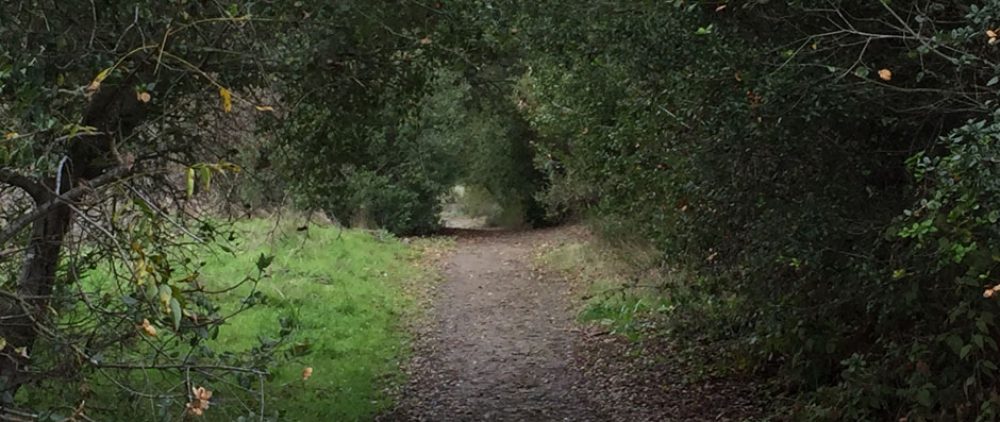
Vickie Lester at Joshua Tree

Vickie Lester at Joshua Tree

Happy birthday Taj Mahal!!

Taj Mahal, 2005. Creative Commons

Taj Mahal, 2005. Creative Commons

Today is the birthday of Henry Saint Clair Fredericks, Jr., one of my all time favorite blues musicians, whose stage name is Taj Mahal.  He was born May 17, 1942, in Harlem to musical parents. His mother sang in a gospel choir, and his father, Henry Sr., was a West Indian jazz singer and piano player, whom Ella Fitzgerald called “The Genius.” The family used a shortwave radio to listen to world music.

Henry Jr. developed an early love for music and mastered a number of instruments, but had an equal interest in farming after the family moved to Springfield, Massachusetts. He went to work on a dairy farm at 16, and at the University of Massachusetts, he majored in animal husbandry before deciding to pursue a career in music. He chose Taj Mahal as a stage name after recurring dreams of Gandhi, India, and social tolerance. In 1964 he traveled to Santa Monica where he formed a band with Ry Cooder and won a recording contract a short while later.

Mary and I heard him once at the Palms Playhouse, in Davis, CA, when it was still housed in the barn on a family farm, a casual and intimate venue musicians loved. We were in the second row, right in front of Taj as he hammered away on a grand piano. He’s a big man, tall enough for the NBA, and he threw himself into the music. It was an unforgettable evening.

I play this music when I want something upbeat –  roots music in the widest sense of the term, evoking that impulse toward joy that makes people everywhere want to sing.

Happy birthday Taj, and many, many more!

The power of solitude

Beside the Dalai Lama, Pema Chödrön is probably the most widely known practitioner of Tibetan Buddhism. Born in New York City, she was ordained as a nun in 1974 and has written several popular books on Buddhist practice, including When Things Fall Apart (1996), The Places That Scare You (2001), and Start Where You Are (2004).

In 2006, Bill Moyers talked with Pema Chödrön as part of his Faith and Reason series. Here is the full interview, and below is segment, lasting just under five minutes. Chödrön, who spent a year in silent retreat, says everyone needs periods of solitude in life, even if just a brief time every day. Distraction, she says, is not just our phones and gadgets, but the distracted state of our ordinary minds. Just a little time out from this allows us to re-engage our lives with a “more spacious” awareness, and this makes it profoundly valuable.

Guarding the mind

guard mind 1

One summer when I was working in high-tech, I had the following experience for several weeks: I’d leave the house, enjoying the fine weather. After a pleasant enough commute, I’d grab some coffee at the cafe, greet co-workers who were doing the same, and then find myself, when I arrived at my cubicle, in a foul mood, angry, and/or depressed.

Finally, I began to notice the almost subliminal self-talk that started the moment I hit the parking lot: imagining negative outcomes for everything I had going on that day. I’d picture meetings, or presentation, or projects falling apart. A quiet but persuasive inner voice would label co-workers’ motives in the harshest light. My boss at the time was a friend who had just finished his MBA and was still finding his way by trial and error. This made him a perfect projection screen. I’d sometimes find myself wondering if he was now out to get me.

Once I caught this inner thought train and started to listen, it fell apart, as such things do in the light of day. This is one key result of mindfulness practice: attend to a thought – any thought – and it begins to shift and change, revealing its nature as something far less substantial than we think. Jung had a parallel insight when he realized, “My thoughts are not my own,” and compared them to animals encountered while walking in the forest.

Hist Center Window

Since that summer, I’ve learned to listen more closely for thoughts flying under the radar. That’s part of what prompted several posts this spring with the theme of consciously choosing where to place the attention. A recent post on the Shambhala Publications blog quoted a verse along these lines written more than 1200 years ago. A Guide to the Bodhisattva Way of Life by Shantideva (c. 685-763), a great Buddhist master and scholar, is still widely studied today (see note 1 below). In chapter 11, “Vigilance,” he deals with guarding the mind against against unwholesome states, for this is where all our actions are born. The chapter is composed of 109 quatrains. Here are the first three:

1.
Those who wish to keep a rule of life
Must guard their minds in perfect self-possession.
Without this guard upon the mind,
No discipline can ever be maintained.

2.
Wandering where it will, the elephant of the mind,
Will bring us down to pains of deepest hell.
No worldly beast, however wild,
Could bring upon us such calamities.

3.
If, with mindfulness’ rope,
The elephant of the mind is tethered all around,
Our fears will come to nothing,
Every virtue drop into our hands.

Shantideva. Public domain.

Shantideva. Public domain.

Guarding the mind is not just a Buddhist concern. When I Googled the phrase, most of the hits came from Christian websites and blogs. These discussions centered on Philippians 4:8, “Finally, brethren, whatsoever things are true, whatsoever things are honest, whatsoever things are just, whatsoever things are pure, whatsoever things are lovely, whatsoever things are of good report; if there be any virtue, and if there be any praise, think on these things”

Many of the thoughts, suggestions, and practices were similar to Shantideva’s writing as well as a more recent statement by the Dalai Lama. I am even aware of both Buddhist and Christian scriptural practices for wearing imaginal armor to shield the heart/mind from negative influence. I would not be surprised to find similar practices in other spiritual traditions.

I’ve been fortunate enough to have a few days away from my usual routines and concerns to consider these things. I’m struck again, as I was in the work episode I related above, by how subtle the negative inner voices can be.

Another bias I find in myself was articulated by James Baraz, a Buddhist meditation teacher in an article on the Huffington Post, Can We Afford Joy in a World of Suffering. Baraz describes “the Kumbaya factor,” as the fear that if we consciously turn away from what is negative, we may simply wind up “in La-La Land singing Kumbaya.”

Everyone has to work this out for themselves, but Baraz makes several key points. Depression saps our energy. No one benefits self or others while wondering, “what’s the use.” In the work experience I related above, I wasn’t the best of co-workers while imagining others were out to get me.

I’m reminded of a story I heard several times in college. In 1927, Buckminster Fuller walked to the shores of Lake Michigan, thinking to end his life. He had just lost his job and felt responsible for the death of his daughter a few years earlier. He would later tell lecture audiences that as he looked into the waters, he felt surrounded by light and heard an inner voice say:

“You do not have the right to eliminate yourself. You do not belong to you. You belong to the Universe. Your significance will remain forever obscure to you, but you may assume that you are fulfilling your role if you apply yourself to converting your experiences to the highest advantage of others.” (Fuller)

The experience led Fuller to re-examine everything and resolve to live his life as “an experiment, to find what a single individual [could] contribute to changing the world and benefiting all humanity” (see note 2 below). In this epiphany, Fuller locked onto the same truth that Shantideva articulated 1200 years before:

54.
Examine thus yourself from every side.
Note harmful thoughts and every futile striving.
Thus it is that heroes in the bodhisattva path
Apply the remedies to keep a steady mind.

55.
With perfect and unyielding faith,
With steadfastness, respect, and courtesy,
With modesty and conscientiousness,
Work calmly for the happiness of others.

Speaking in the same tradition for a 21st century audience, James Baraz summed up the idea this way: “So can we afford joy in a world of suffering? I believe, in a world of suffering, we can’t afford not to find joy.”

reflection 4

Notes: _____________________________________________________

(1) In Buddhist terminology, a Boddhisattva is one who vows to seek spiritual awakening not for self alone but for the benefit of others.

(2) Some historians, finding no account of Buckminster Fuller’s epiphany in his writings for 1927, have wondered if he made up the story later. I can only speak for myself and observe that I’ve never put my most profound experiences in a journal: the writing is too pale, and there’s no need, since the events themselves remain vivid.

The 10,000 Idiots

Hafiz. Public Domain

Hafiz. Public Domain

Hafiz or Hafez was a great 14th century Persian poet and mystic whose dates are given as approximately 1325-1389. During his life, he is said to have composed 5,000 poems of the seeker’s longing for union with the divine. Unfortunately, many of these were never written down.

His poems retain an amazing resonance to those who practice any kind of spiritual discipline.  This is one of my favorites – not one of his most sublime, but always relevant…

The 10,000 Idiots

It is always a danger
to aspirants on the Path
When they begin to believe and act
As if the ten thousand idiots
Who so long ruled and lived inside
Have all packed their bags
And skipped town
Or
Died

A classic trickster woman

A blogging friend, Calmgrove, commented on my previous post, saying how strange it is that in modern times, despite an abundance of comediennes, there are no female tricksters. Then it struck me – and it’s so obvious, I can’t believe I didn’t think of this earlier.

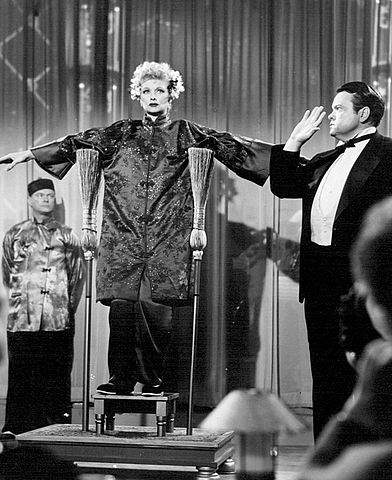
In an era when tricksters come to us on screens rather than stories told around a campfire, we cannot forget Lucille Ball’s role in “I Love Lucy.” The show ran from 1951 to 1957 and was the most watched the American television program during four of those six seasons. It is still in syndication in dozens of countries around the world.

Lucille Ball and Orson Welles.From a 1956 episode. Public domain.

Lucille Ball and Orson Welles.From a 1956 episode. Public domain.

Lucille Ball, with her clowning and physical comedy, set a tone that is still at the core of many sitcoms. Most of the best known women comics who followed cite her as a groundbreaker, an inspiration, a mentor, and often a friend. In terms of our “classic trickster” test, that is what she was, at all times. Never just a funny housewife, Lucy was an outrageous but charming disrupter, whose pioneering humor enlivened the spirits of millions who watched her.

I dare you to get through the chocolate factory scene with a straight face.

Quite a few full episodes of the show are available on YouTube.

Another note on tricksters

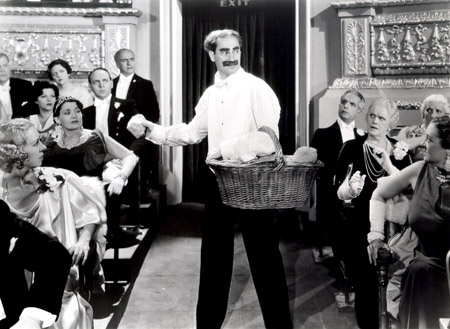
Groucho

I want to argue a paradox…that the origins, liveliness, and durability of cultures require that there be space for figures whose function is to uncover and disrupt the very things that cultures are based on. – Lewis Hyde

It has always made sense to me that the 1920s, 30s and 40s, when times were hard for so many, gave birth to our great movie tricksters: Charlie Chaplin, Laurel and Hardy, The Marx Brothers, and The Three Stooges. Their send ups of the 1%, among other things, are still hilarious. Where are their equivalents today?

My self-imposed moratorium on negative blog themes has passed. As I caught up on news I had kept at arms length, I found myself thinking often of trickster stories. In part because they are funny, and most of the news is not. And partly because the folly of tricksters has a sacred dimension while the folly of our headline makers is often just foolish.  If you invite the Three Stooges to lunch and serve pie, the outcome is fairly certain. I read that the Georgia legislature voted to allow patrons to carry guns into bars; the result is likely to be just as predictable, but without the catharsis of laughter.

stooges pies

In his introduction to Trickster Makes This World (1998), Lewis Hyde emphasized several key points:

1) Tricksters both make and violate boundaries and live in relationship to them. Where there are no boundaries, trickster creates them, as in several Native American creation myths where Coyote makes the land and separates it from the sea. Where there are cultural boundaries, tricksters blur or invert the distinctions: right and wrong, friend or foe, male or female, living or dead.

2) Tricksters are usually on the road, and this makes them outsiders.
Through most of human history, solitary travelers have been rare. Until the last century, most people lived and died close to the area where they were born. Nomadic people travelled as tribes or clans, but Hyde says trickster is “the spirit of the doorway leading out, and of the crossroad at the edge of town. He is the spirit of the road of dusk,” who may pass through city and town but only to “enliven it with his mischief.”

charlie chaplin and dog

Hyde points out that although there is an abundance of clever women who know how to be deceptive in world mythology, they are seldom full-time tricksters. Once the evil is vanquished, the curse lifted, they tend to settle down. Coyote and Loki do not domesticate, and the older cultures who gave us these stories would have had trouble imagining a woman who opted for a solo life on the road.

3) Tricksters are liars and thieves, but they are not petty criminals.
Tricksters steal things like fire and cattle, and according to Hyde, are often honored as creators of civilization. “They are imagined not only to have stolen certain essential goods from heaven and given them to the race but to have gone on and helped shape this world so as to make it a hospitable place for human life.”

We cannot be too doctrinaire about these things, for there is a distinction between “large” stories, like creation myths, and “small” folktales, where trickster sometimes steals cattle for himself. When he does so, however, in tales like “The Little Peasant” from Grimm, it is usually a case of swindling a swindler, or people who are dishonest and greedy to start with.

For obvious reasons, trickster isn’t welcome in corporate boardrooms. Like Robin Hood, he is into redistribution of wealth. He’s the patron of whistle blowers everywhere, and will gladly gum up the machine when it is no longer serving the greater good.

Perhaps that is why we need him now more than ever. We don’t even have to do anything. Hermes travels as fast as thought. For good and for ill, trickster is already here.

Chaplin modern times

I think, therefore

The Thinker, Rodin. Public Domain

The Thinker, Rodin. Public Domain

When I first started to write, in my teens and early 20’s, I was hugely influenced by an eclectic group of American writers that included vocal social critics from the earliest years of the 20th century. People like Theodore Dreiser, who wrote famously clunky prose, but whose An American Tragedy (1925) was a stinging indictment of greed in our culture. Main Street (1920) by Sinclair Lewis depicted the soul-crushing conformity of a milieu we often imagine as small town innocence. But greater than any other influence was Henry Miller, who demonstrated the power of personal essays. His books, like The Air Conditioned Nightmare (1945) shaped my view of our dominant culture.

It was natural that this kind of critique, along with that of more recent writers and essayists like Michael Ventura, should influence  my blogging. But this spring something strange happened. At the start of Lent, though I do not celebrate the season in any formal way, I announced that I would “give up” negative posts for the duration. As expected, the experiment was more interesting than I expected.

"Rodin's thinker?" by Patricia van Casteren, 2006, CC BY-NC-ND 2.0

“Rodin’s thinker?” by Patricia van Casteren, 2006, CC BY-NC-ND 2.0

I’ve already blogged about some of my findings, especially the obvious ones, like the preponderance of bad news in all varieties of media. And I knew in advance there would be less to say if I excluded negative themes. What I didn’t expect was to find myself wondering whether it mattered – it’s virtuous to write about things like climate change and income inequality – isn’t it? A very interesting question since I don’t really believe many writers and artists change social ills directly. Maybe Charles Dickens did, or Jacob Riis, with his photos of child labor, but Dreiser didn’t eliminate greed and Miller didn’t break the ruts of conformity. Writers and artists sometimes change individual hearts and minds, but how does that work? That is not a rhetorical question, but something I often wonder about. How does it work?

Perhaps it was this kind of question that moved Phil Ochs, one of the best of the 60’s protests singers, to write, “You must protest, you must protest they say, it is your diamond duty / Ah, but in such an ugly world, the only true protest is beauty.” Maybe it’s what led Henry Miller, in his last years, to write books like, My Bike and Other Friends, and to focus on his watercolors.

Henry Miller paintings

My biggest discovery, while turning away from negative stories during Lent, concerned inner dialog rather than outer events. I’ve attended to this in a focused way in the past at various times, but not for a while. Mindfulness practice appeared on the cover of Time, so it must be gaining fad status, but that does not diminish its worth. It’s an ancient contemplative discipline that involves simply watching the contents of consciousness. Not fixing, fighting, or merging with, but simply observing what flits through awareness (here’s a good introduction to the practice).

I don’t know about anyone else, but I often find a subtle but persistent stream of critical inner narrative on self, others, and events. The narratives tend grow in the darkness yet dissolve when observed, the way shadows disappear when you turn on the light in a room. Observation eventually leads one to suspect that thoughts have no more substance than shadows, and no more inherent reality, and yet they can have profound effects. I suspect we have all had interesting synchronicities, met things in the world corresponding to our inner states. And if one subscribes at all to notions of the effect of collective thoughts, an idea given names like, “tipping point” or “hundredth monkey,” then the contents of consciousness take on a meaning beyond their effect on oneself alone.

I follow the Dalai Lama on Facebook and often note that when he is asked about topical issues like climate change, he always gives a thoughtful answer, the tone of which is invariably, “I am hopeful.” If I learned anything with this Lenten experiment, it is how hard it can be to cultivate a hopeful attitude. I also cannot imagine anything more important. Can there be a more important seed to plant than this one – “I am hopeful?”