More photographs from Iceland

Here are a few more photographs from the week we spent in Iceland. In a few days I’ll write about our discussions of Icelandic sagas in general, and Njal’s Saga in particular, which framed and guided our travels through the countryside.

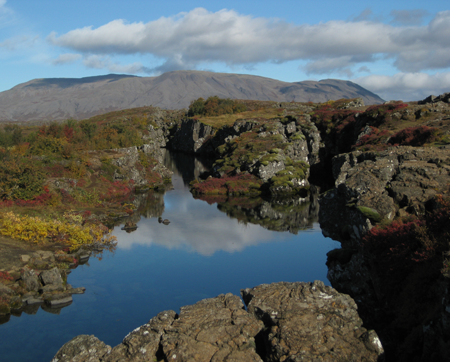
Thingvellir

Farmhouse, Hlidarendi

Kerio, a collapsed volcanic crater

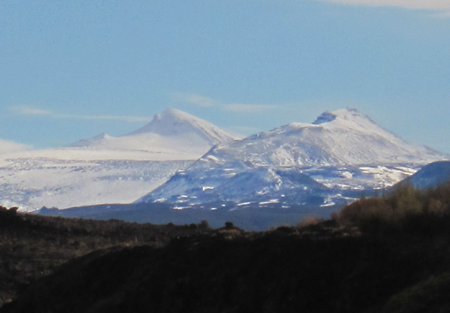
Volcanos Eyjafjallajökull (right) and Katla (left). Mary’s photo.

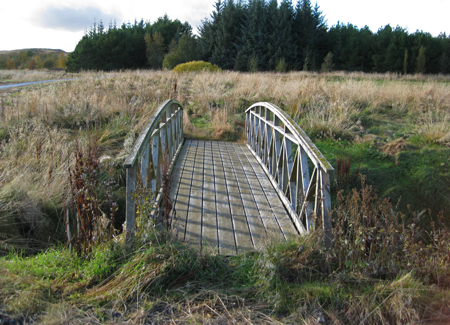
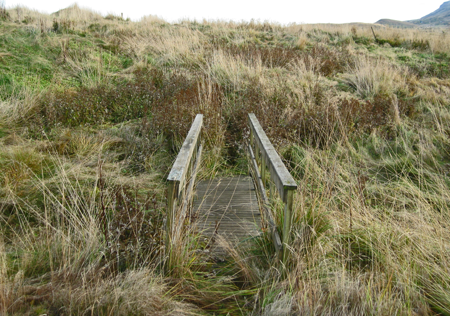
Bridge to nowhere, Skalholt

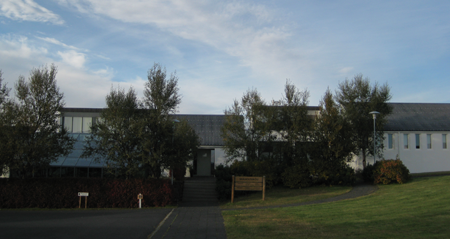
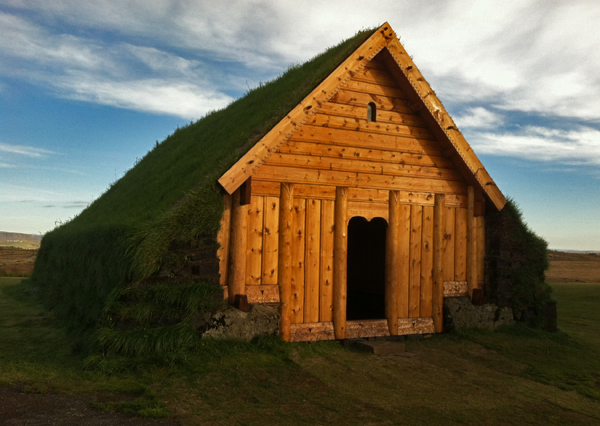
Guesthouse, Skalholt

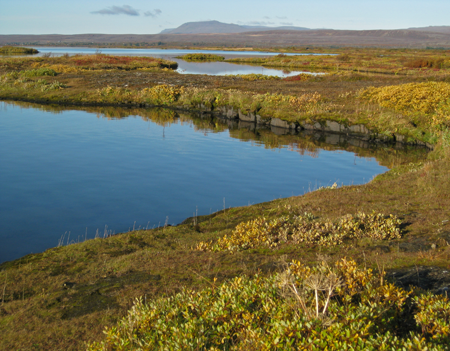
Shore of Lake Thingvallavatn, the largest natural lake in Iceland

Another bridge to nowhere – the metaphorical possibilities are endless.

Skalholt Cathedral from the river path

Churchyard at Oddi

Thingvellir

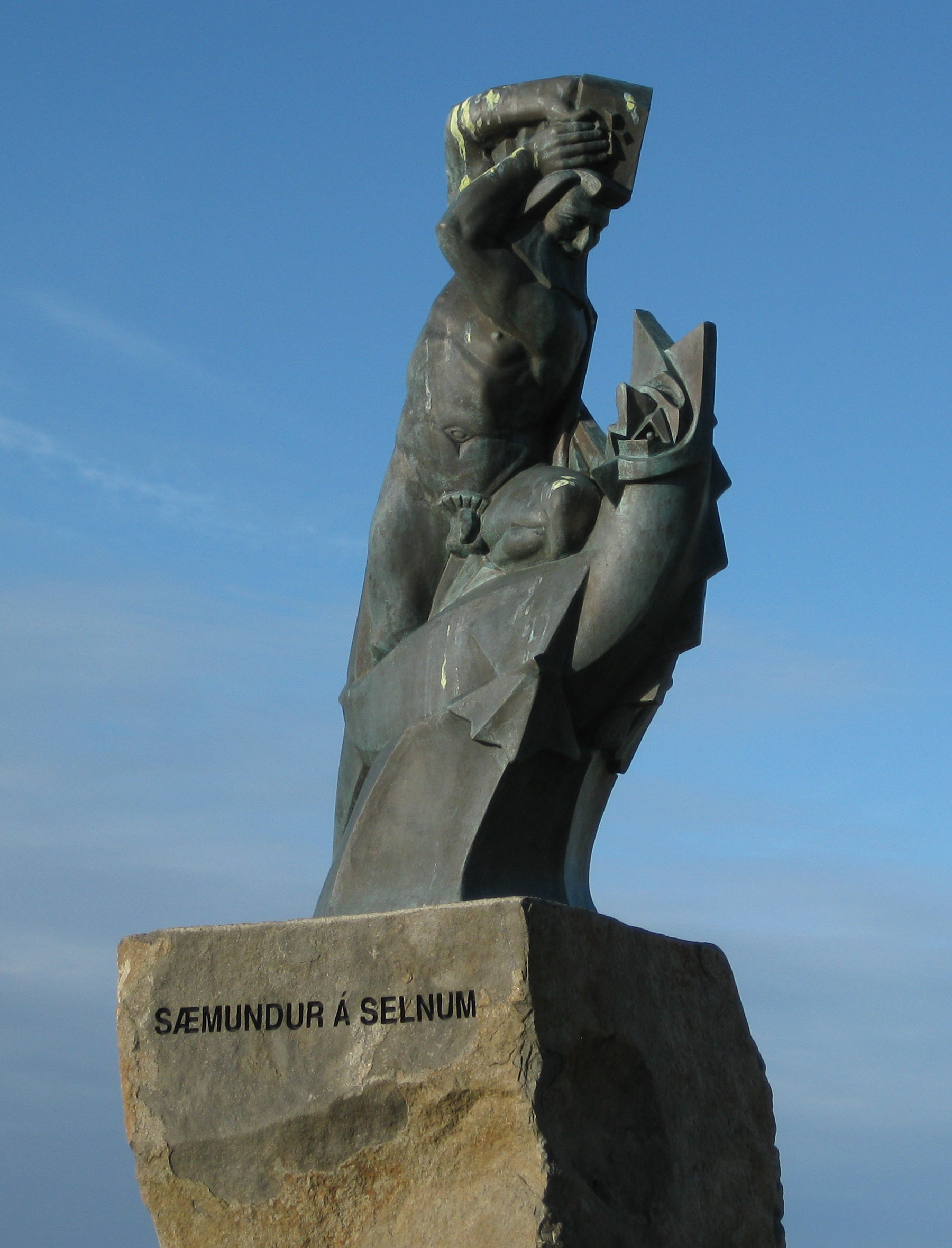
Yours truly by the statue of Saemundur the Learned.

Next: The sagas

Photographs from Iceland

We are back from a week in southern Iceland, which we spent studying one of the great sagas with a small group of storytellers.  We also visited places where this thousand year old drama unfolded. I’ll speak of Njal’s Saga in future posts, but here are a few pictures of the striking Icelandic autumn.

Pool at Thingvellir

A thousand years of volcanic eruption and cutting trees for heat stripped most of the native birch and willow forests.  A joke we heard several times is, “If you get lost in a forest in Iceland, stand up.”  Reforestation efforts are underway, but meanwhile shrubs and even some of the lichen that covers the boulders provide dramatic fall colors.

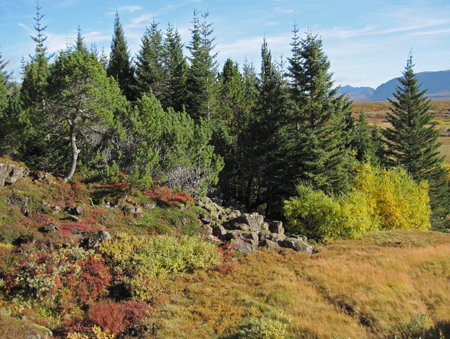
Thingvellir Park. Photo by Mary

Pines are not native to Iceland, but this stand, planted by the government at Thingvellir Park, made a welcome spot for a picnic.

Thingvellir from the cliffs above.

The Law Circle, where the National Assembly met every summer, stands behind the church (a later addition).  Beginning in 930, the Icelanders’ efforts to govern by rule of law was key to the life of the nation and to Njal’s Saga as well.

Njal’s Saga, like The Illiad, is based on historical incidents and people.  This historical marker, along the Ranga River, marks the spot where a key character, the consummate warrior hero, Gunnar Hamundarson, was attacked by 30 men while riding home with his two brothers. The Hamundarson’s killed 14 attackers, but Gunnar’s youngest brother, Hjort died in the battle. In a nearby burial mound, archeologists found a ring engraved with a stag; the name Hjort means “stag.”

Hlidarendi with Eyjafjallajökull in the background

Gunnar lived and died at a farmstead in Hlidarendi, a name that means “Hill’s end.” This is where the highlands slope down to the coastal plain. The green area with a pine border in the middle ground is Nina’s Grove, a park and sculpture garden in honor of Nina Saemundsson (1892-1965), a world-renowned Icelandic sculptor who was born in Hlidrendi, but also spent 30 years in the US. Her statue, The Spirit of Achievement was placed over the entrance of the Waldorf Astoria hotel in New York.

In the distance is Eyjafjallajökull (Icelandic for “Island, mountain, glacier), which erupted in 2010. An explosion of lava blasting through a 700 meter thick glacier created tons of ash that blew toward the continent and stopped European air travel.

View from Nina’s grove over the coastal plains, to islands (on the right horizon) in the Atlantic

This view over the coastal plains shows a view of Nina Saemundsson’s sculpture of a mother holding two children.

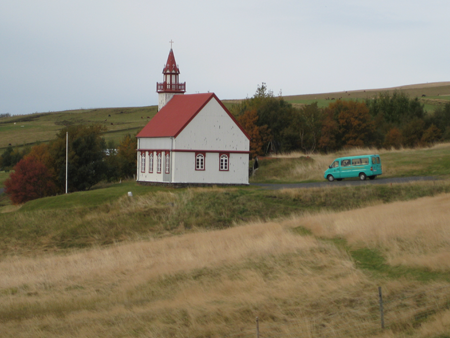
The church at Hlidarendi and a view of the little green van we toured in. Much of the information here came from our driver, who spoke excellent English. He tried to teach us how to pronounce “Eyjafjallajökull,” with little success.

To be continued.

Saemundur the Learned

Saemundur Sigfusson (1056–1133) was an Icelandic scholar, priest, and according to legend, sorcerer, who founded an important center of learning at the southern costal town of Oddi. He was known to have studied abroad, and many said he’d been at “The Black School,” though no one quite knew where it was. People said the headmaster was the Devil.

Seamunder and his fellow students received a fine education in witchcraft and sorcery, but graduation was iffy. The Devil would grab the last student out the door, and that soul was lost for eternity. Seamunder told his classmates not to worry. He told them to file out first, and then he donned a large overcoat. When the Devil reached out, he caught the coat.  Seamunder slipped free and ran out the door, though as it closed, it injured his heel.

The Devil had it in for Seamunder after that, always trying to trick him. Once Seamunder told the Devil he’d give him his soul in return for a voyage to Iceland in which he never got wet. The Devil took the form of a large seal and told Seamunder to climb on his back. The Devil was careful – not a drip of water touched his passenger. Seamunder spent his time on the Devil-seal reading his psalter, and as they neared the shore, he began to beat the seal with his prayer book. Startled, the seal dove under water, Seamunder got dunked, and made his way to the shore near Oddi, a free man.

Seamunder beats the seal with his psalter – statue in the churchyard at Oddi

Legend has Seamunder playing numerous other tricks on the Devil, who is always portrayed as honest and not quite the sharpest tool in the shed.

This information comes from a pamphlet designed by the Oddi Society. Founded in 1990, the Society’s goal is to make Oddi a center of learning again, this time with an emphasis on the environment as well as Icelandic heritage and culture.

A visit to Iceland continued

Gullfoss (Goldwater) falls, southern Iceland

It’s hard to pack for cold weather when it’s 90 degrees, as it was at home before we left. We did pretty well, but today was a challenge. Snow ringed some of the nearby hills as we left for the Gullfoss falls – not the largest in Iceland, but the largest that is easily accessible. The temperatures were below freezing as we climbed down the stairs from the overlook to the level where I took this picture. Rain, wind, and frozen spray from the falls drove us into the heated gift shop, where “California Girls” by the Beach Boys played on the radio.

We stopped down the road at Geysir, home of the geyser named Geysir that gave geysers their name. Is that clear? Geysir itself has grown quiet, erupting only infrequently, but there are many other geysers there, including Strokkur, which erupts at five minute intervals. In the cafe at Geysir, the Stones and the Doors were playing.

Strokkur quiescent

Strokkur erupting

According to Wikipedia, Iceland has about 23 days of rain in September, which fits our experience. Our one sunny day came during our trip to Thingvellir, which not only gave us a chance to admire spectacular autumn colors, but also to explore a spot that is key to Icelandic sagas and to the history of the nation.

Iceland was settled in 870. Sixty years later, the settlers, mostly vikings, formed a national assembly at Thingvellir, on land that was confiscated from a man who was outlawed for murder.

In the best known Icelandic saga, Njal (pronounced NEE-ahl, from Neal, an Irish name) says, “With law our land shall rise but without law, it will perish.” The assembly moved to Reykjavik in 1798, but a quarter of the population met at Thingvellir in 1944 to declare independence from Denmark.

As we left the cafe at Geysir, “Aquarius” came on the radio. “No way!” one of us said, but there it was…

Skalholt, Iceland

The view out my window is Skalholt Cathedal and this reconstructed chapel which is part of an archeological dig at one of Iceland’s key historical sites.  On the horizon behind the chapel likes Hekla, one of Iceland’s most active volcanoes.  In the middle ages, Europeans called it the Gateway to Hell.  Hekla last erupted in February, 2000, but with luck, it will continue to sleep through the rest of the week.

Mary and I are here for a different type of archeology – a dig into an ancient tradition of story.  We are here with three other storytellers to explore Njal’s Saga, the account of a feud with tragic consequences, not unlike the American tale of the Hatfields and the McCoys.  In both cases, events are based in history; we’re visiting some of the key locations mentioned in the saga.  Njal was shaped by an anonymous author into the masterpiece of a unique tradition that influenced Tolkien, among others.

Meeting of the continents: the North American tectonic plate (left) meets the Euro-Asian plate at Thingvellir, Iceland.

This week of the equinox, the temperature drops to freezing at night, but the guesthouse where we are staying is warmed by geothermal energy, by water bubbling up from hot springs that is shipped through pipes to cities and settlements throughout the island. Iceland is 99% energy independent.

I’ll have more to reflect on in future posts, but meanwhile it is seven hours later than west coast time – tomorrow is almost here, so it’s time to log out.  Please enjoy your week and stay tuned for future posts.

Fairytales in the 21st Century

Arthur Rackham, untitled, 1904. Public domain.

When you look at our culture, it seems like fairytales have never been more popular.  “Grimm” and “Once Upon a Time” are starting their second television season.  Earlier this year, we had two movie versions of Sleeping Beauty.  Young adult paranormal stories remain popular with readers of all ages, and I’m currently reading a 1994 collection of classic fairytales retold by some of the best modern fantasy authors.  The book, Black Thorn, White Rose, by editors Ellen Datlow and Terri Windling, was reissued as a kindle edition and features challenging tales by authors like Nancy Kress, Patricia Wrede, and Jane Yolen.

Snow White begs for mercy. From an 1852 Icelandic version. Public doman.

The old stories call out to us with their promise of depth as the stuff and fluff of modern life fails to satisfy the yearnings of the soul.  Yet according to Wolfgang Mieder, professor of German and folklore at the University of Vermont, we’re missing a critical element that earlier generations possessed, and the loss is related to the flood of tales we have today.  “Everybody reads different stories and we no longer know the same fairytales. The connecting element is lost,” says Mieder.  He is optimistic about the survival of fairytales, but questions the way we now receive them.

Mieder, a German-American, won the 2012 European Fairytale Prize and has studied the social significance of fairytales for more than 40 years.  After high school, he traveled to the US from Germany to study mathematics, but a seminar in German folklore changed his life’s direction.  Folklore became very personal for him.  He recalls that in Germany, “In the 1950s you used to be given a colorful picture as a gift when you bought margarine, which I made a lot of effort to collect and paste in my album. With the album I got to know the world of fairytales.”

Wolfgang Mieder. CC-by-SA-3.0

Mieder, who has authored 200 publications and 500 articles, want his students to find the same personal connection to the old stories.  This can be hampered by the sheer volume of folklore appearing on TV, movies, and the internet.  Will the glut of information detract from the impact of stories that generations of people heard aloud in the flickering firelight?  Mieder is hopeful – he has observed a new interest in oral telling of old stories.

This is something I have experienced, both as a story teller and listener.  All over the world, it was largely during the dark months when the stories were told, and now we have a world-wide celebration of stories each November.

In 1988, J.G. Pinkerton, of the Connecticut Storytelling Center, imagined a night of storytelling, which he called Tellebration, to build community support for storytelling.  That year stories were told in six locations throughout the state.  By 1997, there were Tellebration events on every continent except Antarctica.

Tellebration is held on the Saturday before Thanksgiving, November 17 this year.  You can search for events near you – or even organize and register your own – at this site, hosted by the National Storytelling Network: http://www.tellabration.org/index.html

You can access the full article on Wolfgang Wieder here: http://www.dw.de/dw/article/0,,16234957,00.html

And finally, to see a wonderful site devoted to fairytales and folklore – the place where I found the Wieder article – visit the “Sur La Lune Fairy Tales Blog,” listed on my blogroll.

And finally-finally, as in really finally, I’ll be devoting next week to exploring some old stories and oral tradition. I’ll be largely or entirely unwired for the duration, but I promise you will hear more about this in upcoming posts.

Arthur Rackham, The Three Bears. Public domain.
Nerds with time on their hands: The Popinator

The Popinator prototype – under development at Popcorn Indiana

An article in the Huffington Post food section puts it like this: “The problem with popcorn these days, is that it doesn’t pop directly into your mouth as nature intended.”

No more! Intrepid engineers at Popcorn Indiana have a working prototype of a voice activated popcorn cannon that calculates the trajectory to your mouth and launches a kernel when you say, “Pop.”

I am seriously encouraged by the Popinator.  Who says America has lost its edge?  Creativity, engineering prowess, and humor – a potent combination!

This is post #17 in a series of reflections on spirituality and living that fellow blogger, Jason, has been posting every Monday. Each post relates to a letter of the alphabet. Who knew that “Q” could generate such a useful series of thoughts that are both timely and timeless? – Morgan

Jason E. Marshall's avatarLiving In The Now

This is my seventeenth post in a series, where each Monday (if possible) I will post about a point of reflection or insight that I will use to reflect and meditate on during the week. In order to make it a bit more focused and interesting, I will attempt to do this with topics beginning with letters from A to Z. I have often found that having a specific topic to reflect and/or meditate on during the week really lends itself to interesting insights and growth, because you not only have several days to reflect and meditate on the topic, but you have several days to put any lessons and insights that you discover to work in your every day life. For those that follow me on Twitter (@JasonLivingNow) I will try to write updates as the weekly topics come up during meditations, moments of reflection, or just during everyday…

View original post 862 more words