This day in history: the battle of Antietam

Near Dunker’s Church, Antietam. Photo by Alexander Gardner. Public domain.

One hundred and fifty years ago today, Union and Confederate forces clashed at Antietm Creek, near Sharpsburg, MD, in what remains the bloodiest day in American history.  By sunset, 23,000 men lay dead or wounded.  They fell in a cornfield, along a sunken road, and beside a stone bridge – places where George B. McClellan’s Army of the Potomac confronted Robert E. Lee’s Army of Northern Virginia in the latter’s first incursion into Union territory.  Based on opposition to the war in the north, Lee assumed – perhaps correctly – that a southern victory in Union territory might push the Federal government to peace negotiations.

In one of those moments in history that seem providential in retrospect, on the morning of Sept 13, Corporal Barton W. Mitchell of the 27th Indiana Volunteers found a packet of three cigars wrapped in what proved to be a copy of Lee’s battle plan.  Understanding the importance of his find, Corporal Barton sent the papers up through the ranks.  Upon reading them, McClellan was gleeful and said, “Here is a paper with which, if I cannot whip Bobby Lee, I will be willing to go home.”  He moved his army to intercept Lee near Sharpsburg.

Lee’s army of 55,000 was outnumbered 2-1, but the ever-cautious McClellan committed only 3/4 of his forces, allowing Lee to match him by shifting his own troops across the field as the advantage swung back and forth.  There was no clear winner.  After skirmishes throughout the following day, Lee withdrew from Maryland.

Lincoln fired McClellan for failing to pursue Lee, yet driving the southern troops from northern soil was victory enough for the president to release the Emancipation Proclamation.  Lincoln had been waiting for a northern victory to free the slaves, so the move would not be interpreted as a sign of desperation.  He had a long wait, for the south was largely unbeaten early in the war.  Though abolitionists criticized Lincoln for delaying emancipation, Antietam marked the moment when the war became about something greater than simply preventing secession.

One other consequence of the battle was the publication of battlefield photographs by Alexander Gardner.  Within a month of Antietam, civilians saw the price the soldiers were paying.

Confederate dead in the sunken road. Photo by Alexander Gardner. Public domain.

It’s always moving and worthwhile to remember the sacrifices earlier generations made in the name of ideals that underpin our way of life.  Especially in our current election year, characterized in the media as full of divisiveness, when we remember Antietam, we can reflect how the nation has experienced and overcome divisions far deeper than any we see today.

If Gardner’s photos preserve the tragedy of the civil war, the following clip immortalizes resilience, strength, and hope.  Taken in 1938, on the 75th anniversary of the Battle of Gettysburg, it shows veterans of the north and south meeting again at the wall on Cemetery Ridge – in a very different spirit than their first encounter.

I’m not a real active Facebook user, but even I have recently scratched my head at posts on my newsfeed from entities I’ve never liked or friended. Maggie has the answer – “sponsored stories,” a newly implemented FB practice that allows pages to pay-for-“reach.” And here we naively thought all posts were created equal – HA! Show ’em da money! – Morgan

Maggie O'Toole's avatarMaggie (Not Margaret)

Or, Sponsored Stories are Bad News for Facebook Users

Recently, my Facebook reach has been rather down.  What, I’m I suddenly not as interesting?  Are my pictures not as good?  My posts not as funny?  Although Facebook doesn’t provide individual users with stats about their posts’ engagement and reach, I can tell you what my graph would look like – like a plane crashing from 30,000 feet.

For a while, I was thinking that this was a personal problem – that I’d been so fussed on school and work that I’d let my social media presence slip.  I didn’t even want to think about my Klout score.  Then friends started mentioning that they were experiencing lower engagement, as well.  I started seeing, “Hello, can anyone see this?” posts.  Then I noticed that the same problem was happening on the pages that I admin.

View original post 539 more words

Tempest – Bob Dylan’s latest recording

Bob Dylan in concert in Spain, 2010, CC-by-2.0

Fifty years after his first album, Bob Dylan, 71, has released Tempest, his 35th studio album, to critical acclaim.  Over half a century, Dylan has never repeated himself.

Randal Roberts of The LA Times says,  “Dylan lives in every molecule of our being, has taught us about lyrical possibility, has reveled in the joy of words and the power and glory of making things up from scratch. To learn that a new Dylan project is in the works is to know that there’s a good chance your brain will be forever changed by at least one new rhyming couplet, snarling oath or graceful guitar line. On “Tempest,”…there are many such moments.”

The songs range from light to dark, from blues to ballad, from topical references to phrases borrowed from Child ballads, all resonating to Dylan’s unique and raspy voice.

“Scarlet Town,” echoes the “Barbara Allen,” where Sweet William on his deathbed lies, but veers away from easy interpretation, much like the inviting but ultimately opaque American folklore references in Dylan’s much earlier, John Wesley Harding, 1967.  Then and now, the poetry is Dylan’s own:

Scarlet Town, in the hot noon hours,
There’s palm-leaf shadows and scattered flowers
Beggars crouching at the gate
Help comes, but it comes too late
By marble slabs and in fields of stone
You make your humble wishes known
I touched the garment, but the hem was torn
In Scarlet Town, where I was born

The title song, “Tempest,” is a 14 minute ballad about Titanic, phrased as a waltz that echoes the rolling of waves as it borrows The Carter Family’s “Titanic.”

The night was black with starlight
The seas were sharp and clear
Moving through the shadows
The promised hour was near

Lights were holding steady
Gliding over the foam
All the lords and ladies
Heading for their eternal home

Tempest opens with a blues number, “Duquesne Whistle,” written with Robert Hunter, The Grateful Dead lyricist.  It’s followed by the angry and topical “Early Roman Kings.”  There is “Roll on John,” a tribute to John Lennon, “Tin Angel,” a song of murder and suicide, and it ends with “Soon After Midnight,” which sounds like a slow song at the end of a high school dance.

If you’ve ever enjoyed Dylan’s music; if like Randal Roberts it has “forever changed your brain,” I urge you to check out the songs online. I bet you’ll download some or all of cuts, and marvel at the phenomenon of an artist who has continued to grow over fifty years.

Our longest serving independent senator

Senator Bernie Sanders (I-VT). Public Domain photo.

On September 7, Bill Moyers interviewed Bernie Sanders of Vermont, an independent senator for five years who served 16 years before that in the House of Representatives.  Before going to Washington, he spent four years as mayor of Burlington, which was judged one of the most livable cities in the country.

Sanders is proud that his last campaign was financed by 130,000 individual donors who gave an average of $40 each.  This goes to the heart of his recommendation to fix what is most broken in our government:  a constitutional amendment repealing Citizens United.  So far, legislatures and governors in six states have voiced support for such an amendment, and millions of people have signed petitions, 200,000 of them on Sanders’ website alone.

“It is going to be a long process,” Sanders admits.  He goes on to say, “I think in the process we’re going to educate the American people about one of the most serious problems facing this country. And that is that virtually no piece of legislation will get passed in Congress unless it has the okay of corporate America and big money interest. So the corrupting, absolute corrupting impact of big money is something we have to address.”

For those living outside our borders or tuning out the political process entirely, Citizens United was a 2010 decision by the U.S. Supreme court ruling that the First Amendment (freedom of speech) prohibits the government from restricting political contributions by entities like corporations, unions or political action committees (PAC’s).  All attempts at campaign finance reform became void, and several important recent elections have gone to the side that raised the most money.  Sanders told Moyers, “I fear very much that if we don’t turn this around, we’re heading toward an oligarchic form of society.” 

People across the political system seem to agree.  Sixty-four municipalities in Vermont sent resolutions to congress calling for an amendment.  I seem to remember hearing of similar efforts underway in as many as 20 states.  As a concrete step, Sanders’ suggestion carries a lot more weight and plausibility than vague calls to abandon existing political parties and form new ones.  That doesn’t seem feasible on our current playing field.

For me, Bernie Sanders discussion with Moyers was a bright moment in an otherwise dismal political season.  You can find the video and a transcript here.  http://billmoyers.com/segment/bernie-sanders-on-the-independent-in-politics/

*** Update, Sept 14, 2012***

Here is a link to Senator Sanders’ official website: http://www.sanders.senate.gov.

There’s a link to the Moyer’s interview and a button labelled, “Overturn Citizens United.” If you click it, you’ll find a map showing local efforts across the nation, as well as info on how to add your local group information to the list. It’s really encouraging to see that we are not alone in our outrage.

The 2012 Ig Nobel Prizes

There’s still time to get tickets for the September 20 Ig Nobel Prize award ceremony at Harvard, where ten researchers will receive recognition for unusual discoveries.  The prizes are the brainchild of Marc Abrahams, editor and co-founder of “The Annals of Improbable Research” and author of a new book, This is Improbable: Cheese String Theory, Magnetic Chickens and Other WTF Research.

The ten Ig Nobel winners, whose identity has not been revealed, will receive their certificates from “real” Nobel laureates.  According to Abrahams, some dedicated scientists hold awards in both categories.  He cites Andre Geim  and Michael Berry, two UK physicists, who won an Ig Nobel in 2000 for using magnets to levitate a frog.  Ten years later, Geim and a student won a Nobel prize for producing graphene (two-dimensional carbon) in sufficient quantities to study.

Dr. Elena Bodnar, with her Ig Nobel prize winning bra that quickly converts to a protective face mask.

Past Ig Nobel winners who plan to attend this years ceremony include Dr. Bodnar, pictured above, as well as:

  • L. Mahadevan, a Harvard professor, for a “mathematico-physics analysis of how sheets get wrinkled.”
  • Dr. Richard Gustafson for research: “The failure of self-administered automobile-engine-supplied-electric-shock treatment for rattlesnake envenomation resulting from patient’s pet rattlesnake biting the patient on the lip.
  • Dr. Francis Fesmire, for an article in The Annals of Emergency Medicine entitled, “Digital rectal massage as a cure for intractable hiccups.”

Basile Audoly and Sebastien Neukirch won a 2006 Ig Nobel for research on why spaghetti, when broken, often splits into more than two pieces.

  • Dan Mayer for an article on the medical effects of sword swallowing.
  • John Perry of Stanford for his “Theory of Structured Procrastination.”
  • Don Featherstone, creator of the pink plastic flamenco.
  • Glenda Browne of Blaxland, Australia, for her study of the word “the” and the problems it creates for people who try to alphabetize things.

Marc Abrahams

Marc Abrahams says the Ig Nobel committee is looking for research and inventions that make people laugh and then make them think.  “We also hope to spur people’s curiosity, and to raise the question: How do you decide what’s important and what’s not, and what’s real and what’s not — in science and everywhere else?”

A very good question! To learn more about this year’s prizes, check here: http://www.improbable.com/ig/2012/

Soup imitates Art imitates Soup

Fifty years ago, Andy Warhol rocked the art world and the world of popular culture with his depiction of Campbell’s soup cans at the Los Angeles Museum of Contemporary Art. This year, Campbell’s returned the favor, with a collectors edition of 1.2 million cans of tomato soup that went on sale at Target on September 2.

Campbell’s 50th anniversary “Art of Soup” cans feature Andy Warhol picture and quotes on the back.

The art world of the ’50’s was dominated by the Abstract Expressionists, who lived bohemian lifestyles and had little but scorn for popular culture.  Warhol embraced it, even as he critiqued it with comments that ring true to this day, such as, “Someday everyone will be famous for fifteen minutes.”

Campbell’s Soup Cans by Andy Warhol, 1962

Campbell’s at first had reservations about Warhol’s depictions, but two years later, noting the popularity of his art, Campbell’s marketing manager sent Warhol a letter of appreciation and “a couple of cases of soup.” That same year, Campbell’s commissioned the first of several artworks they would purchase from Warhol over the years.

Back of the special cans, with image of Warhol and quote

In one of his memorable quotes, Warhol said, “I am deeply superficial.”  Much like Marcel Duchamp, one of the thrusts of his work was to raise question the nature of art.  The Abstract Expressionists embraced a hard drinking, hard loving, bohemian stance.  Willem de Kooning wore paint spattered jeans to his opening at the Museum of Modern Art.  He shunned imagery that “the masses” could comprehend, and celebrated the personal signature of his unique, impassioned brush strokes.

Warhol wore coats and ties, called his studio, “The Factory,” and his best known works showed common objects, reproduced by photo silkscreen, often by an assistant.  Warhol never touched them at all.  “Art is whatever you can get away with,” he said.  Regarding the bohemian set, he said, ““Those who talk about individuality the most are the ones who most object to deviation.”

If Duchamp and Warhol are kindred spirits, there is one great difference between them.  When Duchamp hung a urinal in a gallery, he did it for the shock value.  By all accounts, Warhol truly loved the icons of popular culture he depicted.  He also loved technology and experimented with an Amiga computer shortly before his death in 1987.  No doubt he would have been pleased by Campbell’s tribute.

Andy Warhol by Jack Mitchell. CC by SA

*** Some Andy Warhol quotes ***

“I think having land and not ruining it is the most beautiful art that anybody could ever want to own.”

“I’d asked around 10 or 15 people for suggestions. Finally one lady friend asked the right question, ‘Well, what do you love most?’ That’s how I started painting money.”

“It’s the movies that have really been running things in America ever since they were invented. They show you what to do, how to do it, when to do it, how to feel about it, and how to look how you feel about it.”

“During the 1960s, I think, people forgot what emotions were supposed to be. And I don’t think they’ve ever remembered.”

“Some day everybody will just think what they want to think, and then everybody will probably be thinking alike; that seems to be what is happening.” 

*** Update on the collectors cans ***

The edition of 1.2 million cans that went on sale September 2 for $0.75 appears to be sold out:  four can sets are going for $20 – $30 on eBay.

Marina, a poem by T.S. Eliot

One of best educational experiences I ever had was a class called “Yeats and Eliot” that I took as a college sophomore. I’ve been reading and rereading his work ever since. The name of this blog, “The first gate(s)” comes from the opening of Eliot’s long poem, “The Four Quartets,” which matches the scope and depth of the work of any poet who ventures into ineffable realms.

T.S. Eliot by Lady Ottoline Morrell, 1934. Public Domain

Eliot must have been quite a character.  He scandalized the early 20th century literary establishment with images like this, from the opening of “The Love Song of J. Alfred Prufrock:”

“Let us go then, you and I,
When the evening is spread out against the sky
Like a patient etherised upon a table;”

At the same time he offended the avant garde because he worked in a bank and joined the Anglican church.  Aware of such contradictions, he was never afraid to parody himself:

“How unpleasant to meet Mr. Eliot!
With his features of clerical cut,
And his brow so grim
And his mouth so prim
And his conversation, so nicely
Restricted to What Precisely
And If and Perhaps and But.”

By all accounts, he was also a joker, who served whoopee cushions and exploding cigars to dinner guests.  He and Groucho Marx were mutual fans.

***

“Marina” was one of the first Eliot poems I came to love, but I hadn’t read it for quite a while.  Ironically, it was the political conventions that brought these lines from the poem to mind:

Those who sharpen the tooth of the dog, meaning
Death
Those who glitter with the glory of the hummingbird, meaning
Death

Marina was #29 in Eliot’s series of  “Ariel Poems,” first published in September, 1930.  It was based on the Jacobean play, Pericles, Prince of Tyre.  Shakespeare is credited with the last acts of the play, the story of Pericles’ separation from, and reunion with, his daughter, Marina (most scholars believe the opening was composed by an inferior collaborator).

The play however, was simply a catalyst for poem that lives a life of its own, with haunting imagery that I think can speak to any of us, wherever we are.

Marina

By T.S. Eliot

Quis hic locus, quae regio, quae mundi plaga? 

What seas what shores what grey rocks and what islands
What water lapping the bow
And scent of pine and the woodthrush singing through the fog
What images return
O my daughter.

Those who sharpen the tooth of the dog, meaning
Death
Those who glitter with the glory of the hummingbird, meaning
Death
Those who sit in the sty of contentment, meaning
Death
Those who suffer the ecstasy of the animals, meaning
Death

Are become insubstantial, reduced by a wind,
A breath of pine, and the woodsong fog
By this grace dissolved in place

What is this face, less clear and clearer
The pulse in the arm, less strong and stronger—
Given or lent? more distant than stars and nearer than the eye
Whispers and small laughter between leaves and hurrying feet
Under sleep, where all the waters meet.

Bowsprit cracked with ice and paint cracked with heat.
I made this, I have forgotten
And remember.
The rigging weak and the canvas rotten
Between one June and another September.
Made this unknowing, half conscious, unknown, my own.
The garboard strake leaks, the seams need caulking.
This form, this face, this life
Living to live in a world of time beyond me; let me
Resign my life for this life, my speech for that unspoken,
The awakened, lips parted, the hope, the new ships.

What seas what shores what granite islands towards my timbers
And woodthrush calling through the fog
My daughter.

Lost, a poem by David Wagoner

David Wagoner, a prolific poet and novelist, was born in the midwest in 1926.  In 1954, he moved to the Pacific northwest and said that crossing the Cascades and coming down into a Pacific rainforest “was a big event for me, it was a real crossing of a threshold, a real change of consciousness. Nothing was ever the same again.”  He has taught at the University of Washington since that time.

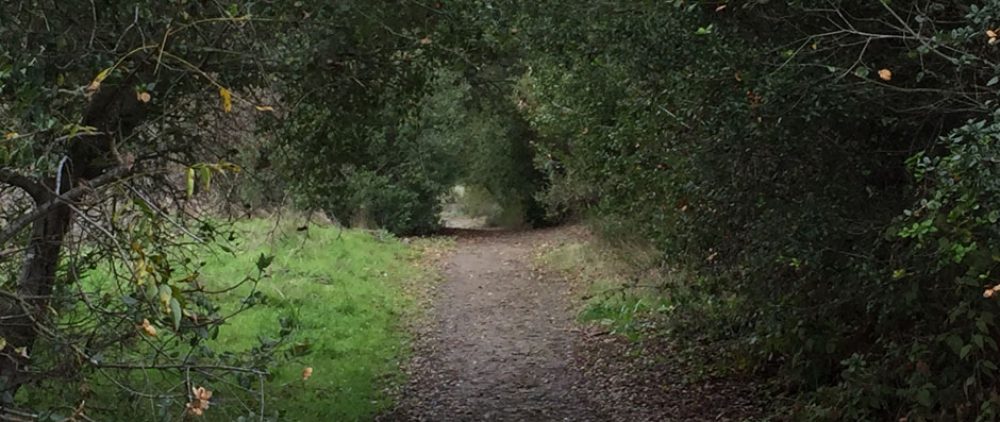
He based his marvelous poem, “Lost” on teachings the northwest coast Indians gave their children on what to do if they ever got lost in the forest.

Lost

Stand still.  The trees ahead and bushes beside you
Are not lost.  Wherever you are is called Here,
And you must treat it as a powerful stranger,
Must ask permission to know it and be known.
The forest breathes.  Listen.  It answers,
I have made this place around you,
If you leave it you may come back again, saying Here.
No two trees are the same to Raven,
No two branches are the same to Wren.
If what a tree or a bush does is lost on you,
You are surely lost.  Stand still.  The forest knows
Where you are.  You must let it find you.

From, Travelling Light, Collected and New Poems, 1999