Another great story rediscovered: Bamboo Charlie

Here is another inspiring tale that I bookmarked some time ago and then forgot.  Coincidentally, like the previous post, its subject is a uniquely creative folk artist.  I read about Bamboo Charlie in a memorial published in the L.A. Times in September, 2012.
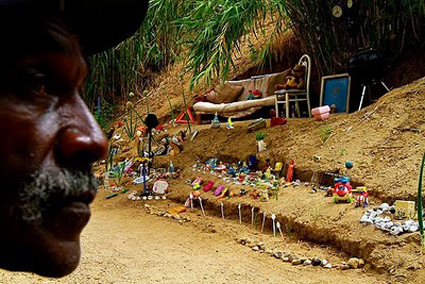
Bamboo Charlie and his whimsical paradise

Bamboo Charlie and his whimsical paradise

Twenty years ago, a homeless Texan named Charles Ray Walker noticed a bamboo grove along a narrow stretch of land by the Los Angeles River in Boyle Heights.  The property owner told Charlie he could stay there if he kept the place clean.

On the strip of land, about 40′ x 200′, squeezed between a parking lot and a warehouse, Walker grew fruits and vegetables.  He carved stairs into the bare slopes and decorated them with hundreds of discarded toys and signs.  He built a shack under a tree, with a TV, bed,and sofa, and then he invited guests to visit: graffiti artists, children and their parents, musicians, police officers, and homeless friends.  He assembled a library out of salvaged books, including best sellers and one called The Semi-Complete Guide to Sort of Being a Gentleman.  Bamboo Charlie was featured on the front page of the L.A. Times in 2010.
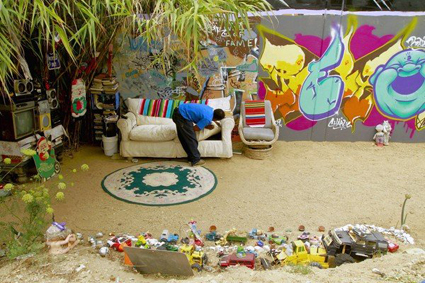
"Bamboo Charlie"

During the 20 years he spent on the parcel, he collected cans for money, sometimes working late into the night. Duruing occasional trips back to Texas to visit his family, he operated a crane at a steel company. “I’m not going to ask another grown man for money. I never have, and I never will,” he said. “People expect that from a homeless man.”  

That pride may have contributed to an early death.  He suffered greatly from ulcers during his final years, but insisted he was fine when friends suggested he see a doctor. On Aug. 26, 2012, a young friend named Teyuca found him dead in his shack, of what the coroner determined was heart disease.  He was 61.

“I really think what he did was folk art, built out of scraps and things found, things that people gave him,” Teyuca said.  “He was a mad genius.  He had such a wild imagination.”

A great story I neglected to post

I found this during a year-end cleaning of my “Drafts” folder – an unfinished post inspired by a newspaper article in July which details the life’s work of unsung folk artist, Arthur Harold Beal, garbage collector for the town of Cambria, CA.

Just down the road from the Hearst Castle, that world-famous monument to excess, lies Nitt Witt Ridge, the house on the hill that Beal lovingly crafted of driftwood, river stones, beer bottles, abalone shells, toilet seats, and other assorted junk.  Beal started work in the 30’s was still going in 1992, when he died at the age of 96.

Nitt Witt Ridge by megpi, CC BY-NC-SA-2.0

Nitt Witt Ridge by megpi, CC BY-NC-SA-2.0

Michael O’Malley, a plumber in town, bought the Ridge for $42,000 in 1999.  Unfortunately, the sale price did not include water rights, so he and his wife cannot live there, and because it is zoned residential, they can’t open the house for public tours.  Several times a week in the summer, O’Malley gives private tours, in return for donations, to people who contact him directly.  He is something of an expert on stories surrounding the Ridge’s creator.

Beal used to say he salvaged his wood from the ocean, but O’Malley points out the quality of the material, and suggests that Beal might have “salvaged” it from local construction sites late at night.  Beal seems to have been a curmudgeon.  Some people asked to visit the house while he was still living.  If he liked their looks, he’d let them in, if not, he would shake his fist and yell, “Move along, small change.”  O’Malley found a video of Beal on a 1981 TV episode of “Real People.”  At age 81, with a long beard and a walking staff, “he looked like a mix of John Muir and Dennis Hopper.”

Here’s a brief but informative clip of O’Malley giving a tour of the house:

Last summer, when I started this post, I added descriptions of other architectural oddities, like the Watt Towers and the Bottle House of Rhyolite, NV.  The story grew too long and languished until now.

The end of the year is a good time to contemplate things like Nitt Witt Ridge.  While others compile their lists of “The Best of 2013,” here is my contribution to a list of things wacky and weird.

Yule ~ The Beginner’s Guide To The Wheel Of The Year

Just in time for the solstice, here is another of Lily Wight’s wonderful “Wheel of the Year” posts, with beautiful illustrations and commentary on the Celtic and Nordic stories surrounding this ancient holiday. Enjoy her post and enjoy the return of light!

Lily Wight's avatarLily Wight

Updated 18/12/2014

     There are four Solar Quarter Days (two equinoxes and two solstices) on The Wheel of The Year calendar.  Yule or The Winter Solstice is celebrated during a twelve day period from December into January.

     Yule commemorates the demise and rebirth of the sun’s powers because The Wheel continues to turn and daylight hours begin to lengthen again beyond The Shortest Day.

     The name “Yule” is thought to derive from the Old Norse ” jólnar”  – a collective term for the gods or “Yule Ones”.   Jólfaðr (Yule Father – interchangeable with All-Father) is one of many names attributed to Odin.  In Old Norse poetry names and terms for Odin are frequently synonymous with celebration and feasting.  Odin The Gift-Giver is undoubtedly the origin of our Santa Claus.

     The Midwinter period between the last harvest (Samhain)…

View original post 390 more words

101 Things that Made America

Apollo suit.  NASA photo, Public Domain

Apollo suit. NASA photo, Public Domain

The Novermber, 2013 issue of The Smithsonian Magazine is devoted to 101 things that made America.  The magazine lists 33 contributors who chose these items from among the 137 million artifacts housed in 19 Smithsonian museums and research centers.

Animals, vegetables, and minerals are represented, and the objects chosen evoke the range of both light and dark aspects of our history.  The opening photograph of a stuffed buffalo is as sad as it is iconic, and the inclusion of the Enola Gay, the plane that dropped the first atom bomb, reminds us that weapons of mass destruction are part of what made us what we are.

The chosen artifacts include:

– The Lewis and Clark Compass (1804). At a cost of $5, it wasn’t cheap, but it survived the 7,000 mile trip.

– A California Gold Nugget (1848)

– Polio Vaccine (1952)

– Abraham Lincoln’s Stovepipe Hat (1865)

– Barbie Doll (1959)

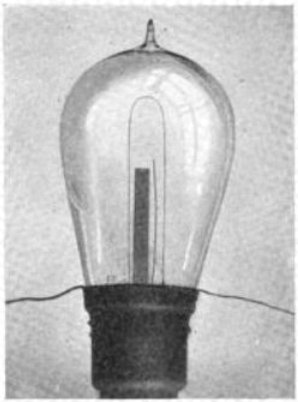
Edison Light Bulb.  Public Domain.

Edison Light Bulb. Public Domain.

– Louis Armstrong’s Trumpet (1946)

– Glass Shards from the Birmingham Church Bombing (1963). Barely a month after Dr. King’s “I Have a Dream,” speech, a bomb blast killed four African-American girls at their sunday school. Outrage over the murder of children at church lent a powerful impetus to the civil rights movement.

– Birth Control Pills (1965)

– The original, tattered Star Spangled Banner that flew over Fort McHenry during the War of 1812 and inspired Francis Scott Keys to compose the national anthem.

– Table and Chairs from Appomattox Court House, where General Lee surrendered to General Grant to end the Civil War (1865)

– The Model T Ford (1913)

– Section of a California Costal Redwood tree.

– Passenger Pigeons: Once there were billions of these birds, but 19th century communities slaughtered them to bake in pigeon pies. The last surviving bird died in 1914 and is stuffed in the Smithsonian.

– The Eniac Computer (1945). I would have chosen an Apple IIE, or even a TRS-80, since it was personal computers, not this behemoth, that changed the world.

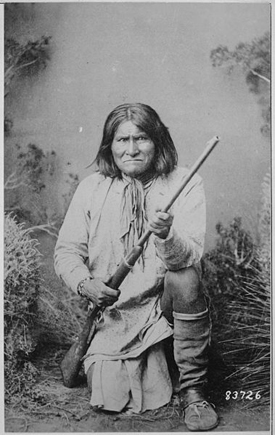
Geronimo, 1887.  Public Domain

Geronimo, 1887. Public Domain

This photograph of Geronimo, taken in 1887. The previous year, Geronimo surrendered his small band and was transported from his beloved Arizona to Florida. He spent the rest of his life in federal prison, though in 1905 he was brought out to ride in the inaugural parade of Theodore Roosevelt. His request to the president to return to his home was denied. On his deathbed in 1909, he reportedly said, “I should have fought until I was the last man alive.”

– Levi’s Jeans (1873)

– Singer Sewing Machine (1851)

– The Colt Revolver (1839)

– Alexander Graham Bell’s Telephone (1876)

– Wright Brothers’ Airplane (1903)

– The Huey Helicopter (1966).  Think of the “Ride of the Valkyries” scene in Apocalypse Now

– Section of the Aids Quilt (1987)

– The first Kodak camera (1888)

– Stage Coach (1851).  I would have included a covered wagon.

– The Teddy Bear (1903).  During a hunting trip in Mississippi, President Theodore Roosevelt refused to shoot a bear that guides had tied to a tree.  This inspired a political cartoon which featured a wide-eyed cub, and led to the toy that is still found in millions of nurseries.

Vintage Teddy Bear by David Crane, 2003, CC BY-SA-2.0

Vintage Teddy Bear by David Crane, 2003, CC BY-SA-2.0

– Ruby Slippers – the ones that Judy Garland wore to take us home in the 1938 Wizard of Oz.

– R2D2 (1983). Here’s the fun story from the Smithsonian Magazine: when filmmaker, George Lucas was finishing production of American Graffiti, the sound designer called for “R2-D2,” which meant, “Reel 2, Dialogue 2.” Lucas, who was already working on Star Wars, said, “What a great name!”

***

This is just a partial list.  You can see all the choices on the website.  No two people are likely to agree on all the artifacts.  What do you think is missing?  Which items should be dropped?  And for those who live in other countries, what are some of your key artifacts and their stories?

Washedashore.org: art to save the sea

Meet Lidia the Seal. She stands as tall as I can reach, in a vacant lot in Bandon, Oregon, the creation of artists and volunteers of the Washed Ashore Project.

Lidia2

The group’s goal is to turn plastic and other ocean garbage into art that illustrates the harm to marine life and the entire food chain resulting from careless dumping.  So far, 1000 volunteers have collected three and a half tons of marine debris along 20 miles of coastline and used it to create 18 giant sculptures.

Detail of Henry the Fish, showing the kinds of objects used to make the sculptures.  Henry is 15'x9'x8'

Detail of Henry the Fish, showing the kinds of objects used to make the sculptures. Henry is 15’x9’x8′

Plaques beside the sculptures explain a little about the dangers of the degrading petrochemicals in plastics in the ocean, as well as the process of collecting, washing, sorting, and recycling what the volunteers collect.

One of the plaques affirms that, “Every action you make in your life has an impact.  Even small actions make a positive difference.  People working together CAN create results.  This project proves it!”

I wish you could have been there to share the delight of rounding a corner to find Lidia and Henry, but for the next best thing, please visit the project website: washedashore.org. There are many more photos and descriptions illustrating the process of turning these castoff items into art, as well as information on exhibits in other locations.

Maybe one day soon, one of these washed ashore creatures will visit a spot near you!  Meanwhile, enjoy these, and perhaps, as one of the plaques says, you will be moved to see art where others see garbage, right where you are today!

Lego Fairy Tales

Once again I’m pleased to feature a post by the amazing Lily Wight, who found some fairytale illustrations I doubt that you’ve seen before. I wonder what the career path is – Lego engineer has always seemed like a dream job!

Lily Wight's avatarLily Wight

     This month’s Lego fix features Little Red Riding Hood, Beauty & The Beast and a rather startled Little Mermaid.

     Just hover over the images for extra information…

View original post

Where to find “Tales of the Elves: Icelandic Folktales for Children.”

In December, 2012, I reviewed a wonderful illustrated book of Icelandic folktales, Tales of the Elves.  I’d brought a copy back from our trip to Iceland in the fall, but was unable to find ordering information.

Tales of the Elves cover

At the end of the post, I invited anyone who discovered that information to pass it along, and a reader named Kimberly just did!  Here’s a link to page for this book at Eymundsson, the premier Icelandic bookseller.  This page, in English, gives a price of 2,499 kronur – at about 100 kronur per dollar, that’s $24.99, what I paid in-country.  If you’re still interested, read on, because now the fun begins:

When you add the book to your cart and move on, the next pages are in Icelandic.  With the aid of an online Icelandic to English dictionary, I came up with translations of these questions you’re asked:

Nafn: name
Heimilisfang: address
Postnumer: zip code
Baer: town
Land: That’s country, and there’s a pulldown
Netfang: email address
Simi: phone

Kodi gjafabrefs: Kodi is code, and I couldn’t find the second term. I’m guessing they mean country codes, which from Iceland to the US is 00 + 1 + area code + number.  Here is a look-up table if you live elsewhere.

Okay, fine!  No one ever said navigating through faerie was easy!  Eymundsson says they’re working to bring their international pages online, so one option is to check back with them in six months.

Would I order this book from them if I didn’t have it?

I have a collection of half a dozen illustrated fairytale books I’ve collected over the course of many years and they have an honored place on the bookshelf.  Each one reminds me of some special moment or place when I found it.  Tales of the Elves is the only souvenir I brought back from Iceland, as the sweaters were too warm for this part of California.

The illustrations inside are as fine as the one on the cover, so if you like this kind of illustrated book and have read this far, you won’t be disappointed.

Fans of movies and fairytales will love this 1922 Cinderella (Aschenputtel), a 12 minute animated silhouette feature by Lotte Reiniger (1899-1981). Reiniger went on to create the first animated feature film in 1926. Those who appreciate the art of fantasy will want to know about Lily Wight’s blog, where so many finds like this appear.

Lily Wight's avatarLily Wight

     German animator Lotte Reiniger created the first surviving full-length animated feature, The Adventures Of Prince Achmed, back in 1926.

     An enchanting collection of Reiniger’s paper silhouette Fairy Tale adaptations is now available on DVD.

     You can watch Cinderella (1922) right here…

     Recommended…

     The Wonderful World Of Froud

     From Aliens To Vampires And Angels To Zombies

     Fantastic Fashion Fairy Tales

     Little Red Riding Hood With Christina Ricci

View original post