More on the eBook Gold Rush

I live about two miles north of the American River.  In 1848, “Captain” John Sutter, who owned this part of the territory, hired John Marshall to build a sawmill on the American not too far upstream, in the town of Coloma.   On the morning of January 24, Marshall spotted some flecks of yellow metal in the mill race.  He knew gold when he saw it.  Marshall tried to keep his discovery a secret, and we all know how that worked out.

Replica of Sutter's Mill at the Gold Discovery Site

 This bit of local history came to mind when I spotted an article in Forbes called, “Who Wants to be a Kindle Millionaire?”  http://blogs.forbes.com/kiriblakeley/2011/03/06/who-wants-to-be-a-kindle-millionaire/?

I would not have bothered with another post about Amanda Hocking, except this piece is writen by a traditionally published author, Kiri Blakeley, who writes in a very measured tone about Hocking’s success and the reality of traditional publsihing:

There used to be a time, not too long ago, when traditional publishing had many benefits…Publishers…used to do all kinds of nifty things for their authors, like throw them a cool book party, send them on a book tour, get their books reviewed in the press and give manuscripts loving yet eagle-eyed editing. Now, chances are an author doesn’t get any of those things—unless she’s on a reality TV show.

Blakeley continues:

… going with a traditional publisher can be extremely expensive. Authors are generally expected to pick up costs for their book’s website, a book’s outside publicist, marketing materials like postcards, and any costs associated with readings or tours. All of this can run into the tens of thousands of dollars. Trust me, I know.

This post is also worth reading because Blakeley’s interview with Amanda Hocking shows the young author to be very savvy about the uniqueness of her success, and dismissive of all the talk about the death knell of traditional publishing. 

Still, with the flurry of articles, you have to assume that every writer, editor, and agent with a computer has heard that Amanda Hocking struck the mother lode.  I have to think that when Forbes runs an article asking who wants to be a kindle millionaire, there are writers buying mules, covered wagons, and gold pans,and  firing up their laptops, and googling, “vampires.”

I find myself humming the naughty verse to “Oh Susannah,” and trying to make up more.

Says Who?

This post is about judging ourselves negatively based on unexamined or under-examined beliefs.  What got me thinking in this direction was the recent exploration I did on ebook publishing.  I’m guessing that most unpublished writers long for the validation that acceptance for traditional publication confers:  “Now I am somebody!”  In fact, those ebook authors who have launched their careers by non-traditonal means have also done an end-run around our customary who’s-who assumptions.  New game, new rules.

I want to consider some of the ideas we use to bludgeon ourselves.  I’m not talking about (relatively) small issues:  I wish I had a nicer lawn. Nor am I considering such serious and potentially clinical issues as a pervasive, non-specific, feeling that I am just no good: I am not up to taking on original sin, in any of its many variations.

I’m talking about the dozens of ideas we or our friends have used to put ourselves down.  Reasons I am a loser:

  • Because I didn’t make the little league team.
  • Because I am dumb in math
  • Because girls think guys in the math club are nerds.
  • Because I’m not as pretty as my sister.
  • Because I didn’t get into my first choice college.
  • Because I don’t like my job.
  • Because I am not married.
  • Because my marriage is on the skids.
  • Because I don’t have any children.
  • Because the kids are out of control, which means I’m a terrible parent.
  • Because I got skipped over for a promotion.
  • Because I can’t handle my new job.
  • Because I got laid off.
  • Because I hate this town and want to live in (fill in the blank).
  • Because I can’t get get my book published
  • Because I want to be somebody.

Something in that list may bring to mind some past or present hot button issues.  Ideas like this can be incredibly painful, but interestingly, the moment our minds change, the issues and pain disappear.  We can see this by considering past ideas, the ones we no longer believe.  One day in grade school, I had a revelation:  I don’t really care about little league – I was just trying out because everyone else was. Instantly, all the inferiority vanished.  I was no longer a loser just because I wasn’t good at baseball.  Soon enough, however, new limiting ideas filled the void and I was a loser again.

That dynamic should make us very suspicious!

It made Cheri Huber suspicious.  Huber, a Zen teacher who is also versed in modern psychology, has made it one of her special missions to take on the voices of self-hate she finds so rampant in our culture.  Huber travels and teaches internationally, is a prolific author, has a regular radio talk show, and hosts workshops both online and at “The Zen Monastery Peace Center,” in Murphys, CA.  http://www.cherihuber.com/index.html

Huber is the author of twenty books, most of them published by “Keep It Simple,” an independent press she and her sangha founded back in the ’80’s.  Perhaps her most pervasive theme is contained in title of one of her most popular books:  There Is Nothing Wrong With You:  Going Beyond Self-Hate.  In the introduction, she writes:

Every spiritual path tells us that what we are seeking is inside us.  Society, the world, others, conditioning, teaches us as children to stop looking to ourselves in order to know what is so for us, and to begin to look to others in order to know what is right.  We first learn to look to parents, then teachers, then friends, lovers, husband or wife, children, Jesus or the Buddha or God – all “out there.”  The love, the acceptance, the approval is out there (emphasis added).

Huber sometimes uses the model of “sub-personalities,” to illustrate the origin of the self-hating voices.  Simplistically, sub-personalities are a series of “mini-me’s” living inside my psyche, with the power to take possession of my awareness from time to time.  Some of them hate me.  Some of them do nothing but whisper poisonous thoughts, and of these, Huber says:

You can listen to the voices that say there is something wrong with you.  It’s actually very helpful to be aware of them.  Just don’t believe them.  Most of what we have been taught to believe we had to be taught to believe because it isn’t true.  This is why children have to be conditioned so heavily!  We would never have reached these conclusions on our own!

I sat in a one day retreat with Cheri Huber in the summer of 2005, and got a sense of her deep commitment to this particular work.  It was clear from her comments that she had come from a starting place of crippling inferiority and lack of self worth.  She now seems like a joyous person, and one who believes her process is open to everyone, and judging by the numbers of people who threw themselves into the work that day, quite a few others have found it true for them.

As you learn to sit down, sit still and pay attention, you begin to glimpse that which sees through the illusion, beyond the voices of society’s conditioning, back to the original being.  And slowly that perceiving becomes more real than all you’ve been taught to believe…you begin to see with a much broader view…you begin to be the love, acceptance, and compassion you have always sought – Cheri Huber.


The Cypress House by Michael Koryta

Arlen Wagner, son of a West Virginia undertaker, knows about death, but nothing prepares him for that midnight in the Belleau Wood when he sees a squadron of skeletons marching toward his position and understands that every one of those men is going to die. In the years after the first world war, Arlen relies on whisky and manual labor to try to live with his unwanted “talent” for seeing death before it strikes.

In the summer of 1935, as Arlen and 19 year old Paul Brickhill, travel to a CCC camp in the Florida Keys, everyone on the train suddenly appears as a dead man. At the next stop, only Paul heeds Arlen’s warning to wait for the next train, and only Paul survives.

After that, things get strange…

That comment is not just meant to be facetious but points to one of the tactics Koryta uses to weave supernatural elements into his tale in a seamless fashion that is too often missing from the “urban fantasy” sub-genre that I once enjoyed but which soon became predictable.  Koryta is a master of mood who plants the vision of dead men on a train among a wealth of ordinary details:  the ever present heat, the smell of unwashed bodies, the cigarette smoke, the card games, and Arlen’s surreptitious sips from his flask.  In the next moment, he can make a simple walk down an empty road in the dark of the tropical night burst with menace.

He delivers on the promise of menace – and secrets.  Everyone has secrets – layers of them.

Arlen and Paul catch a ride with a man who takes them to The Cypress House, a roadhouse in the middle of nowhere, owned by a stunningly beautiful woman.  A few minutes after their arrival, the man who gave them a ride tries to slip away, but is incinerated when a bomb explodes in his car.  Why?  Why are Arlen and Paul arrested for the crime?  What secrets hide in the Cypress House – cypress house – another name for a coffin, Arlen remembers his father saying.  The very best kind of coffin, the coffin of choice for ancient kings and for popes.  Arlen’s father, who claimed he could talk to the dead.  He was insane – wasn’t he?

Michael Koryta, author of five mystery novels, charted a new direction by introducing supernatural elements into So Cold the River, which I praised on this blog last summer.  The Cypress House just came out.  Like its predecessor, this is one of those rare books I could not put down.

How Garth Nix Writes a Novel

Who is Garth Nix?  He is a prolific Australian writer of young adult fantasy, whose “Abhorsen Trilogy,” (1995-2003) more than any other fiction, inspired my own current efforts, and “gave me permission” to write the stories I’m working on now.
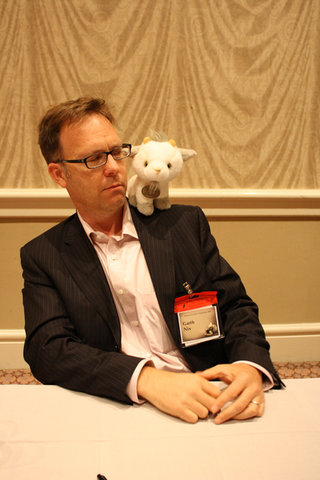
Garth Nix and Yokimo at World Fantasy Con 2009

Writing anything is better than not writing something perfect – Garth Nix

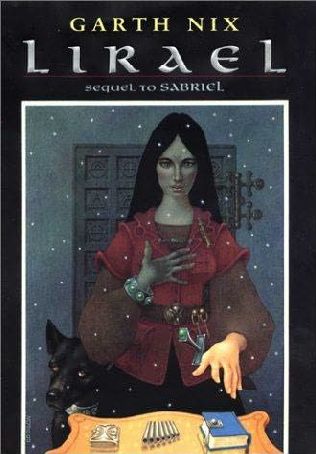
Abhorsens (there is only one at a time), are necromancers charged with keeping the dead, dead – the nastiest dead do not want to stay that way. We’re talking zombies before zombies were cool. In Liraeal (2001), my favorite book of the series, a young woman, apparently a washout from an academy of magical women, sets out with her only friend, the Disreputable Dog, and an inexperienced prince, to save a thinly disguised England and Scotland from several “Greater Dead” leaders of an army of reanimated corpses. Great stuff, like I said!

You can’t write if you don’t read – Garth Nix

Tonight I was browsing Garth Nix’s website (there is a permanent link on my Blogroll) and I came across the author’s account of the nine general stages he has gone thorough in the creation of his 14 novels.  http://www.garthnix.com/Nine%20Stages%20of%20a%20Novel.htm/a>

The nine stages are:

  1. Daydreams and Musing
  2. A Small Vision
  3. Building the Bones
  4. That First Chapter
  5. The Long, Hard Slog
  6. Sprinting Home
  7. Rest and Revision
  8. Revulsion and Dejection
  9. Parting Company

It is instructive to read all of his comments, but here is a summary:

Daydreams and Musing

This is about gathering ideas.  Nix says many people think coming up with ideas is difficult, but he says it’s easy, the fun part.  The difficulties come later.  Images, snatches of conversation, a hunch of a character, these are the the sort of things he gathers, like picking up rocks which “may or may not contain a useful gem.”   He gives examples:

  • The look of the sky in summer when a light rain is falling at sunset
  • Two old men bickering light-heartedly on the street about something that occurred forty years ago
  • The Venetian agents who stole the body of St Mark from Alexandria
  • A car with a cracked speedometer

A Small Vision

This, says Nix, is like a still from a movie he knows nothing about, but it will evoke a mood:

“Two old men are watching the rain from inside a car (with a cracked speedometer) as the sun sets in the distance, discussing their famous expedition to Alexandria to recover the body of St Mark and take it to Venice. The mood is somber and melancholic, something terrible is about to happen.”

Out of this, he is likely to build a scene, often, but not necessarily, the first one.

Building the Bones

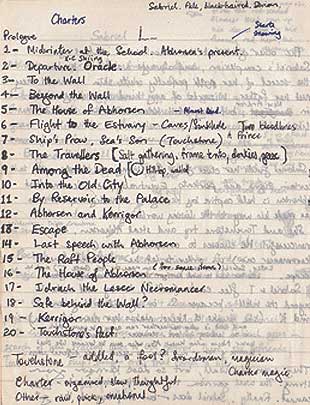
After weeks or months or even years, Nix will review any notes he has made, and write a very simple chapter summary.  He says he often does not know why he does this, since he usually diverges from any such plan within a few chapters, and by the half-way mark the book has little if any relation to the outline, but he notes that an outline serves other purposes:

…it makes me think about the overall structure of the novel, which I think kickstarts some subconscious process that will continue through the writing, monitoring the narrative structure. The second purpose is that it serves as a psychological prop. If I have a chapter outline, I presume I know where I’m going, even when I don’t really.

Chapter Outline for "Sabriel"


The First Chapter

By “first chapter,” Nix says he usually means “prologue,” and that once that and the chapter outline (in whichever order) are complete, the book usually rests for weeks or months.   During the interval he works on other things, and continues to think about the project, but doesn’t actually work on it.

The Long, Hard Slog

Nix always used to write first drafts longhand before copying them to a computer.  Now he is not likely to do an entire draft longhand, but usually the opening chapter(s) are first written in notebooks.  I never tell myself I am writing a 100,000 word book. When I sit down to write, I focus on the fact that I am writing a 2,000-4,000 word chapter. A chapter is a do-able thing. Even so, he calls it a slog, and says 90% of his writing time is an uphill battle to complete the first 2/3 of the novel.

Sprinting Home

At a late stage in the narrative, the writing will kick into overdrive, and the author will find himself working both day and night (he ordinarily likes to keep regular office hours and spend evenings with his family.  I think there is some relationship between the energy put into a book and the energy of the narrative, and when everything is building to the climax and resolution of the story I think that for me at least, it helps to keep at it, to write fast and really charge for the finish line.

Rest and Revision

Nix likes to let the story lie fallow for several weeks before doing revisions, though he says now that’s he is often working on deadline, he has only so much time before he has to send it off to an editor.

Revulsion and Dejection

Nix says, …halfway through a book I usually doubt my work, but I get over it and keep going. Often, when the book is done and has gone off to the editor, this doubt returns and I think that not only have I lost the ability to write, I’ve demonstrated this lack in the latest manuscript. He mentions several of his strategies for getting past this mindset on the website.

Parting Company

The final point he makes is the importance of letting go.   Before breaking into print, Nix worked as an editor at HarperCollins, and says,  In my years in publishing I often met authors whose whole self was entirely bound up in a single book, usually their first. Their lives would rise or fall depending solely on that book’s fate, and in this business, that’s an incredibly foolhardy and dangerous gamble to make.

Garth Nix first came to my attention through an interview in the arts section of the local paper.  I liked his matter-of-fact tone about his writing process then, and I like it on his website now.  He simply offers his process as one approach, not the approach, and the message is, you really do know what to do – now go do it.

Just write one chapter at a time and one day you’ll be surprised by your own finished novel – Garth Nix

The Forgotten Garden by Kate Morton

I choose new books in a variety of ways. Over the last year, I drove frequent round trips to the bay area and became a big fan of audiobooks. Earlier this month, while roaming iTunes, I came across this description of  The Forgotten Garden:

A foundling, an old book of dark fairy tales, a secret garden, a maze, an aristocratic family, a love denied, a mystery – The Forgotten Garden is a captivating, atmospheric, and a compulsive listen about the past, ghosts, family, and memories…

Ghosts, memories, identity – these are hot-buttton themes for me lately, and I did the download. As I got into the story, I wanted to study certain passages in detail, so being a newly-equipped Kindle wonk, I downloaded the eBook.

In 1913 London, a mysterious woman, “the authoress,” leaves a four-year-old girl aboard a ship bound for Australia, with strict instructions to wait for her on the deck.  The authoress never returns.  The child, who hits her head during the voyage, lands with no idea who she is.

A dockmaster takes her home, and he and his wife name her Nell.  On her twenty-first birthday, the dockmaster tells Nell the story, plunging her into a search to learn who she truly is:

Pa’s secret had changed everything.  His words had tossed the book that was her life into the air and the pages had been blown into disarray, and could never be put back together to tell the same story…This person she was, or thought she was, did not really exist.  There was no Nell O’Connor.

Nell never quite unravels the mystery, but when she dies in 2005, with “The authoress…I was supposed to wait,” on her lips, her granddaughter, Cassandra takes up the search.

The book spans over a century, largely focusing on the years 1913, 1975 when Nell travels to England to search for her past, 2005 when Cassandra does the same, and the turn of the century, when we meet the authoress, the mysterious Eliza Makepeace, as an impoverished child in the London of Jack the Ripper.  Eliza lives with her brother Sammy, a changeling….

A what???  A changeling – one of the strange creatures the fairies leave behind when they take a human child.

Some reviewers fault The Forgotten Garden for it’s slow buildup, its rambling style, its sheer length and focus on detail, but I think those very elements may add to the subtle strength of a story that can smoothly fuse what we think is real with what we think is not.  This is not your typical urban fantasy, in the way that Buffy is urban fantasy.  There are still places in Britain where you can walk outside on a moonless night and understand why people believe in other worlds.  Cornwall, where Nell lived as a child, is one of them, and Morton brings this into her story.

It is often the custom these days, for books and movies to open with white-knuckle action.  Perhaps that’s why I like audiobooks so much.  Something about the speaking voice, its rhythms and pauses, slows us down enough to allow the teller to weave the tale.  The point is magic, after all, and there are many ways to get there, some of them in danger of being forgotten.

Kate Morton - Authoress

Kate Morton’s website:  http://www.katemorton.com/

Euphemania by Ralph Keyes

Show of hands: how many know why the British used to refer to bedbugs as Norfolk-Howards? Just as I thought. Or why a one-o’clock meant a fart in Australia? You can find out in: Euphemania: Our Love Affair With Euphemisms, by Ralph Keyes.

Answers:

  • In Victorian England, “bug” was a vulgar word, so a certain Mr. Joshua Bug changed his name to Norfolk-Howard. It didn’t quite work out as he expected.
  • Until World War II, a cannon was fired every day at 1:00pm from Fort Denison, in Sidney Harbor.

According to Keyes, such “situational euphemisms” are relatively short lived, though he notes that some persist for a while:  everyone who watched Super Bowl XXXVIII understands, wardrobe malfunction.

Other euphemisms are much more persistent, none more so than the words we use to avoid mentioning death:  passing away, kicking the bucket, buying the farm, and pushing up daisies (or as the French say, eating dandelions by the root).  Not all of these euphemisms are funny.  Keyes notes that in the military, an event is usually an occasion where someone died, often by friendly fire.  Unlike our more agrarian ancestors who slaughtered animals, we process or harvest them.

Sexual euphemisms are explored too.  Doing one’s duty originated in Rome, in reference to the responsibility of freed slaves to continue to have sex with their former masters.  Hiking the Appalachian Trail came to mean “having an affair,” thanks to a certain philandering governor.  Think of England, y’all!

Those who enjoy pondering words and their meanings will enjoy this article and interview with Keyes on NPR: http://www.npr.org/2010/12/14/132056878/-euphemania-our-passion-for-not-saying-it

The Dream-Maker’s Magic

I have loved fantasy since I was little, growing up on a diet of Norse Mythology, British folklore, and Godzilla.

For years, I helped bankroll the fantasy genre; I patronized specialty bookstores, and even (introvert that I am) went to conferences and Renaissance Faires.  I probably ate up every Tolkien-spinoff quest series ever written.  Eventually, I burned out and wandered to other sorts of reading, but over the last decade, several wonderful books revived my love of fantasy.  One of those gems was Sharon Shinn’s, The Dream-Maker’s Magic.

Shinn’s first book, The Shape-Changer’s Wife, (1995)was critically acclaimed. With her Samaria series, she went on to make a name for herself as an author of adult fantasy. In 2004 she launched a trilogy of thematically connected young-adult fantasies, publishing one a year: The Safekeeper’s Secret in 2004, The Truth-Teller’s Tale, 2005, and The Dream-Maker’s Magic in 2006.

The stories are set in the same world, where magic is part of the fabric of life, and yet it plays a surprisingly minor role. These are not sword-and-sorcery tales. They are more akin to Shakespearean comedy. They are coming of age stories with romantic intrigue, complicated by plot twists and questions of identity, some even resulting from babies swapped at birth.

In The Dream-Maker’s Magic, Kellen Carmichael’s mother almost dies in childbirth. Two weeks later, when she is well enough to care for Kellen, she becomes hysterical, convinced beyond reason, that she gave birth to a boy – and Kellen is a girl.

Kellen says: I was that baby. I was that strangely altered child. From that day on, my mother watched me with a famished attention, greedy for clues. I had changed once; might I change again?  Into what else might I transform, what other character might I assume?  As for myself, I cultivated a demeanor of sturdy stoicism…It was as if I hoped my unvarying mildness would reassure my mother, convince her to trust me.  It was as if she was some animal lured from the wild lands and I was the seasoned trainer who habitually made no sudden moves.

But, Kellen concludes, She never did learn to trust me…or accept me for who I was. It was my first lesson in failure, and it stayed with me for the rest of my life.

If life is hard for her as a child – growing up in boy’s clothing, with sugar-bowl haircuts and a mother who refuses to acknowledge what she is – it becomes even worse in adolescence. Luckily, Kellen begins to meet allies, none more important than Gryffin, a boy who was born lame, whose legs are getting worse, and whose uncle periodically beats him.  Kellen initially scoffs at his unquenchable optimism, at his belief that with an education, he can be anything he desires.  Several days after they meet, however, these two broken people are inseparable friends.

Betsy Palmer, an innkeeper, and her daughter, Sarah, also befriend Kellen, and teach her such arcane mysteries as how to sew a dress that fits and how to do her hair, yet that alone does not end Kellen’s confusion:

…there was one person who was not fooled by my new looks or my modulated personality, and that was Gryffin…He did not seem to notice what I was wearing or how I had arranged my hair…I did not bewilder or surprise him.  He did not think I was trying to be something I was not, as my mother did; he did not think I was trying to break a chrysalis and become something I was meant to be, as Betsy and Sarah surely believed.  He just thought I was Kellen.

I found this the most comforting thing that had ever happened to me.  At times, when I lay awake at night, confused myself about what role I should take and what direction I should try to follow, all that kept me from slipping into tears was knowing I was not completely lost if Gryffin knew how to find me.

That was the point where I put the book down on my first reading, and have every time since, to marvel at the simple way Shinn breaks through all the limits of genre, to evoke something everyone probably longs for:  I was not completely lost if Gryffin knew how to find me.

The Dream-Maker’s Magic is about magic, but it cuts both ways when it appears, and separates Kellen and Gryffin.  The story is a lyrical romance, though you have to watch for the two kisses that Kellen and Gryffin exchange at the very end of the book.  It is a novel whose ending surprises Kellen and the reader; she is not the person she and we imagine her to be.

The ending satisfies in the way that Shakespearean comedies satisfy: what was lost is found, those who were separated are reunited, and poetic justice is meted out.  The story ends on Wintermoon, the holiday when people attach tokens of their hopes and dreams to a wreath, and burn it at midnight, to let the smoke carry their desires to heaven.  Kellen asks Gryfinn what he wishes.  “That every Wintermoon be better than the last,” he says.

Not a realistic wish, as anyone could have told him – but I would not be the one to say so.  Why limit your dreams, after all?  Why not hope for the grandest and the best?  I watched Chase throw the wreath into the bonfire, and I saw the flames scrawl secrets on the sky, and I closed my eyes and knew no end of dreaming.

Be sure to check out Sharon Shinn’s website.  There’s a permanent link in my Blogroll.

Annual “Bad Sex in Fiction” Prize Winner Announced

And now for something completely different:

British author, Rowan Somerville, has been awarded the annual “Bad Sex in Fiction Prize,” for his stunning use of animal and insect imagery in his novel, The Shape of Her.  Judges said they were especially impressed by a passage comparing lovemaking to “a lepidopterist mounting a tough-skinned insect.”

http://www.usatoday.com/life/books/news/2010-11-29-bad-sex-in-fiction-prize_N.htm

Somerville, who beat out such luminaries as Jonathan Franzen, noted during the award ceremony that, “There is nothing more English than bad sex.”   The Shape of Her is not yet available in this country, although I suspect Amazon.UK could ship in time for a holidays.

Rowan Somerville joins an select group of past winners, which includes Tom Wolfe, Norman Mailer, and the late John Updike, who was awarded a “lifetime achievement bad sex prize in 2008.”

Last year’s winner was Jonathan Littell for his novel, The Kindly Ones, in which he described the sex act as “a jolt that emptied my head like a spoon scraping the inside of a soft-boiled egg.”

Show, don’t tell in action…