Notes from 2017 – What is your innermost truth?

truth-2

I  started this post several days ago – in what now seems like a galaxy far away – with something different in mind. My title is paraphrases a question asked by Zen priest, Edward Espe Brown, at a retreat in 2011: “What is your innermost request?”

In the context of the retreat, I took his question to mean, “What is the deepest desire at the deepest core of your being?”  The word, “request,” implies not just desire, need, want, but something akin to prayer. What do we want our lives to be about? What would it take , when our time comes to leave this world, to exit with a sense of peace, victory, satisfaction?

I mean the same kind of thing with, “innermost truth.”  Not just beliefs, ideas, concepts, deductions, or any of the contents of consciousness, for they inevitably change. How many beliefs, ideas, concepts, and so on do you hold from this time a year ago, let alone 10 years ago, 20, or from childhood? What do you know more deeply than emotion and reason both?  Jack Kornfield, in A Path With Heart described this as something you know so deeply that if Buddha and Jesus both said, “You’re wrong,” you would answer, “I am not!”

It’s not an easy question, and there is no simple answer, but it has never been more essential to look to our truths, try to clarify and hold them close over time.

Knowing what we truly believe is an anchor, a center, a “know thyself” tactic at a time when the new president and his minions are trying to normalize lies as “alternate facts.”

The day will come when telling “a Spicer” is a synonym for “telling a whopper,” but until that happens, we need to guard our sense of right and wrong, true and false, as the greatest safeguards we have against the fascist administration that now occupies the White House.

voltaire

Presidents acting presidential

George Washington, 1797. Public Domain

George Washington, 1797. Public Domain

Our Public Broadcasting System is re-running a series on recent American presidents, first aired in 2013. I missed it then, but caught the second episode of “Kennedy” last night (you can watch the entire program here).

The show was excellent. It outlined several glaring failures of the Kennedy administration: the disastrous Bay of Pigs invasion; JFK’s failure to back the emerging civil rights movement; starting us down the slippery slope in Vietnam through mistaking a nationalist revolution for a global communist conspiracy.

Successes included staring down Khrushchev in the high-stakes Cuban missile crisis, and motivating the nation to put a man on the moon, which led directly to the high tech boom, and the laptop or smartphone on which you are reading this post.

Successes and failures aside, the most striking thing I noticed in watching “Kennedy” was that he looked and acted presidential in a way that current presidents do not!  Somewhere along the way, the stature and dignity of the office has been diminished.

It’s not that the presidents of my youth were exemplary human beings: Kennedy and Johnson were notorious philanderers, and Nixon was an angry alcoholic, who sometimes gave orders to “bomb the shit” out of countries that annoyed him (see Drinking in America).  It’s silly to imagine that those who aspire to the office have changed that much in 50 years. It’s rather that the regard we hold for office has diminished.

True, some people exude charisma, or in Johnson’s case, power. It’s also true that an aura often aura celebrities who die young – Kennedy, Marylin, Elvis, Princess Di, and Prince.

I’m tempted to quote what mythologists like Joseph Campbell and Robert Bly have said about the deflation of the archetypes of king and queen, but I think the answer is far simpler, staring us in the face, in our voracious need to pull presidents down to our level, and their willingness to cooperate.

At the start of the primary season, this year’s crop of contenders gathered in mass for the Iowa State Fair, and one reporter detailed which candidates were truly “just folks,” as opposed to wannabe’s, based on whether or not they knew  how to eat ribs.

The cover story on the August 1 issue of Time was, “In Search of Hillary?” What exactly are we searching for?  “Likes poetry, puppies and moonlight walks on the beach?”

I remember Cokie Roberts describing a meeting where Lyndon Johnson got angry and chewed someone out. “It took five years off my life,” she said, while noting that recent presidents, wielding the same power, do not command anywhere near that respect. It’s hard to imagine LBJ on Saturday Night Live or with Stephen Colbert, and during this election year especially, I’m not sure that trade of respect for laughter and buddy vibes has been a good deal for anyone.

Whether the loss of respect moves top-down, or bottom-up, or both, when presidential debates begin to look like the Jerry Springer show, and the rest of us behave accordingly, we’re in a world of trouble!

War reporter, Sebastian Junger, author of, Tribe: On Homecoming and Belonging, outlined one consequence for us in a PBS interview.

A war reporter, Junger was with troops during “hellish deployments,” but noted that some of the soldiers did not want to go home. Junger says that for most of our history, we humans have lived and thrived most in tribes or clans and, “The real an ancient meaning of tribe is the community that you live in that you share resources with that you would risk your life to defend.”

Only at war did many of the young men that Junger met experience this kind of connection. The lack of it, in our culture, is deadly in his opinion. Looking at our current election season, Junger says we look like opposing tribes, that hold each other in contempt.

“No soldier in a trench in a platoon in combat would have contempt for their trench mate. They might not like them. They disagree with them, but you don’t have contempt for someone that your life depends on. And that’s what we’re falling into in the political dialogue in this country. And in my opinion, that is more dangerous to this country than ISIS is, I mean literally like more of a threat to our nation.”

“I wish I had a tribe,” Junger says, “But we don’t. We just don’t. That’s the problem. That’s why our depression rate, our suicide rate, all that stuff is through the roof. That’s the tragedy of modern society.”

I remember watching Kennedy on TV as a kid. I remember walking to grade school in 1962, past a neighbor who was digging a bomb shelter. I remember “duck and cover” hydrogen bomb drills, which we all knew were ludicrous even then. But through all the fear, what I really remember, was growing up in a neighborhood, in “one nation” as we said during the pledge of allegiance.

I don’t know anyone who lives in a neighborhood or one nation anymore. Perhaps that realization is what makes this election so sad – an election like this couldn’t happen if values like “community,” and “nation,” to say nothing of “tribe,” weren’t so completely fractured.

I have some notions of what happened, but that is for another post. And as they say, we cannot even begin to imagine solutions for a problem until we admit that it exists and what it costs.

Drinking in America: Our Secret History by Susan Cheever

Drinking in America

The Pilgrims who came to America on the Mayflower were headed toward Virginia, where they had a land grant from King James.  Instead, they landed illegally in Massachusetts because they were running out of beer.  So says historian, Susan Cheever in her just-released Drinking in America: Our Secret History.  Cheever, a sober alcoholic, documents the pendulum swings of our national love-hate relationship with alcohol as she explores an important but little-known aspect of our past.

Alchohol was a factor at critical turning points in American history.  It is likely that the shot heard round the world was fired by one of the seventy militiamen awakened by Paul Revere, who passed the time while waiting three hours for British troops at the Buckman Tavern on Lexington Green.

According to Cheever, for all the volumes written on the civil war, no one has documented the considerable effect of alcohol on this conflict.  General George McClellan wrote, in February, 1862, “No one evil so much obstructs this army…as the degrading vice of drunkenness.”  McClellan, who did not drink, was relieved of command for indecisiveness in battle – or sanity, as Cheever suggests, while “His colleagues who succeeded on the battlefield – Grant, Meager, and Hooker, for example – were drinkers whose performance was often affected by their whiskey intake.” 

Most who have studied the war know about Grant, but not as many realize that because of the riotous condition of his camps, some credited General Hooker for lending his name as an epithet for prostitute.  General Thomas Meager fell off his horse while drunk as he led his troops into action at Antietam.  He drowned in 1867, after drunkenly falling off a riverboat in Montana.

Grant managed to sober up before his election as president, while Richard Nixon is revealed as an angry blackout drinker whom National Security Advisor, Henry Kissinger, Defense Secretary Melvin Laird, and White House Chief of Staff H.R. Haldeman had to protect from his own drunken rages.  They “danced around the president’s homicidal, drunken orders to bomb the shit out of this or nuke the shit out of that – orders usually not even remembered the next morning.  ‘If the president had his way,’ Kissinger told his aides, ‘there would be a nuclear war each week.‘”

Cheever’s survey not only covers political and military history, for drinking plays a part in our folklore and arts as well. John Chapman, aka, Johnny Appleseed, did not tramp around the countryside planting apples for pies, but for cider, and five of the seven 20th century American writers who won the nobel prize – Sinclair Lewis, Eugene O’Neill, William Faulkner, Ernest Hemingway, and John Steinbeck – were alcoholics. That there is no inherent connection between writing and alchohol is shown by a similar list of 19th century literary greats who did not drink to excess: “Melville, Emerson, Thoreau, Hawthorne, Longfellow, the Alcotts, and…Whitman.”

This underscores the paradox of the poles in our cultural history:  “temperance and intemperance, drinking and abstinence, liquor and sobriety, addiction and recovery.  Our country has been, at times, the drunkest country in the world; our country has been, at times, one of the least drunk countries in the world.”

As she sums up the “objective” view of modern historical authors, Susan Cheever notes that the “broad, dispassionate view,” often misses the “moments that make up our lives.” One of those things often missed by American historians is the effect of drinking on our history and national character.

“What is history?: a way to sift through the past in an effort to comprehend the world we live in; a way to understand ourselves; a way to make meaning of our lives by finding meaning in the past. How can we do that without acknowledging something many of us do every day, the thing that we use to punctuate our lives in celebrations and in sadness; how can we do it without acknowledging that glass of wine or whiskey neat or dry martini that has been such a powerful and invisible part of our life as a nation?”

Her Poison Pen

Dame Agatha Christie, 1890-1976

Dame Agatha Christie, 1890-1976

The Guinness Book of World Records lists Agatha Christie as the best selling novelist of all time. Over the years, I’ve done my part in helping to make her so.

Christie’s preferred fictional murder weapon was poison. Of the more than 300 people who died in her stories, at least 100 ate or drank something they did not live to regret. In a fun segment on last week’s Science Friday, Ira Plato interviewed Kathryn Harkup, chemist and author of A is for Arsenic: the Poisons of Agatha Christie.

From 1914 to 1918, Agatha Christie volunteered as a nurse at a local hospital, and worked in the dispensary when it opened. Back then, all pharmaceuticals were mixed on site, and none of our modern restrictions on drugs were in place, so of necessity, Christie acquired a detailed knowledge of theoretical and applied chemistry in order to pass her apothecary’s assistant exam in 1917. She learned what to do, and more importantly for her future literary career, what not to do with medicines. She was tutored by a local pharmacist who carried a lump of curare in his pocket, “because it made him feel powerful.”

Christie started writing in her twenties and did not meet with instant success. Kathryn Harkup gives an example of the plot complexity of her first published novel, A Mysterious Affair at Styles, 1920.

Spoiler Alert

The elderly victim is killed by with a lethal dose of strychnine, which at that time, was given, in measured doses, to the elderly as a tonic.  The killer, however, added bromide, a popular sleeping powder, to the solution, which caused the strychnine to precipitate out as crystals at the bottom of the bottle. The final teaspoon would be lethal, and the killer could arrange an airtight alibi.

Harkup’s research revealed that Agatha Christie had studied the effect of combining these two drugs as a lesson in what not to do, in the course of her apothecary training.

If you have ever watched a Hercule Poirot or Miss Marple movie, or purchased one of the two billion copies of Agatha Christie books that have been sold, you’ll want to check out the Science Friday interview!

Inside Inside Out, a review of sorts

In a culture that imagines a sharp mind-body split, it isn’t surprising to see images of a smart inner being controlling our physical “machinery.” Inside Out gives us a committee at the helm. Among feature length movies, it is unique in this respect, as far as I know.

Inside-Out-Meet-your-emotions-2

There are many points to ponder during the film’s 90 spectacular minutes of Pixar 3D animation, but given my background, I was especially caught by the movie’s alignment with a key post-Jungian view of the structure of the psyche.

Michael Ventura, a journalist who has written at length upon archetypal themes, and who co-authored We’ve Had 100 Years of Psychotherapy and the World is Getting Worse (1993) with James Hillman, said “There may be no more important project for our time than displacing the…fiction of monopersonality.” 

In Jung’s theory of archetypes, pre-eminent place goes to “The Self,” at once, the center of the psyche and it’s totality. The Self, for Jung, was the god image within us. The problem, according to both Ventura and Hillman, is that none of us ever experience ourselves this way. The idea of a unified, “monotheistic” Self is a longing rather than day to day reality, in Ventura’s words, “the longing of all the selves within the psyche that are starving because they are not recognized.”

Buddha came to a similar conclusion 2600 years ago, but Hillman, chose to rely on western models, and drew from Greek mythology to illustrate his conclusion that the psyche is “polytheistic,” with many archetypal centers.  A contemporary of Jung named these centers, “sub-personalities,” a term I have heard at least one Zen teacher use to illustrate the concept.

The Greek pantheon

The Greek pantheon

Thirty years ago, Michael Ventura wrote,  “It is crucial to every form of human effort that we forge a model of the psyche that is closer to our hour-to-hour experience, because, in the long run, as a society, we can share only what we can express.” (published in Shadow Dancing in the USA, 1985, now out of print but available used).

In the interim, nothing was actually forged – rather, a growing awareness of our “hour-to-hour” experience has emerged. How often do we say or hear others say, “Part of me wants to go left, but another part wants to go right?”

This awareness is now pervasive enough that it’s central to a summer blockbuster, aimed at a PG audience. Even if we don’t spend time studying differing models of the psyche, we understand Ventura perfectly when he says, “If you are alone in the room, it is still a crowded room.”

Thomas Hardy – take two

Let’s try this again…last time I pulled a classic not-paying-attention trick – I hit “Publish” instead of “Save,” and then trashed the previous draft.

So as I was I was saying….

A movie trailer for a new version of Far From the Madding Crowd got me thinking of Thomas Hardy. This is the fourth movie based on Hardy’s fourth novel and the first one that brought him critical acclaim and commercial success. The 1967 film version, starring Julie Christie, Alan Bates, and Terrance Stamp, launched me on a long Thomas Hardy reading jag.

This version of Far From the Madding Crowd is the movie I most clearly remember from my teenage years. Not only did Hardy’s melancholia mesh with my teenage angst, but I’m sure I wasn’t the only teenage boy to fall in love with Julie Christie.  Observe her gaping audience as she sings “Bushes and Briars:”

You can’t read Thomas Hardy without noting his stark vision of tragic fate in human affairs. The simplest act or coincidence can trigger chains of events that lead to disastrous outcomes. In Far From the Madding Crowd, an anonymous valentine, sent as a joke, leads to heartbreak, murder, and a hanging.

In Tess of the D’Urbervilles, also made into four movies, a snatch of conversation overheard at a crossroads by Tess’s drunken father leads to heartbreak, murder, and a hanging.

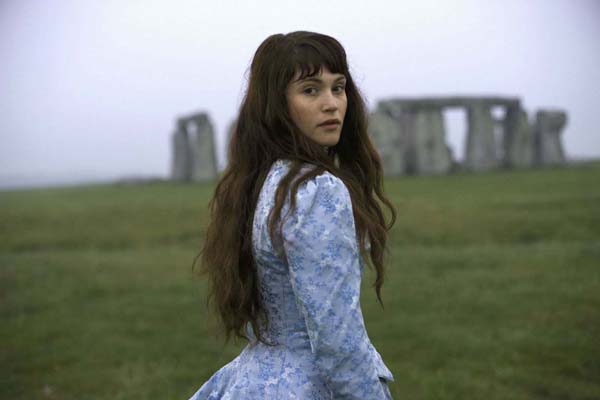
Gemma Arterton as the doomed Tess, 2008.

Gemma Arterton as the doomed Tess, 2008.

In Return of the Native, Hardy’s sixth novel, the beautiful Eustacia Vye, who longs for greater life than she can find on a remote heath, suffers the fate of a Greek tragic heroine. Her moves to escape her fate bring it upon her. Eustacia and her husband’s mother drown. In grief and despair, the husband becomes a preacher.

Catherine Zeta-Jones as Eustachian Vye in "Return of the Native," 1994

Catherine Zeta-Jones as Eustachian Vye in “Return of the Native,” 1994

With recurrent themes of the conflicting demands of culture versus nature for the individual, as well as liberal doses of illicit sexuality, Hardy’s 19th century works were popular with 20th century readers. Seeming to contrast with that is a tragic vision more purely classical than any other novelist I can think of.

And let’s face it, we Yanks love good British period dramas whenever we can get them, whether set in Camelot or on Egdon Heath. So you better believe I’ll be in line to see the new Far From the Madding Crowd when it’s released. It might even prompt me to take another foray into 19th century literature, something I thought I had long left behind. We never know where imagination will turn…

Reversion by Amy Rogers: a book review

Reversion

Dr. Tessa Price lost her infant son to a rare genetic disorder. For Tessa, much more is at stake than science when she invents a radical gene therapy to save another child, seven-year old Gunnar Sigrunsson, who suffers from an equally fatal disease. When her procedure fails to gain U.S. regulatory approval, she opts to treat Gunnar at the Palacio Centro Medico, a posh international center for cutting edge medicine.

During one of her visits to the Palacio, Tessa finds Gunnar almost miraculously improved. On the same trip, chimpanzees in the animal lab seem to go mad, savagely killing one of their own. The events seem disconnected until an animal technician begins to exhibit signs of the same madness and releases the animals, despite their rabies-like symptoms, into the nearby forest.

The leader of a brutal drug cartel occupies the Palacio with his private army, while a rival cartel with modern weapons, lays siege from the outside. As the two factions exchange blows and animals attacks increase, Tessa and a small group of patients hide in the research wing, hoping to avoid detection.

Tessa realizes that the greatest threat may not be the drug lords or deranged chimps, but a revertant virus, combining elements of rabies with a bat virus that creates a rabies-like contagion that can be spread through touch, and apparently through the air. Tessa’s cell studies show that Gunnar is the host. The boy she is trying to save for the sake of personal redemption – for the fatal genes she passed to her own son – might doom everyone around him.

Reversion is the second novel of Dr. Amy Rogers, MD, PhD, who writes science thrillers, a genre one can explore in depth on her blog, sciencethrillers.com.

Dr. Amy Rogers

Dr. Amy Rogers

Amy is also a writing friend I know from the Sacramento branch of The California Writer’s Club. I posted an enthusiastic review of her first novel, Petroplague, in 2011. Once again, she has created a gripping story that parallels the headlines we read in the papers. You can find both ebook and hardcopy versions of Reversion by clicking the icon at the top of this post.

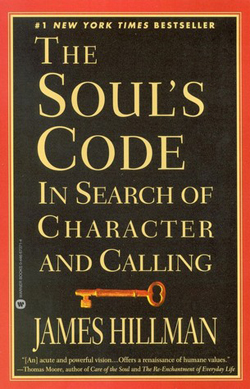
The Soul’s Code by James Hillman

the soul's code

James Hillman (1926-2011), a prolific post-Jungian psychologist, thinker, and cultural critic, wrote more than 20 books, but The Soul’s Code: In Search of Character and Calling (1997) is probably his best known work.

In a head-on attack upon the reductionist nature of both the nature and nurture camps of western developmental psychology, Hillman proposes a view of individual destiny based on Plato’s Myth of Er. Are we nothing but helpless products of our mothers in the first year of life or our luck-of-the-draw genetics? Or is there a deeper meaning to how we grow and unfold?

Hillman proposes an “acorn theory,” arguing that each acorn holds the pattern of the oak it may become, just as each soul that enters the world may bear a destiny shaped by intelligence rather than random chance: “what is lost in so many lives and what must be recovered [is] a sense of personal calling, that there is a reason I am alive.”

Hillman expounds his theory in a number of biographical sketches. He writes of Manolete, the most famous bullfighter of 20th century Spain. As a child, he was sickly and frail. “He stayed so much indoors and clung so tightly to his mother’s apron strings that his sisters and other children used to tease him.” Then, at the age of 11, he became fascinated with bulls.

Current psychology theory would hold that Manolete chose a macho vocation to compensate for his mama’s-boy childhood. Hillman wonders if somewhere deep inside, was “the acorn” that realized his destiny was to face down charging, thousand pound bulls, including the one that gored him to death at age 30. Of course that was too frightening a vision for a boy of 8 or 9 to hold!  Of course he held tight to his mother!

Hillman also discusses the childhood of Eleanor Roosevelt, one of the 20th century’s most influential women. As a child, Eleanor was “funny,” as well as “sullen, stubborn, spiteful, [and] sour…She lied; she stole, she threw antisocial tantrums in company.”

She lost her mother, a brother, and her “playboy father” before she was nine, but all the while carried on a vivid fantasy, “the realest thing in my life,” in which she lived with her father in a large household and traveled the world with him.

Psychotherapy would have regarded her fantasies as delusions and prescribed psychotropic medications to try to return her to normal. But what of the possibility that her visions meant something? What if her fantasies were “invented by her calling,” Hillman asks, and “were indeed more realistic in their orientation than her daily reality.”

“Imagination acted as a teacher, giving instruction for the large ministering tasks of caring for the welfare of a complex family, of a crippled husband, of the state of New York as the governor’s wife, the United States as its first lady, and even of the United Nations. Her fantasies of attending to “Father” were a preliminary praxis into which she could put her call, her huge devotion to the welfare of others.

Hillman is always provocative, inviting us to look deeper into, or “see through” the ideas that limit soul and it’s individual expression. Psychological literalism is often in his crosshairs, as when he says, “Our lives may be determined less by our childhood than by the way we have learned to imagine our childhoods.”

James Hillman, 1926-2011

James Hillman, 1926-2011

The Soul’s Code is a challenging book, but valuable as it sheds new light on many unquestioned assumptions about development, the individual, and destiny that need to be questioned.