Silence

A busy couple of days:  not only a bit of  furious blogging, but finishing up three separate writing projects and reviewing manuscripts for two critique groups.

This morning I attended the California Writer’s Club monthly breakfast and talked with a retired psychiatrist about what’s broken in our mental health care system (hint:  a drug for all that ails you).

After breakfast I came home, and finding this week’s Time in the mailbox, read one of the lead articles, “Are America’s Best Days Behind Us?”

After that it was time for final proofing and submission of entries to two of the writing contests I’ve mentioned here.  The submissions are on their way, one electronically, one by snail mail.  I’ll have results (or lack thereof) in June and November respectively.

Finally – finally, it was time to brew a cup of coffee in my new French Press (which I am just starting to master), kick back, and enjoy one of life’s greatest luxuries – SILENCE.

Strangely enough, I realize I can’t really say what silence is. It isn’t just lack of noise; the yard guys came with their leaf-blowers, and though I do not enjoy the sound, it didn’t throw me out of inner stillness today (though it sometimes does).

Silence is not just about lack of thoughts, though it does seem to be about experiencing them as impersonal events, like the weather.

Inner silence is not just about meditation, though paradoxically, I would not have found a way to get there if I had not been looking for it in meditative disciplines for years and years and years.

I didn’t learn to find silence on a meditation cushion, but at work, among the cubicles.  I didn’t find it through some technique, but because I quit smoking and really missed the hourly time-out-from-everything I used to enjoy when I’d step outside every hour for a cigarette.

I missed those time-outs long after the nicotine was out of my system.  I took to going outside every hour for ten minutes, thought at first I just did a lot of inner whining as I watched other people light up.

Then, at some point, it simply happened:  I found my time-out mojo, my inner stillness.  For me, it has to do with listening.

I think anyone can find it, it’s really easy.  What happens when someone says, “Hey, listen, what’s that?”

Silence is what happens!   Thoughts and distractions return soon enough, so you listen again.  Distractions come, listen again.

Maybe sounds work best for me because they are not my dominant sense and I really have to pay attention.  Thinking of attention I remember a Zen story that goes something like this:

A student goes to the master and says, “Sir, what is the key to enlightenment?”

The master says, “Pay attention.”

A few moments later the student says, “I am paying attention.  What is the secret?”

“Pay attention.”

The student begins to get flustered.  “I am paying attention.  Are you going to tell me or not.”

“Yes.  Pay attention.”

You get it, and presumably the student got it eventually too – the doorway into one of life’s greatest luxuries.

What Do I Really Know?

I’ve been very busy with writing lately, but in a one step forward, two steps back kind of way.  It has also been a time of discouraging words, to paraphrase “Home on the Range.”  Discouraging words about the never-so-crowded playing field for those trying to get into print.  Discouraging result (or lack thereof) from yet another writing contest I entered in the fall to no avail.  This is stuff I ordinarily blow off, but right now I’m in a doldrum phase in my novel.

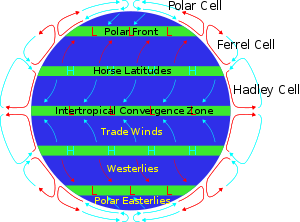
**Doldrums** –  Popular name for the “intertropical convergence zone,” just north of the equator, where winds of the northern and southern latitudes combine, causing extended periods of light or non-existant breezes.  (When my writing hits the doldrums, I Google way too much!)

I picked up a hand full of early chapters of the book to review, but found I was still too close to do any kind of evaluation.  A mass of questions arose:  This seems okay but is that all is – just okay?  Is this still the story I want or need to tell?  Should I take an extended break to write some short stories?  Should I take a non-fiction break.  Would it help to just walk away for a while?

When questions like this bounce around my head, I think of a section of Jack Kornfield’s marvelous book, A Path With Heart.

After a traumatic event, a former student came to Kornfield in a state of great confusion.  Lot’s of well meaning people, each with some claim to spiritual expertise, had been giving her contradictory advice, and she didn’t know who to believe or which way to turn.

Kornfield told her the 2500 year old story of a group of well-meaning spiritual seekers who faced similar confusion.  The sought out the Buddha to ask his advice.  He told them to take no one’s word for the truth, not even his, but to test what they heard for themselves and see which teachings led to “welfare and happiness…virtue, honesty, loving-kindness, clarity, and freedom.”  Kornfield reminds us that “in his last words, the Buddha said we must be a lamp unto ourselves, we must find our own true way.” Based on this teaching, Kornfield posed a question to the woman:

I asked her to consider carefully what she actually knew herself.  If she put aside the Tibetan teachings, the Sufi teachings, the Christian mystical teachings, and looked in her own being and heart, what did she know that was so certain that even if Jesus and the Buddha were to sit in the same room and say, “No, it’s not,” she could look them straight in the eye and say, “Yes, it is.”

Through great good fortune, I know what that truth is for me in the spiritual realm – I’ve written about it, or around it, or hinted at it in the “No-Self” series I posted in November and early December.  What startled me and led to this post was the realization I do not know what the equivalent truth is for me in writing.  What do I know beyond what any expert may say?  What have I hammered out of my own experience?  What is “my own true way?” I’ve been mulling it over, and if I don’t know the truth, I’m pretty darn sure of a few things:

  • In writing as in living, my own true way seems most likely to manifest when the me gets out of the way, and that implies that the first thing necessary, the main thing to take a break from, is attention to results.
  • Whatever kind of writing it is, when it comes alive, it is surprising.  If I am writing honestly, I learn things about myself and about the world.  “Oh, I didn’t quite realize I felt that way, but I guess I do.”
  • On a spectacular day like this, in between winter storms, it’s time to get outside and breathe some fresh air.

Keeping an eye on truths like these, even if they are not quite eternal verities, may be enough to spark a breeze in the doldrums and get the ship moving again.

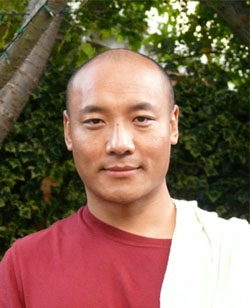
Rebel Buddha: On the Road to Freedom by Dzogchen Ponlop

If I’d had any idea how good this book is, I would have read it much earlier. I have never come across a better introduction to Buddhism, one that is neither too esoteric nor too simplistic.  The author aims to present the core teachings, independent of custom, convention and eastern cultural trappings.  Some of his conclusions may seem surprising.  For instance, he clearly states that practicing Buddhism as a religion is fine, but it isn’t essential, because the Buddha’s central teaching is simply the importance of exploring the mind, including thought, sensation, and emotion, for that is where our suffering happens and where we experience it.

Dzogchen Ponlop’s experience as an easterner transplanted to the west makes him uniquely qualified to speak of this eastern tradition transplanted to the same soil.  When instructors at Columbia University asked him to introduce himself, he was at a loss.  Born of Tibetan parents in exile in India, and emigrating to New York City, he wasn’t sure who or what he was.

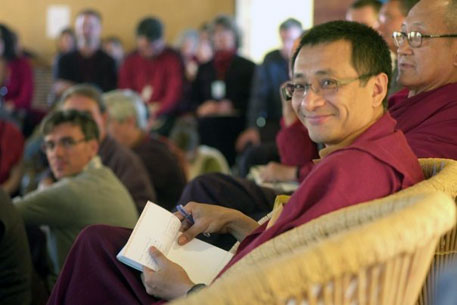
Dzogchen Ponlop Rinpoche

Such disorientation as a prelude to an unexpected opening of awareness parallels the realization of selflessness, which is central in Ponlop’s exposition of the Dharma or teachings.  We look in our body and mind for the “self,” and when we finally realize we cannot find it, thinking may stop, allowing us to experience a moment of pure, unconditioned awareness.  This, he says, is “our fundamental being, our basic, open and spacious awareness.  Imagine a clear blue sky filled with light.”

The fundamental cause of our suffering is clinging to a sense of self that is not only illusory, but divides ultimate and indivisible reality into a minefield of pleasures and pains, friends and foes, of the ego.  The Buddha’s terms “emptiness,” and “selflessness” have negative connotations in the west, but Ponlop explains that the actual experience of these states is anything but heavy or depressing.  “When we have a genuine experience of emptiness, it actually feels good…It’s not a vacuous place where everybody is desolate and moaning about something – that’s our ordinary life.”

***

Ponlop’s title, Rebel Buddha very naturally references the historical Prince Siddhartha, who abandoned all the privileges and responsibilities of a crown prince in his search for spiritual truth.  The title also calls to the indestructible potential for true freedom in each of us.  The rebel buddha within is that unconditioned awareness, “a trouble-maker of heroic proportions,” that will accept nothing less for us than the freedom that all the historical Buddhas discovered.  The actual word, “buddha,” does not refer to a few people only, but means, “awakened,” and is part of our own nature.  Even the willingness to investigate whether this is true can be enough to set our feet on the path.

Ponlop quotes from a famous teaching the historical Buddha gave to the citizens of a town who were confused by the conflicting teachings they had received from a number of itinerant preachers – not so different from what can happen to any seeker now who takes a few workshops an buys a few books on spiritual topics.  Buddha advised the citizens not to take the word of any authority or scripture, and not even to take his word, but to put the various teachings into practice, and “after observation and analysis, when you find that anything agrees with reason and is conducive to the good and benefit of one and all, then accept it and live up to it.”

There’s a lot of that in this book of Dzogchen Ponlop, a spiritual master who writes as a fellow traveller on the road.

The Blogisattva Awards

Yesterday, December 8, was celebrated by some Buddhists as Bodhi Day, a commemoration of the 8th day of the 12th lunar month, when Shakyamuni Buddha is said to have reached enlightenment.  Here is the event as imagined in the excellent movie, Little Buddha:   http://www.youtube.com/watch?v=2xV8xgWlZy0&feature=related

In commemoration, the finalists for the 2010 Blogisattva Awards were announced.  These commendations are given in various categories for “excellence in English-language Buddhist blogging,” aka, “the Buddho-blogosphere.”

Blogisattva: a portmanteau combining the English word for ‘blog’ [which is ‘blog’] with the Sanscrit word for ‘being’ [which is ‘sattva’]. The letter ‘i’ is used as caulk to hold the word-tiles together. Thus, Blogisattva means BLOG BEING.

But as the website notes, this is first and foremeost about excellence in blogging and is only about Buddhism in so far as that is what flavors how we blog and what we write about.

The “what we write about” of these links is life itself:  the joys and pains of raising children, caring for parents with Alzheimer’s, wondering if John Lennon was a boddhisattva, and many many thoughts on the effort to practice meditation and live wisely and compassionately in an ever more complex and confusing world. 

There is now a permanent link here in the right hand column.  Click it for some intriguing and thought provoking articles.

No-Self, Part 3

Jack Kornfield is a widely respected author, teacher of Vipassana or Insight meditation, and a founder of the Spirit Rock Meditation Center, http://www.spiritrock.org.

In a classic discussion of spiritual practice in general, and Buddhist practice in particular, A Path With a Heart, Kornfield devotes a chapter, “No Self or True Self?” to the question of identity.  Two key points emerge:  not to take this too literally, and not to be upset by the concept.  He notes that his teacher, Achaan Chah, said, “If you try to understand it intellectually, your head will probably explode.”

Achaan Chah spoke of this paradox one evening in his monastery in a way that was quite astonishing for a Buddhist master.  He said, “You know, all this teaching about ‘no self’ is not true.”  He went on, “Of course, all the teachings about ‘self’ are not true either,” and he laughed.  Then he explained that each of these sets of words, “self” and “no self,” are only concepts or ideas that we use in a very crude approximation, pointing to the mystery of a process that is neither “self” nor “no self”

Another of Kornfield’s teachers, used to laugh at how easily and commonly we would grasp at new identities.  As for himself, he would say, “I am none of that.  I am not this body, so I was never born and will never die.  I am nothing and I am everything.  Your identities make all your problems.  Discover what is beyond them…

Those teachers and authors I have quoted over the last several posts share an interest in an experience I stumbled into – the seemingly counter-intuitive freedom that comes with relaxing our grip on rigid concepts of what we are and what we are not.  At any time this seems troublesome, the real question becomes, who or what feels enhanced or diminished by the words, “self” or “no-self?”

An excellent resource on this and other questions is the Spirit Rock website given above. Under the “Meditation 101” tab is another tab called “Audio Resources,” with links to literally hundreds of recorded talks, given at Spirit Rock and elsewhere, that plunge into seemingly difficult topics like this.

No Self, Part 2

People and things appear solid and self contained. We mostly experience ourselves as if we just appeared on earth the way Superman did – one day the wonder-baby showed up from outer space. Buddhism suggests that this conventional view is just a story, an idea, that doesn’t align very well with what we discover if we pay attention. In other words, Buddha told some different stories, that align more closely with experience, and with happier experience.

Like other great spiritual teachers, the Buddha knew he was telling stories (google on the Heart Sutra), and in particular, he warned his followers, that just because we suffer if we get attached to the story of a separate self, we will also suffer if we attach to the story of no-self – if we take it as a hard truth, a doctrine, a dogma.

Why does belief in a separate self cause suffering? Because it leads to a foxhole existence. Halt, who goes there, friend or foe? It also brings an awareness of physical mortality as loss – we aren’t going to last and neither is anyone we care about. My favorite analogy is one of the simplest: we experience ourselves as waves on the ocean, rushing to shore.  It may be exhilarating when we’re young and death is something that happens to old people, but let a few decades whiz by, and the rocks and shore look a whole lot closer. And aside from that, how often does the sense of separation cause an uncomfortable sense of disconnection?  A million variations on loneliness.  And how much more suffering do we create for ourselves and others in an effort to scratch the itch, dull the pain?

Jerry Uelsmann - Untitled

Buddha tried to shift our understanding. Yes, we are waves for a while, but our true nature is ocean. Ocean changes but it doesn’t go anywhere.  A wave that knows it is and will ever be ocean has a lot less to worry about.

***

Our true essence goes beyond birth and death.  It can never get sick.  It can never get old.  It is beyond all conditions.  It is like the sky.  This is not a theory.  This is the truth that can only be realized in the realm of enlightened consciousness.  This consciousness is surprisingly accessible to each of us. – Anam Thubten

When that awakening happens there is no longer any desire to become something other than who we are. Every previous idea of who we are vanishes, along with the pain, guilt, and pride associated with our body. In Buddhism this is called no-self. This is the only true awakening. Everything else is a spiritual bypass.– Anam Thubten (emphasis added).

Try this.  Pay attention to your breath in silence.  Look at your mind.  Immediately you see thoughts are popping up.  Don’t react to them.  Just keep watching your mind.  Notice that there is a gap between each thought.  Notice that there is a space between the place where the last thought came to an end and the next one hasn’t arrived.  In this space there is no “I” or “me.”  That’s it. – Anam Thubten (emphasis added).

***

The sense-of-self is an assumed reality.  Only the idea of “me” separates us from the unconditioned truth of our being…It is possible to simply stop believing in the validity of the view of separation and free it from its isolated position by bringing the view of separation itself into awareness.  This means we are cued to the subtle pain caused by separation, and simply release the thought of separation without picking it back up. – Rodney Smith

***

I like the rainbow analogy; I can grasp it because we’re not dealing with something that appears to be solid like a person or a rock.

Let’s say a rainbow decided to practice a meditation common to eastern traditions, by asking the question, “Who am I?” and watching what thoughts pop up.  The rainbow starts out believing it is a thing, but what kind of thing?  Strangely enough, if this rainbow is very determined, it will not find anything called “rainbow!”  It sets out to discover its true rainbow self, and simply but it simply cannot be found.

What am I?   –    A rainbow.
What is a rainbow? – Umm…

What am I? – A person.
What is a person? – Umm…wanna check my ID?

If this rainbow has a lot of courage, it will discover it is made of water droplets.  And sunlight, since there are no rainbows until the storm breaks up.  And it is made of the time of day, since there are no rainbows at night.  And it its existence depends on the perspective of people watching.  Drive another five or ten miles down the highway and we may not see the rainbow anymore, though others behind us may.

As Thich Nhat Hahn would say, our rainbow discovers it is made entirely of non-rainbow elements.  It exists, but it is “empty” of a true, essential, rainbow-self.  The poor little guy may freak out at first, and yet…

Rainbow over Carmel Beach

Ultimately, it may be quite a relief. Rainbows don’t live very long.  Not even as long as flies.  Yet water and sunlight and clouds and daytime and people watching the sky are not going away…

To sneak in a Shakespeare quote:

Nothing of him that doth fade,
but doth suffer a sea-change,
into something rich and strange.

TO BE CONTINUED

No-Self, Part 1

For several months, I have been side-stepping the article I really want to write, because it is difficult, potentially upsetting to some readers if I say it wrong, and because “who do I think I am?”

I have been wanting to write about the Buddha’s teaching of “No-Self,” or Anatta, in the up-close and personal way I have come to experience it.

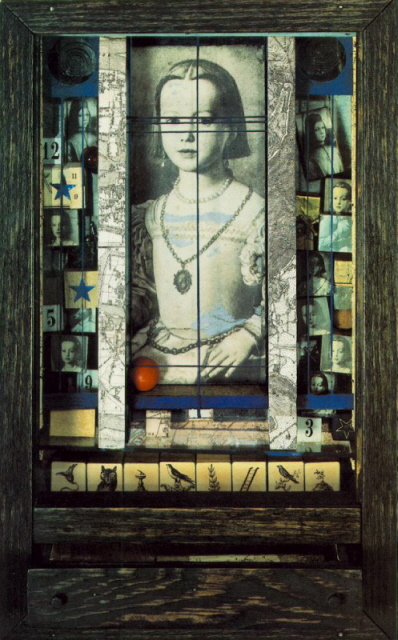
Joseph Cornell - "Medici Princess"

One of the saner things I did at the end my mis-spent youth, was to begin practicing meditation and contemplative spirituality.  Twenty-five years later I was still at it.   I had experienced incremental results: better, health, concentration, relaxation, and so on.  But something was still missing.

Around 2005 I was itching to drop some of my baggage of meditation techniques, theories and beliefs and “cut to the chase.”  To simplify!  It was like walking into a cluttered room and deciding some of the crap has to go.  My thoughts turned to  Zen practice because I had read The Three Pillars of Zen, and I couldn’t think of anything more bare-bones than just to sit and breathe, which I was (hopefully) going to continue doing anyway.

I had shied away from Buddhism because I once tried to read Thich Nhat Hahn and misunderstood what he had to say about “No-Self.”  I thought he was saying the soul or “true-self, that part of us that feels very valuable, is not real.  Buddhists do not say that “self” isn’t real, so much as they say it isn’t real in the way we think it is real.

I like the analogy to a rainbow.  A rainbow is real (while it lasts) but it isn’t real in the way it appears – and we’re better off not pinning our hopes to the pot of gold at the end.

Jerry Uelsmann - "Undiscovered Self"

Anyway, in 2005, I attended a Zen Sesshin (several days of morning-to-night practice) taught by a Catholic priest (which isn’t as uncommon as people might think).  It was…nice.  Not bad, not great, but overall, relaxing and…nice.  I appreciated the simplicity and it hooked me enough that I kept sitting like that once I got home.  And a few months later, nice turned into something a lot more powerful.

One evening during the holiday season, as I thought of family members and friends who were gone, and a parent who was ailing, I felt a profound sense of loss, of precious things slipping away.  But in the next instant a thought came; with perfect, instant, compelling clarity.  The thought just appearedWho is sad? And in that instant, there was nobody there! All that saddness was gone because there was no one there to feel sad.

I didn’t need the priest to confirm that it was the real deal, though he did a while later when I spoke to him again.   I got a further confirmation when I attended a daylong retreat led by Anam Thubten, a Tibetan Buddhist teacher whose message is summarized in the title of his book, No Self, No Problem.  His basic suggestion for meditation is simply to rest from all physical and mental effort:

As we begin to rest and pay attention, we begin to see everything clearly.  We see that the self has no basis or solidity…We might want to apply this simple inquiry whenever problems arise.  If we feel angry or disappointed, simply ask, “Who is the one being angry or disappointed?”  In such an inquiry, inner serenity can effortlessly manifest…When all the layers of false identity have been stripped off, there is no longer any version of that old self.  What is left behind is pure consciousness.  That is our original being.  That is our true identity. No Self, No Problem pp. 5-6.

Anam Thubten

Anam Thubten’s website:  http://www.dharmatafoundation.com/about.aspx

TO BE CONTINUED.

Murder, Magic, and Redemption – the Story of Milarepa

This rather dramatic lead-in comes from a movie teaser: “Milarepa is a tale of greed and vengeance – demons, magic, murder and redemption. It is the story of the man who became Tibet’s greatest mystic.” http://www.imdb.com/title/tt0499238/
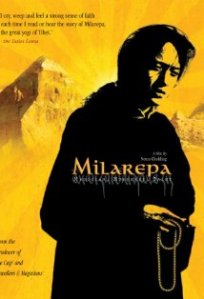
Milarepa film poster

“Milarepa is one of the most powerful and moving stories of love and transformation in world literature” – Richard Gere

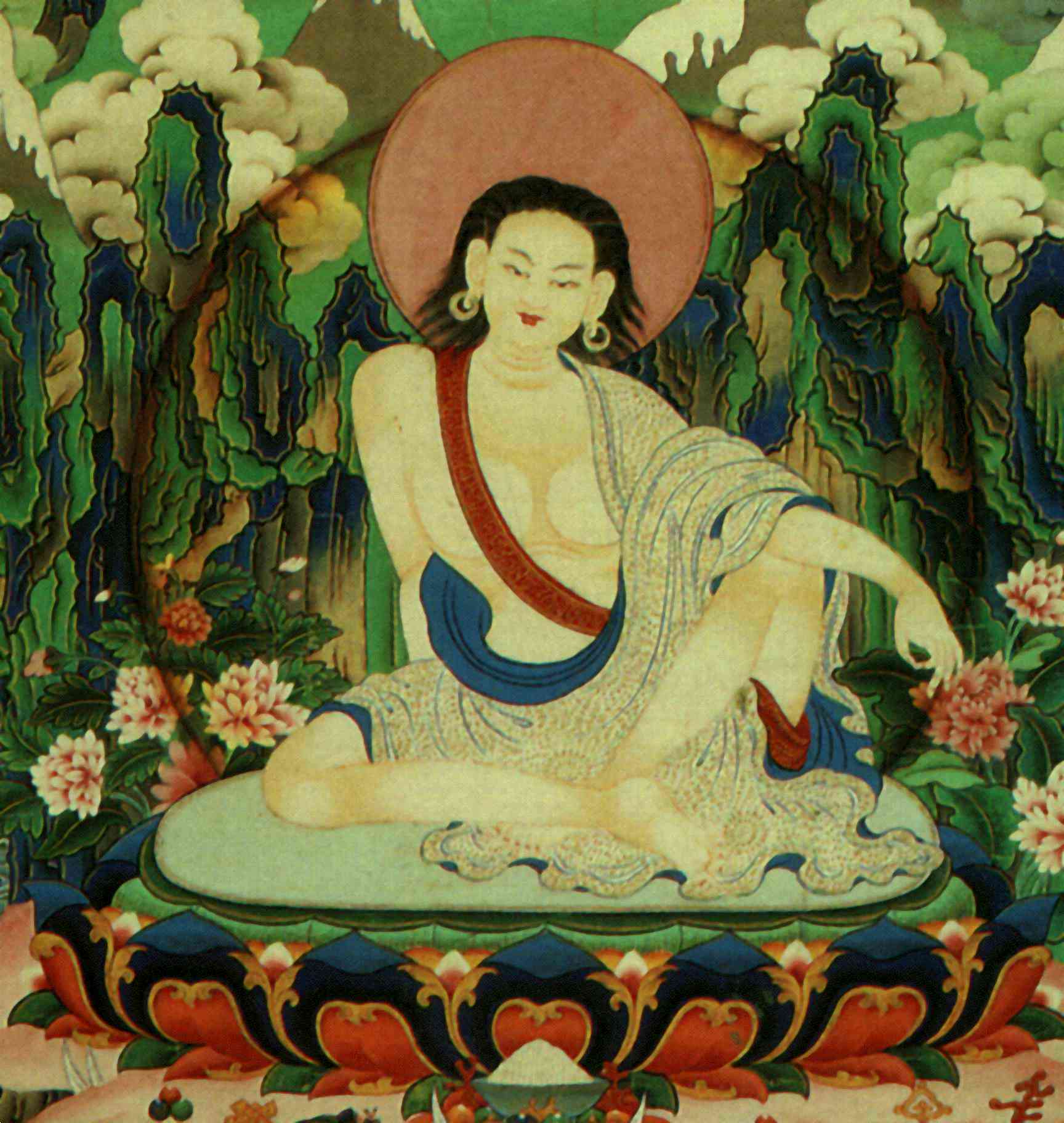
To borrow a term from the previous post, the stories of mystics and prophets are almost always strange attractors. History, shaped by our collective imagination of ultimate things, is guaranteed to be larger than life. Milarepa’s (1052-1135 CE) own teachings are found in the songs and poems he wrote, while the magical legends are from a biography written several centuries later.  The Dalai Lama said, “I cry, weep, and feel a strong sense of faith each time I read or hear the story of Milarepa, the greatest yogi of Tibet.”

Here is a one sentence synopsis: A young man in ancient Tibet commits mass-murder to save his mother, undertakes rigorous spiritual practice to expiate his sin, and becomes a saint whose teachings are still alive nine-hundred years later.

This is the story in greater detail:  Milarepa was born into a prosperous family, but his father died when he was seven, and the house and property went to a greedy aunt and uncle, who treated the family like slaves; they lived in a hovel, ate swill, and toiled in the fields all day.  When he was 15, Milarepa’s mother demanded that he visit a certain sorcerer and learn black magic to extract revenge.  If he didn’t do her bidding, she threatened to kill herself in front of him.

In our culture, where obeying your parents is optional, it’s easy to think the mother was just a whack job, and why didn’t someone think to call CPS?  To understand Milarepa’s story at all, we have to imagine a culture where family honor was more important than life itself.  Where a human incarnation was held to be infinitely precious, and your mother was revered as the chief giver of this gift.  Where allowing harm to come to your mother if you had the power to prevent it was an unimaginable sin.

We speak casually of choosing the lesser of two evils, and for most of us, the dilemma will be over once election day is past.  Not so for Milarepa.  The closest I can come to imagining him wrestling with his choice is to recall the scene of Gary Cooper on the mountain in Sergeant York, a Bible in one hand and the Constitution in another, trying hear the voice of his own conscience.
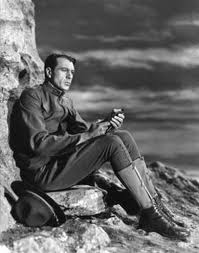
Gary Cooper as Sergeant York

Milarepa chose to obey his mother.  He went to the sorcerer and learned a complex practice that allowed him to invoke spirts who pulled down the stone house where his uncle’s family was celebrating a wedding.  Thirty-five people were in the house.  Ironically, only the aunt and uncle survived.

All hell broke loose.  The relatives of the dead were furious and gave chase.  Milarepa barely escaped pursuit, but he couldn’t escape his own conscience or the negative karma for 33 murders that was sure to land him in Buddhist hells for quite a few incarnations.  His sorcerer contact advised him to seek out a famous guru named Marpa.  When he heard the name, a thrill went through Milarepa, as if a glimpse of his destiny had just opened up.  The night before he arrived, the guru dreamed of someone very special coming into his life.  Though he instantly recognized Milarepa’s potential, he also saw the dark karma and knew the boy would have to work it out before anything else could take place.

Milarepa asked for initiation into spiritual practice, but Marpa refused, saying such treasures were not for someone as “worthless” as he.  Instead, he told Milarepa to move a stone tower to another location three miles away.  It took Milarepa three years to carry the rocks on his back.  Marpa looked at his work, scratched his chin, and said, “You know what?  I think I liked it better at the first location.  Move it back.”

At that point, most of us would be on the phone to our therapist, but Milarepa did what he was told.  In those days, spiritual seekers sometimes endured great hardships and life-threatening journeys for spiritual instruction.  It was all right;  Marpa never wound up on the 6:00 news with charges of fraud or scandal.

Milarepa toiled for for twelve years before receiving spiritual initiation.  After that, he undertook an eleven month retreat in a sealed cave with only a butter lamp for light, and a little slot where someone passed him one meal a day.  Later he moved to another remote cave where he lived on nothing but nettles and local vegetation.  He looked like a living skeleton, but there he attained final awakening.  Just like the parable of the Prodigal Son and related stories from India, Milarepa’s tale asserts that no one is beyond redemption once they sincerely turn in that direction.
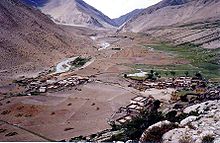
View from Milarepa's cave

Naturally, there are miracle stories about Milarepa.  One of them tells that he pressed his hand into the rock wall of his cave where it still holds the impression.  Here is an online account of someone who visited the site:  http://www.dreammanifesto.com/milarepa-miracle-set-stone.html

During a group pilgrimage to Tibet in the spring of 1998, I chose a route that would lead us into directly to Milarepa’s cave…To demonstrate his mastery over the limits of the physical world, Milarepa had placed his open hand against the cave’s wall at about shoulder level . . . and then continued to push his hand farther into the rock in front of him, as if the wall did not exist! When he did so, the stone beneath his palms became soft and malleable, leaving the deep impression of his hand for all to see…

In anticipation of my questions, our Tibetan translator…answered before I even asked them. “He has belief,” he stated in a matter-of-fact voice. “The geshe [great teacher] believes that he and the rock are not separate.” I was fascinated by the way our 20th-century guide spoke of the 900-year-old yogi in the present tense, as if he were in the room with us. “His meditation teaches him that he is part of the rock. The rock cannot contain him.”
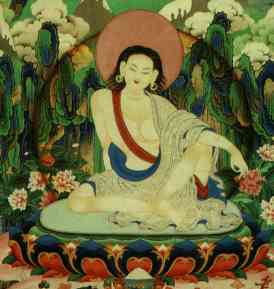
Milarepa

“In my youth I committed black deeds. In maturity I practiced innocence. Now, released from both good and evil, I have destroyed the root of karmic action and shall have no reason for action in the future. To say more than this would only cause weeping and laughter. What good would it do to tell you? I am an old man. Leave me in peace.” – Milarepa http://en.wikipedia.org/wiki/Milarepa

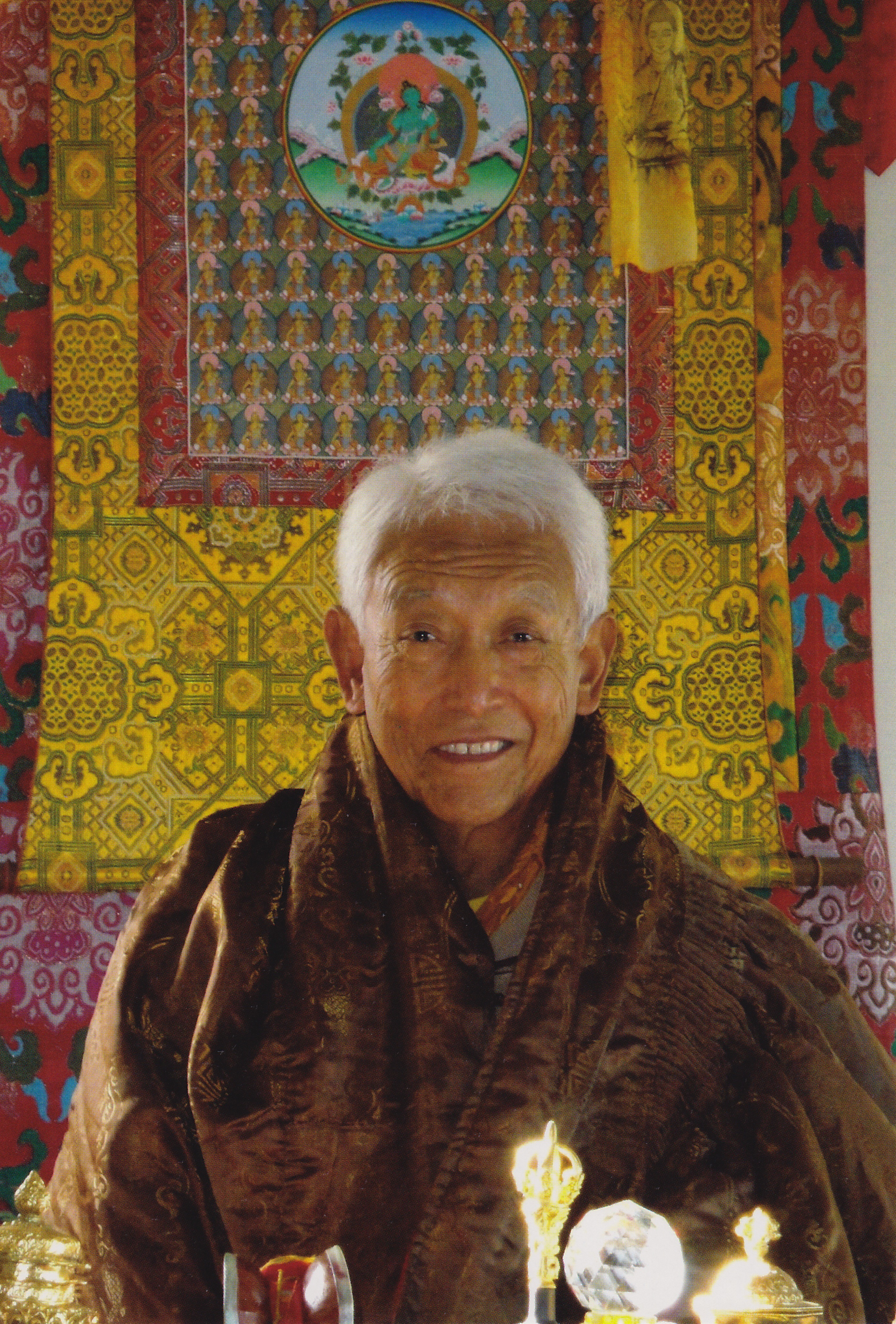
I’m all for stories of solitary heroes going against the crowd.  For stories of finding your life’s purpose and for tales of redemption and spiritual mastery.  My fiction always seems to circle around such themes, but for me, there is even more to the tale of Milarepa.  I’ve been fortunate enough to experience the living nature of his teachings in the person of Lama Kunga Thartse Rinpoche.

Born in Lhasa in 1935, he was recognized at the age of 7 as a reincarnation of Sevan Repa, one of Milarepa’s closest disciples.  He entered a monastery at 8, was ordained as a monk at 16, and became a Vice-Abbot at 24.  Lama Kunga fled from Tibet in 1959, and in 1972, he founded Ewam Choden Tibetan Buddhist Center in the hills just north of Berkeley (there’s a permanent link to the website on this blog).
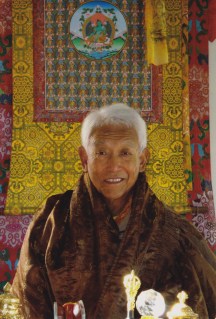
Lama Kunga Thartse Rinpoche

I met Lama Kunga two years ago while searching online for a particular Tibetan ceremony. I knew there was a place in Tucson and had calculated the cost of plane tickets when I found the ceremony was being offered at Ewam Choden, in two days time. I left a phone message, afraid there would be some barrier or pre-requisite, but when Rinpoche returned my call a little while later, he said, “Just come!” I asked if he was sure, and he said once more, “Just come, you are very welcome.”

Ewam Choden is just 90 minutes away, and I’ve been back many times.  On several occasions, I’ve sat through all day teaching sessions that end with the 75 year old lama more energetic than the students who are – at least speaking personally – desperate for a cup of coffee.

No rocks on the back or towers to move.  Lama Kunga is not that sort of teacher at all, as one can gather from the story written about him in the November, 2002 issue of Golf Digest, where he told the interviewer that good golf demands getting past the ego, but then said, “I would like to be reincarnated as a better golfer someday.” http://www.ewamchoden.org/?page_id=46

And finally, if the story of Milarepa seems like a pretty decent fantasy tale and nothing more, that’s fine. It would be fine with Milarepa and with the Buddha before him, who told a group of seekers, “Don’t take my word for anything.”

“Do not go by oral tradition, by lineage of teaching, by hearsay, by a collection of scriptures, by logical reasoning, by inferential reasoning, by a reflection on reasons, by the acceptance of a view after pondering it, by the seeming competence of a speaker, or because you think: ‘The ascetic is our teacher.’ But when you know for yourselves, ‘These things are wholesome, these things are blameless; these things are praised by the wise; these things, if undertaken and practiced lead to welfare and happiness’, then you should engage in them. (Numerical Discourses of the Buddha, p. 66)