I’m Not Dead Yet!

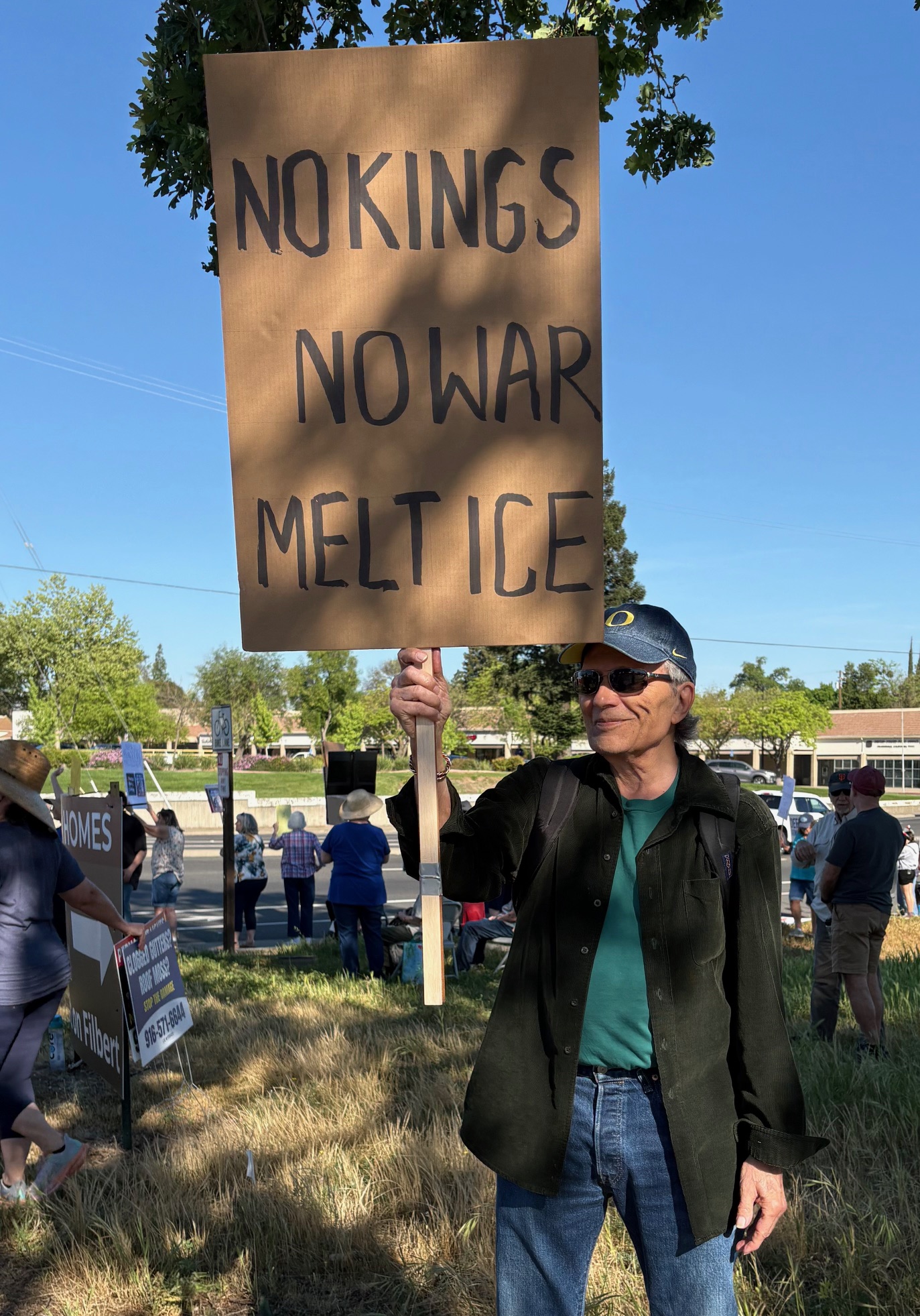
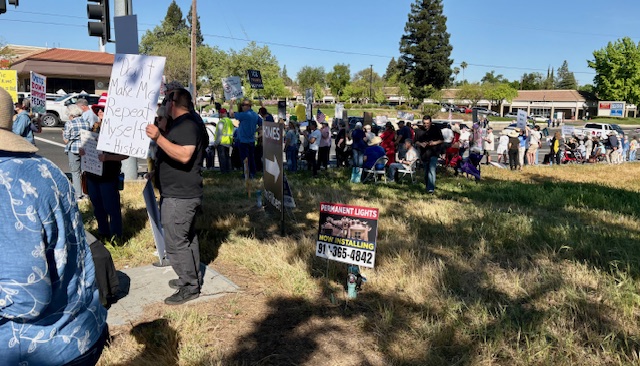
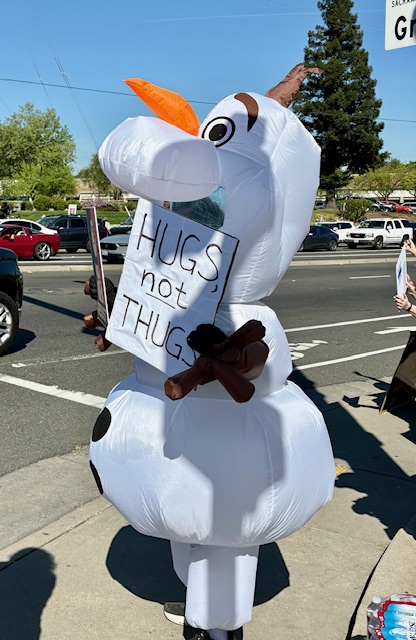
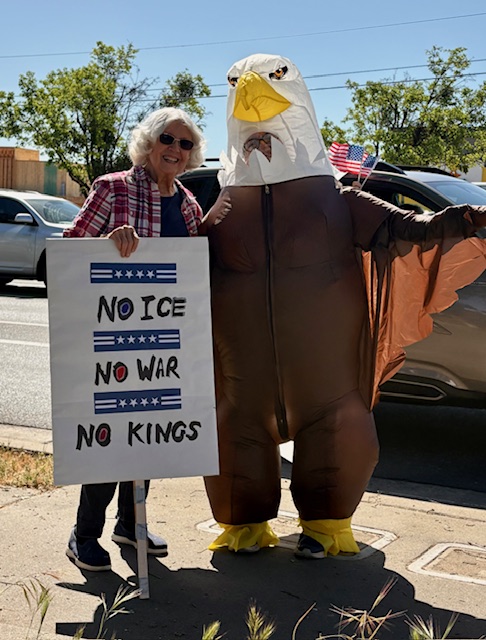
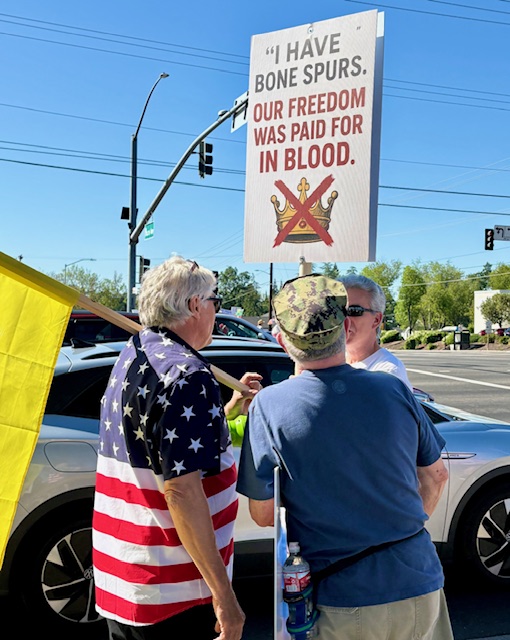
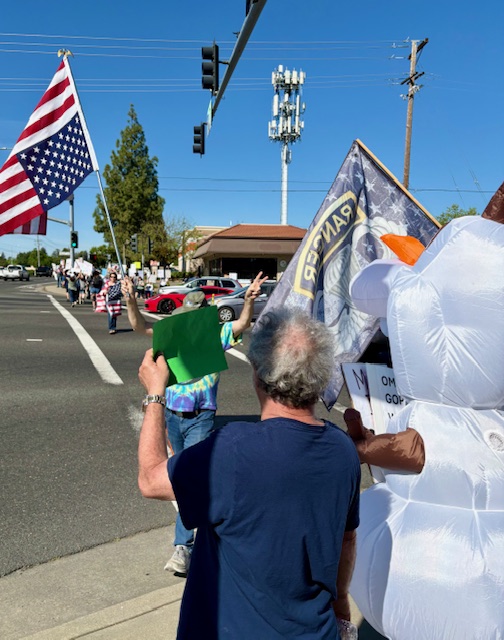
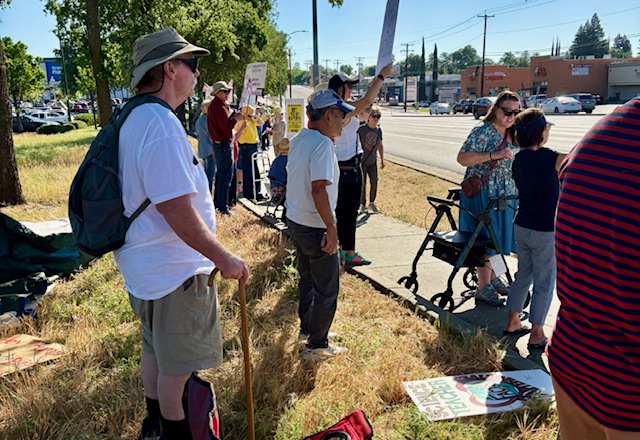
Not dead, just at a loss for words in the jumble of chaotic events in this alternate reality we stumbled into through trusting a criminal whose only talent is selling reality TV as reality. It was satisfying to get out this morning with Mary to a small (250-300 people) No Kings rally in Orangevale, CA.

The morning raised a lot of positive energy, but part of the motivation, at least for me and several people I talked to, was grief for the nation we have become. Several times I’ve started a post on what James Hillman might say about the archetypal roots of our predicament, but that’s an escape from the bare facts – we have become a pariah nation, undoing eight decades of efforts to foster goodwill with our allies and peace with our perceived enemies. Now we’re squandering blood and treasure while committing crimes against humanity, like blowing up innocent fishermen and schoolgirls.

We learn from 12 Step groups that change can come with clear understanding and deep remorse for a problem. Hopefully the growing number of people willing to hit the streets to make their voices heard signals the growth of a critical mass that can tip our nation back to one that decent people can feel proud of.

A Cautionary Tale

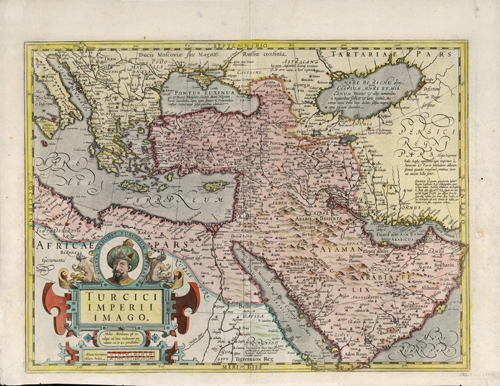
Ottoman Empire, early 17th century. Library of Congress

At its height, the Ottoman Empire (1299-1922), controlled North Africa, much of the Mediterranean, and portions of the Balkans, Italy, Austria, Hungary, and Russia. Innovations in medicine, mathematics, astronomy, architecture, philosophy, chemistry, physics, calligraphy, weaving, music, and literature are part of their cultural legacy. They gave us scalpels, alarm clocks, and coffee.

The following notes on the decline of the Empire come from A World Undone, 2007, by G.J. Meyer, an excellent history of World War I that I have quoted before.

The high point of the Empire occurred during the reign of Sultan Suleiman the Magnificent, from 1520-1566. The Sultans did not have wives, but large numbers of concubines, who gave them large numbers of sons. Suleiman had 300 women in his harem, but became enamored of a red-haired Russian woman, who later became known as “the witch,” She convinced Suleiman that his favorite son was plotting against him. Suleiman had this son killed and the witch’s son, Selim, installed as his heir. Meyer says:

“Selim the Sot was short and fat and a drunk. He never saw a battlefield and died after eight years on the throne by falling down and fracturing his skull in his marble bath.” Meyer describes the Sultans that followed him as “craven.” This started the Empire’s decline.

*****

Let me put this in bold type:

It only took eight years for a craven leader to begin the ruin of what, for 300 years, had been the most powerful and innovative Empire in the known western world.

Spirits

On Sunday, a 39 year old man drove an SUV through the annual Christmas parade in Waukesha, Wisconsin. Five people are dead and many more injured, including 18 children between the ages of 3 and 16, who suffered abrasions, broken bones, and serious head injuries. I remember the joy of a Christmas event like that when I was about 4, that climaxed with Santa arriving by helicopter. Will Advent and Christmas ever be joyful again for the people of Waukesha?

The media mostly glossed over the event. If the killer had used a gun or had a political motive, it would have been front page news, but apparently regurgitated opinions on the Rittenhouse trial got more clicks than another massacre in America.

As of this morning, we know the accused man was on bail after allegedly running over the woman who claims to be the mother of his child at the start of the month. On Sunday, he was involved in a “domestic altercation” before plowing into the crowd. One of the few comments I saw the night of the attack came from Marianne Williamson, who said “an evil spirit” was loose in Wisconsin, and we needed to pray.

Williamson evoked some mockery during the 2019 Democratic primary debates for statements like that, but hers was the one comment I still remember from those events. She said “No amount of policy wonkiness can overcome all the hate in this country.” More recently she echoed words I’ve heard from other leaders in other spiritual traditions that, “There are no political solutions for what ails the nation.

I’ve been thinking about belief in spirits, both good and bad. Some acts are so heinous it’s hard to believe that “mere” human malevolence lies at the root – the Manson murders and Jonestown come to mind. As far as I can tell, only western culture since “the Enlightenment,” has refused to acknowledge the possibility of non-material influence on our behavior. Belief in spirits was part of original Christianity, and “distinguishing between spirits” was listed as a gift of the Holy Spirit by St. Paul (1Co 12:10 NIV). When you’re hearing voices, it’s good to know if they’re trustworthy!

We can call them spirits or call them neuroses, but at times like this, it’s dangerous to call ourselves invincible. In a more peaceful time, when the Star Wars movies first came out, everyone knew the Force was good and wanted it, without taking it literally. It’s worth remembering now that all it takes to turn us to the Dark Side is anger and hatred.

From Sea to Shining…

One of my favorite photos of our nearest shining sea. Sunset, Bandon, OR, 2013.

A story that Tibetan meditation master, Orgyen Chowang Rinpoche told during a Zoom teaching last year came to mind this Independence Day.

Rinpoche said that when he was young, his passion was to learn ultimate truths. He said he eventually realized that ultimate truths are beyond the grasp of our ordinary, discursive minds, and the question he now asks is, “Is this beneficial?”

Historical truths are more accessible than metaphysical ones, but this July 4, the contention over even fundamental “facts” is central to our national malaise. I remain convinced that for a nation, just as for an individual, a fearless admission of wrongs is a pre-requisite to further efforts to manifest dreams and ideals.

Our national ideals of equality, freedom, and democracy, are now International dreams. So are the forces of fear and greed that feed the rising waves of world-wide authoritarian movements. The dream of democracy will survive, and now would be a good time to pray that nations that currently embody it do as well.

***

This seems related – Mary and I were out this morning, and when we got back, it was too hot for a vigorous walk with the dogs, but we took them to the park anyway, sticking as much as possible to the grassy and shady areas. Not many people were out, but at one picnic table, three guitarists with portable amps were playing a stunningly good instrumental version of Dear Mr. Fantasy! It seems like just the song for this Independence Day.

Here’s a nice version of Steve Winwood playing it at Crossroads, 2007.

Normal, anyone?

These days, it’s impossible not to daydream of “getting back to normal,” though it gets complicated the moment you try to figure out what that means. Much of “normal American life” led to our current messes, and some of the least desirable normal things, like mass shootings, have been the first to return to our not-yet, post-pandemic world.

I am profoundly fortunate, with a reclusive temperament and a living situation that allowed me to weather 2020 safely, with a fair amount of residual sanity. Even so, yesterday, I discovered how much I miss some normal things. Mary and I left for an errand near downtown, with nothing more than a piece of toast, so by 10:30, when we were done, we were more than a little ravenous. An impulse led us to Lido’s, on Fair Oaks Boulevard, which has always had outdoor dining on the front porch. Several tables were open by then.

We hadn’t been to a restaurant since the second week of March, 2020, so scrambled eggs, country potatoes, a bowl of fruit, and coffee seemed like the finest breakfast I’d ever had. The good spirts of those dining on the porch were contagious. The downside became apparent after breakfast, when I masked up to go indoors to use the restroom – the place was jammed with maskless people, and I could only reflect that the end of the pandemic is in no way assured!

Stupidity is as normal as genius in this country, and I think we’ve become conditioned, especially after the last four years, to pay closer attention to the former. And yet…

In the afternoon, as I sat on the back porch, two hummingbirds joined the bees in circling and darting through through the apple blossoms.

Cheri Huber, a Zen teacher I met years ago, had a favorite saying: “The quality of your life is determined by the focus of your attention.”

She was right.

At Year’s End

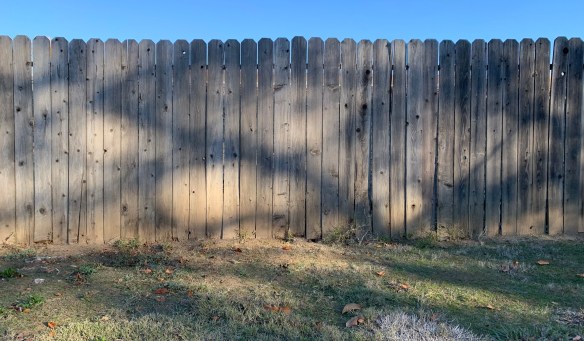
Winter sun and shadow on the back fence

A week or so ago, at noon, I was sitting on the back porch, gazing at the sky. I was dressed warmly for it was 50 degrees and windy, which is cold if you live in a hot climate. Suddenly – and this made no sense – I heard the distinctive jingle of an ice cream truck. Stephen King came to mind, and I imagined a truck full of killer clowns. It has been that kind of year.

King himself has tweeted that nothing he’s written is as scary as 2020 has been. To be precise, he said nothing he’s written “is as frightening as the current administration,” which is to state more clearly what has made America the epicenter of many of the horrors the world has endured this year.

My father was born exactly 100 years ago, on December 31, 1920. As I sat on the porch this afternoon, on another chilly day, I was thankful that he didn’t live to see this year. Then a pleasant memory came to mind. Continue reading

2020 Notes: This too…

Anam Thubten, a Tibetan meditation master, recently told a story that illustrates the Buddhist concept of “impermanence.” Long ago, a king gathered all the sages in his realm and asked them to tell him something that is always true. After conferring among themselves, the wise men and women returned and in just four words, told the king the one thing that is true in every possible circumstance: “This too shall pass.”

Sometimes that’s good news, but in 2020, it seldom is. This year, everyone has experienced loss and the fear of loss. Significant among the losses in this country is the loss of confidence in our future and in “the American way of life.” In a recent Gallup poll, only 13% of Americans expressed “satisfaction with the way things are going in the U.S.”

That many???  I don’t personally know anyone in that 13%, and it’s hard to imagine who they are. Extremely rich? Comatose? Living with wolves? The rest of us may be split over which outcome in November will benefit the nation or destroy the remnants of American greatness, but for most of us, the sense of multiple crises is pervasive.

I’ve long had the sense that the arc of that greatness and its decline extends over many decades, but I’ve not been able to express it or find someone who could until now. I highly recommend an article which appeared on August 6 in Rolling Stone: The Unravelling of America, by Wade Davis. It’s a long article, but worth it.

Davis relates that six weeks after Pearl Harbor, the Japanese had captured 90% of the world’s rubber making capacity. To ramp up the war effort, the U.S. government called for a speed limit of 35 mph to extend the life of existing tires, and the nation complied! No one accused the government of overreach. No one complained that their freedom was compromised or suggested that mandating shared sacrifice during a crisis somehow violates the Constitution.

Perhaps that aspiration for greatness was best expressed by John Kennedy, when he said in his 1961 inaugural address, “Ask not what your country  can do for you, ask what you can do for your country.” That spirit probably started to die when Kennedy did, and Davis reviews, in heart-rending detail, some of the missteps that led us from then until now.

Wade Davis’s article concludes with the observation that when Trump said of the coronavirus, “One day, it’s like a miracle, it will disappear.” he might as well have been speaking of the American Dream…

And yet, to start to imagine solutions to a problem, we must begin by trying to understand what the problem really is. It also helps to remember what the ancient king’s philosophers told him: this too shall pass. 
2020 Notes: A Truth Teller

If you go online anywhere these days, you see advice on how to reduce stress. Mostly the suggestions are ones I’m familiar with and already try to practice: diet, exercise, sleep, meditation, contact with others by whatever means are possible, and so on.

A few weeks ago I saw a suggestion that keeping a journal reduces stress. I first started a journal when I was a teen and have done so on and off ever since, but it’s no easy task when all of our structures appear so fluid and ephemeral that nothng seems constant from one day to the next. “All the children are insane,” sang Jim Morrison when I was in high school. Nowadays truly insane adult children run the country.

We are inundated with learned essays by people trying to make sense of it all, but even the best analyses are also fluid and ephemeral. Their relevance barely lasts a day.

I often think that if we want truth, we’re better off looking to poets. Think of The Second Coming, which has only increased in relevance in the hundred years since Yeats wrote it.

This morning, Mary showed me, Of the Empire, a 2008 poem by Mary Oliver which also seems more true today than it did a dozen years ago when it was published.

Of the Empire
by Mary Oliver

We will be known as a culture that feared death
and adored power, that tried to vanquish insecurity
for the few and cared little for the penury of the
many. We will be known as a culture that taught
and rewarded the amassing of things, that spoke
little if at all about the quality of life for
people (other people), for dogs, for rivers. All
the world, in our eyes, they will say, was a
commodity. And they will say that this structure
was held together politically, which it was, and
they will say also that our politics was no more
than an apparatus to accommodate the feelings of
the heart, and that the heart, in those days,
was small, and hard, and full of meanness.

Finding a truth teller these days is infinitely precious.