A View From Outside Our Borders

I had not planned to comment further on politics or the economy, but recently, in my geek mode, I was cruising for iPhone apps and downloaded the one for The Economist. I was so impressed with the first editorial I read that I decided to pass it along, as a pertinent view from an expert outside our fray.

If you favor the view that austerity is the way to prosperity in the short term, you’re likely to be disappointed because this editorial echoes others I have read suggesting that we have recently been asking the wrong questions.

The article is from the August 6, issue, “America’s Economy:  Time for a Double Dip?”   http://www.economist.com/node/21525405.  You may have to register to see it:

If America does manage to avoid recession and slowly begins to pull out of this mire, it will be testimony to its underlying strengths. It still has huge advantages over other rich countries: a younger, less-taxed population, a more innovative economy and, for now at least, the dollar as the global reserve currency. If only it had the political leaders to match, its chance of avoiding recession would be far better than one in two.

***

And now I return to my usual tricks, in particular, reading a gripping adult fantasy that I plan to review later this week.

Stories of the Fall

I started this blog to write about stories, imagination, and spirituality.  Initially, when I spoke of stories, I meant fiction.  I now use the word in the wider sense suggested by James Hillman when he defined psychology as, “the study of the stories of the soul.”  I also use “stories” as Professor of Religion, David Loy, did in his book The World is Made of Stories, a meditation on the worldwide intuition that what we normally see is not “reality” but our stories about reality.

Right now, stories of money and its lack weigh on everyone’s mind. I have my own stories of recent events that I hesitated to share until yesterday, when I saw that Rush Limbaugh accused the president of, “engineering the decline of the American Republic.”  http://awareamerican.wordpress.com/2011/08/09/limbaugh-on-market-collapse-obama-engineering-the-decline-of-america/.  I decided that since it’s Amateur Hour, I might as well weigh in.  Here’s my story of why the United States and Europe find themselves in such a colossal mess:

***

We are still in the early stages of globalization, but no one seems to remember that.  Limbaugh should blame Al Gore for inventing the internet, the steam engine of our current post-industrial revolution.  The changes are going to take as long, be at least as sweeping, and at least as traumatic as those of the first Industrial Revolution.  Here are a few key events:

1)  NAFTA:  The North American Free Trade Agreement, which went into effect on Jan. 1, 1994, marked the beginning of the end of blue collar work as a viable means of livelihood for large numbers of people in this country.

NAFTA protest

2) Offshoring White Collar Jobs:  This picked up in earnest in the late 90’s, as the internet made it feasible to hire large numbers of skilled foreign professionals for a fraction of the cost of their US counterparts.  I remember lots of phone conferences at the end of the day with engineers in Asia who would sometimes have solutions in our inbox in the morning.

The Y2K scare delayed the effects of sending thousands of tech jobs overseas, but once it was clear that the world was not going to end, the “dot com bust” ended the party for good.  Springsteen’s blue collar lyrics came true for professionals as well:  “Foreman says these jobs are going boys, and they ain’t coming back.”

3)  The Economy on Speed:  Thanks to Alan Greenspan, who held interest rates artificially low, and George Bush, who started two wars, the bust was delayed, but delayed only.  Quite a few people saw it coming:

  •  In 2004, a poster on a Motley Fool bulletin board said, “Soon our biggest industry will be selling each other beanie babies on eBay.”
  • Ca 2004, Warren Buffett called derivatives, “financial weapons of mass destruction.”
  • By 2006, people on all the financial websites were warning that a housing bust was no longer a matter of “if” but only of “when.”  The only thing no one fully realized then was how bad it would be.

Our problem now is not just that housing prices crashed in 2008, but that since the turn of the millennium, housing and consumer spending have been our major industries.

So what comes next?  Here are a few random suggestions and observations, not necessarily in order of importance.

1)  The President should demand to see Rush Limbaugh’s birth certificate.  Evidence suggests he is an alien – and I don’t mean the kind that comes from another part of planet earth:

2) On the Sunday before the debt ceiling resolution, I saw an interview with General Motors CEO, Dan Akerson, that made me hopeful.  Not only has GM paid back the government bailout, but they’ve done so with the introduction of fuel efficient cars.  Akerson articulated our need for independence from foreign oil that politicians since Jimmy Carter have talked about without effect.  Other American auto makers have echoed Akerson’s sentiment.  Now that greener energy is becoming profitable, there there is hope for eventual movement, growth and jobs in that sector.

3)  I’d like to see every Democrat in Washington read this article Julian Zelizer posted on CNN.com, “Where are the Democrat’s Ideas?”  http://www.cnn.com/2011/OPINION/08/08/zelizer.democrats.ideas/index.html?hpt=hp_t1

4)  We all need to look at the situation in Britain as an example of what could happen here if politicians try to balance the budget with only draconian cuts.  It’s time for people who care about the country to name the Flat Earth Party for what it is – an assortment of morons who don’t understand that they live in the 21st century and not in 1776.

5) Vote against any candidate who claims to have “a plan to create jobs” – they are either deluded or lying.  In discussions I’ve heard, usually referencing Japan, the only government action that seems to work is stimulus money applied for the long term, they way you have to use a lot of matches to start a fire with wet wood.   Unfortunately, we’ve exhausted the means and will to do that.

***

If you’ve actually read to the end of my rant, thank you.  It’s no more outlandish than claiming a single man could bring down our Republic all by himself.  To paraphrase Hillary Clinton’s book, it would take a village to do that – a large village, like Washington, DC.
How Much is Too Much?

I have to thank Ceinwenn for this topic.  He or she (I can’t be sure, since the link takes me to a password protected forum) commented on my previous post, Three Requirements of a Book Review (?).  Ceinwenn felt I had given away too much plot info in my review of  David Baldacci’s First Family.  It’s entirely possible.  Several comments mentioned avoiding spoilers, something I have not considered as much as I will now.

In my own defense, I would cite the similarities of a synopsis, which you use as a design and advertising tool with your own fiction, and the plot exposition section of a book review.  In a synopsis, you must reveal what happens; you can’t leave an agent or editor guessing.  In a book review you must not.  Got it.  Thanks.

But that wasn’t what I really wanted to talk about here.  Ceinwenn’s comment spun me off thinking of several recent things I’ve said about blogging, and specifically my discovery that the public act of blogging is far more stimulating than the private act of writing in a journal.  The public nature of blogging makes it challenging in terms of deciding how much self-revelation is right.

My wife has commented on my tendency to get too academic and boring, which is an easy path for me to take.  On the other hand, I remember a psych teacher who was Mr. Sensitive-Self-Revelation, and it wasn’t a pretty sight!  A remember a very calm and poised young woman walking out of the class, shaking her head and making barfing noises.

You get what I’m saying.  As a blogger I want to be real and I enjoy the same quality in others, but I’ve used the delete key on posts that went to far.  I might write about an embarrassing moment, especially if there is humor involved, but I’m probably not going to post my most mortifying-ever experience.  You know the one – you’re driving along and it comes to mind and you slink down in your seat in case the nearby drivers can read your mind.

Some topics rouse caution immediately, notably politics and religion.  Mary and I have a couple of long-term friends that are long-term because we learned early on to stay off these topics.  Here on this blog I circle both politics and religion, but I keep more of a distance than I would personally like to.  Still, because I really dislike door to door religion or candidate salespeople, I don’t want to risk using this space to invade anyone’s right to decide for themselves.  Fortunately, tonight I get to quote someone brilliant on a political topic.

I’m traveling.  As a matter of fact, I’m attending a two day intensive teaching session let by a Tibetan Buddhist teacher of international renown (forbidden topic #1).  I got back to my room and flipped on the news just in time to see the President’s message that a compromise is in the works. (forbidden topic #2).  Whew!  No one with their head screwed on right could wish to see our country in default, and yet, the whole situation is icky!  Have you ever gone for a swim in a lake or river that was too full of alge?  You come out feeling slimy.

It’s far to easy to blame someone else, but none of us are innocent in this mess.  We elected these clowns, most of whom are doing what they think we want them to do in order to get re-elected.  It cuts a lot deeper than that, and once I get home, I may quote from an article I found that has a lot to say about this dance of the public and the politicians.

Meanwhile, here is the brilliant comment I promised, from Walt Kelly, creator of the wonderful comic strip, “Pogo.”  This particular panel was printed in 1971, on the occasion of the first Earth Day, but its message took on a life of its own that goes beyond any single issue.  If we could learn one thing from this latest crisis, this would be my vote.  We, as a nation, will not be destroyed from without, goes the common wisdom, often repeated over the last decade – but clearly we can do it to ourselves.

Remember Real Money?

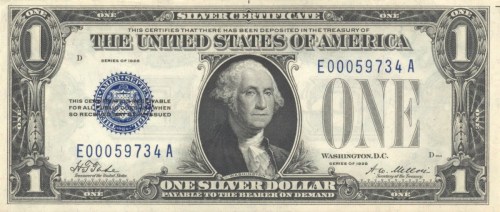
US Silver Certificate

In 1965, my father, who worked for IBM, was assigned to the south of France for two years, so the family packed up for Europe.  Back then, except for a few parodies in Pink Panther and James Bond movies, Americans in Europe got some respect.  Our money got a whole lot of respect – everyone wanted dollars.

My mother, who was an artist and appreciated fine drawing and engraving, drew the line at most European currencies.  “It looks like play money,” she said.  No wonder!  It was colorful and had big heads!  Real money, like good old yankee greenbacks, was sober and serious – it was monochrome and the heads were decently small.  I laughed the other day at a fast food restaurant.  I handed the clerk a twenty and he held it up to the light.  No one trusts a big-head!

Our coins contained silver through 1965

My father was involved in the early development of magnetic card readers.  I remember his mood of euphoria the day engineers succeeded in programming a “1” and a “0” on a magnetic strip.  He announced that someday none of us would carry money at all.

“That sucks,” I said – my usual answer to my father when I was a teenager.  I thought of him today as I used my iPhone to buy a frappacino and then glanced at the budget headlines as I carried it out the door.

Money has always been abstract:  the great Lakota medicine man, Black Elk, called gold, “the yellow metal that drives men crazy.”  To his people, gold was just a pretty stone in the river – nothing to get excited about.

Now money is virtual as well – I used a pattern of pixels to buy my drink.  That doesn’t mean it doesn’t have as much power as it ever did – you can’t see or touch the wind, but this year especially, we have seen what it can do.  Still, in some ways, the increasingly non-material nature of money makes it seem all the more open to abuse.  As I understand it, the Fed doesn’t even have to print big-heads to increase the money supply – a few keystrokes will do it.

Standing liberty quarter

In truth, I love the convenience of electronic money.  A decade ago, when I was managing our affairs and my fathers, I had to write out 30-40 checks a month, a task that took a lot of time and was always subject to error, for my mind wanders when it is bored.  One Friday evening I wrote a payee the entire amount of my paycheck.  Luckily, that honest woman called me a few days later and said, “Uh, sir, I think you made a mistake.”

Abstract or not, we use our money for concrete things – a meal, a car, a house, a movie ticket, a new pair of shoes.  One immediately thinks of bartering, but these days, that seem rather strange.  In the last elections, a conservative senate candidate from Nevada suggested people might think of barter if their medical costs were too high.  Her opponents jumped on that statement, and their slogan, “Chickens for checkups” was a factor in her loss.

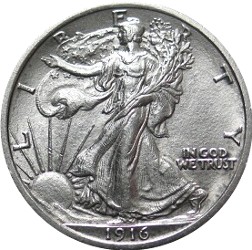
There is one aspect of money we do not think of often – in some of its forms, it is beautiful.  When I was a kid, I collected coins – just pennies for the most part.  I tended to spend anything bigger on baseball cards.  Now I have come to appreciate the sheer beauty of the two types of coins pictured here:  walking liberty halves, and standing liberty quarters.  These pictures show the amazing quality of the engraving.  Coins in this condition are premium, but fortunately, more heavily circulated specimens can be purchased for just a few dollars.  It’s quite an exercise in imagination to hold a coin that is 80 or 100 years old and wonder about its story.

It’s a lot more fun to think in these terms – of the beauty of money – than it is to think of our headlines or watch politicians on TV.  One thing “those European countries” did when we lived abroad, was periodically throw their governments out.  Even now, some nations hold votes of no confidence, which amount to a mass recall.  I remember feeling superior to that  – our system worked after all.  Now as I look at the big-heads in my wallet  – my mother’s old criterion for funny money – I doubt that I am alone in the fantasy of charging our leaders with high crimes of cluelessness and voting the rascals out.

Disruptive Technologies and the End of Borders.

In the electronics industry, one of our truisms was that change is the only constant.  We also talked and thought a lot about “disruptive technologies.”  The term was coined by Clayton Christensen in a 1995 article and elaborated in his 1997 book, The Innovator’s Dilemma.  Even well managed firms (and Borders does not seem to have been one of these), can be blindsided by failing to recognize “the next big thing.”  This is because its first manifestations tend to be clunky and crude.

The makers of fine coaches were probably not too worried when the first loud, dirty, and expensive horseless carriages appeared.  The empty factories and smokestacks in Rochester, NY are mute witnesses to Kodak’s failure to recognize the threat that digital photography posed to their chemical business.  Tower Books, which I loved, failed to develop an online presence, and Borders, among other things, was late to the eReader party.

There is no good news in this for anyone, least of all the 11,000 employees who are out of a job.  Or everyone who found wonderful things while browsing the stacks.  Even the idea that disappearing big-box bookstores will give indies a second chance seems unlikely.  One writer interviewed on NPR, whose books are carried by Borders, suggested that future bookstores may resemble what you find in airports:  “cookbooks, vampire novels, and celebrity tell-alls.”  http://www.npr.org/2011/07/19/138499967/mich-book-chain-borders-closing-after-40-years

I remember a college town where a wonderful independent bookstore closed soon after a Borders opened. Now it has come full circle and both are gone.  All I can think of are these words of the late George Harrison: All things must pass.

The Government and the Marx Brothers

Where's the Seal?

Back in college, one of my professors gave me an idea I’ve never forgotten.  He spoke of myths that shape and inspire our national consciousness, and how they always relate to a past that is not only gone but may not even have happened.  It must have been back in the 70’s, because he referenced the gun-in-the-rack, survivalist twist on the rugged individualism that Bonanza brought into our living rooms once a week.

The Cartwright boys get the job done

I’ve been thinking of myths of politics lately for one simple reason.  In following the current debate in Washington on the debt ceiling, I’ve come to a conclusion I have never reached before, through good times or bad – until now.  Quite simply, I think we are fucked.

Perhaps not over this particular crisis, for I don’t think any politician who wants to get re-elected – all of them, in other words – wants to get stuck with the blame for a national default.  But I think this “debate” reveals how utterly disfunctional our system has become.  Handwringing over the gummint has probably always been a national pastime – I finally believe it is justified.  Still, I prefer laughter and even creative thinking to handwringing, so I have been mulling over what myths I believed about about our leaders in the past, and what might be a better fit now.

Back in the days when my favorite TV show was “Leave it to Beaver,” I watched  Mr. Smith Goes to Washington with my parents: a rugged individualist from Montana takes on the system, and proves that right and integrity still can prevail.

Jimmie Stewart fights the good fight

Soon after I saw Mr. Smith, for a few brief years, we had Kennedy’s Camelot:  “Ask not what your country can do for you; ask what you can do for your country.”   Fast forward six years and there was Kent State and with Crosby, Stills, and Nash singing, “Soldiers are gunning us down.”  It’s been a roller coaster ride since then with ups and downs, times of malaise and times of letting the good times roll, but all along, at least for me, there was the faith that we can make things better.  Our system may be flawed but it works.  There was always someone to believe in, someone like Senator Robert Byrd, a real-life Jimmie Stewart who carried a copy of the Constitution in his pocket.

Sen. Robert Byrd, one of my heroes

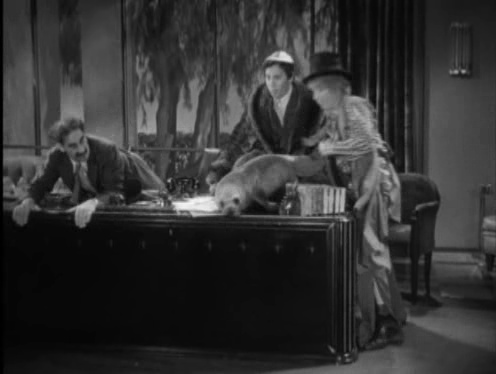
Senator Byrd is gone now, and so is my faith that we can right ourselves in time to avoid driving off a cliff.  What kind of myth fits that?  I’ve been mulling it over for several weeks, and it came to me yesterday, thanks to Turner Classic Movies.  They aired my favorite Marx Brothers film, Horse Feathers, and there it was:  my latest take on the current state of our government:

Do you think there’s a kinder way to depict our current crop of elected “servants?”  If so, please let me know!

Kalachakra For World Peace: In Washington, DC and in Sacramento

Did you know that the Dalai Lama is currently engaged in an 11 day ceremony in Washington DC, called  “The Kalachakra for World Peace?” Did you know that a Sacramento organization, the Lion’s Roar Dharma Center is giving a parallel ceremony from July 23, to July 30?  Please read on for the details.

Kalachakra Sand Mandala

Kalachakra, meaning Wheel of Time, is philosophy and set of practices that “revolve around the concept of cycles and time from the cycles of the planets, to the cycles of human breathing.  It teaches the practice of working with the most subtle energies within one’s body on the path to enlightenment.”  Kalachakra also refers to a Tibetan Yidam or meditational deity, who represents a Buddha.  http://en.wikipedia.org/wiki/Kalachakra

Yidam practice is complex and widely misunderstood, but here is a quick analogy: a kid who pretends to be Luke or Leah or Yoda is doing something similar – invoking a figure who represents and inspires bravery and wisdom.  Perhaps the child experiences an inflow of those qualities – except it is not really an inflow because it is already there, in seed form, inside all of us.  Imagination can awaken these latent potentials in a child and in a practitioner of Tibetan Buddhism.

I used to pretend to be Davy Crockett for the same reason.  There was never any real confusion, although my mother looked at me strangely the day I asked her to pick up some bear meat the next time she went shopping – but I digress.

Kalachakra is one of the most advanced Tibetan practices, but because of his perception of the urgent need for non-violence in the world, the Dalai Lama opened this series of teachings to anyone who was interested.  A Tibetan Sangha in Sacramento, the Lion’s Roar Dharma Center, is offering a similar series of classes, beginning with an introductory lecture, July 23, from 7:00-9:00pm, followed by classes and empowerments from July 24-July 30. http://events.r20.constantcontact.com/register/event?llr=rnxs8gcab&oeidk=a07e3puot1u6e5e5f26

Finally, here is a description of the ceremony by , a Tibetan nun who has been working in Washington since May, 2010 to prepare for the Dalai Lama’s performance of this ritual, which is now in progress.

http://www.npr.org/2011/07/14/137848121/in-washington-a-ritual-for-world-peace?ft=1&f=1003

Harry Potter Fan Fiction

Harry, Ron, and Hermione in The Sorcerer's Stone, 2001

Fan fiction did not begin with Harry Potter or the internet.  According to Lev Grossman’s article, “The Boy Who Lived Forever,” in the July 18, issue of Time, xeroxed fanzines appeared after the premier of “The Man from U.N.C.L.E.” in 1964, and really took off with “Star Trek.”

In the broader sense, telling original stories with borrowed settings and characters is nothing new at all.  Homer did not create the Trojan War, Achilles, or Odysseus.  Shakespeare did not make up either King Lear or Henry V.  But with the internet and Harry Potter, fan fiction has exploded.  There are more than 2 million pieces on fanfiction.net and more than a quarter of these are based on Potter – everything from short stories to full length novels.

The final movie will not be the end of original Potter creations

Grossman explodes most of the stereotypes of those who write and read these tales.  One 38 year old writer and actress says it’s like character improvisation.  A best selling fantasy writer whose novels have been optioned by Peter Jackson says, “Fanfic writing isn’t work, it’s joyful play.”  This raises the key question of why writer’s of fiction write.  Joyful play, a platform, and an appreciative audience are there – and it’s not like many creators of “original” stories get to leave their day-jobs.

Well known authors fall on both sides of the unanswered copyright issue.  J.K. Rowling and Stephanie Meyer encourage new fiction based on their characters and worlds.  Orson Scott Card, Anne Rice, and George R.R. Marin, author of A Game of Thrones do not, and threaten lawsuits.  It may or may not be coincidence that the authors Lev Grossman names as supporting fanfic are more recent and write for a younger audience than those who are in opposition and write for adults.  So far, all cease and desist requests have been honored, so there are no legal precedents in the world of fiction, though court cases involving music have been liberal in their interpretation of what constitutes “fair use.”

This begs the interesting question of who a character or world belongs to.  Groosman says that until recently:

Writers weren’t the originators of the stories they told; they were just the temporary curators of them.  Real creation was something the gods did…Today the way we think of creativity is dominated by Romantic notions of individual genius and originality and late-capitalist concepts of intellectual property, under which artists are businesspeople whose creations are commodities they have for sale.

Personally, I have always loved the poet’s invocation at the start of The Odyssey:  Sing in me, muse, and through me tell the story… 

In my experience, the “I” does not invent worlds or characters.  Whether you call it the muse, the gods, or the collective unconscious, fictional worlds and imaginal people come from somewhere else.  With a bit of luck and humility, the “I” may get to witness what happens, and may even get adept at finding new rabbit holes.  To me, the idea of “owning” a “product” of imagination smacks of hubris.

There is no real data on whether fanfic hurts an author economically.  Intuitively, I can only imagine it benefits Rowling and Meyer.  I hope so.  Creativity is creativity, regardless of what spark ignites it.  I’m thinking of dropping by some of the sites to see what these authors are up to.  For those who write for the joy of it, I wish them a lot more.