The King is Dead; Long Live the King!

The Oak King and the Holly King

As predicted by Las Vegas odds-makers, the Oak King scored a narrow victory today over his twin brother, the Holly King. The Winter Queen is reportedly in mourning, though she is expected to emerge – as she has since time began – in her guise as the Spring Maiden, on or about February 2, (aka, Imbolc, Candlemas, St. Brighid’s Day) to take her place beside the new reigning monarch. At least that is the story the old Britons told to explain how the darkest day of the year hides the seed of summer, and why the Winter King is likely to win the scheduled rematch on June 21.

Winter Solstice: the default explanation

Though I cannot prove it, I’ve always believed this tale of eternally battling twins must have gone into the making of the black-on-the-left vs. black-on-the-right episode of Star Trek.

Is this a real legend – one the Celts and Saxons actually told?   Robert Graves said as much in The White Goddess, suggesting that Balin and Balan, as well as Gawain and the Green Knight represent the eternally dueling pair in Arthurian legend.  Sir James Frazer’s earlier Golden Bough had a similar section entitled “The Battle of Summer and Winter,” although he told the story with only one eternally dying and reborn Divine King.

The Oak and Holly kings battle at a 2005 Winter Solstice ritual. Photo by Anderida Gorsedds.

Whatever you may think of the story, now that the solstice has arrived, may you stay warm and dry, and bask in the confidence that summer is coming around again.

Of Hamsters, Wisdom, and Persephone

Persephone the Innocent

The protagonist of Karyn’s Magic, the young adult novel I’m writing, is a teenager who lets something evil into the world.  Not only must she scramble for damage control, but she is forced to see the same evil as a potential within herself.  I usually think of “loss of naiveté” as theme of adolescence, but remembering hamsters brought to mind a personal experience that happened earlier than that.

My fifth grade teacher had a pair of hamsters, favorite classroom pets.  At one point she could no longer keep them, and asked if anyone could provide them a good home.  I spend my Saturdays at a small museum in Alum Rock Park, in San Jose, that had a small zoo and classes and field trips for young people.  We had day trips to ocean tide pools, a weekend camping trip to the Mojave, plus at the museum we got to play with some of the critters.  One of my favorite stunts was to wrap a boa constrictor around my neck and explain to startled visitors that these snakes never squeezed anything they didn’t regard as food.

I told the teacher I had a home for her hamsters and took them to the museum.  “Great, we can use these,” the director said.  At the end of the day, after the museum closed to visitors, I learned what he had in mind.  Before I quite realized what was happening, he dropped one of the hamsters into a glass case with a huge rattlesnake.

The ensuing drama seemed to go on forever:  the hamster sniffing, scooting around, knowing something was wrong but not quite knowing what.  I wanted to look away but couldn’t.  The snake coiled in slow motion, almost lazily, with hard, unblinking eyes.  It’s strike was a blur, you couldn’t see it;  you could only hear, not see, the hamster slammed into the top of the cage by the force.  It was over in less than a second.  The animal did not even twitch.

I asked about the other hamster and learned that a snake that big cost several hundred 1960’s dollars, and live food was expensive.  I didn’t demand the other hamster back.  There were older kids there, some in jr. high, and I wasn’t about to wimp out. And scientists sometimes have to suck it up, right?

On Monday, the teacher asked how the hamsters were doing.  I told her and the class that they were fine.  I never put another boa constrictor around my neck.  I was at the edge of adolescence, and the world was poised at the edge of “the sixties;” there would be more and bigger occasions for guilt soon enough, but most of those are long forgotten.  This is the event I come back to when I think or write about the loss of innocence.

***

What does she hear on the wind?

James Hillman, the prolific author who coined the phrase, “archetypal psychology,” for his own brand of post-Jungian thought, borrows a phrase from Keats and calls our world, “the vale of soul-making.”  For Hillman, the natural movement of soul is down, into the depths, where a darker kind of wisdom lies.

(to understand Hillman it is critical to know that he uses the world “soul” as the ancients did:  not as the “eternal soul” of western religion, but more as we use the phrase, “psyche.”  He places “soul,” the source of imagination and fantasy, between the “eternal spirit,” and the body – a three-part image of personality you seem to see in biblical references, as well as in eastern religion even now).

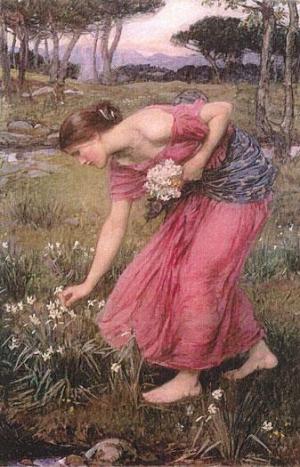
The story that illustrates Hillman’s perspective on “innocence,” is the myth of Persephone.  As a beautiful young girl, she is playing one afternoon with her friends, when she bends to pluck a narcissus flower.  The ground opens up, and Hades, the Lord of the Underworld, scoops her into his chariot and carries her into the depths.  Hillman writes:

“Each of us enacts Persephone in soul, a maiden in a field of narcissi or poppies, lulled drowsy with innocence and pretty comforts until we are dragged off and pulled down by Hades, our intact natural consciousness violated and opened to the perspective of death.”  Revisioning Psychology

By the time the Olympian gods put enough pressure on Hades to cause him to relent, Hermes, messenger of the gods is stunned to see Persephone transformed. No longer the naive maiden, she is the darkly radiant Queen of the Underworld. She has eaten the food of the underworld – six pomegranate seeds, and must spend that six months of every year under the earth.

Supposedly that explains why there is winter, but in a far more interesting sense, it gives us an image of why, despite our wishes, wisdom doesn’t lie in the sunny, flower dotted fields of youth, but in the depths of a soul that knows both light and darkness.

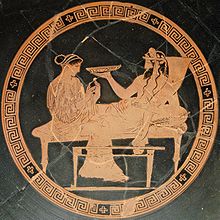
Persephone and Hades


Angelology

When I first read the March 15, Time Magazine review of Danielle Trussoni’s, Angelology,  ( http://www.time.com/time/magazine/article/0,9171,1969720,00.html )I was struck by the killer premise: the heroic battle of an art historian and a young nun against the Nephilim, nasty, arrogant human-angel hybrids who have dominated world affairs for thousands of years.

When the reviewer compared it favorably to The DaVinci Code, I put it in my Amazon cart. Now I wish I had listened to the 100+ Amazon reviewers who gave the book 3 1/2 out of 5 stars.  They were too generous.

The characters, Sister Evangeline and Verlaine are good enough as action adventure heroes go.  Not every protagonist can be or must be unforgettable.  We like them enough to want to see them prevail.

Where the story really breaks down is in the interminable backstory, that fills the entire middle section of the book.  It slows the action to a full stop, and doesn’t really succeed in creating a suspension of belief.

There are several ways to draw readers into a fictional world that has fantasy elements.  One is simply to spin things that exist in our world, as Brown does in The DaVinci Code. The Gospel of Mary Magdalene, and DaVinci’s “Last Supper,” are real, and we’re all too ready to believe in nefarious religious cults.

The other classic tactic is to simply drop us into an alternate universe, as Orson Welles did in the famous/infamous War of the Worlds broadcast – simply announce that aliens have landed in New Jersey.

Trussoni begins Angelology in this manner – with a flashback to the discovery of a Nephilim corpse during  the “second angelological expedition” of 1943.  We’re hooked, especially when Nephilim menace Verlaine and Sister Evangeline before we quite know why.  All the elements of an exciting chase and forbidden romance are in place…and then the author manages to snatch defeat from the jaws of victory.

The story just stops.  If only an editor had reviewed the manuscript and suggested the simple, time tested device for action-adventure tales – sprinkle the backstory into the main action, but keep things moving.  Do not bore your reader to distraction.

Did I say Trussoni failed?  Well that may be an exageration – she has a movie contract and I don’t.  But as a reader, I have to conclude that a writer has failed when I skim or skip huge sections of their book and in the end regret the time and money I have invested in their story.  The following Amazon review by “MWA” sums up my reaction:

This Author may have had an interesting idea but the publisher’s rush to print to catch the wave of Vampire/Mythological/Faux Religious related sales certainly squashed it. The fact that the book is so poorly written is the fault of the people who are supposed to EDIT things prior to publication. This is actually painful to read up until about page 88 and then it is as if the absent editor came back from lunch and skimmed the rest. The worst thing about it is how obviously it is a set-up for another to follow! And a movie deal etc. etc. Enough is enough already.

http://www.amazon.com/Angelology-Novel-Danielle-Trussoni/dp/0670021474/ref=sr_1_1?s=books&ie=UTF8&qid=1280940731&sr=1-1