Robinson Jeffers: An American Stonecutter

My previous post, on the restoration of a medieval Chapter House, reminded me of two renowned people who worked in other fields but turned to stonework for renewal.  One was the great Psychoanalyst, Carl Jung, who viewed stone as a symbol of the True Self, and carved stone as a means of self-discovery.
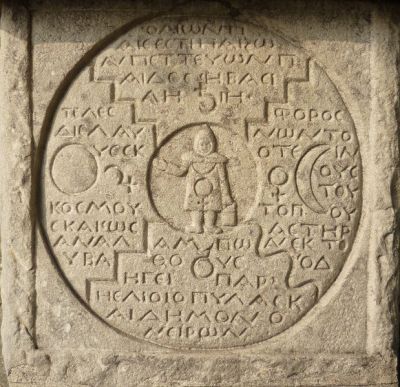
Jung’s Bollingen Stone

The other was the renowned poet, Robinson Jeffers (1887 – 1962), who studied geology in college, and worked in stone all his life.  In 1914, Jeffers and his new wife, Uma, moved from Los Angeles to Carmel, CA.  To build a home, Jeffers first hired a local builder and then worked alongside the man, learning the art of stonemasonry.  By 1919, Jeffers was hauling  boulders up from the beach, shaping them, and using them to add rooms to the home, which he named Tor House.  Later, he built the four story, Hawk Tower, as a gift for his wife, who loved Irish literature and stone towers.

Tor House and Hawk Tower, built by Robinson Jeffers in Carmel

The tower was named for a hawk that appeared while Jeffers worked on the structure, and disappeared the day it was finished.  After his death, Jeffers’ oldest son finished the construction then deeded the buildings to the Tor House Foundation, which was formed by Ansel Adams for their preservation.  The Foundation maintains the grounds and offers excellent guided tours.  You can even climb by a secret stairway to the very top of the tower.  There’s a wealth of information on Jeffers and Tor House at the Foundation website, where you can also schedule tours in advance:  http://www.torhouse.org/.

Jeffers work with stone is central to his austere poetic vision of a human spirit that longs to fly like a hawk and find something that lasts, but must finally acknowledge that in this life, it can do neither.

***

To the Stonecutters
by Robinson Jeffers.

Stone-cutters fighting time with marble, you fore-defeated
Challengers of oblivion
Eat cynical earnings, knowing rock splits, records fall down,
The square-limbed Roman letters
Scale in the thaws, wear in the rain. The poet as well
Builds his monument mockingly:
For man will be blotted out, the blithe earth dies, the brave sun
Die blind, his heart blackening:
Yet stones have stood for a thousand years, and pained thoughts found
The honey peace in old poems.

***

Robinson Jeffers

***

Rock and Hawk
by Robinson Jeffers

Here is a symbol in which
Many high tragic thoughts
Watch their own eyes.

This gray rock, standing tall
On the headland, where the sea-wind
Lets no tree grow,

Earthquake-proved, and signatured
By ages of storms: on its peak
A falcon has perched.

I think, here is your emblem
To hang in the future sky;
Not the cross, not the hive,

But this; bright power, dark peace;
Fierce consciousness joined with final
Disinterestedness;

Life with calm death; the falcon’s
Realist eyes and act
Married to the massive

Mysticism of stone,
Which failure cannot cast down
Nor success make proud.

***

Hawk Tower

In Flanders Field the Poppies Blow

At 11:00am, on the 11th day of the 11th month of 1918, the insanity of the First World War came to an end. Though the United States holiday was renamed to Veterans Day after World War II, it is still known as Armistice Day in France and Belgium. It is known as the Day of Peace in Flanders Field, where many of the dead from the western front are buried and one of the most famous poems of this war or any war was written.

Poppies near the Connaught British cemetery on the western front

Poppies are an annual, summer-blooming wildflower whose seeds are carried on the wind.  They can lie dormant for a long time but will bloom if the earth is disturbed – as it was, of course, during the years of trench warfare.  In many parts of the line, in the summers of 1915, 1916, 1917, and 1918, the little poppies shone as the only symbol of life amid the devastation of no-mans land.

In May, 1915, Major John McCrae, a Canadian military doctor and artillery commander, noticed the poppies growing in the disturbed ground between the graves that surrounded his artillery position near Ypres.  When the chaplain was called away, McCrae was asked to conduct the burial service for a friend.  We think he began his famous poem that evening.

In Flanders fields the poppies blow
Between the crosses, row on row,
That mark our place; and in the sky
The larks, still bravely singing, fly
Scarce heard amid the guns below.

We are the Dead. Short days ago
We lived, felt dawn, saw sunset glow,
Loved and were loved, and now we lie
In Flanders fields.

Take up our quarrel with the foe:
To you from failing hands we throw
The torch; be yours to hold it high.
If ye break faith with us who die
We shall not sleep, though poppies grow
In Flanders fields.

***

***

Even more than McCrae’s poem, Armistice Day / Veterans’ Day brings to mind a song by the Scottish musician, Andy Stewart.  His song, “Young Jimmy in Flanders,” commemorates his uncle James who served as a piper during the war, and miraculously survived.  More than any other picture or poem or story, this ballad evokes for me the terrible sadness and anger at this conflict where boys playing bagpipes led troops against machine guns and poison gas:

He played his pipes to battle,
and the laddies died like cattle,
and the brandy was drunk in Whitehall,
a million miles away.

This song is recorded on Stewart’s fine album, “Fire in the Glen,” 1991.

http://www.youtube.com/watch?v=y-IhN7IVQdk

Interlude on the Oregon Coast

I first explored the Oregon coast as an undergrad when I was studying art and photography at the U of O.  I kept a 4×5 view camera, a sleeping bag, and a coleman stove in the trunk of my ’63 biscayne.  A box of mac and cheese, a few apples, and a jar of instant coffee, and I was ready to spend a weekend poking along the backroads up and down the coast.

One of my favorite spots was the south coast town of Bandon.  With a nice state park, miles of beaches to explore, and expresso and pizza available in town, it was a fairly posh spot for camping.  That was in the mid ’70’s.  Mary and I have travelled there at various times over the years since then, but had not been up for almost a decade.

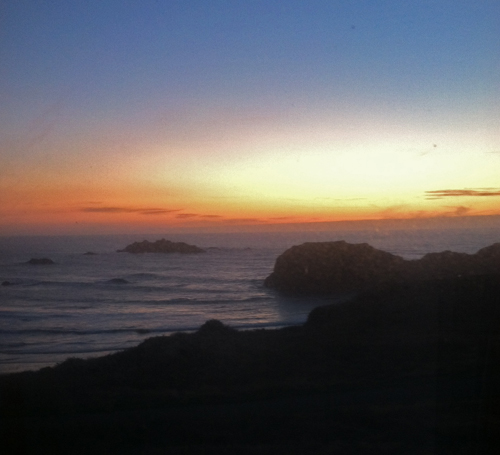
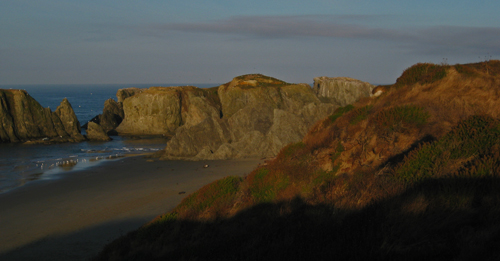
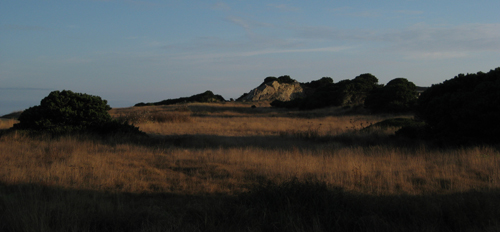
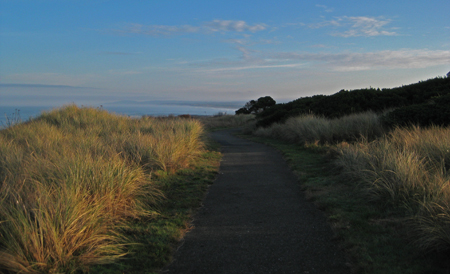
We drove last week to Bandon, and blessed with mild weather, spent some memorable days enjoying the changing leaves and the autumn light on the ocean.

The sound of the waves and the foghorn at night, drifting through an open window, brought T.S. Eliot to mind.  Here are a few photographs, and some of Eliot’s lines from The Four Quartets.

The river is within us, the sea is all about us;
The sea is the land’s edge also, the granite
Into which it reaches, the beaches were it tosses
Its hints of earlier and other creation

It tosses up our losses, the torn seine,
The shattered lobsterpot, the broken oar
And the gear of foreign dead men. The sea has many voices
Many gods and many voices.
The salt is on the briar rose,
The fog is in the fir tree.

The tolling bell
Measures time not our time, rung by the unhurried
Ground swell, a time
Older than the time of chronometers, older
Than time counted by anxious worried women
Lying awake, calculating the future,

Between midnight and dawn, when the past is all deception,
The future futureless, before the morning watch
When time stops and time is never ending;
And the ground swell, that is and was from the beginning,
Clangs
The bell.

If you came this way,
Taking any route, starting from anywhere,
At any time or at any season,
It would always be the same; you would have to put off
Sense and notion. You are not here to verify,
Instruct yourself, or inform curiosity
Or carry report. You are here to kneel
Where prayer has been valid.

Contests for Short-Short Stories and Poetry

Fall seems to be the busy time for writing contests and here are details on two new ones from Writer’s Digest.  How does $3000 for a 1500 word story sound?  Nice work if you can get it, and someone will!

The 12th annual Writer’s Digest Short-Short Story Competition has top prizes of $3000, $1500, and $500, plus prizes of $100 for the next six selections, and $50 WD book credits for those who place 11-25.  Names and story titles of the top 10 winners will be published in the magazine and posted online.  The deadline is is Nov. 15 and you can read the details at  http://www.writersdigest.com/competitions/short-story?et_mid=515537&rid=3017168

The 7th annual Writer’s Digest Poetry Competition has a similar schedule of prizes though they are less, for the maximum length is 32 lines.  All styles are welcome and names of the top 10 winners will be published in the magazine and published on the WD web site.  The deadline is December, 1 and details are here:  http://www.writersdigest.com/competitions/poetry?et_mid=515537&rid=3017168

Finally, don’t forget the ongoing WD contest for longer stories in six categories. Entries are due in September and October, with details available here in an earlier post:  https://thefirstgates.com/2011/07/21/six-writers-digest-short-story-competitions/

Philip Levine: America’s New Poet Laureate

Philip Levine - Poet Laureate of the United States

Philip Levine was born in Detroit in 1928 and started writing poetry at 13.  He hated the “prissy” stuff he learned in school and modeled the language of his early work on preachers heard on the radio.  Levine wrote many of the poems that fill his 16 books in the evenings, after working by day in the auto plants. He has been called the “poet of the proletariat.”

In announcing Levine’s appointment, James H. Billington, of the Library of Congress, called Levine

“one of America’s great narrative poets. His plainspoken lyricism has, for half a century, championed the art of telling ‘The Simple Truth’—about working in a Detroit auto factory, as he has, and about the hard work we do to make sense of our lives.”  http://www.npr.org/blogs/thetwo-way/2011/08/10/139348573/philip-levine-named-as-americas-new-poet-laureate

Levine’s collection of poetry, The Simple Truth won a Pulitzer Prize in 1995.

Here is the title poem:

The Simple Truth by Philip Levine

I bought a dollar and a half’s worth of small red potatoes,
took them home, boiled them in their jackets
and ate them for dinner with a little butter and salt.
Then I walked through the dried fields
on the edge of town. In middle June the light
hung on in the dark furrows at my feet,
and in the mountain oaks overhead the birds
were gathering for the night, the jays and mockers
squawking back and forth, the finches still darting
into the dusty light. The woman who sold me
the potatoes was from Poland; she was someone
out of my childhood in a pink spangled sweater and sunglasses
praising the perfection of all her fruits and vegetables
at the road-side stand and urging me to taste
even the pale, raw sweet corn trucked all the way,
she swore, from New Jersey. “Eat,” she said,
“even if you don’t I’ll say you did.”
Some things
you know all your life. They are so simple and true
they must be said without elegance, meter and rhyme,
they must be laid on the table beside the salt shaker,
the glass of water, the absence of light gathering
in the shadows of picture frames, they must be
naked and alone, they must stand for themselves.
My friend Henri and I arrived at this together in 1965
before I went away, before he began to kill himself,
and the two of us to betray our love. Can you taste
what I’m saying? It is onions or potatoes, a pinch
of simple salt, the wealth of melting butter, it is obvious,
it stays in the back of your throat like a truth
you never uttered because the time was always wrong,
it stays there for the rest of your life, unspoken,
made of that dirt we call earth, the metal we call salt,
in a form we have no words for, and you live on it.

When he first heard of the appointment, Levine was skeptical.  “I’m fairly irreverent,” he said, “and an old union man.”  In the end he realized this was his chance to reach a wider audience than he has had in years, and he accepted.  Levine will hold the office of Poet Laureate for the coming year.

***

Learning of Levine’s appointment was not just exciting in the sense of finding a new author to read, but exciting because the central passage of “The Simple Truth,” contains a compelling challenge.  What are those things, the poem seems to ask, in my life and in yours, that are so simple and true they can stand by themselves, unadorned, beside the salt shaker and a glass of water in evening light as it falls across the table:

Some things
you know all your life. They are so simple and true
they must be said without elegance, meter and rhyme,
they must be laid on the table beside the salt shaker,
the glass of water, the absence of light gathering
in the shadows of picture frames, they must be
naked and alone, they must stand for themselves.

Thank You

I usually think of summer as the laid back season, but not this year.  The last few weeks have been a blur of major construction projects around the home, remedial training for our two rescue dogs, and unwanted interuptions such as the seeming immanent failure of Mary’s hard drive.  There hasn’t been a lot of time for quiet reflection, so I was all the more surprised and grateful when the good people at WordPress chose a recent post of mine to be Freshly Pressed:  https://thefirstgates.com/2011/06/27/a-year-of-blogging/.  I appreciate everyone who stopped by to look and those who left a comment.  I spent some wonderful hours reading and responding to comments and looking at blogs I had never seen before.

The comments that moved me most came from other bloggers, some just starting out, who said they found encouragement in what I had written.  No feedback I have ever gotten for writing means more to me than that.  A few said they were dipping their toes in the water, afraid their writing wasn’t good enough.  I think every writer feels like that on occasion.  Here is what T.S. Eliot, my favorite 20th century poet, had to say on the matter:

So here I am, in the middle way, having had twenty-years –
Twenty years largely wasted, the years of
l’entre deux guerres
Trying to learn to use words, and every attempt
Is a wholly new start, and a different kind of failure
Because one has only learnt to get the better of words
For the thing one no longer has to say, or the way in which
One is no longer disposed to say it.

But Eliot doesn’t stop there, and neither should we.  He goes on to say,  For us, there is only the trying.  The rest is not our business.  Elsewhere he said, Take no thought for the harvest, but only for the proper sowing. 

 At 18, in my first semester of college, I saw a phrase that has never left me:  the invocation at the start of Homer’s OdysseySing in me muse, and through me tell the story…  I remember and sometimes use that phrase because it reminds me that the ego, the small self of “me” and “mine” that worries about results is not the self that can bring them about.

Does anyone else find there is something impersonal about creativity?  It feels very much as if a muse or spirit of inspiration is there to take over the keyboard, if I can just get “me” out of the chair.  Carl Jung said it another way:  “I realized my thoughts were not really my own, but were more like animals I encountered on a walk through the forest.”

One summer when I did some freewriting every day I made a startling discovery – if I allow myself to be lousy, I seldom am.  This doesn’t mean there won’t be editing afterward if I find that one of my seed ideas is worth expanding.  It just means that while I am writing, everything goes better if I’m not looking over my own shoulder.

Several people who commented here said the same thing – their blogging took off when they realized they didn’t need to be perfect.  Thanks again to everyone who stopped by to encourage my imperfect progress!

Two Poems by Rumi

I don’t know why, but I seem to think of Rumi in July.  In my second post, just over a year ago, I used his poem, “Story Water,” as a way of reminding myself of what I thought I was up to on this blog.  https://thefirstgates.com/2010/07/01/story-water/

In “Story Water,” this 13th century Persian poet, whose language leaves you speechless, suggests that most of the time we cannot apprehend truth directly – we need stories and poems as intermediaries.  They serve as messengers that both hide and reveal.  Here are two more of my favorite poems by Rumi.

***

“Love Dogs” speaks of the dark nights that contemplatives of all faiths experience in the quest to move beyond other people’s truths to direct experience.  Here it is in two forms – in the text, from the definitive translation by Coleman Barks, and read aloud by Barks to music – the way poetry was originally meant to be experienced.

The Essential Rumi - trans. by Coleman Barks with John Moyne

Love Dogs” by Rumi.  Translated by Coleman Barks

One night a man was crying,
“Allah, Allah!”
His lips grew sweet with the praising,
until a cynic said,
“So! I have heard you
calling out, but have you ever
gotten any response?”
The man had no answer for that.
He quit praying and fell into a confused sleep.
He dreamed he saw Khidr, the guide of souls,
in a thick, green foliage,
“Why did you stop praising?”
“Because I’ve never heard anything back.”
“This longing you express
is the return message.”
The grief you cry out from
draws you toward union.
Your pure sadness that wants help
is the secret cup.
Listen to the moan of a dog for its master.
That whining is the connection.
There are love dogs no one knows the names of.
Give your life to be one of them.

***

“The Seed Market,” defies almost any attempt to describe it.  I can’t think of anything else in all of literature that paints such a sweeping truth in such simple, everyday language.  Solemn and joyous at once, I read “The Seed Market” when I gave a eulogy at my father’s memorial service, and yet this poem never makes me sad.  Quite the contrary.

“The Seed Market” by Rumi.  Translated by Coleman Barks

Can you find another market like this?

Where,
with your one rose
you can buy hundreds of rose gardens?

Where,
for one seed
you get a whole wilderness?

For one weak breath,
the divine wind?

You’ve been fearful
of being absorbed in the ground,
or drawn up by the air.

Now, your waterbead lets go
and drops into the ocean,
where it came from.

It no longer has the form it had,
but it’s still water.
The essence is the same.

This giving up is not a repenting.
It’s a deep honoring of yourself.

When the ocean comes to you as a lover,
marry, at once, quickly,
for God’s sake!

Don’t postpone it!
Existence has no better gift.

No amount of searching 
will find this.

A perfect falcon, for no reason,
has landed on your shoulder,
and become yours.

One More By William Stafford

I really wanted to include this poem in my discussion of William Stafford yesterday, but I didn’t because the post threatened to get too long.  Several appreciative comments persuaded me to send it out today.  This selection is available in The Way It Is, the collection of Stafford’s poetry I referenced, with a link, at the bottom of yesterday’s post.  This, along with other William Stafford poems, can also be found on various poetry websites.  It was first published in a 1960 collection called, West of Your City.  Enjoy.

A Ritual To Read To Each Other

If you don’t know the kind of person I am
and I don’t know the kind of person you are
a pattern that others made may prevail in the world
and following the wrong god home we may miss our star.

For there is many a small betrayal in the mind,
a shrug that lets the fragile sequence break
sending with shouts the horrible errors of childhood
storming out to play through the broken dyke.

And as elephants parade holding each elephant’s tail,
but if one wanders the circus won’t find the park,
I call it cruel and maybe the root of all cruelty
to know what occurs but not recognize the fact.

And so I appeal to a voice, to something shadowy,
a remote important region in all who talk:
though we could fool each other, we should consider–
lest the parade of our mutual life get lost in the dark.

For it is important that awake people be awake,
or a breaking line may discourage them back to sleep;
the signals we give–yes or no, or maybe–
should be clear: the darkness around us is deep.