The Wind Through the Keyhole, by Stephen King: A Book Review

I recently said I look for “imaginative escapism” in summer reading, and Stephen King’s, The Wind Through the Keyhole, 2012, qualifies on both scores.

This book is a celebration of stories by a consummate storyteller.  It is structured as a frame tale, three levels deep – a story within a story within a story, something you find in some our oldest epics and story collections like The Odyssey and The Arabian Nights.

In case we we miss that connection, King says it another way through his main character, Roland Deschain, who tells his traveling companions, “There’s nothing like stories on a windy night when folks have found a warm place in a cold world.”  Later, during a story concerning his younger self, Roland says, “A person’s never too old for stories…Man and boy, girl and woman, never too old.  We live for them.”

This is the eighth of King’s Dark Tower Novels, and the first I have read, but the introduction caught me up well enough to proceed.  Roland Deschain is a gunslinger in Mid-World.  A gunslinger is a cross between a knight errant and an old west marshall.  Many gunslingers are descendants of “the old White King, Arthur Eld.”

Mid World borders our own and is “filled with monsters and decaying magic.”  In places, there are gates between the worlds, or places where “the veils are thin.”  Three of Roland’s companions come from New York.  The fourth is a billy bumbler, a talking, dog-like creature.

Roland and his companions – his ka-tet – barely have time to find shelter from a starkblast, a devastating storm, with winds like a hurricane, the sudden onset of a tsunami, and temperatures so cold that trees snap and explode.  While the friends shelter by the fire in the only stone building in a deserted town, Roland tells of one of his first assignments as a gunslinger.

In the first story, “The Skin-Man,” Roland rides with his partner, Jamie Red-Hand, to the desolate mining town of Debaria, where a shapeshifter has slaughtered dozens of people.  This a gritty western world, like the bleakest of early Clint Eastwood’s westerns, and the monster is more deadly than the bad and the ugly Clint faced down.

While talking to an 11 year old survivor of an attack, a boy whose father and a dozen others were slaughtered, young Roland tells the second tale, “The Wind Through the Keyhole,” about another 11 year old, Tim Ross, who goes on a dangerous quest to save his mother who has been injured by a treacherous step-father.  Tim sets off to find Maerlyn, aka Merlin, at the heart of The Endless Forest.

Picture an 11 year old on an Arthurian quest, who stumbles into a swamp filled with gators and is saved by a group of plant people who communicate telepathically and give him a strange disk with buttons and lights that speaks and answers his questions in a female voice.  Her name is Daria.  Once she tells him she’ll be “offline” for half an hour, “searching for a satellite link.”

Just when he’d begun to believe she really had died, the green light came back on, the little stick reappeared, and Daria announced, “I have reestablished satellite link.”

“Wish you joy of it,” Tim replied.

Well, why not?  Is a magical iPhone so different from an enchanted sword or magical ring?  A master storyteller like Stephen King can pull of escapades like this because he always has me asking the one question that really matters in storytelling.  To quote Neil Gaiman, that question is, “What happened next?”

There’s adventure, courage, cruelty, humor, horror and much more as Roland Deschain takes us in and leads us back out of three levels of story.  One constant throughout all the tales is the wind, and I think Roland speaks for King when he says:

In the end, the wind takes everything, doesn’t it?  And why not?  Why other?  If the sweetness of our lives did not depart, there would be no sweetness at all.

The Wind Through the Keyhole is a very satisfying summer read – and quite a bit more.

Fairytales for Midlife

Joseph Campbell’s groundbreaking series, “The Power of Myth,” broadcast on PBS in 1988, sparked a tremendous interest in myth and folklore.  A number of fine studies followed during the next few years.  One of my favorites was a series of books on fairytales by Allan B. Chinen, a San Francisco psychiatrist.  In his second book, Once Upon a Midlife, 1992, Chinen discusses stories about the problems and tasks that face us in middle age, “when the Prince goes bald and the Princess has a midlife crisis.”

once upon a midlife

Of the 5,000 fairytales from around the world that Chinen reviewed, 90% were “youth tales,” aimed at young people trying to find their place in the world.  The protagonists leave home, struggle to find their courage, fall love, find a treasure, and come into their kingdom or find a job.  Chinen calls the other 10%, “middle tales.”  The focus is middle-aged men and women, “juggling the demands of family and work, grappling with self-doubt and disillusionment, and ultimately finding deep new meaning in life.”

Allan Chinen

The first of the middle tale themes Chinen explores is “the loss of magic,” embodied in the German tale of “The Elves and the Shoemaker.”  Youthful protagonists thrive when they locate a source of magic; they lose it only if they are mean or greedy.  In middle tales, the magic fades in the course of living.  At some point, we realize we’re not going to write the Great American Novel; we don’t have an unlimited number of do-overs left; we don’t have the skill or the energy to realize all of our youthful dreams.  What is left?  If we listen to the stories, Chinen says, we begin to see other roads between the extremes of naiveté and despair, roads that leads toward renewal.

The next theme is “reversals,” often involving men and women dropping traditional gender roles.  The headline in this week’s newspaper Arts & Entertainment section was, “The Era of the Empowered Princess.”  That may be the theme in Hollywood, but not in traditional “youth tales.”  Where the emphasis is socialization, stories all over the world  praise traditional roles.  Things change in middle tales.  Men sometimes say, “To hell with work,” or quit the army, while women grow more assertive and often save the day, as in “The Wife Who Became King,” a story from China.

The third middle tale theme is a new awareness of death and evil.  Youth stories don’t dwell on either one; bad things happen to others, “out there.”  Dragons die, bad sorcerers die, and sometimes evil step-mothers, but never the hero or heroine, and neither of them are evil.  In middle tales mortality gets personal.  Evil gets personal too; no longer does it simply lie “out there.”  The expansiveness of youth gives way to the psyche’s need for wholeness, which means we have to “confront the shadow,” the darkness we carry within.  The best stories, honed by generations of telling, lead us to realizations by the path of wisdom and by the path of humor.  In “The Tell Tale,” a Japanese story, a woodcutter spies his wife in the arms of a pawnbroker.  At first he is seized by a murderous rage.  Rather than kill his wife and her lover, he concocts a ridiculous story and uses it to trick his wife, humiliate the pawnbroker, and makes enough money to live with his wife in comfort – and fidelity – for the rest of their days.  There is far more of the trickster than the knight-in-shining-armor in these stories.

The final middle tale theme in Once Upon a Midlife is renewal, which in these stories, most often involves descent to the underworld.

“Stripped of all their defenses, individuals come face-to-face with the core of their being.  There they find a primordial source of life, beyond conventional notions of good and evil, male and female.  Whether understood as the inner Self, or God, or the life force, this primal source helps men and women reforge their lives…[they] emerge from their suffering with deep healing – and the ability to heal others.”

To anyone interested in the interpretation of folklore, I recommend this page which lists all of Allan Chinen’s books.

Swan Maidens and Fairy Lovers, Part 2

It’s good to know that glasses can help us drink.  The problem is, we don’t know the purpose of thirst. – Antonio Machado

I hope I didn’t create the impression that I have any solid answers to the questions The Bride of Llyn y Fan Fach raises. Just “hints followed by guesses,” to quote T.S. Eliot.

In stories of this type, from all over the world, beautiful Otherworld women enter the lives of mortal men and then leave.  It’s not too great a stretch to imagine they represent the beauty, the love and fulfillment, the joy and intensity we long for in the world, but usually find to be fleeting.  The occasion for the lake woman’s departure is a tap on the shoulder that counts as a “blow.”  In a literal sense, this is absurd.  I take it to mean that the radiance of the Otherworld is like a spectacular sunset:  it illuminates our world but does not endure.  If it hadn’t been a tap, it would have been something else.  Perhaps as T.S. Eliot said, “Human kind cannot bear very much reality.”

Renunciation is not giving up the things of this world, it’s giving up the idea that they last – a Zen master.

Traditional fairytales are not linked to specific dates and places, but this one is.  This indicates a modern sensibility shaping the story pattern, and it seems especially clear in the lake woman’s belief that the world is a veil of tears.  The usual fairytale heroine does not cry at weddings, where people are “entering trouble,” nor does she laugh at funerals where people are “leaving their troubles.”  Her legacy is the gift of healing to help alleviate suffering.

In the lake woman’s view, this world is not our home, but while we are here, compassion is the highest virtue.  This sentiment could have come from Celtic Christianity.  It is also very eastern and reminds me of the theory that the Celts are linked, by diffusion, with the Aryan warriors of India.  Either way, this is a very different world from the Cinderella tales or stories like The Water of Life which suggest you can find your prince or princess and live a happy life together.

And you know the sun’s setting fast, And just like they say, nothing good ever lasts. – Iris DeMent

At the opening of this story, we learn that the young man’s father “died in the wars.”  The dates vary in different texts. One says the end of the 12th century, and others, the 13th century.  The latter date would coincide with the conquest of Wales by Edward Longshanks, the villain in Braveheart.  Edward invited all the bards in Wales to a council and had them killed, understanding that a nation without stories ceases to be a nation.  What Longshanks didn’t understand was that Celtic stories survive wherever there is a pub, a hearth fire, or a quiet country lane, yet I think the sadness of a conquered people infuses the story.

We know there is another world.  The question is, how far is it from midtown and how late is it open? – Woody Allen

Twenty years ago, Mary and I travelled with a small group of storytellers on a tour called, “The Quest for Arthur’s Britain.”  Our guides were a remarkable couple, Robert Bella Wilhelm and his wife, Kelly, who have devoted their lives to storytelling and the sacred.  I’m happy to say they are still at it.  You can check out their website for details on storytelling trips to the Orkney Islands in May, to Iceland in September, and to Hawaii in Jan., 2013:  http://www.storyfestjourneys.com/

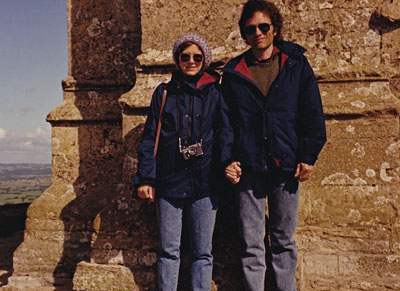
On Glastonbury Tor, Sept., 1991

We spent the last days of this journey at an Elizabethan manor house in the Black Mountain foothills, not too far from Llyn y Fan Fach.  It was one of a very few times in my life that I heard no traffic sound at night and saw no lights of a city.  When the moon was down, it was pitch black.  You could see the shapes of trees against the stars, but little else.

One night I strolled to the end of the yew walk.  The lights from the manor were hidden.  No light, no wind, no sound.  That alone was uncanny, but there was something more.  My Jungian training, which had taught me to understand spirits and fairies as archetypes of the psyche, vanished in a visceral rush of ice down the spine.  Part of me wanted to know what lay beyond, out in the open fields, but I couldn’t bring myself to take another step.  The hair on my neck stood up until I got back to the manor.

Do I believe in other worlds?  I did that night, and I think I do still.  I’m glad I knew the old stories and their lesson:  as human beings, this world is our home, for good or ill.  The peril is very great – too great – for those who venture too close to any other.

Swan Maidens and Fairy Lovers, Part I

When I was an active storyteller, I loved to tell one of the best known legends of Wales.  It’s found in many collections under various names, most often, “The Bride of Llyn y Fan Fach.”  Variations of this story are found all over the world.  A mortal man marries an Otherworld woman who breaks his heart, but sometimes brings marvelous children into the world.

Llyn y Fan Fach and the Bannau Sir Gaer by Rudi Winter. CC by-SA 2.0

I’ve started to write about this legend on other occasions, discarding drafts that rapidly grew beyond the scope of a blog post or two or three.  What prompted me to begin again was a visit to Barnes & Noble.

Barnes & Noble knows what sells.  An entire row is now filled with “Paranormal Romance.”  The covers feature illustrations of winsome teenage girls.  The genre isn’t new; Charles de Lint, a Canadian author, has written stories like this for thirty years.  The popularity is new, and almost all of today’s novels invert the usual folklore setup, in which a mortal man meets a fairy woman.  Not only that, but the odds of a happy ending in these tales are worse than the chance of hitting a single number at roulette.

The Swan Maiden

The Swan Maiden is the most widespread “mixed marriage” type of folktale.  It is also considered the most primitive, since the Otherworld woman’s native form isn’t human.  Usually it’s a bird.  Swan maiden stories are found all over Europe, as well as the middle east, Russia, India, China, and Japan.  There’s a parallel water buffalo woman story in Africa.  According to one researcher, the motif is 30,000 – 40,000 years old, as shown by a bison-woman cave painting.

In swan maiden tales, a man sees a flock of swans glide to earth at night.  Removing their swan robes, they change into beautiful women who bathe or dance together.  Enamored of one in particular, the man takes her robe so she won’t fly away, and eventually persuades her to marry him. Later they have children.  One day the swan-wife hears her children sing of where her husband has hidden the robe, or they tell their mother when they see her in tears.  The swan maiden puts on her robe and flies away forever, leaving the children with their father.

The Welsh Stories

I have a passion for Celtic stories, and those from Wales in particular, but Celtic fairies seldom give a mortal a break.  They put out a Scottish woman’s eye simply because she could see them.  When Thomas the Rhymer succeeded in pleasing the fairy queen for seven years, what did she give him as a reward?  A tongue that could only speak the truth!  Think about how that would serve you at work.  No mystery about why Thomas never married – “Does this make me look fat?”

In Welsh mixed-marriage tales, a mortal man wins the hand of a fairy wife who agrees to stay with him under certain conditions.  They have children, the husband accidentally breaks a condition, usually by touching his wife with iron, and she leaves.  He never sees her again, though she sometimes slips back to visit her children, whose descendants are beautiful and wise.  Here is the best of these stories:

The Bride of Llyn y Fan Fach

At the end of the 12th century, a young man lived with his mother, a war widow, in Carmarthensire in Wales.  Every day he drove their small flock of cattle to the lonely tarn known as Llyn y Fan Fach.  The cows preferred the grass there to any other pasture.

Llyn y Fan Fach, copyright Stuart Wilding, licensed for reuse CC by-SA

One morning, the man (who isn’t named in the tale) beheld a beautiful woman sitting on the water combing her hair.  All he had to offer was a bit of bread, but he walked to the shore and held it out.  She glided over the water and said, “Hard baked is thy bread.  Hard am I to hold.”  Then she dove under the waves.

Unable to think of anything else but her, he brought unbaked dough the next day.  She appeared at noon, glided to the shore, and said, “Unbaked is thy bread.  I will not have thee.”

The lady combs her hair on the water

The third time, the bread was just right.  The lady gave her assent and her father offered a sizable dowry of cattle, goats, and horses, after the young man agreed to one condition – his wife would leave him if he struck her three blows without cause.

Things went well at first, and they had three sons.  Then one day the couple was to attend a christening.  The lady delayed getting ready.  She sent her husband back to the house for her gloves, saying she would saddle the horse.  When she didn’t do so, the young man playfully tapped her on the shoulder with the gloves.  “Not ready yet?”

“Be more careful,” she said.  “For you have just struck the first blow without cause.”  [This incident echoes other stories where the husband touches his fairy wife with an iron bit while bridling a horse, but that detail is missing here.]

A few years later, at a wedding, the wife burst into tears.  The husband tapped her shoulder and asked why she wept.  “I weep for this couple who are now entering trouble,” she said.  “Be careful, my love, for your trouble draws closer.  That was the second blow without cause.”

The man stayed vigilant, and things went well for several more years.  Then one day his wife burst into laughter at a funeral.  He tapped her on the shoulder again and asked why she laughed.  “I laugh because this man has left a world full of trouble,” she said.  “But now your trouble is here.  Farewell, my husband.  You have just struck the third blow without cause.”

Ignoring his protests, she marched to the lake, and all her father’s animals followed.  A pair of oxen dragged a plow six miles to the lake, and the furrows can be seen to this day.  Of the unfortunate husband, we know nothing more.  Longing for their mother, the three sons went to the lake at night and she appeared.  “You are to be of help to the world,” she said.  “I shall instruct you in the arts of medicine.  You and your descendants will be great and skillful physicians.  Whenever you need my advice, I will appear.”

In time, they became the personal physicians of the Prince of South Wales.  The legend of the Bride of Llyn y Fan Fach comes from a book called The Physicians of Myddvai, 1861, by a Welsh printer named Rees.  The Welsh Historical Society has herbal recipes attributed to the lake woman’s descendants, and the last of the line, Dr. C. Rice Williams lived into the 1890’s.

***

What do we make of a story like this?  First, we can recall Marie-Louise Von Franz’s comparison of myth and folklore. The great myths and legends tend to be more polished.  Their plots are coherent enough to satisfy modern demands.  In contrast, folktales are more primal and more opaque.

One unique feature of this tale is the specificity of location and the lake lady’s descendants.  Greek families traced their ancestry to the heroes of Troy, and my mother had a coat of arms dating back to the Normal Conquest.  A similar dynamic is one explanation for the unique segue of this fairy tale into history.

The real mystery for me has always been, why is the husband is doomed from the start?  Who would count a shoulder tap as a “blow?”  Why do mortals never win when they give themselves to Otherworld lovers?

I’ve asked myself why since the day I found a book of local fairytales in a used bookstore in Wales on a visit 20 years ago.  Though I don’t have certain answers, I have some thoughts which I will offer next time.  Meanwhile, does anyone else have any ideas?  Why would the girl’s father set an impossible condition, and why would she actually leave over such a minor slight when the text says she really loves her husband?  I welcome any suggestions you may have.

The Water of Life, Part 2

If you have not already done so, please read the first part of this article in the preceding post.

The Water of Life by Rogasky and Hyman, 1991.

Marie-Louise von Franz, a close colleague of Carl Jung, wrote extensively of fairytales.  She believed that these “simple” stories reveal the core of the psyche better than the great myths and sagas, shaped by poets and spiritual thinkers.  Reading these tales with the same respect the young brother shows the dwarf can reward us with nuggets of wisdom shaped by generations of storytellers sitting beside the hearth fire.

The opening of The Water of Life reminds us that when we don’t know the way, it pays to admit it, at least to ourselves.  We need to pay attention to everything, listen to everything, for we don’t know the shape of the messenger who may show us how to proceed.  Here is the rest of the story:

The dwarf told the third son where to find the castle where The Water of Life flowed.  He gave the prince an iron wand to open the gates, and two loaves of bread to appease the lions who guarded the entrance.

The third son throws the loaves to the lions

In the great hall, he found men turned into stone.  As he left the hall, he spotted a sword and another loaf of bread and picked them up.  Venturing on, he met a beautiful woman who welcomed him.  She said he had set her free. “This realm will be yours and all the enchantments broken if you return in a year to marry me.”

The woman directed him to the Fountain of Life and urged him to leave with the water before the clock struck noon, when the gates would close again. The young man hurried on until he came to a room with a freshly made bed.  Realizing how tired he was, he settled down for a nap.  He woke at quarter to twelve, and just had time to find the fountain, fill a cup with The Water of Life, and race back to the gate.  As it swung closed, it sliced off a piece of his heel.

The dwarf was waiting and told him the sword would defeat any army, and the loaf would feed any multitude and never be diminished.  The young prince then begged the dwarf to free his brothers.  The little man said to forget them, his brothers would only betray him, but he gave in at last to the younger brother’s pleading.

On the way home, the brothers passed through three kingdoms plagued by war and famine, and the youngest used his sword and loaf to save them.  At the same time, he told his older brothers about his success and his betrothal to the Lady of the Fountain.  Before he could give his father the Water of Life, the older brothers swapped it for sea water, which made the king worse.  The older pair then gave the king the true healing draught and claimed the young brother had given him poison.  The king ordered a huntsman to kill his youngest son in the forest, but the huntsman could not bring himself to do it.

The kingdoms the young prince had saved sent riches by way of thanks, and the king began to reconsider.  As the year drew to a close, the Lady of the Water had the road to her castle paved with gold.  She ordered her servants to chase off anyone who walked up the side of the road but welcome the one who strode up the center.  The two older brothers, anxious not to scuff the precious metal, walked beside it and were driven away.  The young prince, able to think of nothing but his love, had no care for gold and walked up the middle of the road.  

The Lady of the Fountain. Detail of an English tapestry

The Lady ran out to meet him.  He became Lord of her realm, freed all the frozen men, and reconciled with his father.  The two older brothers sailed away and were never seen again.

***

If the start of the tale presents a fairly clear dynamic, what follows is more obscure.  The question of how and when to interpret folklore goes far beyond the scope of one or two blog posts.  Folktales may be more primal than myths, as Marie-Louise von Franz suggests, but they leave more open questions.  I tend to follow James Hillman’s advice – “stick with the image.”  When scenes in movies and books, or events in our lives leave us puzzled, we may turn them over in memory and imagination for years without rushing to ask what they “mean.”  In doing so, we let them nourish us without draining their power by settling for simple answers.

For instance, the Lady of the Water of Life gives the youngest son clear instructions to find what he came for and get back through the gates before noon.  So what does he do?  Hits the sack when he spots a bed.  Strange behavior for a lad who has gotten as far as he has through doing what he’s been told.

I’ve come to believe the bed is another trial on the way to the Water of Life.  It took warrior courage and dwarf tricks to get by the lions guarding the gates.  Here the trial is staying awake – not always easy in life.  At the wrong time, if you “look neither right nor left,” you miss the chance of renewal.  At the right time, it’s essential.  If the prince hadn’t made it out by noon, I believe he would have turned to stone like the others in the courtyard.  There is nothing in this text to support this a view; my opinions are based on other stories.  One is a fuller account of stone people in a tale from The Arabian Nights.  The other is a trial-by-bed that Sir Gawain undergoes on a mysterious “Isle of Women.”  When he succeeds, he too becomes the champion of the Otherworld queen.

Such hunches are tentative and subject to change.  It isn’t answers but wrestling with the questions that draws my imagination again and again to this kind of story.

*** 

Two decades have passed since I found The Water of Life, and since then, “Look for the dwarf by the side of the road,” has become something I tell myself every time I’m stuck.  Such renewal is open to everyone – it’s our birthright, though certain attitudes, embodied in the older brothers, will chase inspiration away.  Older brothers pretty much run the world:  they are the movers and shakers, the ones who get things done, which means they keep going even as the walls close in.

That’s one reason I love blogging.  It’s an excuse to discover and celebrate people who talk with dwarves:  those who build little libraries.  Those who buck the trend and open small bookstores.  Those who publish their own books, in the grand tradition of Walt Whitman, who initially sold his poems door-to-door.  People, in other words, who try to occupy their own lives, which is what this story is really about.

A world where the Water of Life flows is filled with individual acts of courage.  A world where the waters are choked off looks very different, for as Michael Meade observes:

“There is something incurable in this world that makes the soul long for the healing and beauty of the otherworld.  Each visit to the other realm requires stopping the business and busy-ness of the daily world in order to listen to the questions being asked from the inner-under-other sides of life…Unless the inner voice and the little people are heard from again, the world will continue to drain of meaning and will keep turning a cold heart to the immensity of human suffering.”

The Water of Life

“Amidst a world increasingly disoriented and at war with itself, each person carries with them the seeds of a unique and valuable story trying to unfold. The youngest part of each psyche still longs to find the holy waters that can ease the pain of living and make life whole and meaningful again.” – Michael Meade

The Water of Life is a German folktale collected by the Brothers Grimm.  It shares a pattern with stories found all over the world:  the youngest brother or youngest sister, the one whom everyone else regards as incompetent, succeeds in a task or quest where the “wise” siblings fail.  In doing so, they bring new life to themselves and to the land.

Carl Jung analyzed The Water of Life in detail because it so neatly aligns with his theory of the four functions – thinking, feeling, intuition, and sensation – which are known to many through the Myer-Briggs Personality Profile.  Jung believed that at critical points in our life, renewal comes through “the inferior function,” the one that is least developed.  This “least competent sibling” lives closest to the unconscious where the healing waters lie.

The story has been a favorite of those who write about folklore from a psychological perspective.  One of these is Michael Meade, who wrote, Men and the Water of Life: Initiation and the Tempering of Men in 1994.  The original version, which analyzed six classic folktales, was based on the work he did hosting large men’s gatherings with James Hillman and Robert Bly.  In 2006, he revised the book and renamed it, The Water of Life:  Initiation and the Tempering of the Soul in an effort to broaden the scope to include both genders.  One more update preceded Meade’s release of an ebook last year.

A new urgency informs the latest version in light of the economic and ecological crises we face.  All along, Meade emphasized that the story speaks to cultures as well as individuals, for both can become rigid and stuck.

So let’s look at the story.  Here is the whole text for those who wish to pursue it: http://www.authorama.com/grimms-fairy-tales-51.html).

A king lies dying.  He calls his three sons and tells them only the Water of Life can save him.  The oldest sets out, looking neither right nor left and soon passes a dwarf by the side of the road.

“Where are you riding so fast, looking neither right nor left?” asks the little man.

“What’s it to you, runt?” asks the prince.

The dwarf is furious.  He speaks a few words, and before long, the oldest son finds the valley walls closing in on him.  He keeps going, looking neither right nor left, until he and his horse are wedged in the rocks unable to move forward or back.

The second son sets out, disrespects the dwarf, and soon he too is stuck.

When neither of his older brothers returns, the youngest begs permission to go on the quest.  Figuring his last son, who has  reputation for being odd, has no chance if the clever brothers are lost, the king is reluctant.  At last the third son wears him down and wins permission to venture forth.

When the dwarf asks where he is going, the youngest son gets off his horse and says, “I seek the Water of Life for my father who is dying.”

“Do you know where to look?” asks the dwarf.

“No,” say the prince.  “I have no idea.”

Because the youngest son is humble and shows him respect, the dwarf points out the road and gives him magical implements he will need to win the Water of Life.

The dwarf helps the youngest son

Others have written long chapters about this part of the story.  I could do the same but I don’t think I need to.  People who live with stories – most readers of this blog, in other words – are going to pick up the gist pretty fast.  Still, a few points that others have made bear repeating.

  • Jung used the dying king to illustrate the changes that come at midlife.  The energy that propels us into the world through our first three of four decades is often exhausted and in need of renewal.  Everyone knows the cliche of the business exec who turns 40 and buys a corvette and a trophy wife.  Most people are wiser than that, but it is the time when renewal comes from the parts of ourselves that we have ignored or suppressed while looking neither right nor left.  As Michael Mead put it, “Only when we are at the end of our wits do we turn to the deeper wit of the youngest brother.”
  • Students of folklore know that success most often hinges on finding a magical ally, and in many stories, the older and “wiser” brothers and sisters blow it as they do here, with arrogance.  It makes little difference whether we understand the dwarf as an archetype of the deep psyche or as our ancestors did, as a creature of the Otherworld which is never far away.  Respect is essential.  The unconscious can bring inspiration or neurosis; magical beings can bless or curse.
  • Meade calls the first two brothers, “the ego brothers.”  These are the “well adapted” parts of ourselves, the inner movers and shakers who get things done.  There are plenty of times in the modern world when you don’t want to look right or left, when you need to charge ahead.  But when our best ideas get us stuck, as they eventually will, we need the humility of the younger brother.  Free of ego, the first step he takes toward healing, both for himself and his father, is to admit, “I do not know the way.”

I read Michael Meade’s first version of this book in the early ’90’s, and it came to mind very powerfully last summer, when our government ground to a halt – as stuck as the brothers pinned between the rocks.  Wouldn’t it have been refreshing to hear even one of our leaders speak the truth and confess, “I don’t know which way to go?”  Unfortunately, no one gets re-elected that way; our leaders are still charging ahead, looking neither right nor left.

Intuitively we know there are times when business as usual no longer works.  As Meade puts it,“Once it has been lost, the Water of Life can only be found by wandering off the beaten path.”

To Be Continued


Angels Incognito

The local California Writer’s Club branch hosts an annual short-short story contest every year.  I hadn’t intended to enter until this morning when one of those end-of-the-night inspirations slipped into awareness.  A story idea:  A reprobate is convinced that “they” are stealing our memories, and he is probably right.

I wrote the opening with relative ease.  We’ll see how it goes; openings are easy, but I also have a great fondness for this kind of character – the guardian or the wise one whose appearance is humble or even repulsive.  You meet him – he is most often male – in various guises in movies and fiction:

Mel Gibson in "Conspiracy Theory," 1997

He is found  in myth and scripture.  John the Baptist is a classic example, who must have dismayed a lot of the city people who came out to hear him.

John the Baptist

Tilopa, (989 – 1069) one of Tibetan Buddhism’s greatest teachers, was expelled from a monastery and made his living as a sesame pounder, a pretty low rung on the social ladder.

Tilopa

Once in a while, you meet someone like this in real life.  I read an account by a man who wanted to go to India in search of a guru, but then found his teacher, a Zen master, earning his living by fixing washing machines in a laundromat 12 miles away.

When my wife was a social worker at Loaves and Fishes, a local center that helps the homeless, she was startled one day as a small hispanic man climbed out of a dumpster in a parking lot. Significantly, his name was Jesus. Mary’s eye’s still light up when she tells what a joyful man he was.  The meeting was so unexpected, but left such a vivid memory, that she thinks of him whenever the subject of angels comes up.

These reflections led me to think of one of my all time favorite fantasy novels, King of Morning, Queen of Day, by Ian McDonald, 1991.  The story features a pair of otherworldly guardians who look a lot like bums as they craft powerful magical charms from bottle caps and debris.  McDonald came to mind when he published his latest novel in December.  I haven’t yet read the new one, but I’ll discuss King of Morning next time.

Meanwhile, has anyone else encountered an angel, a wise man or woman, a mentor or a guardian who showed up disguised as an “ordinary” person but then turned out to be anything but?

Go I Know Not Whither, Bring Back I Know Not What – Part 2

We left Fedot standing outside a tall mountain at the end of the world.  The ancient frog who had been his companion couldn’t carry him further, but she was able to tell him how to proceed.  She advised him to enter a cavern, hide himself, wait for two men to appear, and do exactly what they did.

Everything happened as the frog foretold.  Two old men entered the cavern and called out, “Shmat Razum!  Come and feed us.”  Light blazed from candelabras, a feast appeared at the table, and the two men ate their fill.  When they were done, they cried, “Shmat Razum, take it all away.”  The feast disappeared and the lights went out.

When the men left, Fedot called “Shamat Razum, give me some food.”  Instantly a feast appeared.  Then Fedot did something exceptional.  He said, “Shamat Razum, come, brother, and sit down with me, let us eat and drink together. I can’t stand eating alone.”

The spirit – for that is what he was – thanked the hunter and told him the old men had never once asked him to share a meal in the 30 years he had served them.  Fedot said, “Come and serve me.”  Shamat Razum agreed and they left the cave together.

All along, Fedot has shown two attributes that will save him, qualities that are keys to success in many fairy tales.  Courage and conventional strength are not enough.  First in importance, Fedot is willing to listen to all “the spirits,” all the creatures who offer help and advice.  He also treats them courteously, as welcome guests and friends.  It makes little difference whether we call them spirits or archetypes.   Through his long career, James Hillman, the post-Jungian founder of Archetypal Psychology insisted we treat the figures in our dreams and fantasies with the same respect we would show to any flesh and blood visitor.

In modern terms, Fedot’s journey leads him steadily into the deeper layers of psyche.  His dove-woman wife is closer to the human realm than her mother, and her mother is closer  than the frog.  More distant from everyday life than any of them is Shamat Razum, a spirit whose nature and shape we never know, even though Fedot calls him, “brother.”  These are the critical characters of the story – the only two who are named.  Shamat Razum is the “I know not what” of the story’s title.  Through the rest of the tale, Shamat Razum manifests many qualities.  He is prophetic, he is a spirit of wind and air, and above all, he is a trickster.  The myths of many indigenous groups begins with a trickster who is their world creator.  For some Native American tribes, history begins when Coyote dives into the ocean to bring up the soil to make land.  No spirit is more fundamental.

Fedot and Shamat Razum leave the frog with the mother-in-law and journey on toward Fedot’s home.  When the hunter says he’s too tired to walk, his spirit brother picks him up like a strong wind and carries him through the air.  Shamat Razum finally stops at a small island where he lays out a scam to steal some magical implements.

“Three merchant vessels will sail by and stop at the islet,” he says.  “Thou must invite the merchants hither, hospitably entertain them, and exchange me for three wondrous things which the merchants will bring with them. In due time I will return to thee again.”

The two of them pull off their con job, reminding one of Hermes / Mercury, the classical trickster god, who is also the god of thieves.  We’re not in a world of classical heroes – no knights in shining armor.  Fedot’s life depends on letting go of illusions like that.  Shamat Razum has foreseen that the king will meet him with treachery, so he helps Fedot cheat the merchants out of objects that allow him to raise an army and navy.  In the final battle, Fedot’s kills the king and scatters his troops.  The people choose Fedot and his wife, who was hiding in the forest as a dove, to be their king and queen.  Together they rule the land with “wisdom, peace and grace.”

<

p style=”text-align:center;”>***

James Hillman once said, “If we had more stories when we were young, we’d need fewer therapists as adults.”  In his PBS series on myth, Joseph Campbell showed millions of viewers the treasures of wisdom that hide in old tales.  So what do we make of  Go I know not wither?

I think we have to approach interpretation with something like the courtesy with which Fedot meets the spirits.  In stories that are alive for us, we don’t start by asking what things mean.  We don’t ask what hobbits signify, or what part of the psyche orcs represent.  If someone has written a dissertation on Batman and the Riddler, I’m in no hurry to read it.  Older tales, like this one, are far enough removed in time and space that they’re not alive for us in that sense.  I think it makes sense to ask what it means – carefully.  Everyone has a right to their own answers.  Here are some of mine.

I look at this tale from the point of view of transition points in our lives.  When life and excitement drain from what we are doing, what then?  I believe this story suggests we listen to the small creatures of dreams and fantasy.  That we ponder the little impulse, the little whisper, the voice that says, “Wouldn’t it be nice to…?”  It means not giving in right away to our “rational” voices, the ones that say we have no time for such nonsense.

In speaking of “voices” we’re not talking of taking these things literally.  James Hillman insisted that literalism is the enemy of a soul-centered life, and Fedot does not wind up on a street corner, talking to imaginary friends.  According to St. Paul, the ability to “distinguishing between spirits,” is a gift from God ( 1 Cor 12:10), yet one that people like Campbell suggest we can learn to some degree.  Simply exploring and thinking about old stories, or keeping a dream journal, are ways to begin.

It’s a good bet that the answers we find, the paths we are shown, will not be ones we expect.  Shamat Razum, the way-shower, is a trickster, as hard to pin down as the wind.  If the answers to the turning points in life we’re easy to find, stories like this one would not have told for generations.  Carl Jung once said, “We make all the important decisions in life on the basis of insufficient information.”   Hearing the old tales and listening to imaginal voices may be one more way of getting a clue.

I welcome the comments of anyone who has read this far.  What did you make of this story, and what of you make of old tales in general?  Do you have any favorite collections or authors on the subject?  Please take a moment to post them and leave your impressions.