Notes on Stories by Amy Tan

In my previous post, I spoke of Stephen King’s editorial intro to the 2007 edition of Best American Short Stories.  Today, while excavating (cleaning is too mild a word) the junk in the back room, I found three volumes I had picked up last fall from the used bookstore up the street.  These were Best American Short Stories from 1999 and 2005 as well as Best Mystery Stories of 2002.  I flipped through the three, looked at the intros, titles of stories, and a a few first pages, and then sat down with a cup of coffee and the 1999 stories, which were edited by Amy Tan.  She truly seems like someone you’d like to have coffee with.

Tan’s introduction reveals the depth of her love of stories, and she gets very personal about early events that made them as important to her as air.  She had lots of things to worry about as a child, events like seeing a playmate in a coffin and hearing her mother say that is what happens to children who disregard their mothers.  Small wonder that Tan was attracted to fairy tales and Bible stories, which she found very similar:  both had “gory images, gut-clenching danger, magical places, and a sense that things are never as they first appear.”   Straw-into-gold sounded very much like turning three  loaves into a thousand, she says.  Amy Tan gives us these personal memories after saying she always wants to know personal details about people who presume to act as critics or decide which stories are good and which are bad:

“What are their tastes based on?  What are their biases?…What movies would they watch twice?  Do they make clever and snide remarks , mostly about people who are doing better than they?…What are their most frequent complaints in life?  What do they tend to exaggerate?…Do they think little dogs are adorable or appetizers for big dogs?…In other words, if you ran into this person at a party, would you even like him or her?”

I had been feeling like taking a break or simply doing a post or two here just for fun, and Amy Tan’s comments gave me an excuse; they sent me daydreaming about some of the stories that fascinated me as a kid, ones I still think about now.  I never felt quite as shell-shocked during my first decade as Amy Tan, though we moved a lot too, and one of my childhood playmates died.  The stories and ballads that captured my attention as a young reader were like koans, or life itself – you could chew on them for decades and still not understand all that is going on.

This will be the subject for my next post – stories and ballads I have never forgotten.  It will have to be another post, since one of the stories is from Wales and I need to go dig up the spellings.  Stay tuned!

Some Notes on Short Stories by Stephen King

Last Sunday, as I walked into the Borders where my SCBWI critique group meets, I spotted a winner in the discount racks near the entrance:  The Best American Short Stories of 2007 was marked down to $3.99.  This was a no brainer with the added bonus of featuring Stephen King as editor.

I bought the book without even checking the contents, so I was delighted when I got home and found a story by John Barth called, “Toga Party,” about a group of sixty and seventy-year-olds in a posh retirement neighborhood who all receive invitations to one of those parties, “like that crazy Animal House movie from whenever.”  The story begins humorously but doesn’t end that way.  In a similar vein, Stephen King’s comments on the state of the American short story begin humorously but don’t end that way.

King wrote about going into a large bookstore in Florida in search of that month’s stories to read.  The first thing he saw was a table upfront with titles by James Patterson, Danielle Steel, and himself.  Disposable stuff, but it pays the rent he says, “because money talks and bullshit walks.”   He continues:  “Bullshit- in this case that would be me – walks past the bestsellers, past trade paperbacks with titles likeWho Stole My Chicken?,’ ‘The Get-Rich Secret,’ and’Be a Big Cheese Now,’ past the mysteries, past the auto repair manuals, past the remaindered coffee-table books.”   He finds the magazine wall, next to the children’s reading area.

King says he found The New Yorker and Harper’s without much effort, but had to search the floor-level racks to find the stash of magazines, like the Kenyon Review, that feature short stories:

“So think of me crawling along the floor of this big chain store’s magazine section with my ass in the air and my nose to the carpet in order to secure that month’s budget of short stories, and then ask yourself what’s wrong with this picture.  A better question – if you’re someone who cares about fiction, that is – what could possibly be right with it?”

With an ever dwindling audience, some writers who still care about short stories keep on working, but too often, King notes, their audience is simply other writers who read,“not to be entertained but to get an idea of what sells…and this kind of reading isn’t real reading, the kind where you just can’t wait to find out what happens next…There’s something yucky about it.”

King then says he read “scores of stories that felt…airless, somehow, and self-referring…show-offy rather than entertaining, self-important rather than interesting, guarded and self conscious rather than gloriously open, and – worst of all – written for editors and teachers rather than for readers (emphasis added).

There we have in a nutshell what I have been trying to put my finger on lately.  The last time I went to a large bookstore to browse for books, I went to the mystery section and found the number of rows had been cut in half.  Tough luck for those who like to read and write mysteries – the marketing department, which is after all, just trying to survive – has decided you are not cost effective.

No need for me to belabor the point anymore, it is what it is, but reading King’s editorial notes made me glance at all I have posted here about ebooks.  I certainly never set out to be their champion, in fact I started out somewhat skeptical.  My ideas have changed 180 degrees.  When half the mysteries and most short stories can disappear for reasons that have nothing to do with quality, who can argue with writers who look at a new way to get their books read?

Last week a writer in London asked me to review her ebook after reading this blog and noting that YA fantasy is “my thing.”  Now that I have finished my blog-break, it’s time for me to get back to her work, and with renewed appreciation for her and all the other authors willing to take a chance with a new way to do what storytellers have always done – tell their stories.

A Conference and a Resolution

“If we had more stories as children, we would need fewer psychiatrists as adults.” – James Hillman

On Saturday, I attended the Spring Spirit Conference of the North/Central region of the SCBWI – Society of Children’s Book Writers and Illustrators.  This all day event took place in Rocklin, just 20 minutes from home.  It featured seminars and critiques by writers, editors and agents, aimed at people who write for children and young adults.  I had registered at the end of December, but as the day rolled around, I wasn’t that anxious to go.

Part of it was simple fatigue, the after-effect of this spring’s flu.  Part of it was a kind of burnout.  Earlier this week, as I was reviewing a manuscript for one of my critique groups, I caught myself writing a comment out of habit – a knee jerk response I was not even sure was true.  I’ve found myself doing that several times recently, and as a result, I was feeling an impulse to step away and sort out some ideas that didn’t feel like mine.  I wasn’t sure I needed a professional gathering where I was likely to pick up more.

I was pleasantly surprised by the keynote speaker, author and teacher, Bruce Coville.  “Take everything the presenters say with a grain of salt,” he said.  “Your job is to find your own truth.”  Those words turned my day around.  They set the tone of the day, as did his later seminar on writing fantasy, a genre he notes is snubbed by some literati as less than properly serious.  “Tell that to Homer, to Dante, Milton, and Shakespeare,” Coville said.

Sometimes I write fairytales because it’s the best way to tell the truth.” – C.S. Lewis

As I went through they day, an ongoing problem that is really mine came into focus.  I’ve been stalling out on my current book because several key plot elements need to be re-imagined.  Slogging away is not going to do it this time.  I’ve known I need to take a break, take a step back, but that isn’t easy for an A-Type, yankee-ingenuity, roll-up-your-sleeves mentality.  I needed some kind of plan to make it okay to take a break.  And I found one.

When in doubt, read, read, read.  That in itself is a great idea, but I find it hard to study really compelling books when the great ones sweep me into the story from the start – I’ll do the objective stuff later, and later never comes.  I happened to flip through the first book I ever bought specifically to help with plot and structure, called (would you believe) “Plot and Structure,” by James Scott Bell.

Toward the back of the book, Bell addresses that whole issue in a section called, “How to Improve Your Plotting Exponentially.”  It involves getting half a dozen novels, ones you have read or new ones.  Read them first for pleasure, then read them again with a stack of 3×5 cards and note the events, characters and purpose of every single scene.  Review them when done (like “forming a movie in your head,” says Bell).  Finally, lay out the cards and see how the scenes fit into the traditional three-act structure.  Where are the key plot points?  Where is “the door of no return?”  Where is the final battle joined?

This will take eight to twelve weeks, Bell estimates, but because of all that I earlier learned from him, I’m willing to test his estimation that during those weeks “you will jump ahead of 99 percent of all the other aspiring writer out there, most of whom try to find out how to plot by trial and error.” Trial and error has always been iffy for me.

So I’m giving myself permission to take a reading break.  I’ve already downloaded three books to my Kindle:

1)  The Hunger Games by Suzanne Collins, an acclaimed, post-apocolyptic story for young adults.   I started it yesterday and found to my delight, a YA story I can’t put down – I haven’t come upon too many of those recently.

2)  Gone For Good, by Harlan Coben.  This violates Bell’s instructions to stick with the type of book I want to write, but I’ve meant to read this ever since I saw Donald Maass praise the story in his Breakout Novel Workbook.  Besides, I really enjoy action/adventure and believe the genre contains elements that can improve any sort of writing.

3)  Hollowland by Amanda Hocking.  About time I read something by her!

From time to time I will report back on how this goes and probably review at least some of the titles, but right now, I have to get back to  The Hunger Games!

On Fairy-Stories by J.R.R Tolkien

Once in a while, I worry that I have said everything I have to say, that I have nothing left to blog about.  The mood hit yesterday, after I hit the “Publish” button, and it lasted a good 20 minutes.

Then I remembered that for the last three years or so, my battered and yellowing copy of The Tolkien Reader has been stashed in the software cabinet, along with CD’s for Office, Photo-Shop, and Quicken.  I have no idea why I put it there, but that’s where it stayed because I knew where it is was and it seemed as good a place as any.

When I say yellowing, I mean the pages of this book are really yellow:  it must be at least twenty-five years since I opened it, but I remembered Tolkien’s essay, “On Fairy-Stories” and had a look.

It was downright eerie to see how certain passages I had underlined decades ago are relevant to my present writing interests and concerns.  For instance, those who followed this blog in February will remember a three-part series I wrote on shape-shifters.  “The trouble with the real folk of Faerie is that they do not always look like what they are,” says Tolkien.

Tolkien asks what a fairy story really is and notes that it is not just a story about fairies.  It is also not a story for children, a connection he dismisses as a cultural quirk.  Fairy stories are, he says, “stories about…Faerie, the realm or state in which fairies have their being.”

Faerie lies beyond this world, in an intermediate realm, between the extremes of heaven and hell.  Tolkien quotes the ballad of “Thomas the Rhymer (Child #37) where the Fairy Queen shows Thomas three paths.  They will take the third, which winds into the unknown hills:

O see ye not yon narrow road,
So thick beset wi’ thorns and briers?
That is the Path of Righteousness,
Though after it but few inquires.

‘And see ye not yon braid, braid road,
That lies across the lily leven?
That is the Path of Wickedness,
Though some call it the Road to Heaven.

‘And see ye not yon bonny road
That winds about the fernie brae?
That is the Road to fair Elfland,
Where thou and I this night maun gae.

Analogies jump to mind:  the imaginal realm of Archetypal Psychology, the place of soul, between the physical world and the formless world of transcendent spirit.  The astral world of Hindu cosmology, described in detail in Paramahansa Yogananda’s Autobiography of a Yogi, which is far more subtle than physical reality, and far more dense than the realm of spirit.  I am not just being scholarly here, but trying to point to a key fact:  Faerie is analogous to the place of dreams and nightmares, of angels and demons, in old and new traditions around the world.  I could cite a lot more examples.

According to Tolkien, some our most primal desires lie in our fascination with tales of Faerie:  the desire for “the realization, independent of the conceiving mind, of imagined wonder.”  Another is “the desire of men to hold communion with other living things.”  And finally, we look to “the land of the ever young” in our longing to escape death.  And though we can’t pull that off in physical reality, Tolkien says that “fully realized” or “complete” fairy tales end with “imaginative satisfaction” of some of our deep desires.  They give us “a fleeting glimpse of Joy, Joy beyond the walls of the world, poignant as grief.”

I’d recommend this essay, written in 1939, especially to writers of fantasy literature, but to writers in general, for Tolkien has much to say about another primal desire, the desire to be a creator of worlds – “sub-creator” is the phrase he uses.

***

And finally I will end with some unexpected good news for Tolkien fans.  Today’s Sacramento Bee reported that filming of The Hobbit has started after numerous delays.  This will be a two year, two film project, directed by Peter Jackson, staring Martin Freeman as Bilbo, and also featuring Elijah Wood, Ian McKellan, Cate Blanchett, and Orlando Bloom.   Release of film number one is expected in late 2012.  Something else to look forward to for those who love to explore the world that Tolkien created.

The Stories We Tell Ourselves

Today I took the plunge. Not as in Polar Bear Club or anything that hearty or insane. I took the plunge into Freedom, the novel by Jonathan Franzen that earned its author a Time Magazine cover last year.

Freedom is not the subject of this post however; it was the catalyst that spun me off on a series of reflections that have fascinated for a very long time – the stories we tell ourselves, how they drive our actions, and how they may or may not be adequate.

Freedom begins by telling us that the lives of Walter and Patty Berglund are going to implode.  It then presents as brilliant a character portrait (of Patty) as I recall in any book. Patty is the Volvo driving, cloth diaper using, natural food choosing, urban renewing, athletic young mom who is “already fully the thing that was just starting to happen to the rest of the street.” She is “a sunny carrier of sociocultural pollen, an affable bee,” and the implication is, none of that is enough.

Last year, David R. Loy published,The World is Made of Stories, a short book of quotations and reflections that underline the simultaneous truth and falsehood of the stories we tell, from a Buddhist perspective.

In his preface, Loy says, “The foundational story we tell and retell is the self, supposedly separate and substantial yet composed of the stories “I” identify with and attempt to live. Different stories have different consequences.”

Do they ever!  What stories did your parents and peers and teachers tell about you when you were young?  “He’s the smart one.”  “She’s the pretty one.”  “He’s always getting into trouble.”  How many of these stories are we still telling ourselves, and how many thousands of stories have we heard since then, from TV, from bosses, coworkers, family, churches, strangers, and unknown parts of ourselves?

We need our stories.  One of the more poignant things my father said during the course of a long degenerative illness was, “I don’t know what I’m supposed to be doing now.”

We need stories to tell us who we are and what we’re “supposed” to do, and at the same time we need to take them with a grain of salt.  Ideally, we need a way to step out of our stories, they way we step out of work clothes at the end of the day to put on a pair of cutoffs or comfy sweats.  The moments when we are outside our stories are the ones we remember the longest.

Whatever events occasion it – a sunset, meditation, playing with a puppy or a child, making love, sports, creative work, music, a good book or movie – the moments when we leave the stories of ourselves behind, are the ones when we are most alive and most truly ourselves.

The World as Shapeshifter: A Hindu Parable

Generalizations are dangerous, and here comes a big one:  western cosmologies posit a substantial world because God made it.  Eastern traditions declare the world to be illusory because God dreams it.  This naturally shapes traditional tales of the east, where the emphasis is not on sorting out truth and illusion, but waking up altogether.  As one online Zen teacher quipped, “Strictly speaking, the phrase, ‘true thought,’ is an oxymoron.”

Vishnu Dreams the Universe

Quips aside, the Hindu tradition asserts that nothing is more difficult or more important than waking up to the illusory nature of ordinary appearances, which makes true seem false and false seem true. The name for this cosmic illusion is Maya, beautifully illustrated in the following story, in which Krishna, an incarnation of God, gives his disciple, Narada, an experience of Maya.  The one thing worth noting at the outset is that Narada was already a fully enlightened being; the webs of illusion can even snare a sage.

***

One day as they were out walking, Narada asked Krishna to explain the nature of Maya.  Krisha replied, “Narada, Maya cannot be explained, it can only be experienced.  Come with me.”

Krishna led them to a desert.  Narada asked what a desert had to do with anything, and Krishna said, “Just wait.”

They walked on until Krishna collapsed and said, “Narada, my friend, I can’t go any farther.  Will you get me some water?”

Narada walked on until he came to a village.  At the well, a beautiful young woman drew him some water.  Narada was so taken with her, he followed her home, and was welcomed by her father, the headman of the village.  Before long, Narada asked for her hand in marriage.  Her father agreed, on the condition that Narada stay in the village and live in the family home.

Shortly after the wedding, the girl’s father died, and Narada became headman of the village.  He prospered, and in time, four children were born, but just at the height of his success, a devastating cyclone blew through the land.  Narada put his family in a boat but it capsized in the flood, and his wife and children were lost.

The poor man crawled onto shore and collapsed in the mud, lamenting.  “My wife is gone, my children are dead!  How can I live without them?”

Just then he found himself at the feet of Krishna who said, “Narada, did you remember my water.”

***

It just seems wrong to add anything to a story like this, so I won’t.

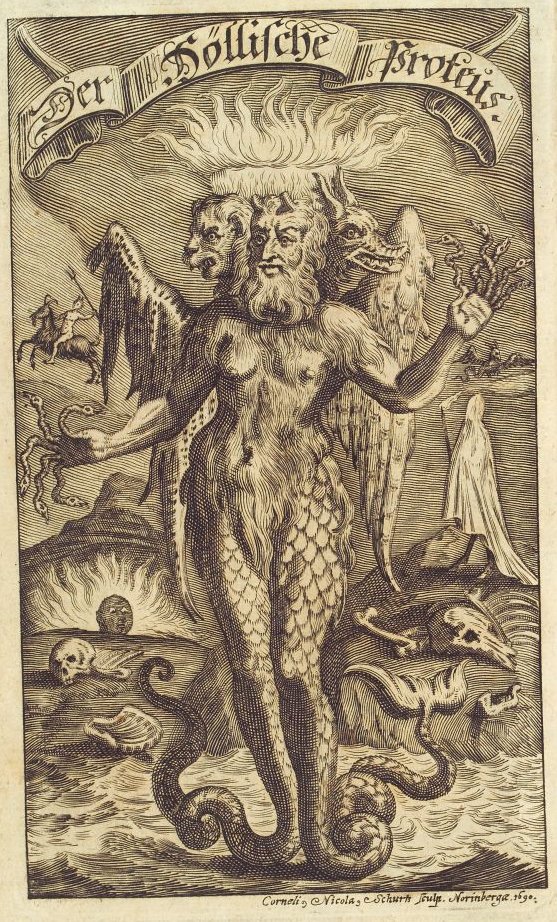
On Shapechangers: Proteus in John Barth’s, The Menelaiad

I’ve been thinking a lot about shapechangers over the last few months.  I’m trying to refine the villain in my current novel, and I really want to give him shapechanging powers, but he needs some restrictions.  Presumably, a villain with an unlimited ability to change his form instantly and at will could never be caught.  That would be a different story than the one I am writing.

The figure of  “The Shapechanger” has fascinated me since I heard John Barth read his story, “The Menelaiad” four decades ago.  I have never forgotten that tale or several related stories which I will discuss in future posts.  “The Menelaiad,” was published in Barth’s collection of short fiction, Lost in the Funhouse, in 1968. English majors love it as “metafiction,” writing about writing, but what really caught me is the “simple” image of a man who wrestles a shapechanger and can never again be certain if his life is really unfolding as it appears, or if he is still engaged in the wrestling match.

Barth was fascinated with “frame tales,” stories within stories.  A classic example is The Arabian Nights.  Scheherazade  tells stories with multiple characters who each tell their own stories, often with people within those stories telling stories.  Barth claimed that in his search of world literature, he never found a story that went deeper than five levels, so he decided to write one with seven.  He began with an episode from the Odyssey, which has plenty of shapechanging and frame tales as it is.

Barth chose the episode where Menelaus, husband of Helen (who launched a thousand ships) relates how he was blown off course, to the Nile delta, after the fall of Troy.  (He tells the tale to Telemachus, son of Odysseus, who was urged by the goddess Athena in the shape of Mentor, an elderly advisor, to seek for news of his missing father – clear enough?)

Luckily for Menelaus, Eidothea, the daughter of Proteus, the Old Man of the Sea, falls in love with him, and relates how he may win sure and certain advice from her father who does not like to dispense such information.

Proteus is herdsman of Poseidon’s seals, so Menelaus must hide himself in a smelly sealskin, jump Proteus when he comes into his cave at noon, and hang on for dear life, for Proteus:  “can foretell the future, but, in a mytheme familiar from several cultures, will change his shape to avoid having to; he will answer only to someone who is capable of capturing him. From this feature of Proteus comes the adjective protean, with the general meaning of “versatile”, “mutable”, “capable of assuming many forms”.  http://en.wikipedia.org/wiki/Proteus

Proteus, The Old Man of the Sea

Barth has a field day letting Menelaus tell the tale of conversations with different people at different times – when someone related what someone else related about what someone else related, he relates.

And yet, for all the tour de force writing, the central image of the tale is like a koan that stays with you.  While holding on to Proteus, Menelaus realizes he can never again be sure that Proteus has not changed into Menelaus holding Proteus, and if so, what or who is he?  All he can know for sure is that he is a voice asking who or what he is.

***

There is a classic Zen story of a man who dreams he is a butterfly.  When he wakes, he wonders if he is a man who dreamed he was a butterfly, or a butterfly dreaming he is a man.

It’s easy to flip the page and forget about that particular story.  It is harder or even impossible to forget Barth’s “Menelaiad,” once you make the effort to wade through some of his bizarre invented ways to use quotes in ways they were never designed to be used.  “”””This is frustrating!”””” he said, she recounted, he told me, I say.

I’ve always suspected that Proteus predates the Olympian pantheon of classical Greece, for what could be more antithetical to the ideals of clarity, order, and rational philosophy than a shapechanger?  There really is no character in mythology more dangerous to any kind of fixed worldview than one who can plant the seed of doubt at the core of awareness.  “Is this really true?”  “Are things really as they appear to be?”  The moment consciousness really and truly begins to entertain questions like these, the wrestling match has begun.

NEXT:  A ShapeChanger in Faerie.

The Wishing Tree

I was recently trying to find a story I read a long time ago, a version of a traditional eastern tale told by Paramahansa Yogananada, called, “The Wishing Tree,” or something very similar.

A search on that name turned up:  a 1999 movie, an acoustical music group, a Salvation Army campaign, an award winning book about a girl whose father goes off to war, a flower shop in Hoboken and another in Singapore – and that was just on page one of the 1,750,000 results reported by Google.

The phrase “wish-fulfilling tree” brought links more in line with what I was after, stories and cautionary tales that seemed to echo a comment of George Bernard Shaw, “There are two tragedies in life. One is not to get your heart’s desire, the other is to get it.”

For Hindu’s, the tree is called Kalpataru and was revealed by Shiva to his wife Parvati.  He tells her,  “‘Kalpa’ means ‘whatever you desire’ and ‘taru’ means ‘tree.’ “Whatever you wish for, you will immediately get from this tree.”

Kalpataru

The site where I found this illustration, http://www.petermalakoff.com/the_wishfufilling_tree2.html, has a version of the story I was looking for, but I like Yogananda’s telling better, and this is how I remember it:

Once a spiritual seeker, who had long roamed the Himalayas in search of enlightenment, spied a single tree growing in the center of a small valley. He took shelter under its boughs and remembered the legend of special wish-fulfilling trees that angelic beings place in such remote regions to help wandering ascetics, and he wondered if maybe….

He pictured a nice juicy orange, and it instantly appeared in his hand. How long had it been since he’d had a good meal? He thought of every delicacy he had ever enjoyed, served on gold plates, and servants appeared bearing the feast. He’d been sleeping in the open so it was natural to wish for a house – no wait, a palace! And anyone with a palace and gold plates needs guards and soon, our friend had a squadron of soldiers saluting and awaiting orders.

He conjured butlers, and cooks, and seamstresses.  Dancing girls, too, of course, and while he was at it, gardens and fountains.

Satisfying one’s every whim isn’t easy, and at last the seeker sought out his own room for a nap.  He gazed through the window at the lush forest he’d planted nearby for hunting, and as he drifted off, he wondered if that had been wise.  What was to prevent a fierce tiger from jumping into his window?

And that was the last thought he ever had.

***

I’m not usually fond of stories with explicit morals, but I first came upon this as a teaching story, in the context of a transcribed talk Yogananda gave on the power of thought.  He summed up by saying we all live our lives under a wishing tree, only we call it imagination. Lucky for most of us, our normally scattered minds are slower to manifest what we dwell on than the tree in the story.  At one point, Yogananda said, “If you doubt the power of thought, try repeating the mantra, ‘headache, headache,’ and see what happens.”

A similar aphorism that’s stuck with me since I first heard it came from Zen teacher, Cheri Huber:

The quality of your life is determined by the focus of your attention.

…which is actually very good news, as is my new favorite bumper sticker:

( you can get it at http://www.snowlionpub.com/html/product_7869.html)