Sacred Stones in Northern California

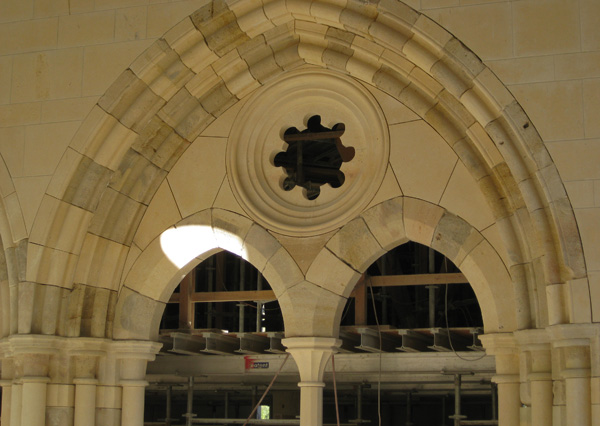
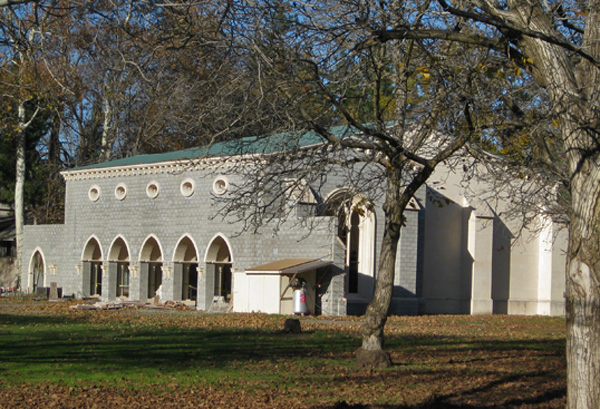
There are only two medieval structures in North America. Now a third is nearing the end of restoration in the small agricultural town of Vina, California, 100 miles north of Sacramento. It’s the 12th century Chapter House of Santa Maria de Oliva, a Spanish monastery that stood near Madrid. This building’s round the world journey makes an interesting tale.
The monks began their day in the Chapter House, where a chapter of the Rule of St. Benedict, an ancient guide to monastic living, was read and interpreted. This went on through the centuries until 1835, when the Spanish government closed all small monasteries and seized their lands. Santa Maria de Oliva was sold to a wealthy family that used the Chapter House to store farm equipment.

In 1931, William Randolpf Hearst bought the Chapter House for $285,000, intending to use the stones in the interior of a house he planned near Mt. Shasta. All the stones were marked for reassembly, and sent to California on 11 separate ships. The depression and WWII delayed Hearst’s plan, and in the end he donated the stones to the City of San Francisco to erect a Medieval museum in Golden Gate Park. This never happened and the stones lay outdoors in the park. Many were damaged, lost, or used for other projects

Meanwhile, the Cistercian Abbey of New Clarvaux was founded in Vina in 1955, and the first abbot began to make inquiries. In 1994, the Fine Arts Museums of San Francisco gave the stones to New Clarvaux with the stipulation that reconstruction begin in 10 years and the completed Chapter House be open to the public.

I first went to New Clarivaux in 1998 to stay for a few days at their retreat facilities. It’s an amazing place to unwind, and I have been there a number of times, so I saw the foundation of the Chapter House laid in 2001.

Section of New Clairvaux guest rooms

I had not been there recently, however, so when I drove up this past weekend, I found the structure was almost done – almost meaning another 18 months in a 10 year effort. Only 40% of the original stones were usable. The rest had to be repaired or replaced by stonemasons the abbey employed (they’ve raised $6.3 million to date, largely through small donations from across the country).

Master stonemason, Frank Helmholz, left Vina in November, bound for Luxor, Egypt, where he will spend the winter restoring a 3,400 year old temple. He plans to return to Vina next May. In an interview for the abbey newsletter, Helmholz said:

“In this modern age when everything is done fast and often doesn’t last long and serves no higher purpose, carving stones is a bit of a refuge. To create something that takes patience, dedication, and is lasting is very rewarding. And serving the monks in their spiritual lives gives a greater sense of meaning that is rare nowadays…to be part of something that has a higher purpose than one’s own comfort is inspiring in whatever form it takes.”

The abbey newsletter points out another significant point in the life of the Chapter House. It was built by Cistercians in Spain. Now it stands in another Cistercian abbey in the land that once was called New Spain. The stones have finally come home.

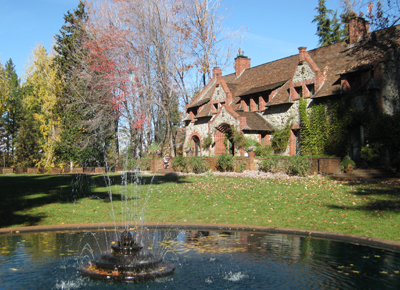
I have only alluded to the retreat facilities at New Clairvaux. In addition to nut crops and a vineyard, it’s one of the ways the monks earn their living, and it’s a marvelous place to spend some time apart. I will post about it later, but meanwhile, you can follow the link below for a summary.
www.sacredstones.org

www.newclairvaux.org

The Empire Mine

The visit of a friend over the holiday weekend was an excuse to drive out of the valley fog and into a stunning late fall day as we made our way to the Empire Mine State Park, a mile east of Grass Valley.  This is the site of California’s richest gold mine, in operation from the 1850’s through 1956.  We lucked out:  on Saturday they were holding a special open house.  Park personnel in historical costume were greeting visitors and explaining things in both the “cottage,” where the mine owner lived with his family, and at the diggings themselves.

The Empire Cottage

Gold was discovered in 1848, and by 1850, the rivers were panned out.  There was plenty of gold, but larger operations were needed to extract it.  The Empire Mine got off to a shaky start as it bought out numerous small claims, but faced serious difficulties in getting at veins of gold that laced the strata of quartz at deeper levels.  Starting in 1879, William Bourn Jr., who gained a controlling interest, and his cousin, George Starr, the mine superintendent, created a very successful enterprise, largely because of the technical know how and labor of a large number of miners from Cornwall, England, a region where hardrock mining for tin and copper was a thousand years old.  By 1890, Grass Valley was estimated to be 85% Cornish.

Cottage from the ornamental garden

Bourn ran the mine from 1879 until 1929 when poor health forced him to sell it to Newmont Mining. In today’s terminology, these miners, photographed in 1905, are the 99%. According to one of the living history guides, the least prestigious job was that of a “mucker.” After a blast, they would load the ore carts and push them up the tracks to one of the main shafts where the rock would be hauled to the surface. The muckers could fill six or seven carts an hour, and each held a ton of ore.  Muckers made $3 for a 10 hour shift.

Miners descending the main shaft (postcard)

In 1905, that wage beat the median income of twenty-two cents an hour.  In addition, the mine prospered during the 1930’s – The Great Depression didn’t happen in Grass Valley.  The safety record appears to be pretty clean too.  Not only are hard rock mines the safest, but after the San Francisco earthquake in 1905, when miles of steel rails were twisted beyond use by railroads, Bourn bought them up to reinforce the shafts.  In movies you see mines shored up with timber.  At Empire, the shafts were braced with steel.

Inside one of the shafts (state park photo)

Still, with more than a bit of claustrophobia, I would have sought work in one of the craft shops above ground.  Carpenters and metalworkers on site made and repaired almost everything used in the mining operations, including the ore carts and their wheels.

Empire Mine Carpentry Shop

The metal shop

The blacksmith shop (state park photo)

The mine was closed as a non-essential industry but the War Production Board at the start of WWII. It reopened in 1945 but the price of gold was fixed at its 1934 level of $35 an ounce. By 1956, each ounce cost $45 to produce, and the mine closed in January, 1957.

During its years of operation, the Empire mine produced 5.6 million ounces of gold – roughly five billion dollars at current prices. The state owns the surface structures and grounds, but Newmont mining retains mineral rights, and there’s still gold underground. If the price of rises high enough, mining operations could resume. The real value these days, however, is the historical interest and beauty of the place.

Swimming pool below the cottage

Rose gardens behind the cottage

The heritage roses behind the cottage had all been cut back, but small plaques identified the roses and their dates. Most came from the 19th and early 20th century, but a few were earlier than that. When they are in bloom, you can buy cuttings.

View from the formal gardens toward the mine

I had been to the Empire Mine once before, in the 80’s one January day when the trees were bare, the pool was dry, and no one was no one around. I’d been wanting to return for most of this year, but something always came up until this past Saturday. I had no idea how much I would enjoy the site, and I highly recommend it if you are ever in California’s central valley, with a yen to explore the foothills and the gold country.  http://www.empiremine.org/

Interlude on the Oregon Coast

I first explored the Oregon coast as an undergrad when I was studying art and photography at the U of O.  I kept a 4×5 view camera, a sleeping bag, and a coleman stove in the trunk of my ’63 biscayne.  A box of mac and cheese, a few apples, and a jar of instant coffee, and I was ready to spend a weekend poking along the backroads up and down the coast.

One of my favorite spots was the south coast town of Bandon.  With a nice state park, miles of beaches to explore, and expresso and pizza available in town, it was a fairly posh spot for camping.  That was in the mid ’70’s.  Mary and I have travelled there at various times over the years since then, but had not been up for almost a decade.

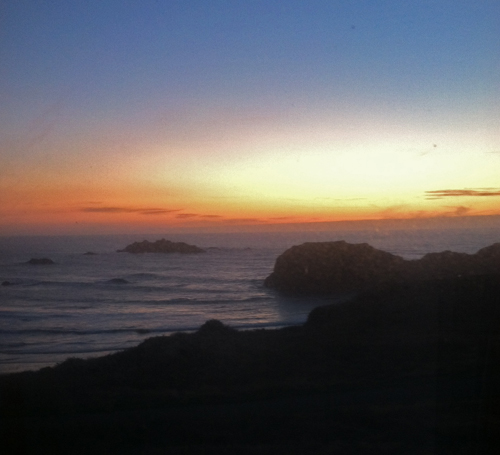
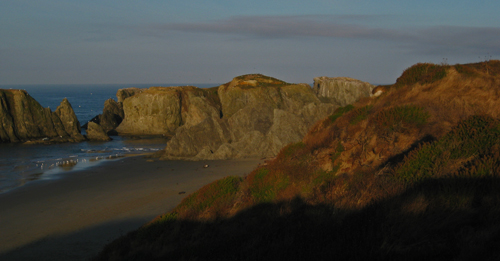
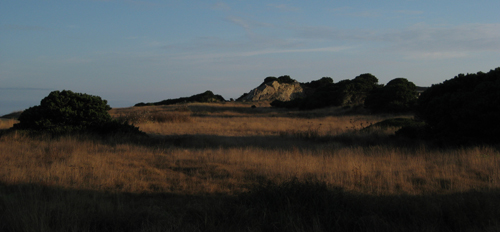
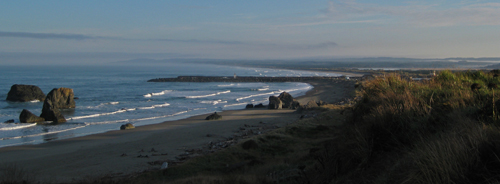
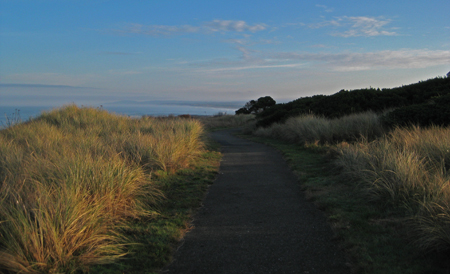
We drove last week to Bandon, and blessed with mild weather, spent some memorable days enjoying the changing leaves and the autumn light on the ocean.

The sound of the waves and the foghorn at night, drifting through an open window, brought T.S. Eliot to mind.  Here are a few photographs, and some of Eliot’s lines from The Four Quartets.

The river is within us, the sea is all about us;
The sea is the land’s edge also, the granite
Into which it reaches, the beaches were it tosses
Its hints of earlier and other creation

It tosses up our losses, the torn seine,
The shattered lobsterpot, the broken oar
And the gear of foreign dead men. The sea has many voices
Many gods and many voices.
The salt is on the briar rose,
The fog is in the fir tree.

The tolling bell
Measures time not our time, rung by the unhurried
Ground swell, a time
Older than the time of chronometers, older
Than time counted by anxious worried women
Lying awake, calculating the future,

Between midnight and dawn, when the past is all deception,
The future futureless, before the morning watch
When time stops and time is never ending;
And the ground swell, that is and was from the beginning,
Clangs
The bell.

If you came this way,
Taking any route, starting from anywhere,
At any time or at any season,
It would always be the same; you would have to put off
Sense and notion. You are not here to verify,
Instruct yourself, or inform curiosity
Or carry report. You are here to kneel
Where prayer has been valid.

A Mountain Interlude

Interlude:  n.  <origin> Middle English (originally denoting a light dramatic entertainment):  from medieval Latin interludium, from inter “between” + ludus “play.”

1  an intervening period of time.
2  something performed during a theater intermission.
<special usage>: a temporary amusement or source of entertainment that contrasts with what goes before or after.

Trail in Yosemite Valley

Normally the valley is brown by September, but weather has not been normal this year.  Extreme rainfall this spring and recent thunderstorms have kept parts of the valley bright green.

Stump in one of the meadows

Over the years I’ve found the beauty that moves me most right at hand, right in front of me on a walk, rather than the famous scenes, the stuff of picture postcards, which are almost too much to take in.

Along the south fork of the Merced River

I first saw Yosemite when I was 12.  My family came up year after year, in all of the seasons, as often as they could.  I got my first job up here, washing dishes and flipping burgers, because I wanted to stay for a whole summer.

Above the river

Mary and I first came up soon after we met, and have continued to visit these woods for the last 35 years, by ourselves and with family, friends, and dogs.  Mary took this photo near the Awahanee:

Photo by Mary Mussell

Some of my favorite spots are outside of the valley. Chilnuala Falls, in Wawona, near the south entrance to the park is one of them. As people learned all too well this year, you have to be careful when hiking and climbing, and once you get away from the crowds, keep an eye out for mountain lions too.  Still, I’m sure driving is infinitely more dangerous.

lower Chilnuala Falls

I know this area better than any other place on earth.  I’ve photographed here for decades, in all seasons and in all kinds of light. Nothing is ever the same twice. You truly cannot step into the same river – or walk along the same riverbank – twice.

The Road goes ever on and on,
Down from the door where it began.
Now far ahead the Road has gone,
And I must follow if I can.
Pursing it with eager feet,
Until it joins some larger way,
Where many paths and errands meet.
And wither then? I cannot say.
– J.R.R Tolkien

Gettysburg Day: The Third Day, July 3, 1863

On the afternoon of July 3, 1863, 15,000 men of General George Pickett’s division sheltered behind McPherson’s Wood during the fiercest artillery bombardment of the war.  Ninety minutes later, when the cannons fell silent, they passed through the wood and and marched over a mile of open ground to attack the Union center.

Numbers identify trees the War Dept. has identified as survivors of the battle

As you stand beneath the boughs of the trees, and gaze at the stone wall marking the Union position, it is almost beyond imagining what those men were feeling as they formed their ranks.  They were all veterans.  They probably knew what would happen as well as their commander, General James Longstreet, who did his best to talk Robert E. Lee out of the attack.  Lee would not budge.  His men had repeatedly done the impossible; maybe they would do it again at Gettysburg.

Where some of the generals wore plumes in their hats, talked of the bravery of southern manhood, and thought in terms of Napoleonic tactics, Longstreet was a pragmatist who knew that warfare had changed.  He had already invented a new kind of trench, anticipating the tactics of WWI.  He knew that bravery wouldn’t keep you alive when facing the fire of rifled muskets that were lethal at half a mile or when charging into cannons loaded with ball bearings.  He told Lee that no 15,000 men ever assembled could take the ridge, but he was overruled.  When Pickett asked, “Shall I go,” Longstreet could not even answer; all he could do was nod his head.

In one of the most tragic events of the Civil War, the men of Pickett’s division formed their ranks and moved over the fields in lines the northern men found stunningly beautiful, even as they fired their cannons and blew them apart.

Pickett’s 15,000 men suffered 60% casualties that afternoon.  As the survivors staggered back to the woods, Lee met them.  “It is all my fault,” he told the troops.  “All my fault.”  The south never had another chance to win the war.

The only brigade to reach the wall was led by General Lewis “Lo” Armistead.  His story illustrates the brother-against-brother tragedy of the Civil War.  Armistead and Union General John Hancock were close friends during the Mexican War and later in California.  On the night before they took separate trains to join opposing armies, they gathered with other officers to drink and sing and make tearful toasts to each other.  Armistead said, “May God strike me dead if I ever lift a hand against you.”  When he learned that he would have to march against Hancock, who commanded the Union center, Armistead did not think he would survive; he sent his family bible to Myra Hancock, his old friend’s wife.

Armistead was shot three times as he crossed the wall.  As union solders gathered around him, he said, “Tell General Hancock that General Armistead is so very sorry.”

This clip from Gettysburg is one of the most moving of the film and represents one of the saddest events in American history.  It is Armistead who gives the order to March.  It is worth noting that this scene, like most in the movie, was filmed on the Gettysburg battlefield, with the help of thousands of Civil War re-enactors who bring tremendous realism into all of the scenes involving the armies.

On the next day,  July 4, the Confederates reformed their lines as driving rain fell.  Lee hoped Meade would attack, mirroring his own mistake of the day before, but no attack came.  That night, the southern troops left the field and started their march back to Virginia.  Meade pursued the retreating Confederates, but half-heartedly, allowing the remnants of Lee’s army to escape.  WIth vigorous action, he might have ended the war – instead it dragged on for another two years.

Gettysburg: The Second Day, July 2, 1863

By the morning of July 2, both armies were in place on ridges facing each other about a mile apart, but the Union forces, arranged in the shape of a fishhook, had the advantage of easily defensible terrain and ease of communication.  The Confederate line was five miles long and messages were harder to transmit.

Lee planned a series of coordinated, “en echelon” attacks on both flanks.  Timing was critical.  One attack was to follow another, to confuse the enemy and prevent men from reinforcing other parts of the line.  The distance worked against Lee.  So did his unfamiliarity with the terrain.

Battle lines on the afternoon of July 2

The assault was supposed to begin in the morning, but it took Longstreet longer than expected to position his men.  At one point the column came into view of the Union troops, and to preserve the element of surprise, they doubled back and  took a roundabout way to reach their objective.  The assault did not launch until 4:00pm, and Ewell’s planned diversionary attack on the right did not begin start 7:00pm, too late to confuse the northern forces.  To make things worse for Longstreet, his commanders were not in position to roll up the Union flank as Lee had expected.  Instead, the ground before them was well defended.

In the course of the bloody afternoon, both sides realized the hill called Little Round Top was undefended.  Union commanders rushed Joshua Chamberlain’s 20th Maine, including the 114 former-mutineers, into position, with orders to “hold to the last.”

Some historians now dispute the assertion that the Union army would have fallen if Little Round Top was lost, but everyone who ought for the hill that day believed it.  Chamberlain’s men repulsed repeated assaults.  They started the battle with 60 rounds each, but even taking the cartridges of the fallen, they ran out of ammunition before the battle was over.  Under orders not to retreat, but with his men unable to shoot, Chamberlain ordered a bayonet charge, a tactic from the books of military history he had studied.

The Confederates were exhausted.  The day was hot, and many of them had been fighting all afternoon with empty canteens.  When the Union forces came charging downhill out of the trees, many gave up the fight and surrendered.  The others fled.

Chamberlain was wounded in the foot that day, one of six wounds he would receive in the course of the war.  One, in 1864, was so serious he was promoted to brigadier general where he was fallen, since no one believed he would survive the day.  He recovered and his regiment was chosen by Grant as the honor guard at Appomattox when Lee surrendered.

Joshua Lawrence Chamberlain served four terms as Governor of Maine, and thirty years after his stand on Little Round Top, he received the Congressional Medal of Honor.  After retiring from politics, Chamberlain became president of Bowdoin College.  He died in 1914, a few months before the guns of August signaled the world’s descent into another round of the folly he had survived.

Gettysburg: The First Day, July 1, 1863

By the summer of 1863, Major General John Reynolds was regarded by officers of both north and south as the best general in the Union army.  In a confidential meeting on June 2, Lincoln is said to have offered Reynolds command of all northern forces.  Reynolds supposedly said he would only accept if he could have free rein and be shielded from Washington politics, conditions Lincoln could not meet.  This left Reynolds at front of the Union army when Buford sent urgent messages requesting assistance in holding a strong field position against vastly superior forces.  Where many other northern generals would have dithered and delayed, Reynolds understood the gravity of the situation and moved his troops forward with all possible haste.

Gen. John Reynolds. Public domain

He arrived just in time.  After repeated assaults, Buford’s line was ready to break when Reynolds arrived with two corps to counterattack.  Buford and Reynolds’s bold moves preserved the Union position on the heights, which in the end decided the battle.  Reynolds bought the advantage at the cost of his life, for as he urged his men forward, he was shot through the neck and died instantly.

About the time that Reynolds fell, Confederate General Richard Ewell’s troops arrived from the north.  Attacked on two sides, the Union forces fell back through the town and reformed on Cemetery Hill.  When Lee arrived on the field, he ordered Ewell, who commanded Stonewall Jackson’s old brigade, to take the hill, “if practical.”  Jackson undoubtedly would have found it practical.  Ewell did not, and also did not send troops to neighboring Culp’s hill, which the northern forces occupied under the cover of darkness.

The vision and courage of Union generals Buford and Reynolds, combined with the hesitation of Ewell, gave the northern army a huge advantage in field position after the first day of fighting.

John Buford died in December, 1863, in part from the effects of old wounds.  On the last day of his life, Lincoln promoted him to Major General in recognition of his service at Gettysburg.  Buford asked, “Does he mean it?” and when assured that he did, he said, “It’s too late now.  I wish that I could live.”  He died in the arms of fellow cavalry officer, Miles Keogh, who would later ride with Custer to his death on the Little Bighorn.

John Buford monument at Gettysburg

To be Continued

Gettysburg: The Eve of Battle

On the morning of June 30, 1863, Col. Joshua Lawrence Chamberlain, awoke with the aftereffects of the heat stroke he had suffered while marching the day before.  Chamberlain, 34, was a professor of rhetoric at Bowdoin College who spoke seven languages, but had always wanted to be a soldier.  He had asked for a leave to join the army the year before but was denied, so he applied for a sabbatical to study language in Europe.  When it was granted, he went instead to the Governor of Maine, who commissioned him a Lt. Colonel in the newly formed 20th Maine regiment.

Col. Joshua Lawrence Chamberlain

On the morning of June 30, Chamberlain had other problems as well:  120 men from another Maine regiment had refused to fight because of a controversy involving their enlistment papers.  They had been sent under guard to Chamberlain, with a note from the commander of the army saying Chamberlain could shoot them “if necessary.”

Instead, Chamberlain used his rhetorical skills to persuade 114 of these men to join the 20th Maine, which had lost more than 700 of its original strength of 1000 men to battle and to smallpox.  This was one of those destiny moments in history; two days later, Chamberlain and the men of the 20th Maine would save the Union army at Little Round Top.

***

Another key bit of destiny was in play the day before the battle.  Union general John Buford, a cavalry officer who loved the western territories, didn’t know how to curb his tongue, which has never been a good survival tactic in Washington – it got him assigned to a desk.  Just two weeks earlier, he had won command of a cavalry troop of 2500 men and 6 cannons.  His orders had been to shadow Lee’s army from a safe distance and communicate their movements back to the infantry.  But Lee had changed directions during the night.  Suddenly, at noon on June 30, as Buford rode into Gettysburg, that safe distance was gone!  He was faced with Confederate general Harry Heth’s column of 8000 infantry entering the town.

Then, incredibly, Heth retreated.  Buford correctly reasoned that Heth was under orders not to attack until the troops were in place with greater strength.  He could see that the heights around Gettysburg offered excellent field position and whoever occupied them first would have a huge advantage.  He had seen the slaughter that resulted from fruitless charges against such positions.  He sent couriers galloping to the main force and ordered his own vastly outnumbered troops to dig in and prepare to hold until help arrived.

http://www.youtube.com/watch?v=LzZOp-nPho8

To Be Continued