First Family by David Baldacci: A Book Review

Sometimes you luck out and find good reads just by browsing, and so it was with David Baldacci’s First Family, 2009, an action adventure novel featuring private detectives Sean King and Michelle Maxwell.  As ex-Secret Service agents, both know Washingon, and in this case, the first lady, who calls them when her 12 year old niece, Willa, is kidnapped.

At first, we know who the good guys and bad guys are, and the breakdown of that certainty as the story moves forward is the single most telling feature of this tale.  In fact, for me, Sam Quarry, the mastermind of the kidnapping plot is likely to be the most unforgettable character.  He is ruthless, even fanatical, in the pursuit of his brand of justice, but then we see him stop in a nursing home to read Jane Austin to his daughter who has been in a coma for 13 years.  As the story unfolds, we come to appreciate the ingenuity he brings to bear on his personal concepts of right and wrong.  Our gradual understanding of what drives him parallels the fall of our admiration for several other characters who at first appeared virtuous but are revealed as anything but.

This is Baldacci’s fourth novel featuring the team of Sean and Melissa.  If I’d started the series at the beginning I might know why they left the Secret Service under clouded circumstances.  They are a compelling team, and the plot is complicated when Melissa’s mother is murdered in a separate event that parallels the main action when it leads to the exposure of family secrets.

The rhythm of a book, its pacing, is something very mysterious.  James Patterson sets a hook or mini-crisis every four pages, which is the length of his chapters.  Other writers speed things up even more

Baldacci steps away from constant thrills and chills.  Yes, there is the obligatory shootout early on, but the author also keeps us reading as he details the minute preparations Sam Quarry has made on his land in rural Alabama.  The little shack he has planned and constructed by hand is lined with metal and surplus dental x-ray blankets.  Why?  The video camera mounted almost invisibly near the cabin has a hidden feed to a bunker up the hill.  Why?  Quarry spends hours in the basement of his falling-apart family home, with charts and notes, illustrating a web of connections he has spent years uncovering.  We know just enough to keep us reading.  Baldacci knows that mystery and nagging questions can keep us turning the pages as eagerly as drama and shoot-em-up action.

I cannot say much more without giving away the plot.  I can say this – I am definitely going to read the first of the Sean King and Michelle Maxwell mysteries, and if First Family is any indication, I have a whole new series to enjoy.
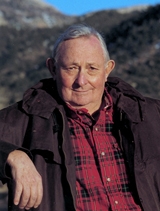
Tony Hillerman: An Appreciation

Tony Hillerman

Tony Hillerman

For many years during the nineties and the early part of the last decade, Tony Hillerman’s mysteries were a part of my annual celebration of spring.  In April or May his newest title would hit the bookstores – just in time for the beach or the pool at the gym.  “Beach read” is often synonymous with “guilty pleasure,” but I never feel guilty about enjoying good stories.

Hillerman is best known for the 18 mysteries set in northern Arizona and New Mexico and featuring Navajo tribal policemen Joe Leaphorn and Jim Chee, and later in the series, officer Bernadette Manuelito, who eventually marries Chee.  This series won Hillerman the 1974 Edgar Award, the 1991 Mystery Writers of America Grand Master Award, as well as the Navajo Tribe’s “Special Friend of the Dineh Award.”  Dineh is usually translated as “the People.”

The stories emphasize the Navajo ideal of living in harmony with the world and bring in themes from Navajo cosmology.  Many of Hillerman’s criminals are rumored to be witches – the worst thing you can become.  Leaphorn, the first detective in the series is skeptical, but…

Leaphorn didn’t believe in witchcraft.  He believed in evil, firmly believed in it, saw it practiced all around him in its various forms-greed, ambition, malice-and a variety of others.  But he didn’t believe in supernatural witches.  Or did he? (The Shape Shifter, 2006).

Chee, the younger officer, tries to walk in the worlds of both a modern policeman and a tribal shaman.  More than once, at the end of a case, Chee undergoes a traditional ritual to restore his balance and harmony.

Details of Navajo culture pervade all of Hillerman’s books and lend the restrained pacing of a people who think it rude to interrupt someone else who is talking.  In real time, the cops may have to drive a hundred miles to interview a suspect, but Hillerman keeps things moving by letting his detectives constantly mull over the compounding mysteries, and notice tiny details in the vein of Sherlock Holmes.

That said, the book I recently found, The Shape Shifter, the only one the Navajo mysteries I had not read read, is not where I would suggest a new reader start.  In places, it is a bit too slow, and it assumes we are familiar with the characters.

Skinwalkers (1990) would make a better first time Hillerman read.  This is the book where Leaphorn and Chee first team up, and the story is filled with supernatural menace.  Skinwalkers are especially nasty witches who change shape to harm others, like European werewolves.  Skinwalkers is one of three Hillerman titles featured on the PBS series, Mystery, with Wes Studi brilliantly cast as Leaphorn.

Skinwalkers movie

This is old-time detective fiction at its best, with the unique slant of a unique people, living in a remote and beautiful part of the country.  I only wish there were more of Hillerman’s books I hadn’t read.

Literary Comfort Food

In early March I was searching the shelves at a Barnes&Noble for a mystery for Mary’s birthday, when I spotted a treasure – one of Tony Hillerman’s Navajo Tribal Police mysteries neither of us had read.  The Shape Shifter (2006) is the last of the 18 titles in this series that won Hillerman (1925-2008) numerous awards both as a mystery writer and as a friend of Native Americans.  I will review The Shape Shifter when I finish, but starting it today reminded me of other stories that represent pure reading pleasure to me.  Books that carry me into another world.  Books that I read because I like to hang out with the characters, almost regardless of what they are doing.

I realized this morning as I sat down to coffee with Lieutenant Joe Leaphorn, and officers Jim Chee and his new wife, Bernadette Manuelito, that the greatest pleasures I’ve had in reading, bar none, are books in which I just want to be with the characters, almost regardless of whether they’re solving mysteries or buying groceries.  In addition to Hillerman’s tribal officers, other examples come to mind:

  • Frodo Baggins and friends.
  • Holmes and Watson.
  • Amelia Peabody and family in Elizabeth Peters’ Egyptian mysteries.
  • Rat and Mole and Toad in Wind in the Willows.
  • The sometimes annoying but always brilliant, Hercule Poirot.
  • Lirael and the disreputable dog in Garth Nix’s Abhorsen Trilogy.
  • Hamish Macbeth, the irrepressible Scottish detective in M.C. Beaton’s series.

I have also spent way too much money and time reading second rate fantasy series in the often vain hope of recapturing the Tolkien experience.

It’s important to realize that in stressing the importance of characters, I am not referring to the contemporary buzzword, “character driven.”  That has little or nothing to do with my list of comfort-food books, since with the possible exception of Wind in the Willows, these titles all belong in the “plot driven” category;  most mysteries begin, not with the detective’s quirks but with the discovery of a corpse, and problem of the Ring of Power was independent of Frodo.

As I said – these fictional people are friends, whether they are solving mysteries, dodging orcs, or sitting down to second breakfast.  This is a real clue for me, something to remember as I juggle plot elements.  Even though that is critical work, I find myself anxious to get back to the characters, both the heroine and the villain.  That, more than anything else, tells me I am heading in the right direction.

But now, before that or anything else, I have to get back to the The Shape Shifter, where storm clouds, both literal and metaphorical, are gathering over the reservation.

True North

In December, 1975, my sister sent me a small wrapped box with a note attached.  Our mother had died suddenly the previous May, but my sister found a small package, wrapped for Christmas the year before, at the back of a closet.

Inside was a compass.  I’m sure my mother intended it as a pragmatic gift – I was spending a lot of time on back roads and camping out in the southwestern deserts where you really want to know where you are and where you are going, but ever since, that particular compass and compasses in general, have carried a lot of symbolic meaning for me.  Finding true north.  Finding one’s way.

The earlier name for a Compass Rose was Wind Rose

My ideas have changed since I got that compass.  I used to imagine “one’s way” as “one way.”  As if our lives were like trains, and we are either on the track or off.  Now I imagine something more like “possible futures,” (a classic sci-fi term).  Not a single track, but an ongoing dance between ourselves and the world, of choices and unfolding events.

***

Recently I posted that I am rethinking the plot of the novel I’m writing because my forward progress had slowed and a step back showed there were flaws and gaps in my core conception.  Later I realized some of the story elements had become so common as to have already become cliches.  I understand how fast that can happen; Thomas Edison used to speak of times when “ideas were in the air,” and I’m sure there were far fewer inventors in his day than young adult writers in ours.

I’ve taken my own advice recently, and done a lot of free-writing, easily filling up single spaced pages with several alternate plots that seems fresher to me, but remain similar in setting and character to the story I was working on before.  One in particular sparked my excitement.  Then I spotted a review of a recently published, YA novel that had features strangely in common with my current conception.

Conventional wisdom urges us not chase popular stories, but these days, my impulse is almost the reverse – it almost seems harder to run away from what other people have done!  Something else we are told often is, “tell the story that only you can tell.”  To me, this sounds a lot like the “true north” idea.  Our thoughts, our emotions, our memories are not stable, so why should our stories be?  That kind of imagined fixity  is something the conscious mind loves, but the unconscious or whatever you wish to call the wellsprings of our creativity, does not share in such linear thinking.

I used to admire an Arizona man named Frederick Sommer, who took hauntingly surreal photographs in the desert.  Once an interviewer asked him why he photographed, seeming, from the tone of the article, to want some kind of deep philosophical rationale.  Instead, Sommer shrugged and said, “You’ve got to do something during the day.”  I’ve always loved the irreverence of his response.  I remember it in moments when I begin to take myself and work too seriously.  As ego involvement grows, I risk mistaking what I do for what I am.

Frederick Sommer

In retrospect, I learned a lot when I was writing software.  I learned that when something isn’t working, you look at it closely, and if necessary, try something else.  I may have missed schedules but I seldom missed sleep.  The years that I spent writing software convinced me that I can solve problems – that if I keep looking long enough, I’ll find a creative solution that was there all along, overlooked.

I write for a lot of reasons.  One of them is that I have to do something during the day.

Four Key Ingredients – Part Two

Wrestling with Originality:  A real-life Example.

It’s easy to talk in the abstract about things good fiction needs, but “originality” is an issue I have been wrestling with for real lately.  Recent “market research” – checking book jacket blurbs in stores and online – revealed a mass of new titles in the fantasy sub-genre where I have been working, in a two steps forward one back fashion, for several years.  Now that even the diehard fans are satiated with vampires, many hopeful writers have trooped to Faerie.

How many?  Well, two of the first half-dozen titles I sampled featured half-human/half-fairy protagonists – like mine.  A few discoveries like that throw the very possibility of being original into question.

I noticed something else too – several of these new books reuse a plot that was common in 1980’s adult fantasy – a war of good and bad fairies in which a human participant somehow tips the balance.  What I suspected then, I am sure of now – that storyline originated in the world of Dungeons & Dragons and online role-playing games.  It is simply not present in the original sources.

Given this seeming recycling of recycled plots, my choice seems fairly straightforward – give it up or dig deeper.  Donald Maass’ writing is full of encouragement for the latter choice, and I’m getting excited about some of the new ideas welling up since I started this process.  Here are a few of my current thoughts:

  • Go back to original sources.  In traditional fairy stories, there are no “good” and “bad” fairies – all encounters are problematic for humans.  Maass’ criterion of “inherent conflict” is built into the old tales and ballads of the relation between humans and the fey.
  • I’ve found a simple way around my heroine’s ancestry, since being half-fairy is now a cliche.  I like this even better.
  • I am probably going to rename the fairies and Faerie the way Sharon Shinn did in her 1995 YA story, Summer’s at Castle Auburn.  There the land and people are called, “Alora.”  Everyone gets it in “quack like a duck” fashion.

The point of giving these personal details is to underscore my belief in Donald Maass’ suggested lines of digging deeper.  “What if?” is a good question for any storyteller.  I have a long way to go, but I am enjoying the process again, and confident that I am on the right track.

Gut Emotional Appeal – Donald Maass’ Fourth Criterion for Really Good Novels:

There’s a formula for this:  create a likable character who must struggle to achieve something important.  Good as far as it goes, which is not very far.  And never mind that someone like Jonathan Franzen can throw out the advice and still win critical acclaim – the rest of us should not try that at home.  Most writers I know really care about their characters; the problem is how to make an audience care.

At a recent conference, a presenter used the Michelangelo analogy – chipping away what doesn’t belong – for the writer’s craft as well.  I think this is pertinent to the character breakthroughs I watch others make – they keep working, and eventually come to characters who somehow embody some of their own deeper truths.  In practice it isn’t nearly as weighty and ponderous as it sounds.

One critique group friend has long been enamored of Raymond Chandler type hard boiled detectives, with a dash of James Bond thrown in.  My friend worked and worked, creating better and better versions of characters we have seen before.  Recently, his own humor and mischievousness got into the mix, and a hero emerged who parallels, in my opinion, the tongue-in-cheek charm of the chick-lit detective who curses the bad guys if she breaks a nail while taking them down.  My friend’s character, Jonathan, a wastrel ex-Royal Marine, returns fire when assassins attack him on the golf course, furious that they ruined his score.  The battle had me in stitches as it caught up a foursome of startled ministers who realize the Lord moves in more mysterious ways than they had imagined.

Another critique group friend, writing about a troubled teen, made a quieter but equally profound breakthrough.  You see it in a little shift.  The bravado falls away, and the character is quietly real and telling her truth beyond any stereotype.

We have to start with characters and situations that matter to us, and then go deeper into ourselves that we expected – this much I am sure of.  How and when that happens is a mystery.  None the less, I find Donald Maass’ criteria:  Plausibility, Conflict, Originality, and Gut Emotional Appeal valuable questions to ask of my own or anyone else’s writing.

You can’t always say what or how but you know writing that has these things.  And if they are missing?  It simply means there is more chipping away to do.

Four Key Ingredients – Part One

Stories begin with ideas and these can come from anywhere. For some writers, some of the time, they may arrive fully formed, but I suspect that for most of us, they show up as seeds which we have to nourish and grow, in acorn-to-oak fashion.

Since I have allowed myself to drop back to the “acorn stage” of my own story, I turned once again to Donald Maas who has a lot to say about brainstorming and the care and feeding of story ideas as the critical first step in writing what he calls, “the breakout novel.”

Another name for that is simply “publishable novel,” because according to Maass, good is not good enough anymore.  I see antecdotal evidence to support his claim.  I still find the phrase “breakout novel” a bit high-falutin, so I just tend to think of “really good novels.”  Really good novels begin with a really good premise.

Maass uses the word “premise” both for the initial seed idea (“What if there were a whole other world at the bottom of that rabbit hole”) and for a more polished, high level description (“A girl named Alice follows a talking rabbit and…”).  He insists that really good, breakout ideas can be made.  He gives many useful examples of brainstorming and suggests that a key skill is learning to ask “what if” questions and then throw away one’s first responses which are likely to be obvious and cliched.

In the second chapter of Writing the Breakout Novel, he asks the reader to go find their three all time favorite books – the one’s we have read so many times the bindings are cracked.  The ones that have nourished our hearts and spirits for decades.  Maass suggests that four elements common to our favorite stories are likely to be, Plausibility, Inherent Conflict, Originality, and Gut Emotional Appeal.

Plausibility is perhaps the easiest of these concepts to understand and build into a story.  Avoid the extremes of the obvious and the impossible; according to Maass, we want our stories “surprising yet credible.”   As a fan of fantasy and science fiction, I would add that this applies to alternate universes as well.  Google on “world building” and you find a ton of information – much of it coming from gamers – on constructing internally consistent fantasy or extra-terrestrial worlds.  The internal consistency is what matters.  Orcs are all right in Middle Earth, in fact we expect them; Martians would be over the top.

Inherent Conflict:  If the story is set in an era and world where conflict is part of the situation, it aids the writer, but with craft, we can find or create conflict anywhere.  The nominally placid suburbs can be battlegrounds according to John Updike, and now Jonathan Franzen.  Anywhere you have teachers and students, parents and children, boys and girls you have the raw materials for conflict and tension.  Even better, according to Maass – you have conflict between groups or individuals who both have a claim to be “right.”.  It is our job as writers to find the conflict and keep in in the spotlight, for this is the stuff that generates excitement.

Originality:  This is one of those magical qualities – we know it and applaud it when we see it, but can we set out to deliberately be original?  To a degree, I think we can.  If we can allow ourselves to brainstorm or play with ideas, and are willing to reject our first (and usually obvious) solutions, we put ourselves in a place where something new can emerge.  (strictly speaking there may not be any “new” stories, but in practical terms, there are books that make us think, “Wow, I wish I had thought of that”).

I assume we all have practical ways of generating ideas – taking a walk, sinking into reverie, listening to music, keeping things silent, free writing, or some combination of methods like this.  The next step is to apply it.  If one can pull an entire plot out of ether, like a magician pulls an endless string of scarves out of a hat, bravo, but at some point, we’ll get stuck or have decisions to make.  I cannot remember where I got this piece of advice but I find it effective.  Ask an important plot question.  Write down 20 solutions.  Throw out the first 19 and the one that is left will be something original.  Twenty or ten or pick a number that works, as long as it doesn’t make things go too easy.

NEXT:  A real-life example and the fourth ingredient

Simple Things or Peeling Onions

Since I couldn’t settle on one title to express what I wanted to say in this post, I chose a compound name which conveniently illustrates the opposite of what I am getting at.  I find myself wanting to get to the bottom of things, the root, the core, the ground, the seed idea.  For example:

  • I am back to the Tassajara Breadbook, and this time I’ve got some homemade sourdough starter going.  It’s appealing not only because I love sourdough, but because it is the simplest way to make yeasted bread.  Even so, something even more simple than that has gripped my imagination.  In an article called “Easy Dough,” in the Spring issue of Tricycle, Noa Jones describes a trip across the Sinai with Bedouins.  She describes how intrigued she was upon seeing how few supplies they carried.  None the less, each evening they mixed up dough and cooked it right on the campfire.  Jones describes the procedure but gives no exact recipe – figure it out for yourselves, she says.  I really can’t wait to try – flour, water, fire, and a pinch of salt; you can’t make a simpler bread than that.  This is the sort of thing I am getting at.
  • I’m at a similar point in my meditation practice.  Over the years I have learned and used some complicated techniques, but I find that all I want to do right now is the simplest practice I know.  It has a Japanese name which is usually translated as, “just sitting.”

I have mentioned that in my writing, I’m reviewing a half-dozen books to pick up ideas on spicing up plots, but I’ve even taken a small break from that to ask more fundamental questions about the story I’m working on.  Questions about all my current assumptions – everything on the table.

For instance, do I really want to write fantasy?  Well, yeah, at the moment I do – gut preference.

Do I really want to write young adult vs. adult fantasy?  I’m not so sure on that point – I sometimes go back and forth, but overall, yes, I am drawn to reading and writing YA fantasy.  Reminds me of the keynote speaker at a conference I went to saying, “You should be thankful for your crappy childhoods, since now you get to be writers!”

And finally – maybe the key question: what is my story?  Not for all time, but for now.  Clarity is required.  What is the core story I want to tell?

Well, I did some free writing, and out of that exercise, extracted a brief description and it hit me – the basic pattern of the story is, “The Sorcerer’s Apprentice.”  And beyond that lies Pandora.  Pandora has meaning for all of us, especially, when we are young.  We fling open doors and rip open boxes before we know what we’re doing.  No way to avoid it.  As Jung said, “All the major decisions in life are made on the basis of insufficient information.”  As Pandora discovered, we discover, once the horse is out of the barn…

I was very pleased to arrive at that point.  This is a solid discovery, the outcome of really important work.  Something to build on.  There are many more questions, a whole list of them, and I will be discussing more of them.

Meanwhile, to end this post, I found a version of a great old Shaker song that’s been going through my head for several days.  At first I could not find it, since I thought the name was “Simple Things.”   It is actually called, “Simple Gifts,” and it’s a nice hymn for the end of a post on Easter.

Between the Beginning and the End

I recently wrote of my intention to take a step back from my current writing project to read six books with a view to understanding how their plots are put together.  https://thefirstgates.com/2011/04/04/a-conference-and-a-resolution/  As promised, I’ve posted reviews of the first three books I read.

I had not planned in advance what I would read next.  As I scanned my shelves, I happily found something I had overlooked, The City of Ember by Jeanne DuPrau.  I picked up a signed copy of the book a year ago when Ms. DuPrau was a presenter at the 2010 NorCal SCBWI conference (the link above explains what that is and has notes on the 2011 conference).

Author Jeanne DuPrau

The City of Ember (2003) is a middle-grade, post-apocalyptic fantasy – (is it just me, or is that really in the air these days?).  A movie version, starring Tim Robbins and Bill Murray was released in 2008.  I will review the book when I finish, but now I want to talk about some of the comments DuPrau made at the conference, since she shared some of the ups and downs she experiences in plotting.

Beginnings are relatively easy, she said, and her goal is to know the ending (more or less) when she starts, so her story has a destination.  She said wrote the first chapter of Ember, and knew the ending, ten years before she was able to complete the middle of the book.  She was working a day job at the time, but even so, months went by when she didn’t take Chapter One out of the drawer because she didn’t know how to proceed.  Traditional methods failed her, notably outlining.

Now this is stuff I personally identify with.  At the end of the conference, I picked up a written critique of my opening by Ms DuPrau that I had arranged for in advance.  It was pretty positive.  I think I do openings well, and then bog down in the middle, as she describes.  Outlining works to organize ideas I already have, but I’ve never been able to think my way into inventing something new.  I can write my way there and imagine my way there – sometimes – but these can be round about methods.  If I set out for San Francisco, but decide on the way to visit Carmel, I may eventually reach my destination, if I have enough time.  In plain terms, I’d rather not break DuPrau’s ten year record!

So what does she do?  According to my notes, she writes and imagines her way through the plot and keeps herself focused by asking one very specific question at a time.  Both free-writing and “focused” dog walks are methods she has evolved – ones that I have also applied, though not in so concentrated a manner.  In fact I found several pages of free-writing I’d done at breaks in that conference and appreciated the reminder that here is something valuable – a “disciplined” method of aiming toward an unknown destination!

***

The final thing DuPrau shared that day was the story of her success, and she revealed her method for that as well.  After Ember was finally done, she combed Publisher’s Weekly for contact information on new agents who were just setting up shop and looking for clients.  She cut a deal with the first agent she applied to who was actively seeking fantasy.  DuPrau’s story is living proof that even in this notoriously difficult age for publishing, the right combination of hard work, inventiveness, and luck can open doors to success.