More on, “So Cold the River”

(Warning: spoilers ahead)

It is rare and delightful to find a book I hate to see end.  It is rarer to find a creepy book I hate to see end, and this is the first time ever I have hated to see a story end when the most compelling character is the villain.

Campbell Bradford, the villain of Michael Koryta’s,  So Cold the River, is no ordinary bad guy; he not just a bad man, he is evil. This important distinction is made by eighty-something, Edgar Hastings.  “He [Bradford] put a chill in your heart. My parents saw it; hell, everybody saw it. The man was evil.” The only fictional villain I can think of in his class – as evil and fascinating – is Hannibal Leckter in Silence of the Lambs

The evil Campbell Bradford is not the ninety-five year old Campbell Bradford who freaks out when hero, Eric Shaw, shows him a bottle of haunted “Pluto Water.”  This faux Bradford whispers, “So Cold the River,” and dies a short time later, sending Eric, a failed Hollywood filmmaker, to West Baden, Indiana, to learn the story of Bradford, Pluto water, and the newly restored West Baden hotel, (which actually exists), a once famous spa that was the domain of presidents, prize fighters, royalty, and gangsters.
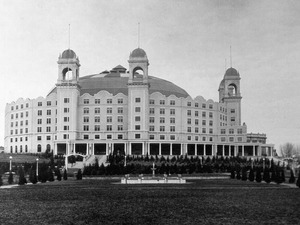
The West Baden Hotel

The evil Campbell Bradford is a ghost, a very malevolent ghost, who possesses his great-great-grandson, Josiah, and later tries to possess Eric.  Bradford’s era is the roaring twenties, but his voice and tone suggest an earlier time.  Perhaps it is his fictional distance, the sepia toned feel of the old west that surrounds this villain, that works like the glass that allows us to watch a cobra in a zoo with an equal degree of fascination.  Imagine the Clint Eastwood of the sphagetti westerns as an angry psychopath, ready to sacrifice anything and anyone for his ambitions.  The ambitions of Campbell Bradford’s ghost drive the story.

“Look for the artifacts of their ambitions.”  That is Eric Shaw’s philosophy of documentary filmmaking, announced at the opening of the book.  The artifacts of Bradford’s ambitions are dead people. In the end, the mysterious Pluto Water, which carried Bradford’s spirit back to West Baden, allows Eric to survive his onslaught to tell the tale.

But Eric stops short of trying to unravel the whole story.  He will not seek the honey-flavored spring where Bradford lost his life.  Is the spirit really gone? Apparently. And yet, as Anne McKinney, who has devoted her life to watching the weather and waiting for the big storm cautions, “You can’t be sure what hides behind the wind.”

Sequeul anyone? I will definately read it if it comes.

Short Short Story Competition

This one is from Writer’s Digest, for stories of 1500 words or less, due Dec. 1. http://writersdigest.com/short

PRIZES
First Place: $3,000 and a trip to the Writer’s Digest Conference in New York City
Second Place: $1,500
Third Place: $500
Fourth Through Tenth Place: $100
Eleventh Through Twenty-Fifth Place: $50 gift certificate for Writer’s Digest Books

I do not see any genre categories for this. 1500 words is about six pages. Hmmm. I’m not a short story writer, but this might be a chance to exercise some unused muscles…

New help for coulrophobics

According to an NPR report, coulrophobia, the fear of clowns, is the third most common phobia in Britain, right behind the fear of spiders and needles. Our cousins across the water fear clowns more than they do flying in airplanes. Coulrophobia on NPR

Now there is new hope for sufferers thanks to the dedicated clownselors of the John Lawson circus, who offer pre-show therapy. Paul Carpenter, aka, Popol the Clown, explains how clown therapy works:

...we invite them to the big top during the day when it’s quiet and they meet me and our other clown, but they meet us in our normal, everyday guises, not in makeup or anything. And then we take them into the circus ring, and they watch us as we slowly transform ourselves into our clown personalities.

Popul (Paul Carpenter), right, and his friend, Kakehole

We put on our makeup very slowly, and then we put on our costumes. And if that goes well and they haven’t run for the door, we then try and get them interacting with us in the circus ring. We go through a few clown routines, getting them involved. And if that goes well, our ultimate aim is to get the person themselves dressed up in costume and makeup, and then we help them find their own inner clown..they come into the circus being scared, and then they end up leaving as a clown themselves.

Hmm…I’m not sure ’bout that. Finding my inner clown sounds pretty good, but why do I keep thinking of Stephen King and Chuckie?

I knew a real clown who was truly funny. I met Amelia Mullen, aka, Pansy Potts the Clown, at the Sacramento Storyteller’s Guild. There seem to be two general ways of telling a story to a crowd, either in “quiet” way of a storyteller around the campfire, or in the dynamic way of an actor on a stage, the way vaudeville must have been. My way is very much the former, while Amelia worked the crowd, strutting across the stage with gestures and wild voices. No one fell asleep when she was telling a story.

I later realized she developed this style of storytelling as a way of keeping the attention of rowdy four year olds while entertaining at birthday parties – now there is something to give you a phobia!

Writer’s Digest Popular Fiction Awards

Here is a Popular Fiction competition from Writer’s Digest for stories of 4000 words or less in the categories of:

  • Romance
  • Mystery/Crime
  • Science Fiction/Fantasy
  • Thriller/Suspense
  • Horror

Entries are due November 1 with a $20 fee.  Multiple entries are allowed, online or by snail mail.  Prizes are:

Grand Prize: a trip to the Writer’s Digest Conference in New York City, $2,500 cash, $100 worth of Writer’s Digest Books and the 2011 Novel & Short Story Writer’s Market.

First Prize: The First Place-Winner in each of the five categories receives $500 cash, $100 worth of Writer’s Digest Books and the 2011 Novel & Short Story Writer’s Market.

Honorable Mention: Honorable Mentions will receive promotion in Writer’s Digest and the 2011 Novel & Short Story Writer’s Market.

Full details are available here: http://www.writersdigest.com/popularfictionawards

The Peddler of Swaffham

A comment here on a post about ghost stories put me in mind of certain tales that everyone has seen or heard in one variation or another.  Show of hands – how many heard “The Hook Man,” around the time they started to date?  How many variations of “The Vanishing Hitchhiker” have been made into TV movies or episodes of The Twilight Zone?

A much older tale that is widely distributed tells of a poor man who becomes rich by paying attention to a dream.

I first heard “The Peddler of Swaffham” told by Robert Bela Wilhelm, who, with his wife Kelly, has devoted his life to inspiring people to tell stories and explore the spirituality of stories.  Be sure to check out some of the riches on the Wilhelm’s website: http://www.storyfest.com.

Carving of the Peddler in a Swaffham church

Bob told “The Peddler of Swaffham” on one of his “Storyfest Journeys.”  More about the journeys soon when I dig out some of the pictures.

The gist of the story is, a peddler from a village in Norfolk dreams that he will find gold if he travels to London bridge.  He makes the journey with his dog, spends three days and nights on the street waiting, and is wondering what went wrong when a merchant asks what he is about.  The peddler says he dreamed of the riches he would discover at London Bridge.  The merchant laughs and says dreams are just foolishness:  “Why just last night I dreamed of a bag of gold under the peddlar’s oak in the village of Swaffham, wherever that is, but you don’t see me running all over the countryside, do you?”

According to Wikepedia, (http://en.wikipedia.org/wiki/Pedlar_of_Swaffham) the first version of this story was a poem by Rumi, In Cairo Dreaming of Baghdad; In Baghdad Dreaming of Cairo, that later became a story in The Arabian Nights. I know I have seen a Jewish version of the story where the city is jerusalem. The story more recently was incorporated into the plot of The Alchemist by Paulo Coelho.

Monument to the Peddler in Swaffham

What the Peddler of Swaffham or Cairo or Jerusalem has in common with countless folktales all over the world is it’s lesson that it is voice of the small, the despised, the overlooked, the ignored – the dream, the third son, the dwarf, the old woman, the child, the animal beside the road, that points the way toward the riches of a more awakened existence.

I once heard a psychology professor say that the way to get moving again if we are stuck in our lives is to listen for the small hunch, the little impulse, the passing thought that, “Oh, this might me interesting to try.”

The same teacher, on another occasion said that in his study of folklore, the greatest predictor of success, bar none, was the hero or heroine winning the help of a talking animal – but that is a story for another occasion.

September Writing Contests

Zoetrope:  All-Story Short Fiction Contest: http://www.all-story.com/contests.cgi

Prizes: $1,000, $500, and $250 and seven honorable mentions. Deadline October 1. 5000 words or less.

The announcement says: We accept all genres of literary fiction.   If the juxtaposition of “genre” and “literary fiction” has you scratching your head, you can purchase an online issue to get an idea of what that means.

They also say:  There are no formatting restrictions; please ensure only that the story is legible. That puts me in mind of colored inks and napkins, but that’s just because I do not knowingly write literary fiction.

Delacorte Press Contest for a First Young Adult Novel: http://www.randomhouse.com/kids/writingcontests/

This contest is in its 29th year. First prize is a book contract from Random House, $1,500 cash, and a $7,500 cash advance against royalties. This is for fiction in a contemporary setting, between the ages of 12 and 18, with manuscript length between 100 and 224 pages.

Fairly standard formatting requirements (no napkins) and entries must be postmarked between October 1 and December 31. The judges reserve the right to not award a prize and looking at the list of past winners it is clear that sometimes they have not.

Hint Fiction Writing Contest: http://www.writingclasses.com/ContestPages/hintfiction.php

This is the 25 word short story contest I talked about in another post here.   There are still five weeks left.  I initially set out to write a story a day…so far I have done five, so I need to get busy.

I find it a fun way to play with images, especially with “other” genres, imagining things like an innocent person kneeling beside a corpse.  It isn’t hard to write good 25 word stories, but I am finding it is maddeningly hard to do great ones.

I’m sure there are many other contests coming up, and one of these days I will have to go looking for them.

How to Write a Great Novel

“Put your left hand on the table. Put your right hand in the air. If you stay that way long enough, you’ll get a plot,” Margaret Atwood says when asked where her ideas come from. When questioned about whether she’s ever used that approach, she adds, “No, I don’t have to.”

“How to Write a Great Novel,” is not a title one expects to see in an article in the online Wall Street Journal, but here it is. A friend sent this piece, dated Nov. 2009, which recounts some of the strategies eleven different authors use to deal with, “the daily work of writing, clocking thousands of solitary hours staring at blank pages and computer screens.

http://online.wsj.com/article/NA_WSJ_PUB:SB10001424052748703740004574513463106012106.html

Nicholson Baker rises at 4:00am and writes in the dark, on a black screen with gray type, then goes back to sleep and when he rises again, edits what he produced in the “dreamlike state.” For a recent novel about a “rambling professor,” he grew a beard, put on a floppy hat, and spent a lot of time creating the character’s voice which was “something I had to work on a lot in order to get the feeling of being sloppy.”

Hilary Mantel also likes to work in the morning, even before she has coffee  [yow!!!!!].  Mantel spent five years writing Wolf Hall, a Tudor historical drama, and kept a 7′ bulletin board in her kitchen to capture ideas jotted in the notebooks she carries everywhere.

Richard Powers lounges in bed all day and “speaks his novels aloud to a laptop computer with voice recognition.”

Junot Diaz, a Pulitzer-prize winning author, shuts himself in the bathroom and perches on the edge of his tub with a notebook when working on difficult passages.

Kate Christensen was “two years and 150 pages into her first novel,” when she discovered what the book was “really about.  She threw out her earlier work and started again.  The process repeated itself with her second, third, and fourth novels. Christensen, who won the PEN/Faulkner award in 2008, starts her mornings with housework, emails and phone calls “to avoid facing her work.”   In the past, she’s played 30 games of solitaire before typing a first sentence.

Michael Ondaatje writes in 81/2 x 11 notebooks, then cuts and pastes his sentences with scissors and scotch tape.  His prose will sometimes run four pages deep.

Kazuo Ishiguro, author of six books including “Remains of the Day,” which won the Booker Award, spends two years researching and one year writing his novels, but says sometimes they still don’t come together.  He showed his wife a draft of a story set in medieval Britain and she said, “This is awful. You have to figure out how they speak to each other. They’re speaking in a moron language.”

 These are interesting vignettes to read, because the authors vary so widely in their working habits:  some use computers, some write longhand.  Some make elaborate plotting diagrams, others get up early to sidestep the rational mind.  Some have trouble turning off the flow of words, and some approach the writing desk with trepedation. 

What they have in common is a very uncommon tenacity, and a willingness to arrange their lives and and working methods in very personal ways in order to coax imagination onto page.

A Novel Planning Method

There seem to be two general approaches to plotting a novel. When I was younger, my efforts consistently ran aground because I tried to fit myself into the outlining and pre-planning camp.

When I first learned to trust imagination and revel in the lets-see-what-happens-next process, I finished a 90,000 word draft in seven months of evenings and weekends. The good news is, I’d found my natural way of working – the bad news is it took me seven months to see the gaping plot flaws an outliner could have flushed out in a couple of weeks.

I undertook a study of plot and learned about the three act structure, the key plotpoints, and various other fundamental concepts.  What I still didn’t have was a method of planning that didn’t inhibit imagination, the way an armature supports a ceramic sculpture but doesn’t inhibit expression.

I found something very useful online, Randy Ingermanson’s “Snowflake Method,” a literary brainstorming practice  that takes its name from the simple to complex process of designing a snowflake fractal:

http://www.advancedfictionwriting.com/art/snowflake.php

Ingermanson begins by suggesting a one-sentence synopsis of the entire story – something that may seem impossible at first, but which I now believe is absolutely necessary.  The process clicked into place for me when I saw, on another web site, the following example offered for  The DaVinci Code: A late night murder in the Louvre leads to the discovery of a secret the Vatican has tried to suppress for 2000 years. Very high-level like that.

Ingermanson then suggests growing this story summary to a paragraph and then a page, in the spirit of discovering what the story is really about.  If the villain isn’t bad enough or is too easily defeated, it’s worth knowing upfront rather than thousands of words later.

Once I have gone as far as I wish with the Snowflake Method, I’ve got a decent high level map of plot and perhaps my protagonist and villain, but for me, something is still missing – how do I find out what’s going to happen next?  How do I dream up new complications, discover and weigh alternative endings, without writing those thousands of practice words?

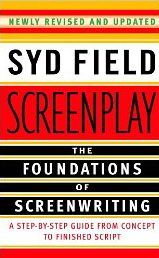
I’ve recently begun to explore something I saw a decade ago, the “storyboards” Peter Jackson and his team developed to map the scenes of The Lord of the Rings. This was part of the “making of” section of the DVD’s. I dug them out and watched again after recently reading Syd Fields’ excellent, Screenplay: The Foundations of Screenwriting, which recommends using 3×5 cards to work out plot.

Screenplay

I find that either a quick sketch or a few words can sum up a scene in a graphic manner that appeals to imagination. I can carry a few cards in a shirt pocket and glance at them over a cup of coffee or mull them over while driving home.

Two Towers Storyboard

They do not need to be nearly this detailed, because we are not planning camera angles.  This could be summed up as:

After witnessing Frodo confront the Nazgul, Faramir releases Frodo, Sam, and Gollum to pursue their mission to Mordor, or simply, After Nazgul, Faramir lets them go.

I find that if I let the images play around in the background of my mind long enough, the next step will come, and often surprise me.  I fully expect this process to evolve and change, but for now, this is a huge step forward.