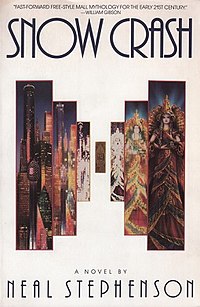
Snowcrash by Neal Stephenson – An Appreciation

Twenty years ago, Mary and I got our first real home computer (the Commodore 64 didn’t quite count).  With an Intel 486 processor, 500k of ram, an 8k external modem, and AOL memberships, we were wired!  Full-fleged members of the information age, at least by the standards of the day.

The same year, 1992, Neal Stephenson published a visionary novel called, Snowcrash. In retrospect, it merits the word, “prophetic,” for its sketch of life in the metaverse – a word Stephenson coined – and in the inconvenient world we call “reality.”
Consider:

In Snowcrash, Stepenson posits a world where nation states have transferred most of their power to corporations. Most people are corporate citizens and live in corporate enclaves, or less prestigious burbclaves.  The hero of Snowcrash, Hiro Protagonist, is a citizen of “Mr. Lee’s Greater Hong Kong.”  Military power belongs to private contractors, as do the roadways, which vie for driver/customers.  The post office is gone; private couriers deliver snail-mail.  The United States occupies a smallish territory centered in the Mohave Desert, and keeps it’s employees busy with make-work projects.  The former United States economy hinges on two industries – computer microcode and high speed pizza delivery, which has been revolutionized since the Mafia took control.

Though Hiro is a citizen of Hong Kong, as a pizza driver, he can’t afford to live in their enclaveclave.  Home is a self-storage unit under the flight path at LAX.  Like most of his hip and cyber-savvy generation, he spends most of his time online in the guise of his avatar, navigating virtual worlds.  But something is happening in the online world.  A strange new computer virus, when opened, generates a graphic pattern that scrambles the brains of the user.  They are dazed and speak in tongues.  With a young woman named YT, for Yours Truly, Hiro sets out to unravel the mystery.

The villain turns out to be a charismatic preacher.  In his attempt to secure both temporal and spiritual power, he has tapped into the ancient Sumerian glyphs that first scrambled human speech patterns in the event known as the Tower of Babel.

It’s been 20 years since I’ve read Snow Crash, so I’m writing this from memory.  I’m not necessarily recommending the whole novel.  The first jaw-dropping 100 pages, where Stephenson built his world, flew by and still leave me in awe.  I remember the rest of the book dragging in parts, but I still think of the story all the time.  Most futuristic fantasies prove as silly as the 1930’s movie shorts that show humans zipping along in their air cars between high rise buildings, happy and without any accidents.  This book is different.

In 1992 there were no virtual worlds.  Now there are, and you have to create an avatar to negotiate them.  These days, it isn’t so hard now to imagine a bright young man living in a self-storage shed.  But above all, Snow Crash comes to mind because in the wake of “citizens united,” it’s so easy to see corporate power growing while government power wanes.  With Super Pac money rolling the election year dice, does the government control corporations or do corporations control government?  Neal Stephenson saw this and other aspects of our world coming 20 years ago.

Snow Crash, is a visionary novel that all lovers of fantasy should know.

An Author’s Guide to Publishing in 2012 – A Guest Post by Amy Rogers, Part 2

This is the second part of a guest post outlining ways writers can understand and respond to the rapid changes in the world of publishing.  If you haven’t read Part 1, I suggest you start with that post, which immediately precedes this one.

_____________________________________________________________________

An Author’s Guide to Publishing in 2012 – Part Two, by Dr. Amy Rogers

Part 2: Indie Publishing

Take all of the above and add another, less glamorous tech advance: print-on-demand publishing.  What you get is a slew of new publishing options.  Traditional New York-based publishers (now consolidated into six major houses with many imprints) used to be the only game in town.  What was once derisively called vanity publishing has become “indie”, and indie publishing encompasses a wide range of approaches.

Self-publishing:

This is the buzzword on everyone’s lips, but what does it mean?   I find that many people use the term “self-published” to broadly describe any book in any format that does not have the imprimatur of a Big Six publisher.  This fails to account for the various degrees of self-publishing and also the new professional indie publishing options out there.

1.  A truly self-published book is written, edited, designed, formatted, and distributed all by the author.  The main advantages of this approach are total control and minimal financial expense (though the investment of time may be substantial).  Some writers create their own publishing company to do this.  However most self-pubbing authors hire out at least some the non-writing tasks.  In fact, the majority of “self-published” titles were published by a subsidy publisher chosen and paid for by the author.

2.  Subsidy publisher

A subsidy publisher is a company hired by the author to turn his text file into a paper or digital book.  In most cases, the subsidy publisher provides online distribution but NOT to bricks-and-mortar bookstores.

With subsidy publishing, the author pays out of pocket for all expenses.  The cost and services provided vary a lot, so it pays to shop around.  Unlike old “vanity” publishing, print on demand technology frees the author from having to pay in advance for a print run of books that might never sell.  This keeps the costs low relative to the old days.  In this model, the author is the publisher’s customer.

The next step closer to a traditional publishing arrangement is assisted self-publishing where the author does not pay the costs upfront but rather shares future royalties with the service provider.  This means the book has to be good enough that somebody is willing to take a modest financial risk in publishing it.  Several literary agencies are now offering this type of “consulting” service to their existing clients in exchange for a commission.

3.  Not self-pub: Small presses

A small press is any traditionally-structured publisher that is not owned by the Big Six.  University presses, regional presses, niche publishers and others fit in this category.  Such companies may only publish a few titles per year.  The key distinction that makes this “not self-pub” is the publisher, not the author, pays the costs of getting the book out there.  In this model, booksellers and readers are the publisher’s customers.  Unlike self-publishing, the author must provide a manuscript that is deemed commercially viable on at least a small scale.

4.  Digital-only full-service publishers

This category didn’t exist until a few years ago.  Digital-only publishers operate like small presses but release their titles only in e-book formats.  This keeps their costs lower and allows them to take on riskier projects—such as first novels—that may not sell enough copies to catch the attention of a Big Six imprint.  My own publisher, Diversion Books, is a leader in this category.

With Diversion, the author retains the right to self-publish in paper.  This creates an interesting situation: my science thriller Petroplague is currently on sale with two different covers and two different publishers.  One cover is for the professional e-book with Diversion; the other cover is on the paper books I produced at my own expense with the help of a subsidy publisher.

One size does not fit all in publishing these days.  Indie authors can choose to learn a variety of non-writing skills and publish their books themselves, or they can hire others to do it for them.  If the book is marketable and the author is willing to split royalties, a small press or a digital-only publisher may be an alternative to the Big 6.  For the first time in the history of the book, barriers to entry are low and every writer has the power to bypass the gatekeepers and put his or her words in the hands of readers.

—–

Amy Rogers is a Harvard-educated scientist, educator, and critic who writes science-themed thrillers. Her debut novel Petroplague is about oil-eating bacteria contaminating the fuel supply of Los Angeles and paralyzing the city.  She is a member of International Thrillers Writers Debut Class (2011-2012).  At her website ScienceThrillers.com [there’s a link on thefirstgates blogroll], Amy reviews books that combine real science with entertainment.  You can follow Amy on Twitter @ScienceThriller or on her Facebook fan page http://www.facebook.com/pages/Amy-Rogers/202428959777274

_____________________________________________________________________

Please stop by Amy’s blog, ScienceThrillers.com, to leave a comment if you enjoyed this series.  While you are there, take a look at the features, sign up to receive the newsletter, and enjoy the reviews of a number science-related thrillers, ranging from The Hound of the Baskervilles to Jurassic Park.  

An Author’s Guide to Publishing in 2012 – A Guest Post by Amy Rogers

Last September, I wrote an enthusiastic review of Petroplague by Amy Rogers http://wp.me/pYql4-1ep. With a PHD in microbiology, Dr. Rogers is uniquely qualified to bring her considerable writing skills to bear on a thriller in which an oil-eating bacteria ravages Los Angeles.  Airplanes fall from the sky.  Millions of cars stall on the streets and freeways.  No food deliveries.  No ambulance, police, or fire service as a greedy corporate criminal and deluded eco-terrorists strive to suppress a solution.

On two occasions, New York agents represented Amy Rogers’ work but were unable to sell it.  With a keen understanding of the turmoil in traditional publishing, Amy decided to take matters into her own hands.  After I posted my review, I invited her to write a summary of her experience for us.

Last week I received an email saying she’d finished a “5,000 word treatise” on current publishing options for writers.  This will form the basis for her presentation at the June meeting of the Sacramento California Writer’s Club branch.  She graciously sent a 1500 word, abridged version, for thefirstgates.  I am delighted to be able to share her account, for I think her observations and experiences can serve as as Ariadne’s thread as we work our way through the current publishing maze.

Because of the length, I am going post this article in two parts.  Meanwhile, I invite everyone to visit Amy’s blog, Science Thrillers.com (listed on my blogroll), and to follow her on Twitter at, @ScienceThriller.  Also, check out her Facebook fan page, where you’ll see that she has been invited to participate in the New Author’s Breakfast at the Left Coast Crime 2012 conference in Sacramento at the end of the month. http://www.facebook.com/pages/Amy-Rogers/202428959777274

And now, without further delay…

_____________________________________________________________________

An author’s guide to publishing in 2012 by Dr. Amy Rogers

Part 1: What’s going on with publishing today?

Book publishing is undergoing a revolution unlike anything seen since the invention of moveable type, an explosion of diversity in the paths leading to publication.  After centuries in a desert of limited choices, writers now have a rainforest of options to get their work in front of readers.

But the changes are so profound and happening so rapidly, many writers can’t keep up with the business.  We’re writers, so we write, but what then?  The simple formula—write book, sell rights to a print publisher, collect royalties—doesn’t apply to the majority of published books today.  Is this a bad thing?

The big changes in publishing are both challenge and opportunity.  Whether the changes are “good” or “bad” depends on where you stand.  In this series, I’ll first summarize some of the major trends in the book business that are affecting the way books get published and sold.  In the second, I’ll discuss how writers seeking “publication” of their work can navigate the path that’s right for them.

So why does the publishing business feel like a Kansas farmhouse in a tornado?  Simple: technology.  Digital disruption devastated the music industry; now it’s rolling over publishing.  The end results for various stakeholders (authors, publishers, readers, retailers) are far from certain.

1.  Ebooks

Top of the list of disruptive technologies: e-books.  Amazon’s Kindle e-reader is now in its third or fourth generation.  The critical $100 price point has been breached (a Kindle now costs as little as $79).  Barnes & Noble’s Nook e-reader and tremendous numbers of Apple’s iPad plus various smartphones (which can also be used as e-readers) give millions of Americans easy access to e-books.  (Not to mention ubiquitous laptop and desktop computers, which can be used to read e-books, though uncomfortably.)

How rapid is the rise of the e-book?  The Economist reports that in the first five months of 2011, “sales of consumer e-books in America overtook those from adult hardback books” and “amazon now sells more copies of e-books than paper books”. http://www.economist.com/node/21528611 Granted, Amazon’s experience does not represent the entire bookselling business, but it is significant.  In my own genre—thrillers—over half the books sold are now in digital formats.

2.  Distribution

Digital technology is changing the way books are distributed.  Obviously, e-books can be sold online—from anywhere in the world, to anywhere in the world, no neighborhood bookstore required.

But it’s not only e-book sales that are affected by digital tech.  The emergence of amazon as a global book retailer with no physical presence in communities has also changed how paper books are sold.  People are shopping for paper books over the Internet and getting them shipped.  Neighborhood and mall bookstores are struggling.  Browsing is nice, taking your book home with you on the spot is nice too.  But amazon’s price advantage is killing these stores.  The giant online retailer subsidizes much of its bookselling business, has smaller fixed costs, and still dodges sales tax in most states.

3.  Publicity

The best way to get a person to buy a book is word of mouth: a trusted source, whether a friend or a reviewer, mentioned the book.  Digital technology—the Internet and “social networking”—is truly revolutionizing word of “mouth”.  Successful book marketing is increasingly based in this virtual world.  Book bloggers, readers’ collectives like GoodReads and LibraryThing, Facebook, Twitter, book trailers on YouTube—this is what sells books.  Reviews remain critical, but the traditional venue—newspaper sections devoted to in-house book reviews—is vanishing.  Only a few papers still publish their own book reviews, and generally these reviews are few in number.  So authors and publishers must go online to get reviews and build “buzz” around a title.

_____________________________________________________________________

Section two of Dr. Amy Rogers, A Writer’s Guide to Publishing in 2012 will be featured in my next post.

Quiz: Who Said These Words on the Senate Floor?

No prize for the answer to this one, but in today’s climate, it is an eye-opener to realize these words were spoken by an earlier generation’s, “severe conservative.”  Unlike today’s crop, this man was always respected for his integrity and the strength of his convictions:

“I’m frankly sick and tired of the political preachers across this country telling me as a citizen that if I want to be a moral person, I must believe in ‘A,’ ‘B,’ ‘C’, and ‘D.’ Just who do they think they are? And from where do they presume to claim the right to dictate their moral beliefs to me? And I am even more angry as a legislator who must endure the threats of every religious group who thinks it has some God-granted right to control my vote on every roll call in the Senate. I am warning them today: I will fight them every step of the way if they try to dictate their moral convictions to all Americans in the name of ‘conservatism.’” – Sen. Barry Goldwater, Sept. 16. 1981.

From Richard Brenneman’s blog, eats shoots ‘n leaves: http://richardbrenneman.wordpress.com/

My First Ever, Caption the Cartoon Contest!

My recent resolution to stay more positive on this blog is challenged almost every time I pick up a newspaper or turn on the evening news.  Believing that laughter is better than tears, and in keeping with this week’s headlines, I’m announcing a little contest:

Thanks to istockphoto.com for this royalty-free cartoon

I’m guessing that everyone who isn’t living with wolves knows why poor little Mr. Happy is sad. I will award a $10 Amazon gift card to the best caption for this cartoon, submitted as a comment to this post by midnight PST, Saturday, March 10.  Multiple entries are encouraged.

***

If you have been on vacation, or on a media fast, or if you live in a country that still has real political debate, you may not have heard of the controversy over rules that require health-care providers to cover contraception even if it violates the conscience of certain faith-based employers.  Throwing gasoline on the fire, conservative talk show host, Rush Limbaugh, called Sandra Fluke, a third-year law student, a “slut” and “a prostitute” after she testified in favor of insurance coverage of birth control. http://www.sacbee.com/2012/03/03/4307985/contraception-fight-intensifies.html

So now that you know the story, what are you waiting for? Get busy writing your captions!

Life: The Movie by Neal Gabler – A Book Review

In his final movie, Being There, 1979, Peter Sellers plays Chance, a gardener with a low IQ, who becomes an advisor to the president and business tycoons. In one iconic scene, Chance is accosted by a knife wielding youth in Washington, DC.  He pulls out his TV remote control and clicks it to change the channel.  He is puzzled when the assailant doesn’t vanish.

Peter Sellers as Chance in “Being There”

This might be the perfect illustration for Neal Gabler’s, Life, The Movie:  How Entertainment Conquered Reality, (2000).  Gabler quotes historian, Daniel Boorstin, who wrote in the early 60’s that, “We risk being the first people in history to have been able to make their illusions so vivid, so persuasive, so ‘realistic’ that they can live in them.”  Done deal, according to Gabler, who calls us, not just a “post-modern culture,” but a “post-reality culture.”

At times I had to keep my own assumptions in check:  subjects like reality and imagination open onto psychological and spiritual vistas beyond the scope of this or any other single book.  But when Gabler cited concrete examples, I found myself nodding my head on almost every page.

“You know how to brood because you have seen Rebel Without a Cause,” Gabler says, quoting cultural analyst, Louis Menand.  “What better model does the world offer?”

Gabler charts the ascendency of entertainment in America from the early 19th century, where the split between high and low culture was fueled by our democratic suspicion of all elites.  Calling someone “aristocratic” was a serious insult.  During the 1840 presidential campaign, when a man called Daniel Webster an aristocrat, he thundered back that he’d grown up in a log cabin, and anyone calling him an aristocrat was “a coward and a liar.”  ( Sound familiar? )

Nathaniel Hawthorn despaired of the fate of serious writers amid the flood of “trash” being published.  One publisher sold four million dime novels in five years, at a time when the US population was only 25 million.

In 1850, 1% of the population owned 50% of the nation’s wealth and held almost all public offices.  Upward mobility was a myth, since 98% of that wealth had been inherited.  While the one-percent held the power, then as now, culture wars raged, sometimes with a violence that we (thankfully) haven’t seen yet.  One night in New York, rival Shakespearean actors, one British and one American, were both scheduled to perform, the former in an uptown theater, the latter downtown.  Police ejected the rabble who had bought tickets solely to heckle the British actor.  A much larger crowd gathered across the street to throw rocks as the “aristocratic” crowd tried to leave.  The militia was called, a riot ensued, and before the night was over, 22 lay dead and more than a hundred wounded.

In the end, it was movies that won the day for popular culture.  The 1% stayed away from the early nickelodeons, which tended to be crowded and crass.  Later, with middle-class patronage, refined behavior became the norm, but the elite have never fared well in the movies, from the Marx Brothers  Night at the Opera, to the present, where a too-expensive suit is always the mark of a villain.

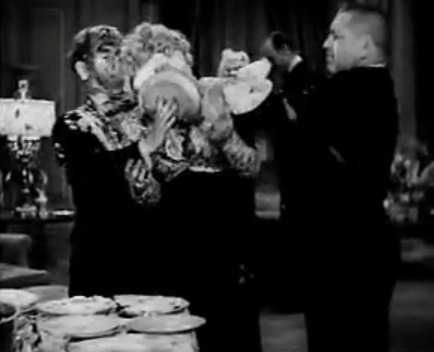
Three Stooges + high society + pies = disaster

As he charts the history of high vs. popular culture, Gabler makes a telling point.  It isn’t just about high brow and low brow – it’s about the ascendency of entertainment.  Being entertained is easy, and the corollary is that when the goal is entertainment, grabbing and holding audience attention is the supreme value, and “things that do not conform – for example, serious literature, serious political debate, serious ideas, serious anything – are more likely to be compromised or marginalized than ever before.”

Life: the Movie is a complex and disturbing book.  Gabler says in the introduction, it is diagnostic and not prescriptive.  To offer easy answers, he says, would be like the movie illusion where we meet the monster in act one and see it vanquished in act three.  Writing 12 years ago, Gabler said:

“One is almost compelled to admit that turning life into escapist entertainment is a perversely ingenious adaptation to the turbulence and tumult of modern existence.  Why worry about the seemingly intractable problems of society when you can simply declare ‘It’s morning in America,” as President Reagan did in his 1984 reelection campaign, and have yourself a long-running Frank Capra movie right down to the aw-shucks hero?”

I read this book after watching Neal Gabler speak on the fictions that lace the current election campaign on Moyers & Company, as I described in the preceding post. Because of it’s scope, I would recommend Life: the Movie only to those who want to delve into this issue in some depth.

But  I would recommend that everyone watch the ongoing conversation this year between Gabler and Moyers.  The confusions and illusions surrounding the political process are more convoluted than when the book was written, but Neal Gabler remains a reliable guide to pulling back the curtains and helping us draw closer to the truth.

Politicians as Would-Be Movie Stars

James Hillman died last fall at the age of 86.  Even though I only met him twice at lectures, I’ve read his books for decades, and he is one of only a few people who deeply shaped and changed the way I see the world.  Hillman was an influential post-Jungian thinker.  As I said in my “About” page, from Hillman I learned to search for the fantasy in our “realities,” and the reality in our “fantasies.”

James Hillman

Hillman considered literalism one of the great diseases of our time, but one area where I have trouble “seeing through” the illusion of “fact” is election year politics.

On Sunday I got a clue about why so much of the rhetoric sounds like bad dialog in a B grade movie – to a great extent, it is!  A guest on Sunday’s edition of Moyers and Company was Neal Gabler, a film historian, cultural critic, and author of Life the Movie: How Entertainment Conquered Reality (2000). Gabler says our politicians are trying to play movie heroes.  We-the-people demand it, but it makes us cynical because we know it’s a sham:  “we’re…in a campaign season where what we’re really watching is not so much political debate, though it’s called that, as we are watching a movie in which candidates are contending to be our protagonist-in-chief.”

Neal Gabler

Gabler continues:

“There’s a kind of American schizophrenia about our politics. On the one hand we love to sit back and see these people be compelled to seduce us because elections are basically about seduction…But that also gives way to an incredible cynicism about the process…And one of the reasons we’re cynical is because we get it. We get how it works.”

Gabler says now that we have an Occupy Wall Street movement, we need an Occupy Media movement.  We need people fed up enough to say, “I want a real debate on issues.”  Otherwise, “if we don’t start asking those questions we can’t move this forward at all. All we’re going to get is punditry and analysis of who’s winning and who’s losing and a movie. We’ll get nothing but the movie. But the problem is movies don’t answer the pressing questions of America. Policy answers the pressing questions of America and we have to demand to know what these guys are going to do and what choices they’re going to make.”

I personally don’t have much hope that it’s going to happen in this election cycle.  Meanwhile, Gabler’s image of the candidates-as-would-be-actors, trying to be Clint Eastwood or John Wayne, makes their actions intelligible.  There is Hillman’s “fantasy in the reality.”

If this sounds as interesting to you as it is to me, you can watch the 20 minute interview or read the transcript here:  http://billmoyers.com/segment/neil-gabler-on-how-pop-culture-influences-political-culture/

The good news is, Moyers promised to have him back on the show as the election year continues.

Little Free Libraries

Todd Bol and Rick Brooks, with their Little Library

Todd Bol’s mother, a book lover, died a decade ago. Two years ago, to honor her memory, Bol built a miniature library, filled it with books, and set it in his front yard in Huron, Wis.  He and his friend, Rick Brooks, an outreach program manager at the University of Wisconsin, thought the idea could grow.  It has.  Bol and Brooks estimate there are 300 to 400 little libraries in 24 states and 8 countries.  Their website, http://www.littlefreelibrary.org/, has plans for people who want to build their own, places to purchase the small structures, and a map to track their locations.

“Take a book, leave a book,” is the operating principle.  Right now, a group of Wisconsin prison inmates is building libraries for new communities.  In New Orleans, Bol plans to make libraries out of debris left by Hurricane Katrina.  In El Paso, Texas, an elementary school where illiteracy was a problem now has two Little Libraries.  Lisa Lopez, the school librarian, says books are circulating “like crazy.”

“People tell us over and over, there’s something about the physical feel about the book in your hands,” Bol says. “It has meaning. There’s a spirit that can’t be found electronically.”

from an article in USA Today: http://www.usatoday.com/news/nation/story/2012-02-21/little-libraries-lawn-boxes-books/53260328/1